
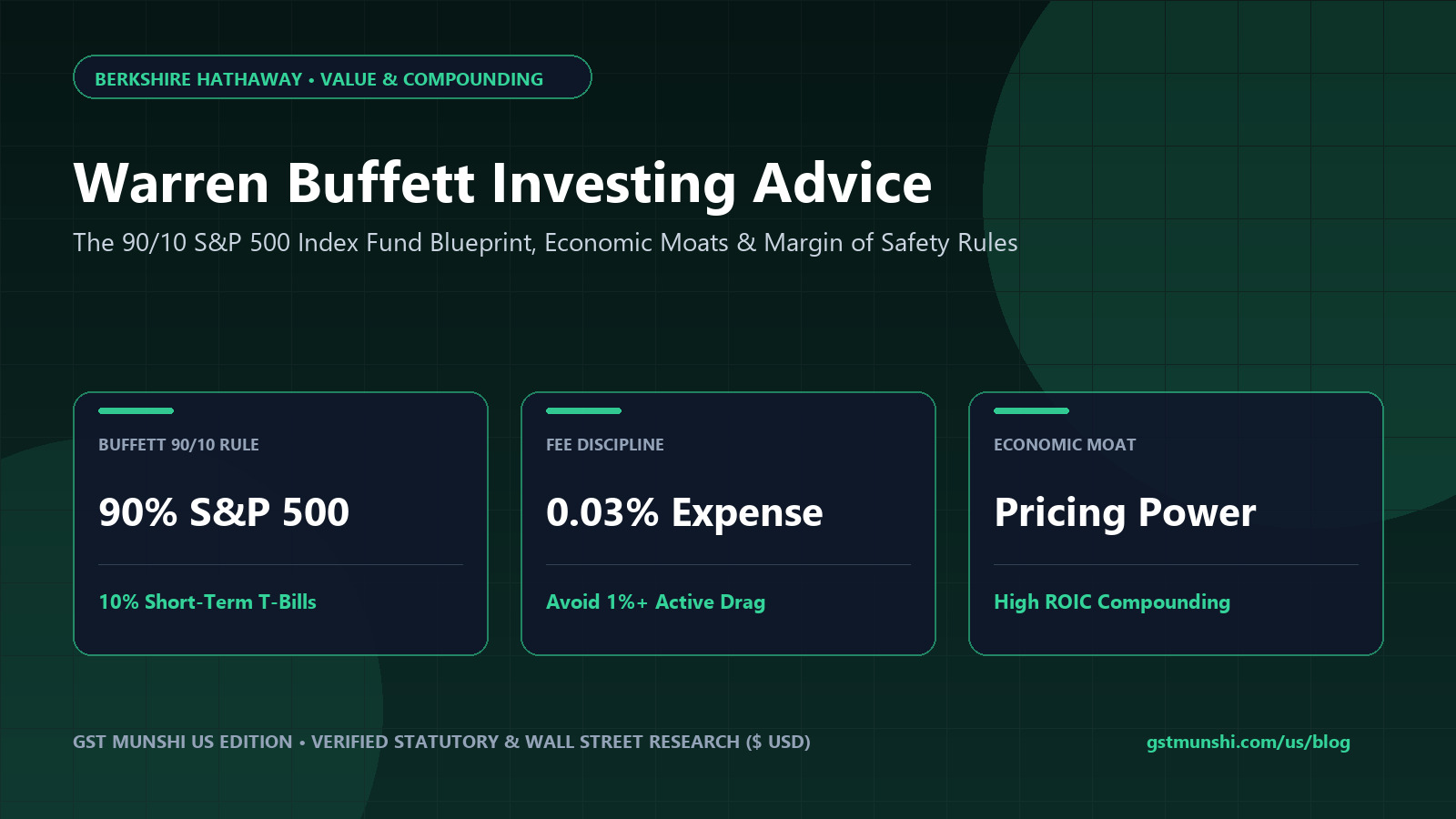
What is Warren Buffett's #1 investing advice for everyday long-term investors, and why does he recommend an S&P 500 index fund?
Warren Buffett consistently advises everyday investors to dollar-cost average into a low-cost S&P 500 index fund rather than trying to pick individual stocks or pay high fees to active Wall Street fund managers. In his landmark 2013 Berkshire Hathaway Shareholder Letter, Buffett revealed his personal estate trust instruction: put 90% of the cash into a very low-cost S&P 500 index fund (such as Vanguard's) and 10% into short-term US government Treasury bills.
Warren Buffett 90/10 Portfolio Compounding & Active Fee Drag Simulator
Simulate Warren Buffett's famous estate instruction: 90% in a low-cost S&P 500 index fund (0.03% ER) and 10% in short-term US Treasury bills vs. a traditional active fund charging 1.15% per year.
1The 90/10 S&P 500 Blueprint: Inside Warren Buffett's Estate Trust Instructions
Despite being the most successful stock picker in modern financial history—compounding Berkshire Hathaway's per-share market value at nearly twice the annual rate of the S&P 500 since 1965—Warren Buffett has repeatedly stated that most non-professional investors (and even institutional pensions) achieve superior long-term results by owning a low-cost S&P 500 index fund.
In page 20 of his 2013 Berkshire Hathaway Shareholder Letter, Buffett disclosed the exact directive written into his will for the trustee managing his wife's inheritance: 'My advice to the trustee could not be more simple: Put 10% of the cash in short-term government bonds and 90% in a very low-cost S&P 500 index fund. (I suggest Vanguard's.) I believe the trust's long-term results from this policy will be superior to those attained by most investors—whether pension funds, institutions, or individuals—who employ high-fee managers.'
The structural brilliance of the 90/10 rule lies in behavioral protection. The 90% S&P 500 allocation captures the full compounding earnings power of 500 premier American businesses at a 0.03% annual expense ratio, while the 10% short-term US Treasury bill sleeve provides up to two to three years of living expenses so a retiree is never forced to sell stocks at depressed prices during a bear market.
- 90% Growth Engine: Vanguard S&P 500 ETF (VOO / VFIAX) or Fidelity 500 Index Fund (FXAIX) capturing broad American corporate earnings.
- 10% Liquidity Shield: 3-month to 12-month US Treasury Bills (or ETF equivalents like SGOV / BIL) providing zero-credit-risk cash yield.
- Rebalancing Discipline: If equities drop 25%+ during a recession, withdrawals come exclusively from the 10% Treasury bill buffer until stock prices recover.
2How the S&P 500 Crushed Wall Street in Buffett's $1 Million Decade Bet
In 2007, Warren Buffett issued a public $1 million charitable wager via Long Bets: he bet that a simple, unmanaged Vanguard S&P 500 Admiral Index Fund would outperform any portfolio of at least five hedge funds hand-picked by an industry professional over a 10-year period (January 1, 2008 to December 31, 2017), net of all fees, costs, and expenses.
Protégé Partners LLC accepted the challenge and selected five elite 'funds-of-funds' representing over 200 underlying hedge funds charging the traditional '2-and-20' fee structure (2% annual management fee plus 20% of profits). Ironically, the bet began right as the 2008 Global Financial Crisis hit, causing the S&P 500 to fall 37% in year one.
Over the full ten-year horizon, however, American corporate earnings recovered and compounded relentlessly. By the end of 2017, the low-cost S&P 500 index fund delivered a cumulative total return of +125.8% (8.5% annualized), whereas the five hedge fund baskets returned just +2.8%, +28.3%, +42.3%, +62.8%, and +87.7%—an average cumulative return of only +36.3% after Wall Street fees.
3Economic Moats, Pricing Power & Intrinsic Value for Individual Stock Investors
For investors who choose to dedicate time to researching individual companies alongside their core S&P 500 index holdings, Buffett's methodology centers on identifying an 'Economic Moat'—a structural competitive advantage that protects a company's high Return on Invested Capital (ROIC) from competitors for decades.
In Buffett's framework, true economic moats fall into four categories: (1) Intangible brand and ecosystem pricing power (the ability to raise prices above inflation without losing unit volume, exemplified by Apple and Coca-Cola), (2) High customer switching costs (mission-critical enterprise software and financial rails), (3) Network effects (payment networks like Visa and American Express where every new user increases network value), and (4) Structural low-cost production advantages (such as GEICO or Costco).
In his 1991 Fortune analysis and shareholder letters, Buffett emphasized that the single most important test of a great business is pricing power: if you have to hold a prayer session before raising prices by 5%, you are in a commodity business; if you can raise prices effortlessly to match or beat inflation, you own a compounding fortress.
4Benjamin Graham's Two Pillars: 'Mr. Market' & The Margin of Safety
Buffett consistently credits Chapters 8 and 20 of Benjamin Graham's 1949 classic, The Intelligent Investor, as the bedrock of rational investing. Chapter 8 introduces the allegory of 'Mr. Market'—an emotionally unstable business partner who appears every trading day offering to buy your shares or sell you his shares at a quoted price.
On days when macroeconomic news is euphoric, Mr. Market quotes absurdly high prices; on days of geopolitical panic or recession headlines, he offers to sell world-class franchises for pennies on the dollar. The disciplined investor never lets Mr. Market's daily price quote dictate the value of the business, using market crashes strictly as buying opportunities.
Chapter 20 defines the 'Margin of Safety': never purchase a security unless its market price trades at a substantial discount (typically 25% to 35%) below a conservative calculation of its intrinsic value—defined as the discounted present value of all cash that can be taken out of the business during its remaining life.
5Why Holding Forever ('Our Favorite Holding Period') Beats Frequent Trading on Taxes
One of the most overlooked advantages in Warren Buffett's strategy—applicable equally to S&P 500 index funds and individual stocks—is the power of deferred capital gains taxation. When an active trader sells stocks every year to realize a 10% gain, they immediately surrender 15% to 37% of those profits to the IRS and state tax authorities, shrinking the capital base available to compound in year two.
By holding an S&P 500 ETF (like VOO) or high-quality businesses uninterrupted for 20 to 30 years, 100% of your unrealized capital gains stay invested and earn returns on money that would otherwise have been paid to the U.S. Treasury—functioning like an interest-free, non-recourse wealth loan from the IRS.
Warren Buffett's 6 Core Investing Rules Applied to a 2026–2027 Portfolio
| Buffett Principle | CoreBerkshire Philosophy | Practical Action for Retail Investors |
|---|---|---|
| 1. The 90/10 Index Rule | Low-cost S&P 500 beats 88%+ of active managers over 15 years | Allocate 90% to VOO/FXAIX (0.015%–0.03% fee) + 10% to US T-Bills |
| 2. Circle of Competence | Risk comes from not knowing what you are doing | Avoid complex leveraged ETFs, penny stocks, or businesses you cannot explain in 2 minutes |
| 3. Durable Economic Moat | Buy wonderful businesses at fair prices, not fair businesses at cheap prices | Screen for consistent 15%+ Return on Invested Capital (ROIC) and gross margin stability |
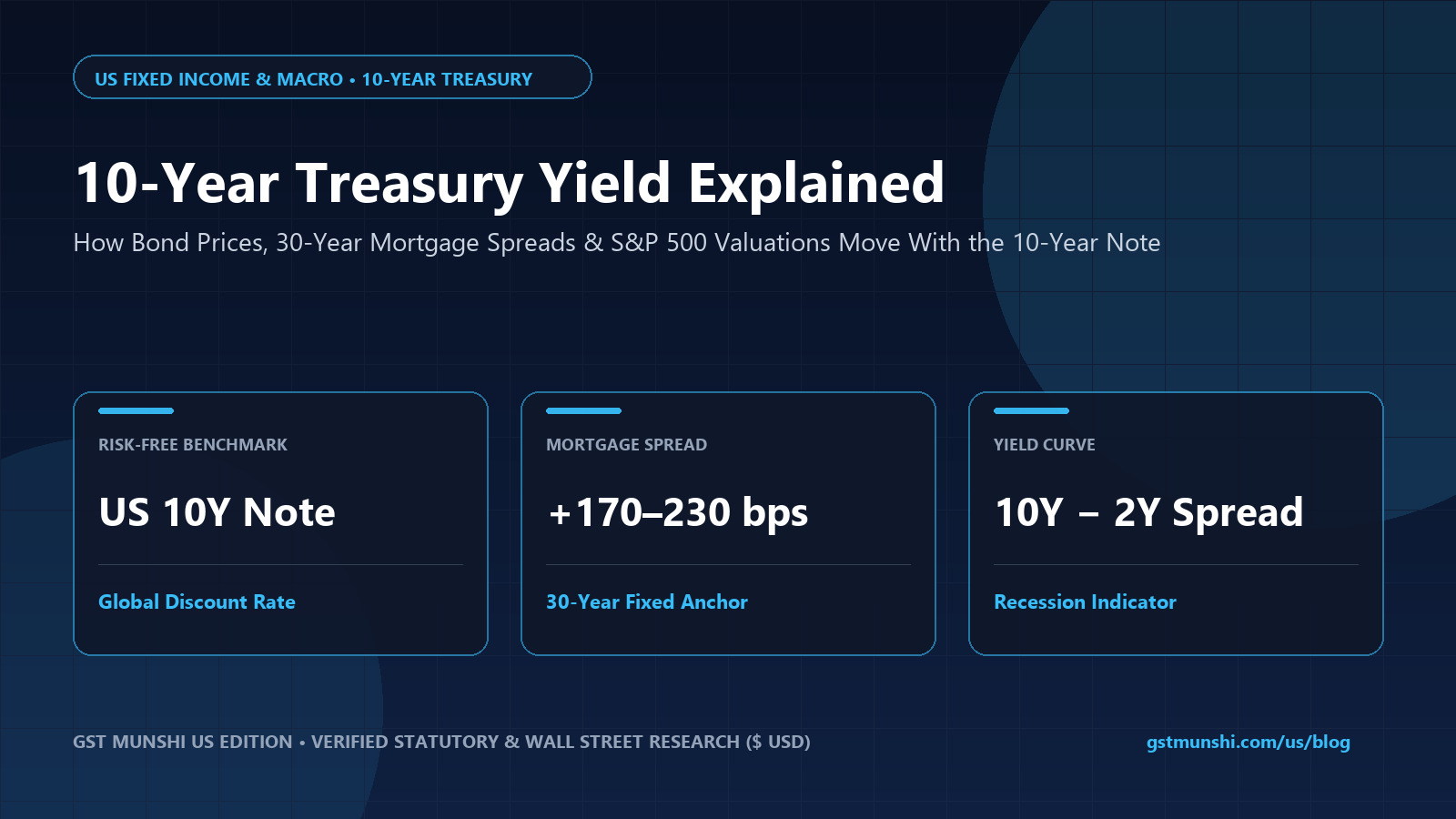
| 4. Margin of Safety | Price is what you pay; value is what you get | Compare free cash flow yield against the 10-Year US Treasury risk-free rate |
| 5. Mr. Market Temperament | Be fearful when others are greedy, and greedy when others are fearful | Automate monthly dollar-cost averaging and increase contributions when CBOE VIX > 30 |
| 6. Uninterrupted Compounding | Our favorite holding period is forever | Minimize portfolio turnover to defer IRS capital gains taxes across decades |
4-Step Blueprint to Build a Buffett-Style Long-Term Portfolio
Automate Monthly Contributions Into a Low-Cost S&P 500 Index Fund
Set up automatic bi-weekly or monthly transfers into VOO, IVV, SPLG, or FXAIX inside your 401(k), Roth IRA, and taxable brokerage account regardless of daily market headlines.
Maintain a 10% Short-Term US Treasury Bill Cash Buffer
Hold 10% of your liquid portfolio in 3-to-6-month US Treasury bills (state-tax-exempt) so you have dry powder to buy equities during 20%+ bear markets without ever selling stocks at a loss.
Audit Your Portfolio for Hidden Management & Advisory Fees
Replace mutual funds charging 0.50%–1.25% expense ratios with 0.02%–0.03% index funds; saving 1% per year on a $100,000 portfolio adds over $300,000 in retained wealth over 30 years.
Enable Automatic Dividend Reinvestment (DRIP) Across All Accounts
Reinvested S&P 500 dividends account for over 40% of total historical cumulative equity returns over multi-decade holding periods.
Curated Expert Video Walkthroughs & Wall Street Briefings

Frequently Asked Questions (Verified Statutory Answers)
Q1: Why did Warren Buffett recommend Vanguard's S&P 500 index fund specifically?
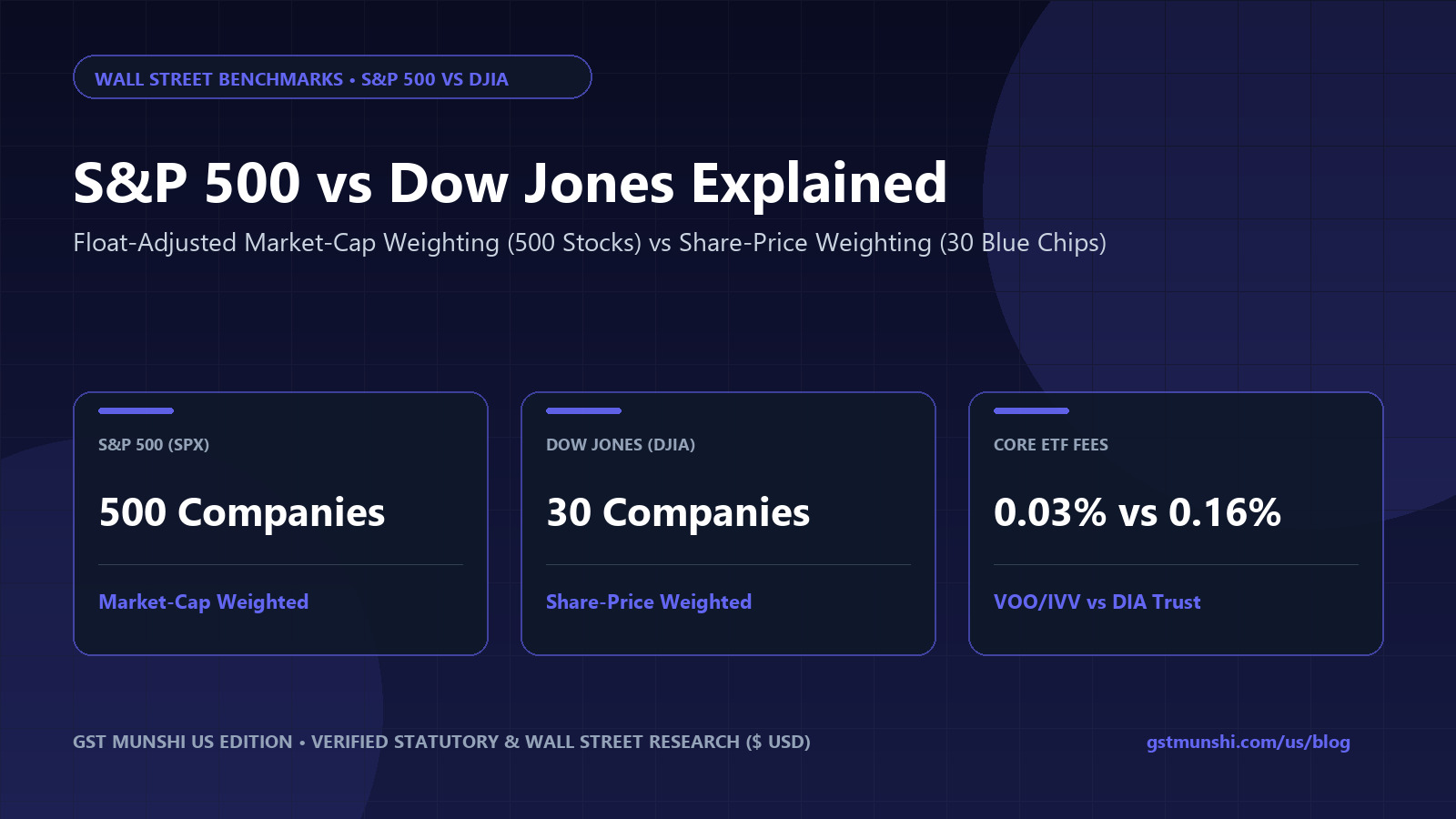
Founded by John C. Bogle, Vanguard operates under a unique mutual ownership structure where the funds own the management company, driving expense ratios down to rock-bottom levels (0.03% for VOO and 0.04% for VFIAX). Today, Fidelity (FXAIX at 0.015%), Schwab (SWPPX at 0.02%), and State Street (SPLG at 0.02%) offer equally low-cost S&P 500 funds that fulfill Buffett's exact criteria.
Q2: Does Berkshire Hathaway itself own S&P 500 ETFs?
Berkshire Hathaway operates as an insurance and industrial conglomerate holding concentrated direct stakes in companies like Apple, American Express, Bank of America, Coca-Cola, and Chevron alongside wholly owned businesses like BNSF Railway and GEICO. Buffett recommends S&P 500 index funds for individual and institutional investors who do not manage full-time corporate acquisitions.
Q3: What is the 'Buffett Indicator' for overall stock market valuation?
The Buffett Indicator compares the total market capitalization of all publicly traded US stocks (typically measured by the Wilshire 5000 or FT Wilshire 5000 Index) to US quarterly Gross Domestic Product (GDP). Historically, a ratio near 100% indicated fair valuation, whereas readings significantly above 150%–180% signal elevated equity valuations and lower forward 10-year expected returns.
Q4: How should investors handle the 10% Treasury bill portion of the 90/10 portfolio?
You can hold the 10% allocation in individual 3-month or 6-month US Treasury bills rolled automatically at maturity, or in a low-cost ultra-short Treasury bill ETF such as iShares 0-3 Month Treasury Bond ETF (SGOV) or Vanguard 0-3 Month Treasury Bill ETF (VBIL).
Q5: What did Warren Buffett mean by 'Rule No. 1: Never lose money'?
Buffett's famous maxim does not refer to temporary daily stock market fluctuations; rather, it warns against permanent loss of capital caused by overpaying for speculative assets, using excessive margin debt, or investing outside your circle of competence.
Q6: Is lump-sum investing or dollar-cost averaging better for an S&P 500 index fund?
Buffett notes that gradually buying into an S&P 500 index fund over time (dollar-cost averaging through every paycheck in a 401(k) or IRA) is essential because it diversifies your entry price across market peaks and recessions, preventing the behavioral mistake of buying only when headlines feel euphoric.
Curated Expert Insights & Verified Consumer Disclosures
“According to the latest S&P Dow Jones Indices SPIVA Scorecard, over 88% of actively managed US large-cap funds underperformed the S&P 500 over a 15-year horizon. Buffett's 90/10 rule works because mathematical fee drag is a certainty, while active alpha is rare.”