
How do S&P 500 index funds work, and what should investors consider when choosing between an S&P 500 ETF and a mutual fund?
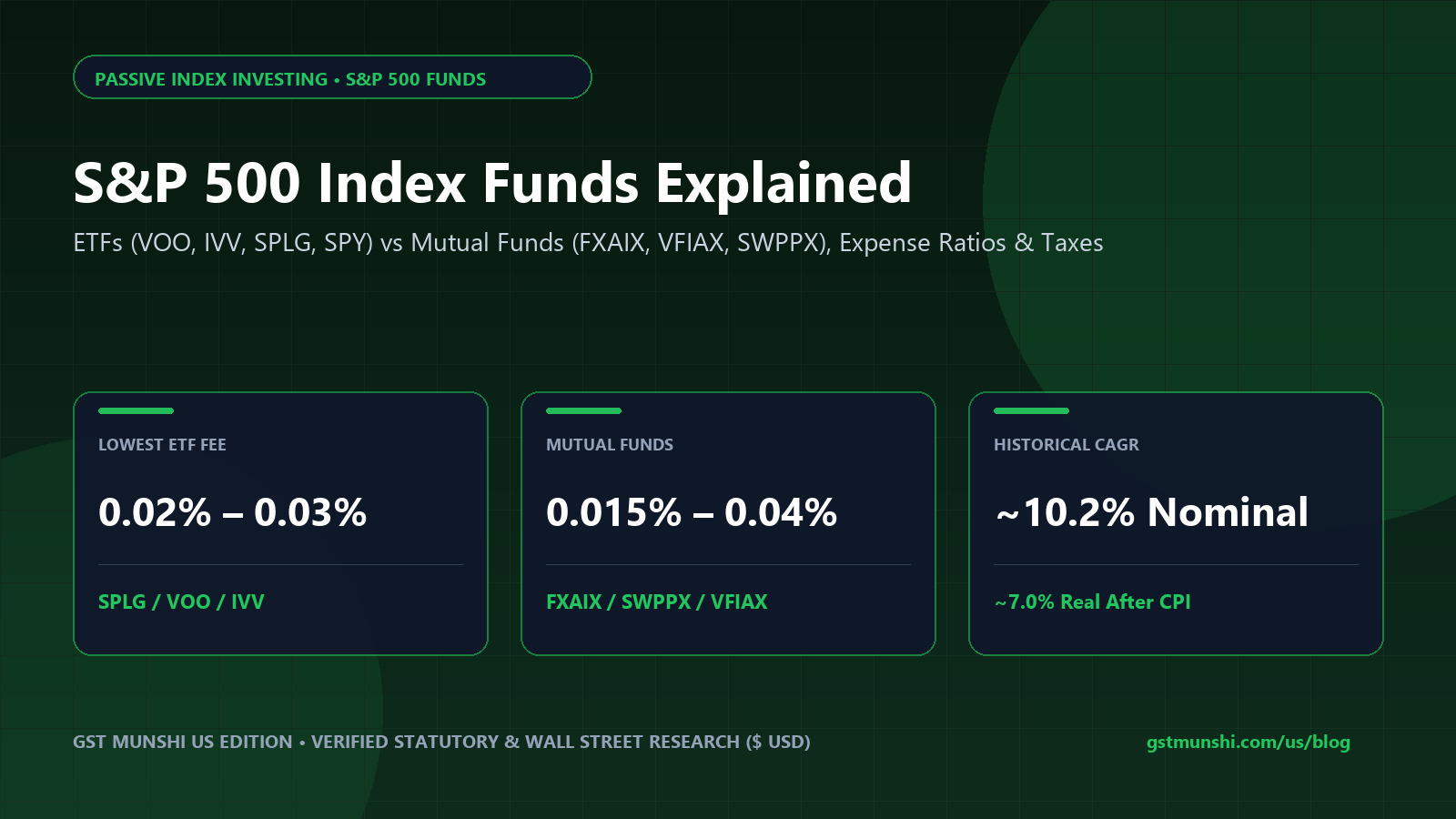
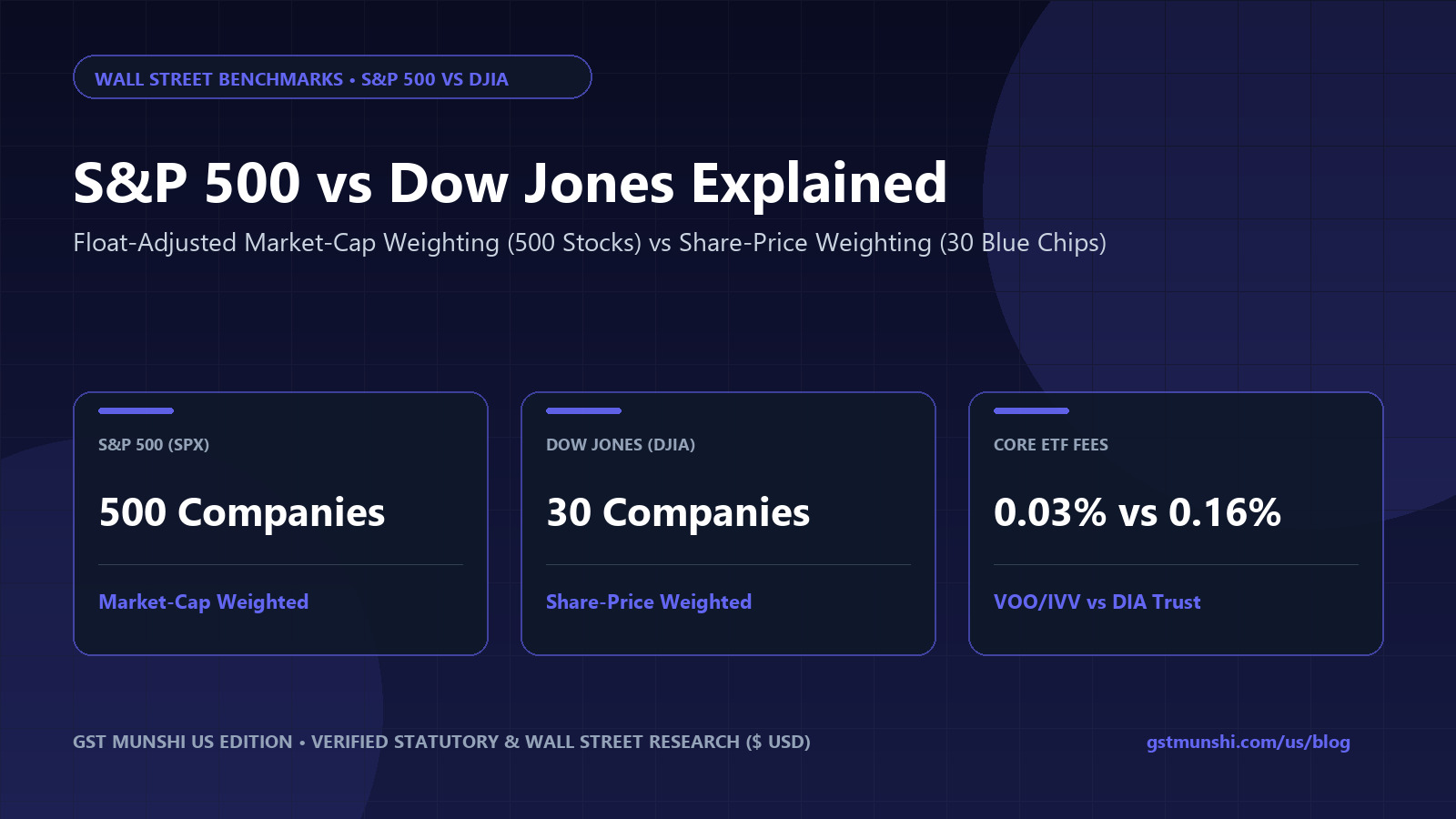
An S&P 500 index fund is a pooled investment vehicle—available as either an Exchange-Traded Fund (ETF like VOO, IVV, SPLG, or SPY) or an Index Mutual Fund (like FXAIX, VFIAX, or SWPPX)—that automatically holds all 500 companies in the S&P 500 Index in exact proportion to their float-adjusted market capitalization. Because no active stock pickers are required, top S&P 500 funds charge ultra-low expense ratios of 0.015% to 0.03% ($1.50 to $3.00 per year per $10,000 invested) while delivering ~10.2% historical annualized returns.
S&P 500 ETF vs. Mutual Fund Fee Comparison Calculator (FXAIX vs. VOO vs. SPY)
Compare long-term wealth accumulation and total cumulative expense ratio drag across top S&P 500 index funds: Fidelity FXAIX (0.015%), Vanguard VOO / iShares IVV (0.03%), and SPDR SPY (0.0945%).
1How S&P 500 Index Funds Work: Full Replication & Self-Cleansing Market-Cap Weighting
When you invest $1,000 into an S&P 500 index fund, the fund manager does not guess which stocks will beat the market next quarter. Instead, the fund uses 'Full Replication'—a quantitative computer system that purchases every single one of the 500 constituent companies in the S&P 500 Index in exact match to their float-adjusted market capitalization weight.
For example, if Apple represents 6.8% of the S&P 500, Microsoft represents 6.4%, NVIDIA represents 6.1%, and JPMorgan Chase represents 1.4%, your $1,000 investment automatically buys $68 of Apple, $64 of Microsoft, $61 of NVIDIA, $14 of JPMorgan Chase, and proportional amounts of the remaining 496 corporations across all 11 US economic sectors.
Because the fund is market-cap weighted, it is largely self-rebalancing. If a constituent company's stock price doubles, its weight inside the S&P 500 doubles automatically without the fund having to buy a single additional share. Conversely, if a legacy company loses profitability and drops below S&P's eligibility thresholds, the Index Committee removes it and replaces it with a profitable rising company—giving index investors a self-cleansing portfolio that adapts across generations.
- Zero Manager Drift: Tracks the S&P 500 benchmark within 1 to 3 basis points per year (minimal tracking error).
- Low Portfolio Turnover (~2%–4% per year): Only trades when companies enter/exit the index or adjust share float, minimizing transaction costs and tax drag.
- Quarterly Cash Dividends: Aggregates dividends paid by all underlying S&P 500 companies (~1.25%–1.50% annual yield) and pays them out every quarter.
2S&P 500 ETF (VOO, IVV, SPLG, SPY) vs. S&P 500 Mutual Fund (FXAIX, VFIAX, SWPPX)
Before buying an S&P 500 index fund, you must choose between two legal structures regulated under the Investment Company Act of 1940: an Exchange-Traded Fund (ETF) or an Open-End Index Mutual Fund. While both hold the exact same 500 stocks and deliver virtually identical pre-tax returns, they trade and settle differently.
S&P 500 ETFs (such as Vanguard VOO, iShares IVV, and SPDR Portfolio SPLG) trade on stock exchanges all day from 9:30 AM to 4:00 PM ET just like individual stocks, are portable across any brokerage firm without transfer penalties, and carry a $1 minimum at brokerages offering fractional shares. Moreover, under Internal Revenue Code Section 852(b)(6), ETFs use an 'in-kind' creation and redemption mechanism with Authorized Participants that flushes out low-basis shares without triggering taxable capital gains distributions—making ETFs ideal for taxable brokerage accounts.
S&P 500 Index Mutual Funds (such as Fidelity FXAIX, Charles Schwab SWPPX, and Vanguard VFIAX) execute orders once per day at 4:00 PM ET directly at exact Net Asset Value (NAV) with zero bid-ask spread, and allow effortless automated dollar-amount investing—making them the premier choice inside employer 401(k) plans and IRAs held directly at Fidelity, Schwab, or Vanguard.
3Why Expense Ratios Matter: Comparing FXAIX (0.015%), SPLG (0.02%), VOO (0.03%) & SPY (0.0945%)
Because every S&P 500 index fund owns the exact same underlying basket of 500 stocks, an index fund's gross return before fees is identical. Therefore, the single most reliable predictor of which S&P 500 fund will produce the highest net wealth over 20 or 30 years is its annual Expense Ratio.
While the oldest ETF in the United States—the SPDR S&P 500 ETF Trust (SPY, launched in January 1993)—dominates institutional options trading, it charges a 0.0945% expense ratio ($9.45 per $10,000). By choosing State Street's newer SPDR Portfolio S&P 500 ETF (SPLG at 0.02%), Vanguard VOO (0.03%), or iShares IVV (0.03%), long-term buy-and-hold investors cut their annual fee by more than two-thirds.
4What to Consider Before Investing: Concentration Risk, Sequence of Returns & Time Horizon
Although the S&P 500 has delivered an average nominal annualized total return of ~10.2% (~7.0% after inflation) since 1957, it does not earn 10% in a straight line every calendar year. Investors must be psychologically and financially prepared for periodic bear-market drawdowns of 20% to 50% (such as the 2000–2002 dot-com bust, the 2008 financial crisis, or the 2022 inflation reset).
Additionally, because the S&P 500 is market-cap weighted, its top 10 largest technology and growth constituents currently account for roughly 33% to 36% of the entire index. Investors should never put money needed within the next 1 to 3 years (such as a home down payment or emergency fund) into an S&P 500 index fund; keep short-term cash in FDIC-insured High-Yield Savings Accounts or US Treasury bills, and commit equity capital for a minimum 5-to-10+ year horizon.
Top 6 US S&P 500 Index Funds (ETFs vs. Mutual Funds) Comparison Matrix
| Fund Name & Ticker | Fund Structure | Expense Ratio | Minimum Investment | Best Account Type & Use Case |
|---|---|---|---|---|
| Fidelity 500 Index Fund (FXAIX) | Index Mutual Fund | 0.015% ($1.50 / $10K) | $0 Minimum | Best for Fidelity 401(k), Roth IRA & HSA Accounts |
| SPDR Portfolio S&P 500 ETF (SPLG) | Open-End ETF | 0.020% ($2.00 / $10K) | 1 Share (~$68) or $1 Fractional | Lowest-Fee S&P 500 ETF with Low Share Price for Retail DCA |
| Schwab S&P 500 Index Fund (SWPPX) | Index Mutual Fund | 0.020% ($2.00 / $10K) | $0 Minimum | Best for Charles Schwab IRAs & Automated Mutual Fund Plans |
| Vanguard S&P 500 ETF (VOO) | Open-End ETF | 0.030% ($3.00 / $10K) | $1 Fractional / 1 Share | Gold Standard for Taxable Brokerage & Retirement Accounts |
| iShares Core S&P 500 ETF (IVV) | Open-End ETF | 0.030% ($3.00 / $10K) | $1 Fractional / 1 Share | Institutional-Grade Taxable & Tax-Loss Harvesting Pair with VOO |
| Vanguard 500 Index Admiral (VFIAX) | Index Mutual Fund | 0.040% ($4.00 / $10K) | $3,000 Minimum | Classic Mutual Fund with Patented ETF Share-Class Tax Shield |
4-Step Guide to Investing in Your First S&P 500 Index Fund
Prioritize Tax-Advantaged Accounts First (401(k) Match, Roth IRA, HSA)
Before funding a standard taxable account, capture 100% of your employer's 401(k) match and max out your Roth IRA ($7,000 limit; $8,000 if age 50+) so your S&P 500 gains compound 100% tax-free.
Select an ETF (VOO, IVV, SPLG) for Taxable Brokerage Accounts
In regular taxable brokerage accounts, choose an open-end ETF (0.02%–0.03% fee) to ensure zero surprise year-end capital gains tax distributions and full portability across brokerages.
Turn On Automatic Dividend Reinvestment (DRIP) & Recurring Transfers
Configure your brokerage account to automatically reinvest quarterly S&P 500 cash dividends into additional fractional shares and schedule a recurring transfer every payday.
Avoid Panic-Selling During Routine 10%–20% Market Corrections
The S&P 500 experiences an average intra-year pullback of ~14% almost every single year while still finishing positive in roughly 3 out of every 4 calendar years.
Curated Expert Video Walkthroughs & Wall Street Briefings


Frequently Asked Questions (Verified Statutory Answers)
Q1: Is there any difference in the stocks held by VOO, IVV, SPLG, SPY, and FXAIX?
No. Every one of these funds tracks the exact same S&P 500 Index maintained by S&P Dow Jones Indices. Their underlying holdings and percentage weights are identical; the only differences are their legal structure (ETF vs. Mutual Fund) and their annual expense ratio (0.015% to 0.0945%).
Q2: How are S&P 500 index fund dividends taxed in a standard US brokerage account?
In a taxable brokerage account, over 95% of dividends paid by S&P 500 index funds qualify as 'Qualified Dividends' under IRC Section 1(h)(11) (provided you hold the shares for more than 60 days during the 121-day window around the ex-dividend date), meaning they are taxed at favorable long-term capital gains rates of 0%, 15%, or 20% rather than ordinary income tax brackets.
Q3: Can an S&P 500 index fund go to zero?
For an S&P 500 index fund to fall to $0.00, all 500 of the largest corporations in the United States—spanning Apple, Microsoft, JPMorgan Chase, Johnson & Johnson, ExxonMobil, Walmart, and Visa—would have to go simultaneously bankrupt and worthless.
Q4: How much money do I need to start investing in an S&P 500 index fund?
At Fidelity (FXAIX) and Charles Schwab (SWPPX), the minimum investment for their S&P 500 index mutual funds is $0 (you can start with $1). Similarly, brokerages offering fractional ETF shares allow you to buy VOO, IVV, or SPLG starting with just $1 to $5.
Q5: Should I buy both VOO and FXAIX for diversification?
Buying two different S&P 500 funds (such as VOO and FXAIX) does not add any diversification because both funds hold the exact same 500 companies in the exact same weights. To diversify beyond the S&P 500, investors add US Small/Mid-Cap funds, International Developed/Emerging Market funds, or US Treasury bonds.
Q6: What is the historical average annual return of the S&P 500?
Since the index expanded to 500 companies in March 1957, the S&P 500 has delivered an annualized nominal total return (including reinvested dividends) of approximately 10.2% per year, or roughly 6.9% to 7.1% per year in real inflation-adjusted purchasing power.
Curated Expert Insights & Verified Consumer Disclosures
“Why do long-term investors prefer VOO (0.03%) or SPLG (0.02%) over SPY (0.0945%)? Beyond the 3x–4x lower expense ratio, VOO and SPLG are modern open-end 1940-Act ETFs that can immediately reinvest internal cash dividends between quarterly payout dates, eliminating cash drag during bull markets.”