What happens when the Social Security Trust Fund is depleted in 2033–2035?
The Actuarial Reality: Demystifying the 2033 Social Security Solvency Cliff
Few domestic economic issues generate more anxiety among active workers, pre-retirees, and current seniors than the impending depletion of the Social Security Trust Funds. Pundits and viral headlines frequently frame the issue as imminent bankruptcy, sparking unfounded fears that Social Security checks will vanish entirely into thin air.
In reality, Social Security is funded predominantly through a pay-as-you-go financial mechanism where current workers pay dedicated FICA taxes to fund benefits for current retirees. The depletion milestone refers strictly to the exhaustion of surplus asset reserves accumulated during decades when the Baby Boomer generation was in peak working years. This master guide delivers an uncompromising actuarial breakdown of the statutory rules, exact benefit reduction percentages, historical 1983 precedent, and leading Congressional legislative reform proposals.
Interactive Social Security Solvency & 2033 Benefit Cut Simulator
Model your monthly retirement check under CBO automatic cut projections versus Congressional legislative reform options.
Comparative Policy Analysis: Congressional Reform Solutions
Compare the primary bipartisan and partisan legislative proposals currently under consideration to resolve the 75-year Social Security actuarial deficit.
| Reform Proposal | Mechanism & Scope | 75-Yr Deficit Solved | Impact on Retirees | Political Feasibility |
|---|---|---|---|---|
| Do Nothing (Current Law) | Automatic 21%–23% cut upon reserve exhaustion | 100% (By force) | Immediate $441/mo check reduction | Unacceptable to voters |
| Scrap Taxable Wage Cap | Apply 12.4% FICA tax on earnings above $250k/$400k | 65% – 73% Solved | Zero cut to current/future benefits | Supported by Democrats |
| Raise FRA to Age 69/70 | Gradually increase full retirement age for birth cohorts >1965 | 30% – 40% Solved | Effective 13% cut for early claimers | Supported by Republicans |
| Bipartisan Grand Bargain | 0.5% payroll tax bump + high-earner tax + Chained CPI | 100% Solved | Checks protected; modest future slowing | Most Likely 1983-Style Solution |
Verified Expert Masterclasses: Social Security Trust Fund Explained
Watch comprehensive actuarial explanations, CBO projections, and retirement planning strategies from certified financial planners and policy economists.
Insolvency Projections & Funding Gap Explained
Trust Fund Mechanics & Check Size Impact
Frequently Asked Questions: Social Security Solvency
Q1.When will the Social Security Trust Fund officially be depleted?
According to the Congressional Budget Office (CBO) and the Social Security Board of Trustees, the Old-Age and Survivors Insurance (OASI) Trust Fund reserves are projected to be exhausted between 2033 and 2035. If combined with the Disability Insurance (DI) trust fund, the depletion baseline shifts slightly to 2035.
Q2.Will Social Security benefits drop to zero when the trust fund runs out?
No. Social Security will never drop to zero. The program is fundamentally financed on a 'pay-as-you-go' basis through ongoing FICA payroll taxes collected from active workers. Even with zero reserves, incoming tax revenue is sufficient to pay approximately 77% to 79% of scheduled benefits.
Q3.What percentage benefit cut will retirees face if Congress does nothing?
Under statutory law, the Social Security Administration cannot borrow money or pay benefits exceeding incoming tax receipts. Without legislative action, an automatic, across-the-board benefit cut of 21% to 23% will take effect immediately upon trust fund exhaustion.
Q4.How much money would a typical retiree lose each month under the 23% cut?
For a retiree receiving the average monthly benefit of $1,920, a 23% reduction equates to an immediate loss of approximately $441 per month, reducing their monthly check to $1,479 and causing an annualized loss of over $5,290.
Q5.What is the proposal to eliminate the Social Security tax wage cap?
Currently, payroll taxes (6.2% employee + 6.2% employer) only apply to earnings up to the annual statutory wage cap ($176,100 in 2025/2026). Legislative proposals such as the Social Security Expansion Act advocate applying payroll taxes to earnings above $250,000 or $400,000, eliminating roughly 65% to 73% of the 75-year actuarial shortfall.
Q6.Will Congress raise the Full Retirement Age (FRA) to 68, 69, or 70?
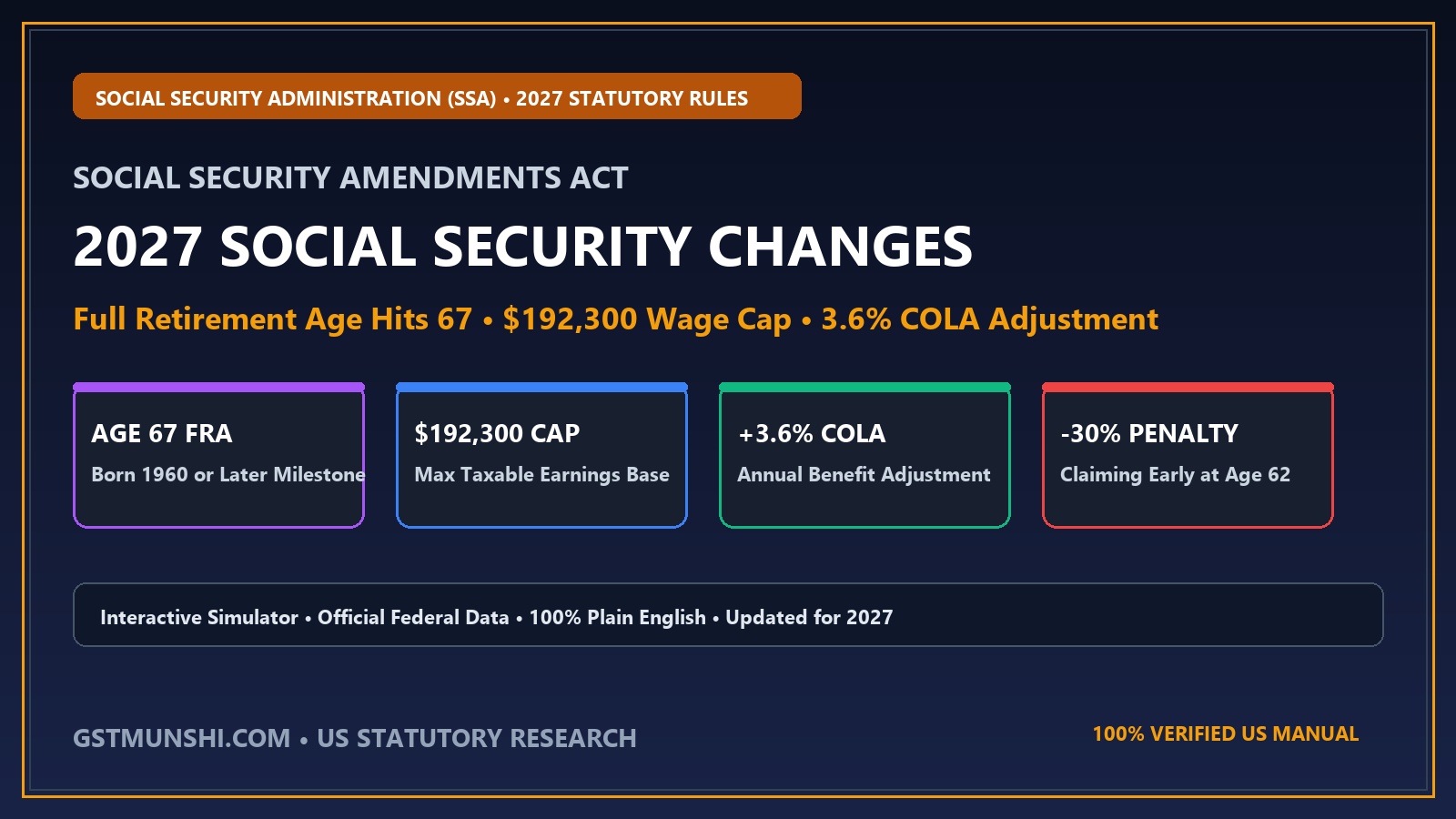
Several bipartisan proposals suggest gradually raising the Full Retirement Age from 67 to 69 or 70 for younger workers born after 1965 or 1970. Each 1-year increase in the FRA represents an effective across-the-board benefit cut of roughly 6.5% to 7.0% for early claimers.
Q7.Can Congress use general federal income tax revenue to fund Social Security?
Under the Social Security Act of 1935, benefits must be funded strictly from dedicated payroll taxes and trust fund interest. Transferring general tax revenues would require amending the statutory charter of the program or increasing the federal debt ceiling.
Q8.How does the 1983 Greenspan Commission reform provide a precedent for 2033?
In 1983, Social Security was within six months of insolvency. President Ronald Reagan and Speaker Tip O'Neill passed a bipartisan compromise that gradually increased the retirement age from 65 to 67, accelerated payroll tax rate increases, and introduced federal taxation on benefits for higher earners.
Q9.Should pre-retirees claim benefits early at age 62 to beat the potential cut?
Financial planners generally advise against panicking and claiming at 62 solely due to trust fund concerns. Claiming at 62 permanently locks in a 30% reduction compared to claiming at FRA 67. If benefits are cut in 2033, the early claimer suffers the 30% age penalty PLUS the 23% trust fund haircut.
Q10.How does the annual Cost-of-Living Adjustment (COLA) affect solvency?
High inflation and elevated COLAs (such as 8.7% in 2023) accelerate trust fund depletion because benefit outflows expand faster than wage-tax growth. Some policy proposals advocate shifting from CPI-W to 'Chained CPI', which grows roughly 0.25% to 0.30% slower annually.
Q11.Are disability benefits (SSDI) threatened by the OASI trust fund depletion?
No. The Disability Insurance (DI) trust fund is in robust financial health, with reserves projected to remain solvent for well over 75 years due to lower disability application rates over the past decade.
Q12.What is the 75-year actuarial deficit of the Social Security program?
The Social Security Trustees report a 75-year actuarial deficit of approximately 3.50% of taxable payroll. This means an immediate and permanent payroll tax increase of 1.75% for employees and 1.75% for employers (or an immediate 24% benefit reduction) would solve the deficit for 75 years.
Retirement Preparation Playbook: Protecting Your Cash Flow Ahead of 2033
Stress-Test 20% Cut
Recalculate retirement cash flow assuming an 80% baseline Social Security payout starting in 2033.
Maximize Roth Accounts
Accelerate tax-free Roth IRA and Roth 401(k) conversions to diversify future income against benefit changes.
Delay Claiming to 70
Earn 8% annual delayed retirement credits up to age 70 to maximize the absolute monthly dollar baseline.
Track Legislative Action
Monitor bipartisan Senate Finance Committee drafts and President's budget proposals for grandfather clauses.