
How do ACA health insurance marketplace subsidies work for 2027 plans?
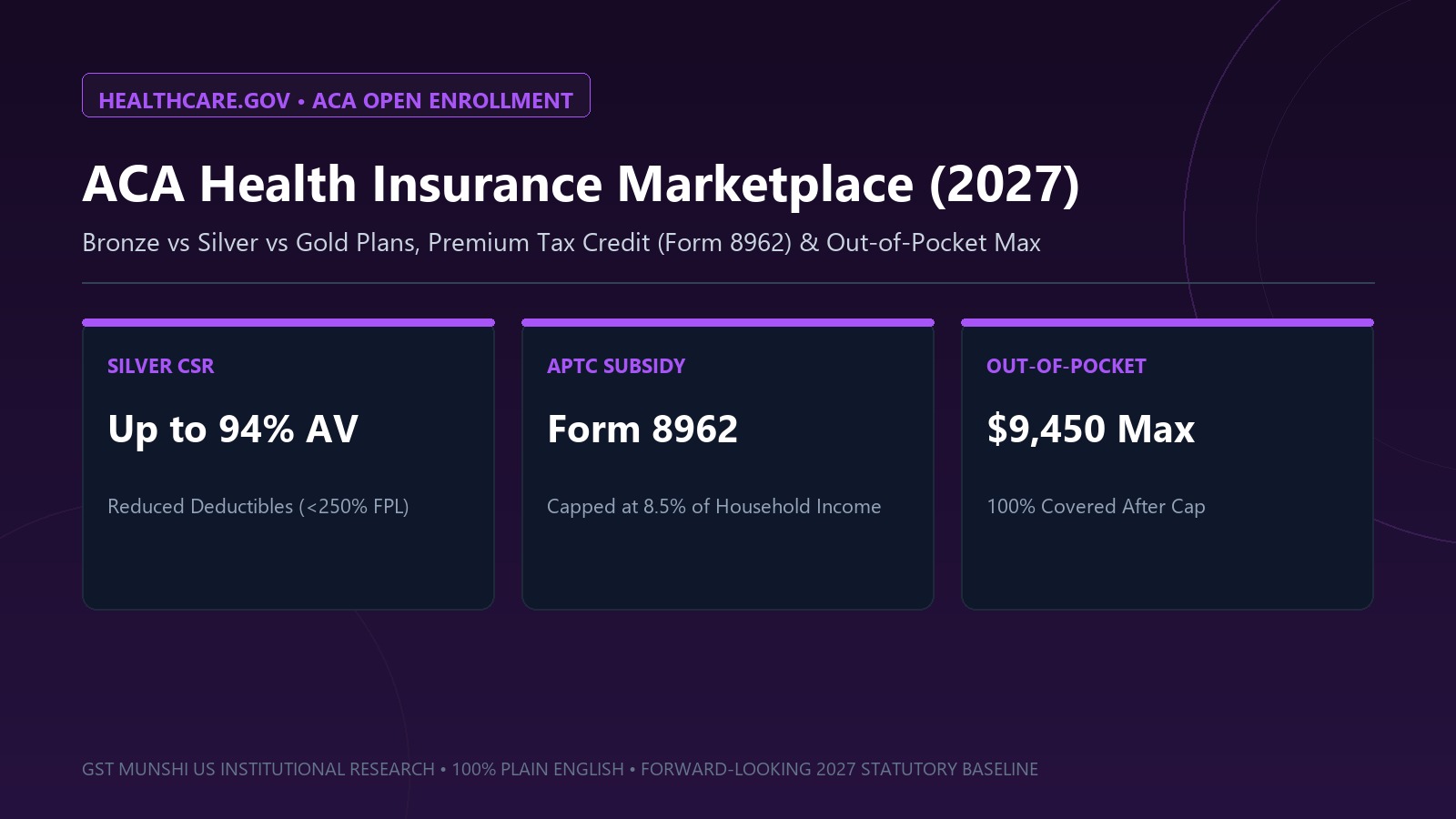
Under the Affordable Care Act (ACA), eligible individuals and families purchasing health insurance on Healthcare.gov or state exchanges receive Advance Premium Tax Credits (APTC) that cap the cost of the benchmark Second Lowest Cost Silver Plan (SLCSP) at 0% to 8.5% of household Modified Adjusted Gross Income (MAGI). Households earning between 100% and 250% of the Federal Poverty Level (FPL) qualify for Silver plan Cost-Sharing Reductions (CSR), reducing annual deductibles from $6,000+ down to $0–$1,500.
2027 ACA Marketplace Premium Tax Credit (APTC) & Silver CSR Calculator
Enter household income and family size to calculate your Federal Poverty Level (FPL %), monthly subsidy credit, and eligibility for zero/low deductible Silver plans.
12027 Open Enrollment Deadlines & Special Enrollment Periods (SEP)
The annual Open Enrollment Period for Affordable Care Act (ACA) marketplace health insurance begins nationwide on November 1 and runs through January 15 in federal exchange states using Healthcare.gov. Selecting a plan by December 15 ensures coverage begins on January 1, while plans selected between December 16 and January 15 take effect on February 1.
Outside of the annual open enrollment window, individuals can only enroll if they experience a qualifying life event (QLE) triggering a 60-day Special Enrollment Period (SEP). Qualifying life events include losing employer-sponsored coverage, getting married, having or adopting a baby, permanently moving to a new ZIP code, or experiencing an income change that affects Medicaid or subsidy eligibility.
2Bronze vs Silver vs Gold vs Platinum: Actuarial Value Decoded
All ACA marketplace plans cover the 10 Essential Health Benefits (including ambulatory services, emergency room care, hospitalization, maternity, mental health, prescription drugs, and preventive screenings with zero co-pays). Plans are categorized into standardized metal tiers based on their Actuarial Value (AV)—the percentage of total healthcare costs the plan pays on average across a standard population.
- Bronze (60% Actuarial Value): Lowest monthly premiums, but high annual deductibles ($7,500–$9,450). Best for healthy young individuals seeking catastrophic financial protection against major accidents.
- Silver (70% Actuarial Value Standard, Up to 94% with CSR): Moderate premiums and moderate deductibles. If your income is between 100% and 250% of FPL, Silver is the undisputed best value because Cost-Sharing Reductions upgrade it into a Gold/Platinum level plan for free.
- Gold (80% Actuarial Value): Higher monthly premiums, but low deductibles ($1,000–$2,000) and low specialist co-pays. Ideal for individuals with chronic medical conditions, regular brand-name prescriptions, or planned surgeries.
- Platinum (90% Actuarial Value): Highest premiums, near-zero deductibles, but rarely cost-effective compared to subsidized Silver plans.
3The Silver CSR Secret: How to Get Gold/Platinum Coverage at Silver Rates
Cost-Sharing Reductions (CSR) are federal subsidies built directly into the ACA statute under Section 1402. Unlike the premium tax credit (which lowers your monthly payment), CSRs slash the out-of-pocket costs you pay when you actually receive medical care—lowering deductibles, co-pays, and out-of-pocket maximums.
Crucially, Cost-Sharing Reductions are ONLY available if you select a Silver tier plan. If you earn 150% of the Federal Poverty Level and choose a Bronze plan, you forfeit thousands of dollars in medical subsidies. At 100%–150% FPL, Silver plans are automatically boosted to a 94% Actuarial Value plan, slashing typical deductibles from $6,500 down to $0–$250.
4IRS Form 8962: Navigating the Premium Tax Credit Clawback Trap
When you enroll on Healthcare.gov, your monthly subsidy is calculated as an Advance Premium Tax Credit (APTC) based on your projected annual Modified AGI. When you file your federal income tax return the following spring, you must attach IRS Form 8962 to reconcile your advance subsidies with your actual tax return income (reported on Form 1095-A).
If your actual income is lower than projected, you receive the difference as an extra tax refund. However, if your business or gig income surged unexpectedly during the year, you may be required to repay a portion of the advance subsidies back to the IRS. For households earning below 400% FPL, statutory repayment caps limit clawbacks, but exceeding subsidy thresholds without planning can result in unexpected tax liabilities.
2027 ACA Metal Tiers & Silver Cost-Sharing Reduction (CSR) Brackets
| Income Bracket (% of FPL) | Qualifying Plan Tier | Effective Actuarial Value | Typical Individual Deductible | Max Benchmark Premium % |
|---|---|---|---|---|
| 100% – 150% FPL ($15,650 – $23,475) | Silver Plan with CSR 94 | 94% Actuarial Value | $0 – $350 (Near Zero) | 0.0% of household income ($0/mo) |
| 150% – 200% FPL ($23,476 – $31,300) | Silver Plan with CSR 87 | 87% Actuarial Value | $750 – $1,500 | 0.0% to 2.0% of income ($0–$52/mo) |
| 200% – 250% FPL ($31,301 – $39,125) | Silver Plan with CSR 73 | 73% Actuarial Value | $2,500 – $3,500 | 2.0% to 4.0% of income ($52–$130/mo) |
| 250% – 400% FPL ($39,126 – $62,600) | Standard Silver / Bronze / Gold | 70% AV (Silver) / 80% (Gold) | $5,000 – $7,500 (Silver) | 4.0% to 8.5% of income |
| Above 400% FPL ($62,600+) | Any Metal Tier | Standard Tier AV | Standard Plan Deductible | Capped at 8.5% of household income |
4-Step Blueprint to Enroll in the Best ACA Marketplace Health Plan
Accurately Estimate Your Household Modified AGI
Calculate your projected annual Modified AGI for the upcoming tax year (gross wages plus net self-employment earnings minus pre-tax deductions like traditional IRA or HSA contributions).
Check Provider In-Network Status & Drug Formularies
Before choosing a plan, verify that your primary care physician, preferred hospital system, and prescription medications are classified as in-network (Tier 1 or Tier 2) on the insurer's provider directory.
Select Silver if Household Income is Below 250% FPL
If your income falls below 250% of the Federal Poverty Level, always choose a Silver tier plan to automatically activate Cost-Sharing Reductions that slash your deductible and out-of-pocket maximum.
Report Income Changes Within 30 Days to Prevent Tax Claws
If your salary increases or drops mid-year, update your Healthcare.gov account within 30 days to adjust your monthly APTC subsidy and prevent surprises on IRS Form 8962 at tax time.
Curated Expert Video Walkthroughs & Wall Street Briefings



Frequently Asked Questions (Verified Statutory Answers)
Q1: What is the difference between an HMO and an PPO health plan?
A Health Maintenance Organization (HMO) requires you to select a Primary Care Physician (PCP) who coordinates your care and provides written referrals to see specialists; out-of-network care is not covered except in life-threatening medical emergencies. A Preferred Provider Organization (PPO) allows you to see any in-network doctor or specialist without a referral, and provides partial coverage for out-of-network providers at higher co-pays.
Q2: How does a Health Savings Account (HSA) work with ACA marketplace plans?
To qualify for a triple-tax-advantaged Health Savings Account (HSA), you must enroll in an HSA-qualified High Deductible Health Plan (HDHP)—typically found in the Bronze or Silver tiers. HSA contributions are 100% tax-deductible, grow tax-free through index fund investing, and can be withdrawn 100% tax-free for qualified medical, dental, and vision expenses at any time.
Q3: What happens if my income exceeds the 400% Federal Poverty Level threshold?
Under the extended federal subsidy enhancement rules codified by Congress, the historic 400% FPL 'subsidy cliff' has been eliminated. Households earning above 400% FPL are protected by a statutory 8.5% cap: your benchmark second-lowest cost Silver plan premium will never exceed 8.5% of your household income, regardless of how much you earn.
Q4: Are dental and vision care included in adult ACA marketplace health plans?
Pediatric dental and vision services (for children under age 19) are legally mandated as an Essential Health Benefit on all ACA plans. However, routine adult dental cleanings and adult vision eye exams are generally not included in standard medical plans. Adults can purchase standalone dental and vision plans on the marketplace or through private carriers.



Curated Expert Insights & Verified Consumer Disclosures
“4 out of 5 marketplace customers qualify for health plans costing $10 or less per month after tax credits. If you haven't shopped in the last 2 years, updated subsidy rules mean you could save over $800 annually on premiums.”
“The biggest mistake enrollees make is picking Bronze because of a $0 premium when their income is under 200% FPL. For just $15-$30 more a month, a Silver plan with Cost-Sharing Reductions drops their deductible from $8,000 down to $500.”