What are the key Medicare Open Enrollment rules, IRMAA brackets, and Part D out-of-pocket caps?
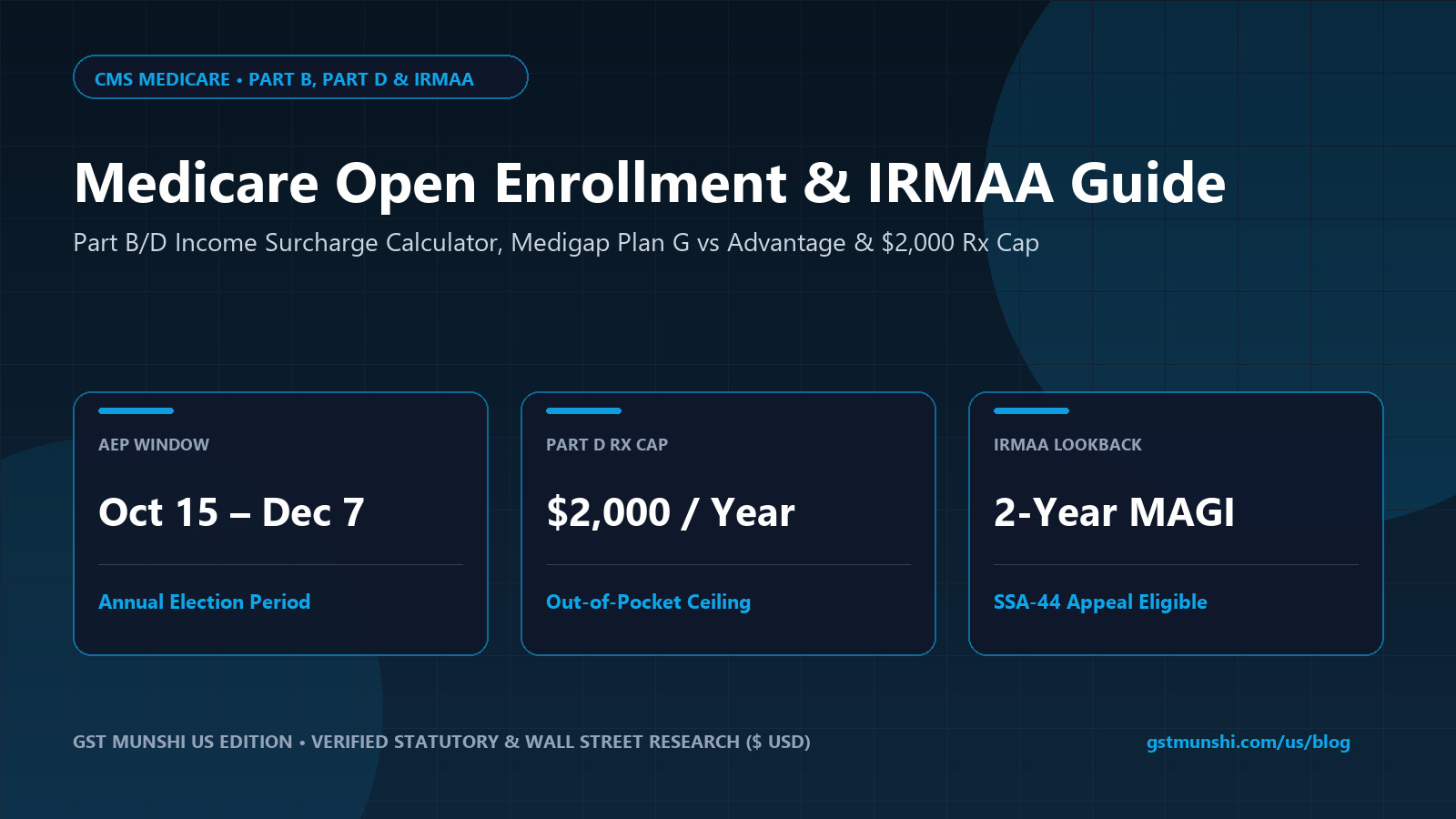
Medicare's Annual Election Period (Open Enrollment) runs every year from October 15 through December 7, with coverage changes taking effect on January 1. Under federal law, Medicare Part D prescription drug plans feature a hard $2,000–$2,100 annual out-of-pocket cap (eliminating the historic 'donut hole'). Retirees with Modified Adjusted Gross Income (MAGI) above $106,000 (Single) or $212,000 (Married Filing Jointly) on their 2-year lookback IRS tax return pay an Income-Related Monthly Adjustment Amount (IRMAA) surcharge on top of standard Part B and Part D premiums.
Check Your 2-Year Lookback MAGI & Monthly Medicare IRMAA Tier
1Original Medicare (Part A + B + Medigap Plan G) vs Medicare Advantage (Part C)
Choosing between Original Medicare paired with a Medigap supplement (such as Plan G) and a private Medicare Advantage (Part C) HMO/PPO plan is the most consequential healthcare decision US retirees make at age 65.
Original Medicare + Medigap Plan G allows you to see any doctor or specialist nationwide who accepts Medicare (including premier cancer centers like Mayo Clinic and MD Anderson) with zero network referrals and zero prior authorizations, paying only the small annual Part B deductible (~$257). Conversely, Medicare Advantage plans advertise $0 monthly premiums and dental/vision perks, but enforce strict HMO/PPO networks, prior authorizations, and annual out-of-pocket maximums up to $8,850–$9,350.
Original Medicare + Medigap Plan G vs Medicare Advantage (Part C) Comparison
| Feature | Original Medicare + Medigap Plan G | Medicare Advantage (Part C HMO/PPO) |
|---|---|---|
| Doctor & Hospital Access | Any US Provider Accepting Medicare Nationwide | Restricted to Plan's Local HMO/PPO Network |
| Prior Authorization Required? | Rarely (Covered if Medically Necessary under CMS) | Frequent for MRI, Surgery, Rehab & Specialist Care |
| Monthly Supplement Premium | $130 – $240/mo (Plus Part B & Part D Premium) | $0 – $60/mo (Plus Base Part B Premium) |
| Maximum Annual Medical Out-of-Pocket | ~$257 (Only the Annual Part B Deductible!) | Up to $8,850 – $9,350 In-Network |
| Switching Back Later? | Guaranteed Issue Only in 6-Month Initial Window (Medical Underwriting Applies Later in Most States) | Can Switch Annually Oct 15 – Dec 7 |
4-Step Medicare Enrollment & IRMAA Surcharge Defense Blueprint
Lock In Medigap Plan G During Your 6-Month Guaranteed Issue Window
Your 6-month Medigap Open Enrollment starts the month you turn 65 and enroll in Part B—insurers cannot deny you or charge more for pre-existing conditions.
Re-Shop Your Part D Prescription Drug Plan Every October 15 – December 7
Drug formularies and preferred pharmacy tiers change every January. Run your exact medication list on Medicare.gov Plan Finder every autumn.
Stop HSA Contributions 6 Months Before Applying for Medicare
Medicare Part A coverage is retroactive up to 6 months (not earlier than age 65). Contributing to an HSA during retroactive Part A coverage triggers a 6% IRS excise penalty.
File Form SSA-44 Immediately Upon Retirement to Waive IRMAA
Do not overpay IRMAA based on your peak working income from 2 years ago. Submit Form SSA-44 citing 'Work Stoppage' or 'Work Reduction' to reset your premium to the base tier.
Curated Expert Video Walkthroughs & Wall Street Briefings




Frequently Asked Questions (Verified Statutory Answers)
Q1: Can I switch from Medicare Advantage back to Medigap Plan G five years into retirement?
In most US states (except year-round guaranteed-issue states like New York, Connecticut, Massachusetts, and Maine), switching from Medicare Advantage to a Medigap policy after your initial 12-month trial right requires passing medical underwriting—meaning insurers can deny your application if you have developed chronic health conditions.
Q2: What is the Medicare Part B late enrollment penalty?
If you do not sign up for Part B when first eligible at age 65 and lack qualifying active employer group coverage (from a company with 20+ employees), your Part B monthly premium permanently increases by 10% for every full 12-month period you delayed.