
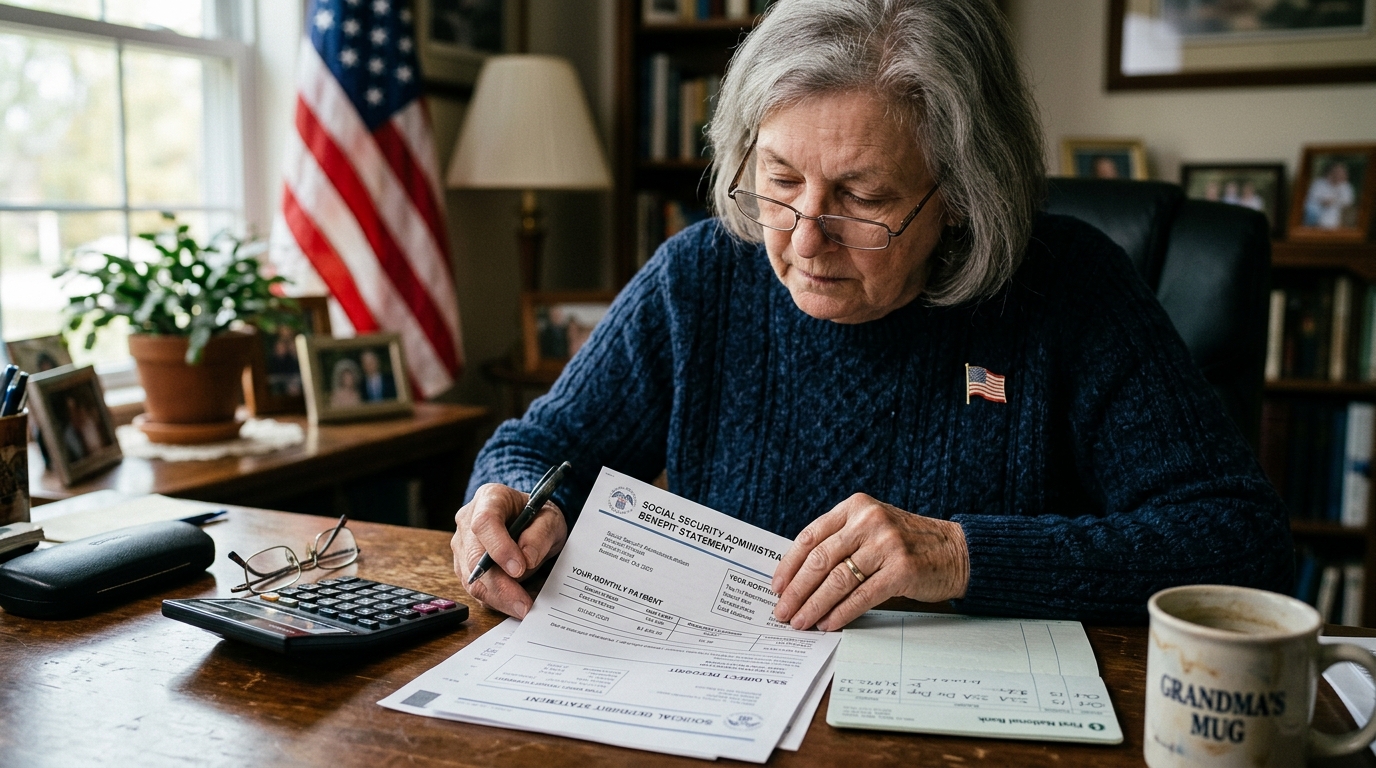
Why did I receive an unexpected $90 direct deposit from the Social Security Administration?
An unexpected $90 deposit labeled 'SSA TREAS 310' is most commonly a retroactive reconciliation of Medicare Part B premium withholdings. If your state Medicaid program (QMB/SLMB) retroactively took over your premium payments, if CMS corrected an erroneous Part B deduction, or if you received a retroactive COLA or earnings recalculation adjustment, SSA automatically issues the owed funds as a separate ACH transfer. Under statutory rules (POMS GN 02403.001), these funds are legitimate credits and generally safe to retain.
Why Did I Get $90 (or Other Unexpected Sum) from Social Security? Diagnostic Tool
Select your recent unexpected bank deposit details to decode the official SSA ACH Treasury 310 transaction code, understand statutory deductions, and verify if the money is safe to spend.
Medicare Part B Premium Reconciliation & Refund Offset
Your $90 deposit is most commonly a retroactive reconciliation of Medicare Part B premium withholdings. If the Centers for Medicare & Medicaid Services (CMS) or your state Medicaid Buy-In program retroactively paid your premium or adjusted your IRMAA tier, SSA automatically refunds the excess withheld amount directly via ACH Treasury 310.
1The $90 Anomaly: Deciphering SSA Direct Deposit Statements & ACH Codes
Every month, over 70 million Americans receive retirement, SSDI, or SSI disbursements from the federal government on an exact statutory calendar (typically the second, third, or fourth Wednesday depending on birth date). However, receiving an unexpected out-of-cycle deposit—frequently for $90.00, $185.00, or odd amounts like $12.40—triggers widespread anxiety among beneficiaries fearing an administrative clerical error or clawback.
When the Bureau of the Fiscal Service processes payments on behalf of the Social Security Administration, bank ledgers display an Automated Clearing House (ACH) descriptor such as 'SSA TREAS 310 MISC PAY', 'SSA TREAS 310 BENEF', or 'SSI TREAS 310'. The '310' code simply signifies a standard federal direct deposit. When followed by 'MISC PAY', it designates a one-off non-recurring adjustment distinct from your regular monthly entitlement check.
- SSA TREAS 310 MISC PAY: One-time retroactive adjustments, underpayment reconciliations, or premium refunds.
- SSA TREAS 310 BENEF: Standard monthly Title II Old-Age, Survivors, and Disability Insurance (OASDI) benefits.
- SSI TREAS 310: Needs-based Title XVI Supplemental Security Income disbursements (usually credited on the 1st of the month).
- IRS TREAS 310: Federal income tax refunds or statutory tax credit payments administered strictly by the Internal Revenue Service.
2Reason #1: Medicare Part B Premium Reconciliation & CMS Adjustments
The most frequent mathematical trigger behind a $90 deposit is Medicare Part B premium alignment. By statutory default under 42 U.S.C. § 1395s, Medicare Part B premiums (standard baseline ~$185.00/month) are automatically withheld directly from your gross Social Security retirement or disability check before funds hit your bank.
However, premium obligations fluctuate. If the Centers for Medicare & Medicaid Services (CMS) retroactively cancels an enrollment, adjusts an Income-Related Monthly Adjustment Amount (IRMAA) surcharge following a successful Form SSA-44 appeal, or corrects an erroneous duplicate billing period, SSA must issue a prompt adjustment credit. A $90 payment often represents a partial-month proration or a 50% premium offset refund.
3Reason #2: State Medicaid Dual-Eligible Buy-In Delays (QMB & SLMB)
Low-income seniors and disabled individuals frequently qualify for Medicare Savings Programs (MSPs)—specifically the Qualified Medicare Beneficiary (QMB) or Specified Low-Income Medicare Beneficiary (SLMB) programs—wherein their state Medicaid agency legally assumes responsibility for paying their Medicare Part B monthly premiums.
Due to data exchange latency between state welfare departments and the SSA master database (codified under POMS HI 00815.001), local county agencies often take 60 to 90 days to establish the 'State Buy-In'. During this transition, SSA continues withholding the monthly premium from your check. Once the state agreement syncs, SSA automatically reimburses the deducted funds in retro batches, frequently hitting bank accounts as unexpected credits between $90 and $185.
4Reason #3: The 10% SSA Overpayment Recovery Cap & Installment Refunds
In prior years, if the Social Security Administration determined that a beneficiary had been overpaid (even due to an agency calculation error decades prior), statutory policy allowed the agency to seize 100% of the beneficiary's monthly check until the debt was satisfied. This severe practice caused devastating financial hardship across the country.
Under major policy overhauls enacted by the SSA Commissioner, the default overpayment withholding rate is capped at 10% of monthly benefits. If your benefits were previously subjected to aggressive withholding agreements or if a clawback balance was recently re-amortized, the agency automatically remits the differential cash back to the beneficiary, resulting in unexpected mid-cycle deposit notices.
5Reason #4: Retroactive COLA Calculations & Revised Lifetime Earnings Records
Your Social Security benefit is not static. If you continue working part-time or consulting while receiving benefits, your employer files Form W-2 with the IRS at year-end. Months later, the SSA Automated Earnings Reappraisal Operation (AERO) ingests these earnings records into your 35 highest-earning historical years (Average Indexed Monthly Earnings - AIME).
If your recent earnings replace a lower-earning year from your past, your Primary Insurance Amount (PIA) increases retroactively to January of the prior tax year. SSA then calculates the accumulated underpayment difference—often amounting to $5 to $15 per month over a 6-to-12 month window ($60 to $120 total)—and deposits it directly as a single lump-sum adjustment.
6Is It Safe to Spend? How to Verify with SSA to Prevent Clawback Penalties
If you receive an unexpected deposit, NEVER immediately withdraw the cash without performing due diligence. If an ACH payment was routed to your account due to an errant routing number or a deceased beneficiary account cross-wire, the U.S. Treasury has the legal authority under federal banking law to initiate an immediate Automated Reclamation directly from your account within 5 business days.
However, if the deposit matches a legitimate adjustment, you are fully entitled to use the funds without penalty. Follow the official verification protocol to verify statutory legitimacy.
- Log into 'my Social Security' at ssa.gov and open your Message Center to view recent Notices of Change in Benefits.
- Download your updated Benefit Verification Letter to verify your gross and net monthly entitlements.
- Examine your end-of-year Form SSA-1099; all legitimate retroactive adjustments and tax-exempt portions will be clearly reported in Box 3 and Box 5.
- If the amount exceeds $500 and no correspondence appears within 7 business days, telephone your local SSA field office or call 1-800-772-1213.
Official SSA ACH Bank Transaction Codes & Deposit Variance Matrix
| Bank ACH Description | Typical Deposit Amount | Statutory Authority / POMS | Underlying Cause & Action Required |
|---|---|---|---|
| SSA TREAS 310 MISC PAY | $90.00 – $185.00 | POMS HI 00805.001 / GN 02403.001 | Medicare Part B premium refund or state Medicaid buy-in reconciliation. Safe to keep once confirmed. |
| SSA TREAS 310 BENEF | Standard Monthly Check ($1,800–$3,800+) | Social Security Act Title II | Regular monthly OASDI retirement or SSDI disability benefit. Disbursed according to birth date calendar. |
| SSI TREAS 310 | $967 (Single) / $1,450 (Couple) or partial | Social Security Act Title XVI | Needs-based Supplemental Security Income. Disbursed on 1st of month. May include state supplementary split. |
| SSA TREAS 310 MISC PAY | $10.00 – $75.00 | POMS RS 00601.120 (AERO) | AERO lifetime earnings recalculation or fractional statutory COLA rounding underpayment. Fully legitimate. |
| FED SALARY / OPM TREAS | Varies ($500 – $4,000) | 5 U.S.C. Chapter 83 / 84 | Civil Service (CSRS) or Federal Employees (FERS) retirement pension administered by OPM, NOT the SSA. |
| IRS TREAS 310 TAX REF | $100 – $3,000+ | IRC Section 6402 | Internal Revenue Service tax refund, amended return credit, or statutory interest. Not an SSA disbursement. |
4-Step Blueprint to Verify an Unexpected Social Security Direct Deposit
Audit the Exact Transaction String on Bank Mobile App
Tap the deposit in your banking application to inspect the ACH Trace Number and descriptor. Verify whether it reads 'SSA TREAS 310 MISC PAY' or an unrelated agency tag.
Review the 'my Social Security' Online Message Center
Sign into your account at ssa.gov. Navigate to 'Your Benefit and Payment Details' and check the 'Notice of Change in Benefits' letter archive.
Check Your State Medicaid MSP Coverage Status
If you applied for QMB or SLMB assistance through your county health agency, check if your state Medicaid card was recently issued or renewed.
Allow 7 Business Days for Official Postal Notice Arrival
SSA automated mailing systems generate paper Form SSA-L2000 explanation notices 3 to 7 business days following an automated Treasury ACH transfer.
Curated Expert Video Walkthroughs & Wall Street Briefings



Frequently Asked Questions (Verified Statutory Answers)
Q1: Will Social Security take the $90 back if it was sent by mistake?
If the deposit was an administrative error or sent to the wrong routing number, the U.S. Treasury can reverse the ACH transfer via a Treasury Reclamation notice. However, if the payment resulted from a genuine Medicare Part B premium refund, state buy-in, or COLA adjustment, the funds are legally yours and will NOT be clawed back.
Q2: Why did I get $90 on a Tuesday or Friday instead of my normal Wednesday?
Regular monthly retirement and SSDI benefits are disbursed strictly on the second, third, or fourth Wednesday of the month. Non-recurring retroactive payments, Medicare reconciliations, and one-time credits are processed in off-cycle nightly ACH batches, meaning they can appear in your checking account on any business day.
Q3: What does 'SSA TREAS 310' mean on my bank statement?
'SSA' stands for Social Security Administration, 'TREAS' indicates the payment was drawn on the United States Department of the Treasury, and '310' is the standard Federal Reserve Bank ACH routing code signifying a direct deposit transaction.
Q4: Is an unexpected $90 Social Security deposit taxable as income?
If the $90 is a Medicare Part B premium refund, it is NOT taxable income—it is merely a reimbursement of previously withheld post-tax or pre-tax funds. If it represents retroactive retirement benefits, it is subject to standard IRS provisional income rules (IRC Section 86) where up to 50% or 85% of benefits may be taxable depending on your total income.
Q5: How does the Medicare 'Hold Harmless' rule affect my monthly deposit?
Under the statutory Hold Harmless provision (Section 1839(f) of the Social Security Act), your net Social Security benefit cannot decrease year-over-year due to an increase in Medicare Part B premiums. If an erroneous deduction breached this rule, SSA will issue an automated adjustment refund.
Q6: What should I do if I cannot find any explanation in my ssa.gov portal?
Wait 5 to 7 business days for physical postal correspondence to arrive. If no notice arrives, telephone the Social Security Administration national toll-free hotline at 1-800-772-1213 (TTY 1-800-325-0778) between 8:00 AM and 7:00 PM local time and request a payment tracer (Form SSA-3911).

Curated Expert Insights & Verified Consumer Disclosures
“Woke up to an unexpected $90.00 deposit from SSA TREAS 310. Called our local field office after checking my Social Security portal: turns out my state Medicare Savings Program (QMB) finally processed retroactively to August, and SSA refunded the Part B premium deduction difference. Do not panic—just verify your portal letters!”
“Clients frequently ask about random SSA deposits of $15, $90, or $185. In 95% of cases, it is either an AERO earnings recalculation from part-time work or Medicare Part B hold-harmless adjustments. Keep the paper trail, check Form SSA-1099 in January, and never spend money if the name on the account is incorrect.”