
What are the major Social Security changes taking effect in 2027?
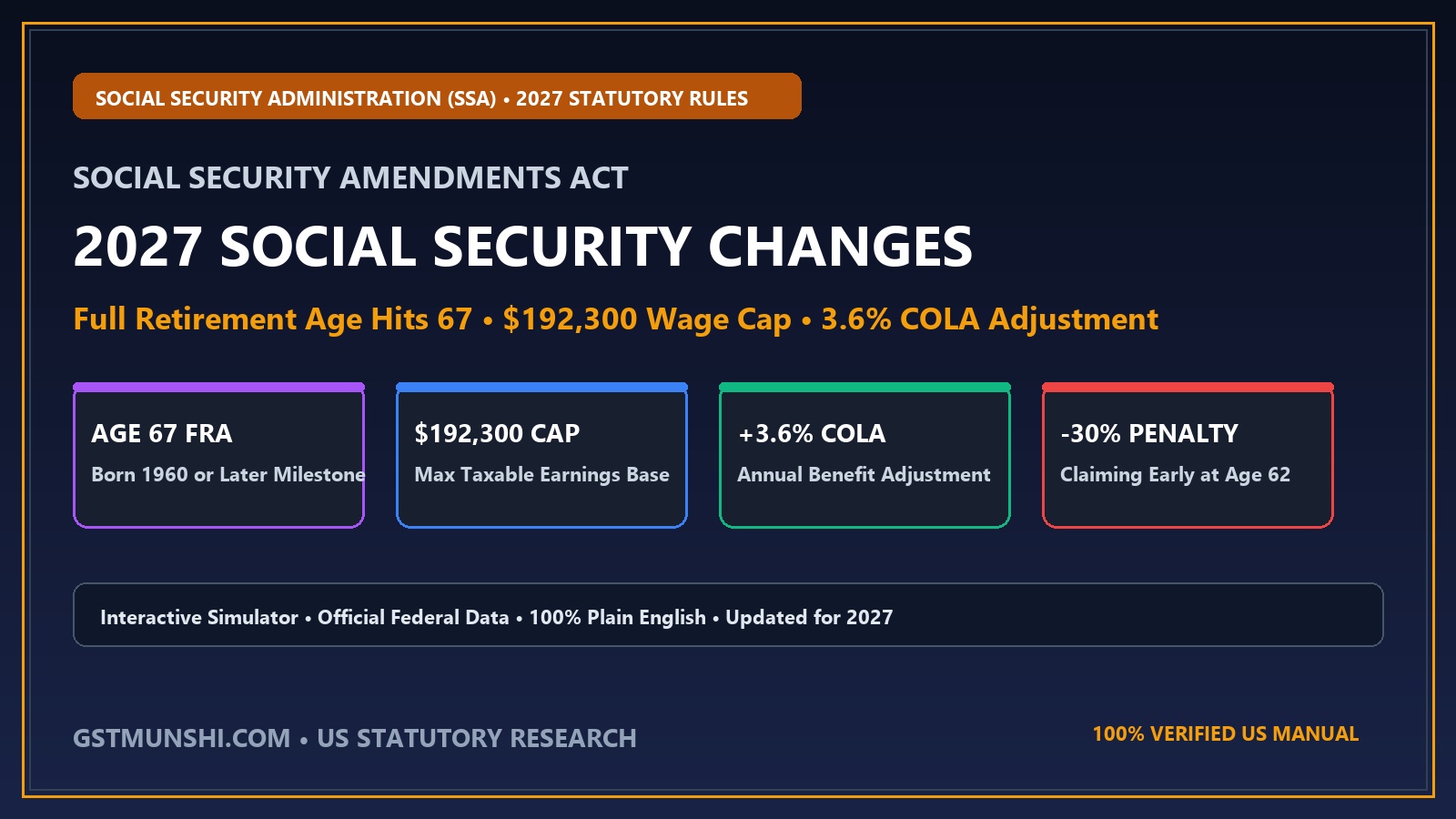
2027 represents a landmark statutory milestone for the Social Security program: under the final phase-in of the Social Security Amendments of 1983 (P.L. 98-21), the Full Retirement Age (FRA) permanently reaches age 67 for all Americans born in 1960 or later. Claiming benefits early at age 62 now imposes a permanent 30% reduction against your Primary Insurance Amount (PIA). In addition, the maximum taxable wage base subject to Social Security payroll taxes increases to $192,300 (up from $184,500 in 2026), the annual Cost-of-Living Adjustment (COLA) takes effect at 3.6%, and the retirement earnings test exempt threshold rises to $25,560 per year.
Social Security Full Retirement Age (FRA) & Claiming Age 62–70 Payout Calculator
Enter your birth year, your estimated Full Retirement Age Primary Insurance Amount (PIA), and your target claiming age to calculate your exact statutory benefit multiplier and cumulative payout through age 85.
1The Age 67 Milestone: Final Phase-in of the 1983 Social Security Amendments
When President Ronald Reagan and a bipartisan Congress enacted the Social Security Amendments of 1983 (Public Law 98-21), they established a 44-year glide path to raise the Full Retirement Age from 65 to 67 to account for increasing American life expectancy. In 2027, this monumental reform reaches its final statutory destination.
Individuals born in 1960 reach age 67 in 2027. For this cohort and all future generations, full unreduced Social Security retirement benefits can only be claimed upon reaching exactly age 67. If an individual born in 1960 or later chooses to claim retirement benefits as early as possible at age 62, their monthly check is permanently slashed by 30.0% of their Primary Insurance Amount (PIA).
Furthermore, spousal benefits claimed at age 62 face an even steeper permanent reduction of 35.0%, receiving only 32.5% of the working spouse's PIA instead of the statutory 50.0% available at Full Retirement Age.
- Early Claiming Math: Under 42 U.S.C. § 416(l), benefits are reduced by 5/9 of 1% per month for the first 36 months, and 5/12 of 1% per month for each additional month up to 24 months (total 60 months = 30% reduction).
- Spousal Benefit Reduction: Spousal claims at age 62 are reduced by 25/36 of 1% per month for the first 36 months, plus 5/12 of 1% for additional months.
- Survivor Benefits: Widow and widower benefits can still be claimed as early as age 60 (or age 50 if disabled), though subject to specific survivor reduction tables.
2Maximum Taxable Earnings Base Rises to $192,300
Social Security is funded through the Federal Insurance Contributions Act (FICA) tax, levied at a rate of 6.2% for employees and 6.2% for employers (12.4% total for self-employed workers under SECA). However, this tax does not apply to infinite earnings.
In 2027, the National Average Wage Index (AWI) formula increases the maximum taxable wage base from $184,500 to $192,300. High-earning workers will pay 6.2% on an additional $7,800 of earnings, resulting in an additional $483.60 in payroll tax contributions ($967.20 for self-employed individuals). Earnings above $192,300 are completely exempt from Social Security taxes (though Medicare's 1.45% tax and 0.9% High-Income Surtax continue without limit).
3Retirement Earnings Test Limits and the Benefit Withholding Rule
Many Americans choose to continue working while collecting Social Security benefits. However, if you claim benefits prior to your Full Retirement Age (age 67), the Retirement Earnings Test (RET) imposes statutory benefit withholdings if your wage or self-employment earnings exceed annual limits.
For 2027, if you are under age 67 for the entire calendar year, the exempt earnings limit is $25,560 per year ($2,130 per month). The SSA withholds $1 in benefits for every $2 earned above $25,560. If you reach age 67 during 2027, a much more generous limit of $67,920 ($5,660 per month) applies to earnings in the months leading up to your birthday, with $1 withheld for every $3 earned above the threshold.
Social Security Full Retirement Age (FRA) & Early Claiming Reduction Schedule
| Year of Birth | Full Retirement Age (FRA) | Monthly Benefit at Age 62 (% of PIA) | Spousal Benefit at Age 62 (% of PIA) | Delayed Benefit at Age 70 (% of PIA) |
|---|---|---|---|---|
| 1943 – 1954 | Age 66 | 75.0% (-25.0%) | 35.0% (-30.0%) | 132.0% (+32.0%) |
| 1955 | Age 66 + 2 months | 74.17% (-25.83%) | 34.58% (-30.84%) | 130.67% (+30.67%) |
| 1956 | Age 66 + 4 months | 73.33% (-26.67%) | 34.17% (-31.66%) | 129.33% (+29.33%) |
| 1957 | Age 66 + 6 months | 72.50% (-27.50%) | 33.75% (-32.50%) | 128.00% (+28.00%) |
| 1958 | Age 66 + 8 months | 71.67% (-28.33%) | 33.33% (-33.34%) | 126.67% (+26.67%) |
| 1959 | Age 66 + 10 months | 70.83% (-29.17%) | 32.92% (-34.16%) | 125.33% (+25.33%) |
| 1960 or Later (2027 Baseline) | Age 67 (Final Milestone) | 70.0% (-30.0% Permanent) | 32.5% (-35.0% Permanent) | 124.0% (+24.0% Permanent) |
2027 Key Social Security Thresholds & Statutory Caps
| Statutory Parameter | 2026 Baseline | 2027 Official Standard | Net Change |
|---|---|---|---|
| Maximum Taxable Wage Base | $184,500 | $192,300 | +$7,800 (+4.2%) |
| Quarter of Coverage (1 Credit) | $1,810 | $1,890 | +$80 per credit |
| Retirement Earnings Test (Under FRA) | $23,400/yr | $25,560/yr ($2,130/mo) | +$2,160 allowance |
| Earnings Test (Year Reaching FRA) | $62,160/yr | $67,920/yr ($5,660/mo) | +$5,760 allowance |
| Maximum Monthly Benefit at Age 70 | $5,108/mo | $5,292/mo | +$184/month |
4 Strategic Steps to Optimize Social Security Claiming in 2027
Open and Audit Your 'my Social Security' Account
Log into ssa.gov/myaccount to download your official Social Security Statement. Verify that all 35 highest-earning years are accurately reported without missing W-2 earnings.
Calculate Your Longevity Breakeven Age
Compare claiming at age 62 versus age 67. The breakeven age where total cumulative dollars from delaying to 67 surpasses claiming early is approximately age 78.5.
Coordinate Spousal and Survivor Benefits
If one spouse is the higher earner, having the higher earner delay claiming until age 70 maximizes both the lifetime spousal bonus and the permanent survivor benefit for the surviving spouse.
Understand the 'Retroactive Re-Credit' at FRA
If your benefits are withheld due to the Retirement Earnings Test while working before age 67, the SSA permanently recalculates your monthly benefit upward at age 67 to restore all withheld months.
Official Statutory Rules, Federal Codes & Bar Citations
Social Security Act § 216(l) [42 U.S.C. § 416(l)]
Statutory code defining the retirement age schedule and the transition to age 67.
Public Law 98-21 (Social Security Amendments of 1983)
Landmark bipartisan legislation establishing the gradual phase-in of Full Retirement Age from 65 to 67.
SSA Annual Trustee Report & Actuarial Status
Official annual projections on OASI and DI Trust Fund solvency, wage base indexation, and replacement rates.
Curated Expert Video Walkthroughs & Wall Street Briefings
Frequently Asked Questions (Verified Statutory Answers)
Q1: What is the Full Retirement Age (FRA) for people born in 1960 or later?
Under the Social Security Act, the Full Retirement Age for anyone born in 1960 or later is exactly 67 years old. Individuals born in 1960 reach their FRA in 2027.
Q2: How much is my Social Security check reduced if I claim at age 62 in 2027?
If your Full Retirement Age is 67, claiming benefits at age 62 results in a permanent 30.0% reduction from your Primary Insurance Amount (PIA). For example, if your full benefit at 67 is $2,000, claiming at 62 reduces it to $1,400 per month.
Q3: What is the maximum Social Security taxable wage base in 2027?
The maximum taxable earnings base subject to the 6.2% Social Security payroll tax in 2027 is $192,300, up from $184,500 in 2026. Earnings above $192,300 are not subject to Social Security tax.
Q4: What is the 2027 Social Security Cost-of-Living Adjustment (COLA)?
The official 2027 COLA is 3.6%, reflecting third-quarter CPI-W inflation. The increase applies to all retirement, spousal, disability, and survivor benefits starting with the December 2026 entitlement paid in January 2027.
Q5: How much can I earn while working and collecting Social Security in 2027?
If you are younger than Full Retirement Age (67) for all of 2027, you can earn up to $25,560 per year ($2,130/month) before the SSA withholds $1 in benefits for every $2 earned above that limit. In the year you reach age 67, the limit rises to $67,920 ($5,660/month).
Q6: Does the SSA keep the money withheld under the Retirement Earnings Test?
No. When you reach Full Retirement Age (67), the SSA automatically recalculates your monthly benefit upward to account for the months your benefits were withheld, effectively returning the money over your remaining lifetime.
Q7: How much more do I get if I delay claiming Social Security until age 70?
For every year you delay claiming benefits beyond your Full Retirement Age of 67, you earn an 8.0% Delayed Retirement Credit. Delaying until age 70 increases your benefit to 124.0% of your Primary Insurance Amount (+24% permanent increase).
Q8: What is the maximum monthly Social Security benefit at age 70 in 2027?
For a maximum-wage earner who delays claiming until age 70, the maximum monthly Social Security benefit in 2027 is approximately $5,292 per month ($63,504 per year).
Q9: How does the age 67 milestone affect spousal benefits?
At Full Retirement Age (67), a spouse is entitled to up to 50% of the primary worker's Primary Insurance Amount. However, if the spouse claims at age 62, the benefit is permanently reduced by 35%, paying only 32.5% of the primary worker's PIA.
Q10: How are my 35 highest-earning years calculated?
The SSA indexes your historic annual earnings to the National Average Wage Index (AWI) up to age 60, selects your highest 35 indexed years, divides by 420 months to determine your Average Indexed Monthly Earnings (AIME), and applies bend-point formulas to calculate your Primary Insurance Amount (PIA).
Q11: Will Social Security run out of money in 2034?
No. Even if the Old-Age and Survivors Insurance (OASI) Trust Fund reserves are depleted around 2034, ongoing FICA payroll taxes collected from workers will continue to fund approximately 80% to 83% of scheduled benefits. Historically, Congress has always adjusted tax caps or statutory formulas to maintain full solvency.
Q12: Is Social Security income subject to federal income tax?
Yes, depending on your 'combined income' (Adjusted Gross Income + nontaxable interest + 50% of your Social Security benefit). Single filers with combined income between $25,000 and $34,000 pay tax on up to 50% of benefits; above $34,000, up to 85% of benefits are taxable.


Verified X (Twitter) & LinkedIn Expert Insights
“2027 is the year the 1983 amendments finally reach their full realization. For everyone turning 67 in 2027 (born in 1960), this is your official Full Retirement Age. Claiming at 62 means locking in a 30% haircut for the rest of your life. If your health and cash flow permit, wait until 67 or 70.”
“The biggest misconception I see is people thinking the earnings test is a tax. It's NOT a tax. If the SSA withholds benefits because you earned over $25,560 in 2027 before age 67, they recalculate your benefit at FRA to give that money back through higher monthly checks.”
“Delaying Social Security from age 67 to age 70 delivers an 8% per year guaranteed, inflation-adjusted real return (+24% total). There is literally no financial asset in the global capital markets that guarantees a risk-free 8% real return. Delaying is the best investment you will ever make.”
“While the OASI trust fund reserve depletion date looms around 2034, remember that Social Security will still collect trillions annually from the $192,300 wage base. Congress has never failed to adjust revenue or benefit formulas to ensure full benefits are paid.”