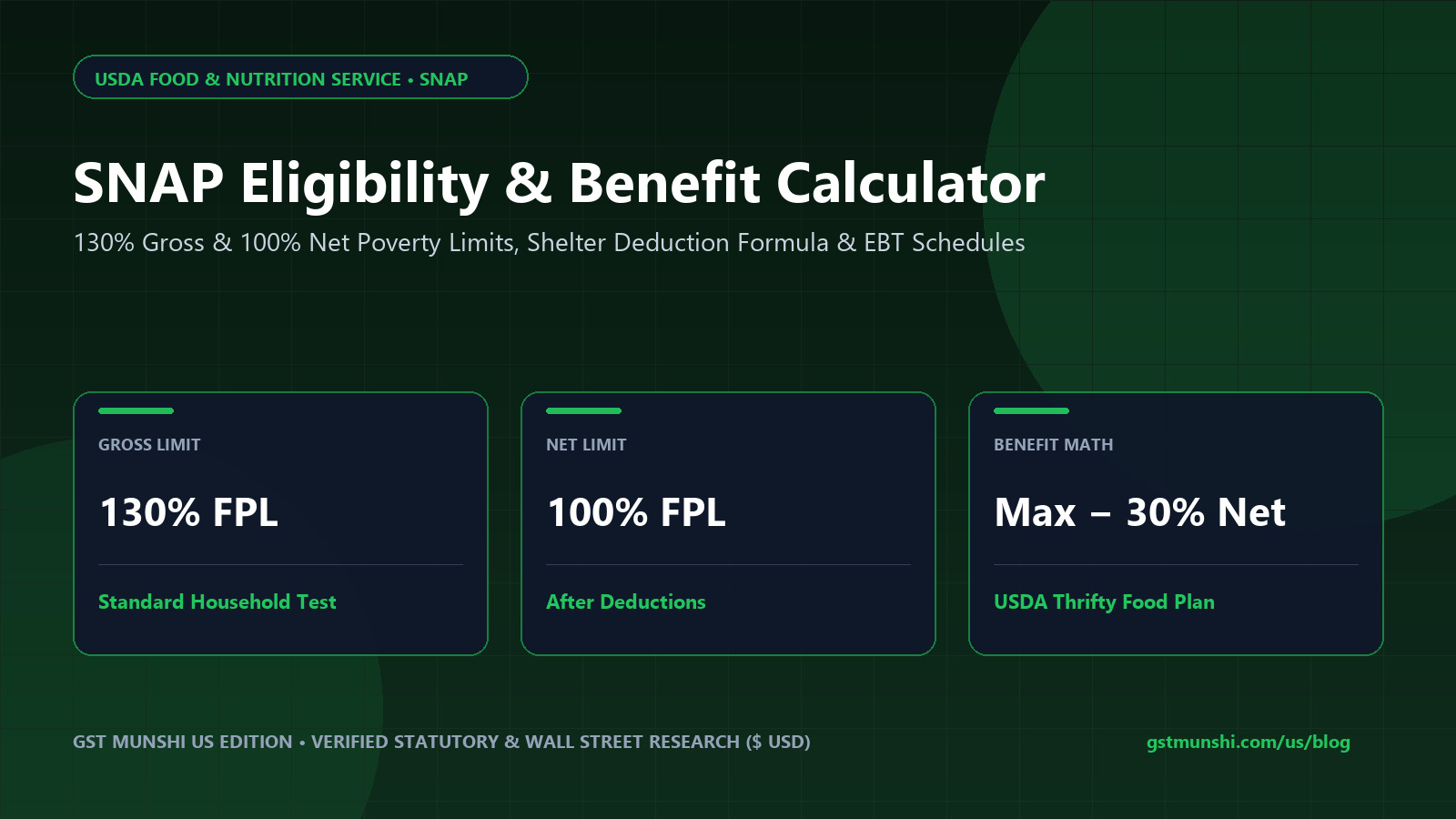
How are SNAP (Food Stamps) income limits and monthly EBT benefit amounts calculated for FY 2026–2027?
Under USDA Food and Nutrition Service (FNS) federal regulations (updated every October 1 for the federal fiscal year), households must satisfy two income thresholds: Gross Monthly Income must be at or below 130% of the Federal Poverty Level (FPL), and Net Monthly Income (after subtracting standard deductions, 20% earned income credit, childcare, and excess shelter expenses) must be at or below 100% of FPL. Your monthly EBT deposit equals the Maximum Thrifty Food Plan Allotment for your household size minus 30% of your Net Monthly Income (the expected household food contribution).
Calculate Monthly Household SNAP Income Limit & Estimated EBT Benefit
1How to Maximize Your Legal SNAP Deductions (Earned Income, Medical & Shelter)
A major reason low-income working families receive less than their statutory SNAP entitlement is failing to report and verify every allowable deduction on their initial state application or recertification form.
Under 7 CFR § 273.9, the federal calculation permits several dollar-for-dollar deductions: a 20% deduction on all earned gross wages (to incentivize employment), a mandatory standard deduction ($200 to $290+ depending on household size), dependent care expenses, out-of-pocket senior/disabled medical costs over $35/month, and the excess shelter deduction.
- 20% Earned Income Deduction: Automatically deducts one-fifth of your gross pay before applying the 30% benefit reduction formula.
- Excess Shelter Deduction: If your combined monthly rent/mortgage, property taxes, homeowners insurance, and standard utility allowance exceed 50% of your net income, you receive a deduction up to the federal maximum ($712+).
- Senior Medical Expense Multiplier: Households with an adult aged 60+ can deduct non-reimbursed prescription copays, dental work, eye care, hearing aids, and transportation to doctors without being capped by standard shelter ceilings.
2USDA Thrifty Food Plan FY2026–2027 Maximum Allotment & Income Thresholds
The federal Thrifty Food Plan dictates the maximum market basket cost needed to sustain a healthy, nutritious diet across different family sizes. In the 48 contiguous United States and Washington D.C., maximum monthly allotments provide up to $292 for a single individual, $536 for a couple, $768 for a family of three, and $975 for a family of four.
Households in Alaska, Hawaii, Guam, and the US Virgin Islands receive substantially higher statutory allotments due to maritime freight shipping costs and remote regional grocery inflation.
- Minimum Monthly Allotment: Eligible 1- and 2-person households receive a guaranteed minimum monthly benefit ($23/month) even if the 30% formula yields a lower amount.
- Automatic EBT Loading: Benefits are deposited onto the household's Quest Electronic Benefit Transfer (EBT) card on recurring calendar dates established by each state.
- Allowable Purchases: EBT funds purchase fresh fruits, vegetables, meat, poultry, dairy, bread, and seeds to grow food; funds cannot be spent on hot prepared foods, alcohol, tobacco, or paper goods.
3ABAWD Work Requirements & State Waivers Under Fiscal Responsibility Legislation
Able-Bodied Adults Without Dependents (ABAWDs) face specific federal work rules to maintain ongoing SNAP eligibility. Under federal law, ABAWD individuals aged 18 through 54 who are not pregnant or medically certified as physically/mentally unfit must work or participate in an approved work program for at least 80 hours per month (an average of 20 hours per week).
Failure to fulfill this requirement limits SNAP assistance to just 3 months in any 36-month period, unless the recipient qualifies for statutory exemptions (such as experiencing homelessness, being a military veteran, or aging out of foster care) or resides in a county with an active USDA economic distress labor waiver.
- Three-Month Time Clock: Non-exempt ABAWDs who do not log 80 hours per month of qualifying activity lose benefits after 3 cumulative months.
- Qualifying Work Activities: Includes unsubsidized private employment, self-employment, state SNAP Employment and Training (E&T) programs, or community service (volunteer work).
- Veterans & Foster Youth Exemption: Military veterans and young adults aged 18 to 24 who were in foster care on their 18th birthday are completely exempt from ABAWD time limits.
4State-by-State EBT Reload Calendars & Digital Anti-Skimming Protections
Unlike federal Social Security payments that distribute strictly on Wednesdays, SNAP EBT benefits are disbursed according to individual state agency schedules. Most states stagger EBT deposits across the first 10 to 28 days of each month based on the last digit of the client's case number, birth year, or first letter of their last name.
With retail point-of-sale card skimming on the rise, the USDA and state health departments have deployed mobile security features through official portal apps (such as ebtEDGE and ConnectEBT), enabling cardholders to freeze their cards between store visits, block out-of-state transactions, and change PINs instantly.
- Texas EBT: Disbursed from the 1st through the 28th based on the last two digits of the Eligibility Determination Group (EDG) number.
- California (CalFresh): Disbursed on the 1st through the 10th of each month corresponding to the last digit of the case number.
- Florida (ACCESS): Distributed between the 1st and the 28th based on the 8th and 9th digits of the case number (excluding the 10th digit).
- Digital Lock Feature: Always freeze your EBT card in the ebtEDGE app after grocery shopping; unfreeze it in the checkout line to eliminate remote card clone skimming fraud.
48 Contiguous States & DC Federal SNAP Income Limits & Maximum Allotments Reference (FY 2026–2027)
| Household Size | 130% Gross Monthly Income Limit | 100% Net Monthly Income Limit | Maximum Monthly SNAP EBT Allotment |
|---|---|---|---|
| 1 Person | $1,632 / month | $1,255 / month | $292 / month |
| 2 People | $2,215 / month | $1,704 / month | $536 / month |
| 3 People | $2,798 / month | $2,152 / month | $768 / month |
| 4 People | $3,380 / month | $2,600 / month | $975 / month |
| 5 People | $3,963 / month | $3,049 / month | $1,158 / month |
| 6 People | $4,546 / month | $3,497 / month | $1,386 / month |
| Each Additional Member | +$583 / month | +$449 / month | +$220 / month |
4-Step Blueprint to Apply for & Protect Your Monthly EBT Benefits
Submit Your State Online Application to Lock In Prorated Retroactive Pay
SNAP benefits are prorated from the exact calendar day your county or state agency receives your signed submission. Apply online through your state's portal (e.g., BenefitsCal, Your Texas Benefits, ACCESS Florida, or myBenefits NY) to lock in your effective date.
Claim the Heating & Cooling Standard Utility Allowance (HCSUA)
If you pay heating or cooling costs separate from rent, claiming your state's HCSUA provides an automatic standard utility deduction (often $400–$600+), maximizing your excess shelter deduction without needing to track individual electric bills.
Verify All Out-of-Pocket Healthcare Costs for Seniors (60+) & Disabled
Prescription co-pays, dental work, vision care, Medicare Part B/D premiums, and medical transit costs exceeding $35/month are fully deductible, significantly lowering your net income and boosting your monthly food stamp check.
Activate Out-of-State & Online Transaction Freezes in ebtEDGE
Protect your food assistance from organized cyber skimming rings by downloading your state's authorized EBT management app, changing your PIN monthly, and toggling on the out-of-state transaction lock.
Curated Expert Video Walkthroughs & Wall Street Briefings



Frequently Asked Questions (Verified Statutory Answers)
Q1: Can I qualify for Expedited (7-Day Emergency) SNAP food stamps?
Yes. Under 7 CFR § 273.2(i), state welfare agencies must issue Expedited SNAP benefits within 7 calendar days if your household has less than $150 in monthly gross income and $100 or less in liquid cash/bank resources, or if your combined monthly gross income and liquid resources are less than your monthly rent/mortgage plus utility expenses.
Q2: Does owning a home or vehicle disqualify me from receiving SNAP?
No. Under federal USDA rules, your primary residence and surrounding lot are 100% exempt from resource calculations in all 50 states. Furthermore, over 40 states operating under Broad-Based Categorical Eligibility (BBCE) waive the asset test entirely, meaning your bank savings, vehicles, and retirement accounts do not disqualify you.
Q3: Are non-citizens or green card holders eligible for SNAP benefits?
Qualified immigrants—including lawful permanent residents (green card holders) with 5 years in qualifying status, refugee/asylee admissions, humanitarian parolees, and children under age 18—are eligible for SNAP. Additionally, citizen children of undocumented parents can receive benefits based solely on the child's eligibility without risking Public Charge inadmissibility for the parents.
Q4: Do unused SNAP EBT benefits roll over to the next month?
Yes. Any unspent balance remaining on your EBT card at the end of the month automatically rolls over into the next month. However, if an EBT card remains completely inactive with zero transactions for 9 months (274 days), federal rules require the state to expunge the remaining funds.