
What are the official Medicare Advantage 2027 Star Ratings and how do bonus cuts affect benefits?
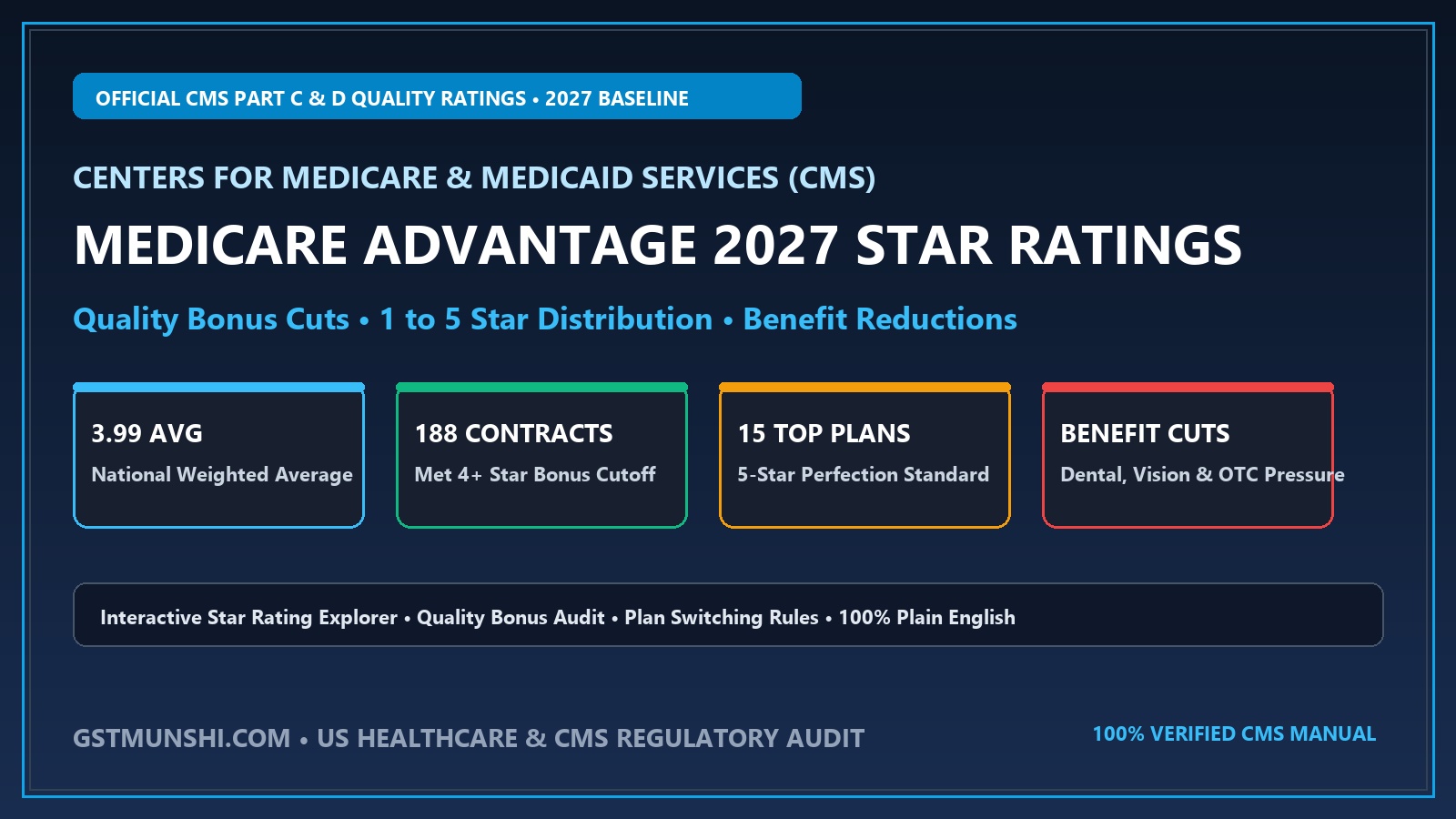
The Centers for Medicare & Medicaid Services (CMS) released the official Medicare Advantage and Part D Star Ratings for 2027, revealing a national enrollment-weighted average of 3.99 stars. Crucially, only 188 out of 508 Medicare Advantage contracts (37%) achieved the critical 4.0-star threshold required to qualify for statutory 5.0% Quality Bonus Payments (QBPs), down from 229 contracts in 2026. Only 15 plans earned the top 5-star rating. Because plans rated below 4 stars lose hundreds of millions in federal bonus rebates, beneficiaries in dropped plans face trimmed supplemental dental, vision, hearing, and OTC grocery allowances, alongside higher maximum-out-of-pocket (MOOP) limits in 2027.
Medicare Advantage 2027 Star Rating & Quality Bonus Impact Simulator
Determine whether your Medicare Advantage plan qualifies for the statutory 5% Quality Bonus Payment (QBP) and evaluate supplemental benefit cut risks.
Under 42 U.S.C. § 1395w-23, plans that achieve 4.0 stars or higher receive a statutory 5.0% Quality Bonus Payment (QBP) added to their benchmark revenue. Plans rated below 4.0 stars receive zero bonus, forcing insurers to trim extra dental, vision, hearing, and OTC grocery allowances.
Plan qualifies for maximum statutory quality bonus payments; dental, vision, and OTC benefits are protected.
1CMS Star Ratings Architecture & Key 2027 Methodology Shifts
The Centers for Medicare & Medicaid Services (CMS) calculates annual Star Ratings on a 1-to-5 scale (with 5 stars representing excellent performance) to evaluate the quality and customer experience of Medicare Advantage (Part C) and Medicare Prescription Drug (Part D) plans. The ratings synthesize approximately 40 distinct clinical, operational, and customer satisfaction measures drawn from HEDIS clinical records, CAHPS member surveys, and CMS administrative databases.
For the 2027 ratings cycle, CMS instituted several high-impact methodological changes. Most notably, the weighting for patient-reported health outcomes—specifically 'Improving or Maintaining Physical Health' and 'Improving or Maintaining Mental Health'—tripled from a weight of 1 to a weight of 3. In addition, CMS incorporated the Health Equity Index (HEI) reward mechanism and respecified Colorectal Cancer Screening measures, creating a more stringent distribution curve.
These technical adjustments made it mathematically harder for mid-tier health plans to secure 4.0 stars or higher, resulting in a dramatic contraction of bonus-eligible contracts from 229 down to 188.
- Tripled Measure Weighting: Patient-reported physical and mental health status now commands 3x weighting in final scores.
- Part D Medication Safety: Introduction of polypharmacy and concurrent opioid/benzodiazepine safety measures.
- Health Equity Index (HEI): Penalizes plans with wide disparity gaps in care delivery among dual-eligible and low-income subsidy (LIS) enrollees.
2The 4-Star Quality Bonus Cliff: Impact on Dental, Vision & OTC Benefits
Under the Affordable Care Act (42 U.S.C. § 1395w-23), Medicare Advantage plans that earn 4.0, 4.5, or 5.0 stars receive a statutory 5.0% Quality Bonus Payment (QBP) added directly to their county benchmark payment rate (and up to 10% in qualifying double-bonus counties). Furthermore, plans with 4.5 or 5.0 stars retain 70% of their bid-to-benchmark savings as rebates, compared to only 50% for plans rated below 3.5 stars.
This financial cliff represents tens to hundreds of millions of dollars in net operating revenue for major health insurers like Humana, UnitedHealthcare, Elevance, and CVS Aetna. When a contract drops from 4.0 stars to 3.5 stars, it loses 100% of its Quality Bonus funding. To absorb these revenue losses without running operating deficits, insurers are forced to scale back non-statutory supplemental benefits in 2027—including reducing dental annual maximums, shrinking OTC monthly debit card allowances, and increasing outpatient surgery copays.
3The 5-Star Special Enrollment Period (SEP): Switching Outside Open Enrollment
One of the most powerful consumer rights in the Medicare program is the 5-Star Special Enrollment Period (SEP). Typically, beneficiaries are locked into their plan choices once the annual Fall Open Enrollment Period ends on December 7 (with limited switching permitted during the MA Open Enrollment from January 1 to March 31).
However, if an elite 5-star Medicare Advantage or Part D plan is available in your service area, CMS permits you to switch into that 5-star plan at any time between December 8 and November 30 of the following year. With only 15 contracts achieving 5-star status for 2027, beneficiaries residing in service areas with a 5-star plan have a unique, year-round exit strategy if their current plan cuts provider networks or drops star ratings.
CMS 2027 Medicare Advantage Contract Star Rating Distribution
| Star Rating Tier | 2026 Contract Count | 2027 Contract Count | Quality Bonus Status | Consumer Impact |
|---|---|---|---|---|
| 5.0 Stars (Elite) | 22 Contracts (4.3%) | 15 Contracts (3.0%) | 5% Statutory Bonus + 70% Rebate | Year-round 5-Star Special Enrollment Period |
| 4.5 Stars (Excellent) | 127 Contracts (24.6%) | 102 Contracts (20.1%) | 5% Statutory Bonus + 70% Rebate | Rich supplemental dental, vision, hearing & OTC |
| 4.0 Stars (Good) | 80 Contracts (15.5%) | 71 Contracts (14.0%) | 5% Statutory Bonus + 65% Rebate | Meets minimum threshold for quality bonus revenue |
| 3.5 Stars (Average) | 171 Contracts (33.1%) | 198 Contracts (39.0%) | Zero Quality Bonus ($0) | Loss of rebate funding; potential benefit trim |
| 3.0 Stars (Below Average) | 93 Contracts (18.0%) | 90 Contracts (17.7%) | Zero Quality Bonus ($0) | High MOOP limits; minimal extra benefits |
| 2.5 Stars or Lower (Low) | 23 Contracts (4.5%) | 32 Contracts (6.3%) | Zero Bonus + CMS Warning Icon | Flagged on Medicare.gov; consider exiting plan |
Key 2027 CMS Star Rating Measure Changes & Weight Adjustments
| Measure Name | Measurement Domain | Previous Weight | 2027 Weight | Significance |
|---|---|---|---|---|
| Improving Physical Health | Member-Reported Outcomes | 1x Weight | 3x Weight | Tripled impact; heavily influences overall score |
| Improving Mental Health | Member-Reported Outcomes | 1x Weight | 3x Weight | Tripled impact; rewards behavioral care access |
| Colorectal Cancer Screening | Clinical Process Quality | Legacy Measure | 1x Weight (Respecified) | Updated clinical guidelines for early detection |
| Concurrent Opioids & Benzos | Part D Drug Patient Safety | New Measure | 1x Weight | New safety penalty for co-prescribing risks |
| Polypharmacy Anticholinergics | Part D Drug Patient Safety | New Measure | 1x Weight | New clinical safeguard for older adult cognitive health |
4-Step Consumer Audit to Protect Your Medicare Coverage in 2027
Check Your Plan's Official 2027 Star Rating on Medicare.gov
Use the official Medicare Plan Finder tool at medicare.gov/plan-compare. Enter your zip code and verify your current plan's overall star rating, health plan rating, and drug plan rating.
Review Your Annual Notice of Change (ANOC) Document
Examine the ANOC sent by your insurer in late September. Specifically check whether maximum-out-of-pocket (MOOP) limits, primary care copays, or dental/vision allowances were reduced.
Verify Provider Network Continuity for Doctors and Hospitals
In response to star rating bonus cuts, several insurers have narrowed physician networks. Call your core specialists to confirm they remain in-network for 2027.
Evaluate 5-Star Plan Options in Your County
Check if a 5-star plan operates in your county. If your current plan dropped below 4.0 stars and cut benefits, you can utilize the 5-Star SEP to upgrade your coverage.
Official Statutory Rules, Federal Codes & Bar Citations
CMS 2027 Medicare Advantage & Part D Star Ratings Fact Sheet
Official regulatory release detailing contract score distributions, measure cut points, and quality bonus thresholds.
42 U.S.C. § 1395w-23 - Monthly Payments to Medicare Advantage Organizations
Statutory authority governing benchmark calculations, quality bonus payments, and plan rebate percentages.
Medicare Managed Care Manual - Chapter 4 (Benefits and Beneficiary Protections)
Codifies beneficiary rights, low-performing plan termination rules, and Special Enrollment Period triggers.
Curated Expert Video Walkthroughs & Wall Street Briefings
Frequently Asked Questions (Verified Statutory Answers)
Q1: What is the national average Medicare Advantage Star Rating for 2027?
The national enrollment-weighted average star rating for Medicare Advantage Prescription Drug (MA-PD) plans is 3.99 stars for 2027, down slightly from 4.01 stars in 2026.
Q2: What is the 4-star Quality Bonus Payment (QBP) threshold?
Under the Affordable Care Act, plans that achieve 4.0 stars or higher receive a statutory 5.0% Quality Bonus Payment added to their benchmark rate. Plans rated 3.5 stars or lower receive 0% bonus.
Q3: How many Medicare Advantage contracts earned 4 stars or higher in 2027?
Only 188 out of 508 contracts (37.0%) achieved 4.0 stars or higher for 2027, down from 229 contracts in 2026, representing an 18% decline in bonus-eligible plans.
Q4: How many plans earned a perfect 5-star rating for 2027?
Only 15 Medicare Advantage contracts earned a top 5-star rating for 2027, down from 22 contracts in 2026.
Q5: Why are Medicare Advantage plans cutting dental and OTC benefits in 2027?
When plans drop below the 4-star threshold, they lose millions in federal quality bonus rebates. To offset this loss of revenue, health plans must trim extra supplemental benefits like dental allowances, vision hardware credits, and over-the-counter (OTC) grocery cards.
Q6: What is the 5-Star Special Enrollment Period (SEP)?
If an elite 5-star Medicare Advantage or Part D plan is available in your service area, you can use the 5-Star SEP to switch into that plan once between December 8 and November 30 of the following year, outside the standard open enrollment period.
Q7: What happens if my Medicare Advantage plan gets 2.5 stars or lower?
Plans with 2.5 stars or lower for three consecutive years are flagged with a low-performing icon on Medicare.gov. CMS sends warning notices to enrollees, and beneficiaries are granted a Special Enrollment Period to leave the plan.
Q8: What major methodology changes did CMS introduce for the 2027 Star Ratings?
CMS tripled the weight (from 1 to 3) for member-reported physical and mental health improvement measures, implemented the Health Equity Index (HEI) reward, respecified Colorectal Cancer Screening, and added new Part D polypharmacy safety measures.
Q9: Why are health insurers suing CMS over the 2027 Star Ratings?
Insurers like Alignment Healthcare and others have filed federal lawsuits arguing that CMS's cut-point adjustments and statistical methodologies were arbitrary and violated the Administrative Procedure Act, depriving them of hundreds of millions in earned bonus payments.
Q10: Where can I check my plan's official 2027 Star Rating?
You can check your plan's official Star Rating by entering your zip code on the Medicare Plan Finder tool at medicare.gov/plan-compare.
Q11: Does a lower star rating mean my doctors will drop out of my plan?
Not necessarily, but insurers facing bonus cuts often renegotiate or narrow provider networks to control costs. Always verify network status directly with your physicians before the start of the plan year.
Q12: Can a plan's star rating change in the middle of the year?
No. Star ratings are assigned annually by CMS every fall and remain in effect for the entire upcoming calendar year.

Verified X (Twitter) & LinkedIn Expert Insights
“The drop from 229 to 188 bonus-eligible 4-star contracts is a watershed moment for Medicare Advantage. Insurers relied on $12+ billion in annual quality bonus payments to finance zero-dollar premiums and rich dental cards. As bonuses shrink, beneficiaries must scrutinize their ANOCs closely for trimmed benefits.”
“If your plan drops to 2.5 stars or lower, Medicare.gov will flag it with a low-performing icon. Do not ignore that warning. CMS gives you a special enrollment right to exit a consistently low-performing plan and move to a higher-quality option.”
“The wave of lawsuits from Alignment Healthcare and major payers against CMS over cut-point methodology highlights how volatile star ratings have become. One-tenth of a decimal point can mean a $200 million swing in QBP revenue.”
“5-star plans are now down to just 15 contracts nationwide. For beneficiaries lucky enough to live in a county with a 5-star plan, remember the 5-Star SEP: you do not have to wait for open enrollment to switch.”