
What are the official 2027 VA disability rates and COLA increase percentage?
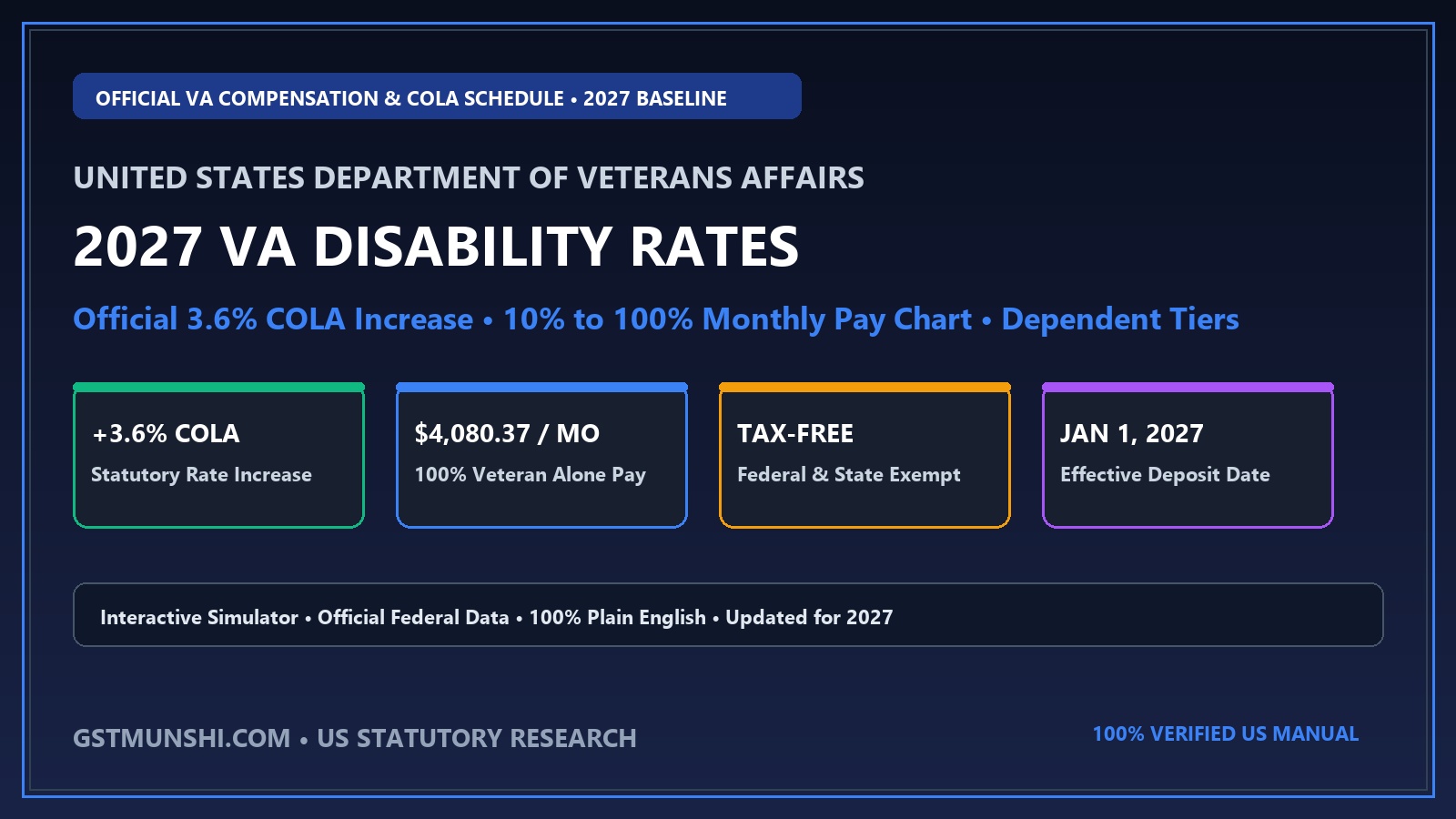
Under Title 38 of the United States Code, annual VA disability compensation rates are legally pegged to the Social Security Administration's Cost-of-Living Adjustment (COLA), determined by third-quarter CPI-W inflation data. For 2027, the official COLA increase is 3.6%, raising monthly tax-free disability payments across all rating tiers from 10% to 100%. A veteran with a 10% rating receives $186.92 monthly, while a 100% disabled veteran alone receives $4,080.37 per month (up from $3,938.58 in 2026). Payments with the 3.6% boost take effect December 1, 2026, and deposit on January 1, 2027.
2027 VA Disability Pay & COLA Compensation Calculator
Calculate your monthly tax-free VA compensation, annual benefits, and the exact +3.6% COLA raise taking effect December 2026 / January 2027.
Under 38 U.S.C. § 5301, VA disability compensation payments are 100% exempt from federal and state income taxes. They are never reported on IRS Form 1040 and do not reduce Social Security retirement benefits.
1How the 2027 VA Disability COLA is Calculated from BLS CPI-W Data
The Department of Veterans Affairs does not set its own cost-of-living adjustments independently. Instead, Congress enacts the annual Veterans' Compensation Cost-of-Living Adjustment Act, which legally binds VA disability compensation, dependency allowances, and clothing allowances to the Social Security Administration's annual inflation calculation under Title 38 of the United States Code.
The calculation compares the average Consumer Price Index for Urban Wage Earners and Clerical Workers (CPI-W) for the third quarter of the current fiscal year (July, August, and September) against the average third-quarter CPI-W from the prior year. The resulting 3.6% increase applies uniformly across all 5.5 million service-connected disabled veterans in the United States.
Because VA benefits are disbursed in arrears, the December benefit entitlement (which reflects the higher 2027 rates) is paid out on the first business day of January. For 2027, since January 1 is a federal holiday (New Year's Day), payments arrive electronically via Treasury Direct Deposit on the preceding business day or January 1 depending on banking clearance.
- Third-Quarter CPI-W Averaging: Formula measures inflation pressure across food, shelter, energy, and medical care.
- Uniform Statutory Application: Applies equally to peacetime veterans, wartime service members, and Gulf War / PACT Act toxic exposure claims.
- Compound Accumulation: A veteran rated 100% alone has seen their monthly payout grow from $3,332.06 in 2022 to over $4,080.37 in 2027, an increase of over $748 per month.
210% to 100% Rating Tiers & Combined Ratings 'VA Math'
VA disability ratings are assigned in 10% increments from 10% to 100% based on the severity of service-connected disabilities documented in military service records and Compensation and Pension (C&P) examinations under the 38 C.F.R. Part 4 Schedule for Rating Disabilities.
Crucially, multiple disabilities are not combined using standard arithmetic. Under Title 38, the VA uses 'Whole Person Theory' (commonly known as 'VA Math'). A veteran with a 50% rating for PTSD and a 30% rating for back injury does not receive an 80% rating. Instead, the 50% PTSD rating leaves the veteran 50% healthy; the 30% back rating applies against the remaining 50%, adding 15% to reach 65%, which rounds up to a final combined rating of 70%.
3Dependent Allowances for Veterans Rated 30% and Higher
Veterans with a combined disability rating of 10% or 20% receive a flat monthly payout regardless of family size. However, once a veteran's combined rating reaches 30% or higher, the VA provides additional monthly cash allowances for qualifying dependents, including legal spouses, dependent minor children, adult children aged 18 to 23 enrolled in approved full-time college education, and dependent parents.
For example, a veteran rated 100% with a spouse and one child receives $4,383.52 per month under the 2027 schedule, compared to $4,080.37 for a veteran alone—providing an additional $303.15 per month ($3,637.80 per year) in tax-free family support.
Official 2027 VA Disability Compensation Pay Chart (3.6% COLA)
| Disability Rating | 2026 Monthly Rate | 2027 Monthly Rate (Veteran Alone) | 2027 Rate (Veteran + Spouse) | Annual Tax-Free Total |
|---|---|---|---|---|
| 10% Combined Rating | $180.42 | $186.92 | N/A (Dependents apply at 30%+) | $2,243.04 |
| 20% Combined Rating | $356.66 | $369.50 | N/A (Dependents apply at 30%+) | $4,434.00 |
| 30% Combined Rating | $552.47 | $572.36 | $634.36 | $6,868.32 |
| 40% Combined Rating | $795.84 | $824.49 | $907.49 | $9,893.88 |
| 50% Combined Rating | $1,132.90 | $1,173.68 | $1,277.68 | $14,084.16 |
| 60% Combined Rating | $1,434.98 | $1,486.68 | $1,611.68 | $17,840.16 |
| 70% Combined Rating | $1,808.45 | $1,873.55 | $2,019.55 | $22,482.60 |
| 80% Combined Rating | $2,102.15 | $2,177.83 | $2,344.83 | $26,133.96 |
| 90% Combined Rating | $2,362.30 | $2,447.34 | $2,634.34 | $29,368.08 |
| 100% Combined Rating | $3,938.58 | $4,080.37 | $4,289.37 | $48,964.44 |
2027 Monthly Dependent Add-On Allowances (Ratings 70% to 100%)
| Dependent Category | 70% Rating Add-on | 80% Rating Add-on | 90% Rating Add-on | 100% Rating Add-on |
|---|---|---|---|---|
| Spouse Alone | +$146.00/mo | +$167.00/mo | +$187.00/mo | +$209.00/mo |
| Spouse + 1 Child | +$210.00/mo | +$240.00/mo | +$270.00/mo | +$303.15/mo |
| Each Additional Child Under 18 | +$49.00/mo | +$56.00/mo | +$63.00/mo | +$71.00/mo |
| Child Age 18–23 in College | +$158.00/mo | +$181.00/mo | +$204.00/mo | +$229.00/mo |
| Each Dependent Parent | +$118.00/mo | +$135.00/mo | +$152.00/mo | +$171.00/mo |
4 Steps to Verify Your 2027 VA Benefit Increase and Add Dependents
Log into VA.gov or the VA Health and Benefits App
Sign in using your Login.gov or ID.me verified credentials to view your current active disability rating, award letter, and monthly payment history.
Verify Direct Deposit Account Routing
Ensure your bank routing and account numbers are updated under your VA profile settings to prevent delayed payments during the holiday transition.
Add Qualifying Dependents via VA Form 21-686c
If you married, had a child, or have an unmarried child between 18 and 23 attending college, submit Form 21-686c online to capture immediate retroactive dependent allowances.
Download Updated VA Benefit Verification Letter
Starting December 2026, download your official 2027 Benefit Summary and Service Verification Letter from VA.gov for property tax exemptions and state military perks.
Official Statutory Rules, Federal Codes & Bar Citations
Title 38 United States Code § 1114
Statutory authority establishing rates of wartime and peacetime disability compensation for disabled veterans.
38 U.S.C. § 5301 - Nonassignability and Exempt Status of Benefits
Codifies the complete federal and state income tax exemption for VA disability compensation and DIC payments.
BLS CPI-W Detailed Inflation Report
Benchmark third-quarter inflation measurements determining Social Security and military compensation cost-of-living increases.
Curated Expert Video Walkthroughs & Wall Street Briefings
Frequently Asked Questions (Verified Statutory Answers)
Q1: What is the official 2027 VA disability rate increase percentage?
The official Cost-of-Living Adjustment (COLA) for 2027 is 3.6%, matching the Social Security Administration's inflation adjustment. All VA disability compensation rates increase by 3.6% effective December 1, 2026.
Q2: How much will a 100% disabled veteran receive in 2027?
A 100% service-connected disabled veteran with no dependents receives $4,080.37 per month in 2027, an increase of $141.79 per month from the 2026 baseline of $3,938.58. With a spouse, the payment increases to $4,289.37 per month.
Q3: When will veterans see the 2027 VA disability rate increase in their bank accounts?
Because the VA pays benefits in arrears, the higher 2027 rates apply to the December 2026 entitlement month. Direct deposits will arrive in veterans' bank accounts on Friday, January 1, 2027 (or the preceding business day, December 31, 2026, depending on your bank's holiday deposit processing).
Q4: Do I have to apply or contact the VA to receive the 3.6% COLA raise?
No. The cost-of-living adjustment is completely automatic. The VA updates all active claim profiles in its computerized payment systems. You do not need to call the VA, file an appeal, or submit paperwork.
Q5: Is VA disability compensation considered taxable income by the IRS?
No. Under Title 38 of the United States Code (38 U.S.C. § 5301), VA disability compensation payments are completely exempt from federal and state income taxes. They do not generate IRS Form 1099 and are not reported on Form 1040.
Q6: At what rating percentage can I add dependents to my VA disability compensation?
You must have a combined disability rating of 30% or higher to receive additional monthly compensation for dependents (spouse, minor children, adult children in college, and dependent parents). Ratings of 10% and 20% pay a flat rate regardless of dependents.
Q7: Can I receive both VA disability compensation and Social Security retirement benefits?
Yes. There is no statutory offset or reduction between VA disability compensation and Social Security retirement benefits. You are legally entitled to collect 100% of both benefits simultaneously.
Q8: Does the 2027 COLA increase apply to Dependency and Indemnity Compensation (DIC)?
Yes. The 3.6% COLA increase applies equally to Dependency and Indemnity Compensation (DIC) paid to surviving spouses and dependent children of deceased service members and veterans.
Q9: What is Special Monthly Compensation (SMC) and how is it affected by the 2027 COLA?
Special Monthly Compensation (SMC) is an additional tax-free benefit paid to veterans who have suffered specific severe disabilities, such as the loss or loss of use of limbs, blindness, or the need for regular aid and attendance. All SMC tiers (SMC-K through SMC-R) receive the full 3.6% COLA increase, with top tiers reaching up to $11,677 per month in 2027.
Q10: How does 'VA Math' work when combining multiple disability ratings?
The VA uses non-additive Whole Person Theory. Each disability rating is calculated as a percentage of the veteran's remaining healthy efficiency. For example, a veteran with a 60% rating and a 40% rating is 60% disabled (40% remaining healthy). The 40% rating applies against the remaining 40% (0.40 × 40 = 16%), resulting in a 76% combined disability, which rounds up to an 80% final rating.
Q11: Can the VA reduce my disability rating once I receive the 2027 COLA increase?
Receiving the annual COLA increase does not trigger a re-examination and will never cause a reduction in your disability rating. The VA can only reduce a rating if you have a non-static condition scheduled for a routine future examination and medical evidence proves sustained material improvement.
Q12: What is the 20-year continuous rating rule for VA disability?
Under 38 C.F.R. § 3.951(b), once a service-connected disability rating has been in effect continuously for 20 years or more, the VA cannot reduce it below that percentage for any reason, except in cases of proven fraud.

Verified X (Twitter) & LinkedIn Expert Insights
“The confirmed 3.6% COLA increase pushes 100% veteran compensation past the $4,080/month milestone. Remember, this money is 100% tax-free. For a veteran in a state with income tax, earning $4,080 tax-free is equivalent to earning over $65,000 in gross civilian wages. Make sure your dependents are properly claimed on VA.gov before December 1.”
“Veterans often ask whether COLA increases reduce Social Security retirement or SSDI. The answer is an absolute NO. You can collect your full Social Security benefit and your full VA disability payment simultaneously without any offset or dollar-for-dollar reduction.”
“The jump from 80% ($2,177) or 90% ($2,447) to 100% ($4,080) is life-changing. If you have secondary service-connected conditions caused by your primary ratings (like radiculopathy from back injuries or depression from chronic pain), file for an increase now under the PACT Act guidelines.”
“The 2027 COLA increase represents a statutory mandatory appropriation. Congress does not debate whether to fund this; it passes automatically by operation of law. Your direct deposit on January 1 will reflect the new 3.6% rates without any administrative delay.”