How is gratuity calculated for private employees and what is the maximum tax-free limit in 2027?
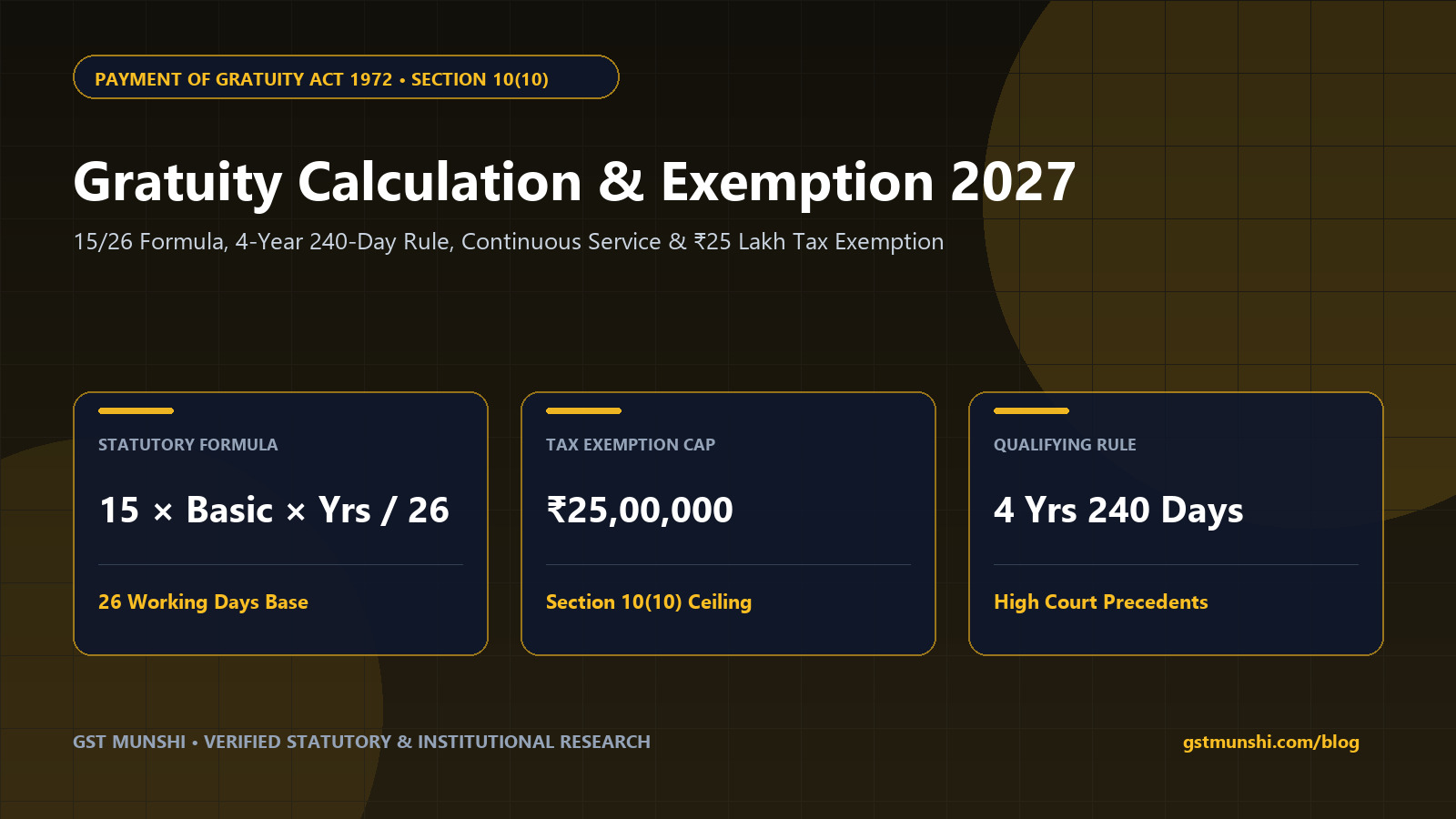
Divided by 26 working days in a calendar month
Enhanced lifetime cumulative tax-exempt threshold
4 Years 240 days continuous service legally qualifies
Zero monetary tax ceiling for civil servants
Interactive Gratuity Entitlement & Tax Exemption Calculator
Simulate your last drawn pay, service tenure, and verify your payout against the ₹25 Lakh statutory exemption limit.
Statutory Mechanics of the Payment of Gratuity Act 1972
Gratuity represents a statutory terminal benefit guaranteed to employees in recognition of continuous long-term service. Governed by the Payment of Gratuity Act 1972, it applies universally to factories, mines, oilfields, plantations, ports, railway companies, shops, and commercial establishments employing 10 or more persons on any day of the preceding 12 months.
The calculation formula divides a monthly salary by 26 rather than 30 because the Supreme Court of India in Jeewanlal Ltd. v. Appellate Authority held that an employee receives wages for 26 working days in a month (excluding four Sundays). Thus, dividing by 26 yields the true daily wage rate, which is then multiplied by 15 days of wages for every completed year of service.
How Continuous Service is Defined Under Section 2A
While employers commonly tell resigning staff that exactly 5 full years (60 months) are required to receive gratuity, labor courts and the Madras and Karnataka High Courts have firmly established the 4 Years and 240 Days doctrine under Section 2A of the Act.
Under Section 2A(2)(a), if an employee works for not less than 240 days in the 5th year of service (in a non-mine establishment), they are legally deemed to have rendered continuous service for that 5th year. Consequently, employees resigning after 4 years and 240 days (or ~4 years and 8 months) are entitled to full statutory gratuity payout.
SOP Protocol: How to Claim Your Gratuity Upon Resignation
Submit formal written application in Form I within 30 days of resignation or retirement to the HR/payroll department.
The employer must verify records, calculate the exact amount, and issue Form L specifying the exact payout date within 15 days.
Under Section 7(3), employer must disburse gratuity within 30 days. Delay beyond 30 days attracts simple interest up to 10% per annum under Section 7(3A).
If the employer refuses or delays payment, file Form N before the Assistant Labour Commissioner (Controlling Authority under the Act).
Verified Labor Law Advocate & HR Advisory Disclosures
“Employees who complete 4 years and 240 days often forfeit their gratuity due to lack of legal awareness. Under Section 2A, completing 240 days in the 5th year constitutes continuous service. Employers cannot override this statutory guarantee with company policy handbook clauses.”
“When negotiating exit packages, verify that your employer calculates gratuity strictly using the 15/26 formula and does not arbitrarily deduct special allowances from your Basic + DA denominator. Your last drawn month's basic pay is the sole statutory benchmark.”
“If your company delays your gratuity payment beyond 30 days after full-and-final settlement, they are legally liable to pay 10% compound interest per annum. Don't sign unconditional no-dues receipts if gratuity is delayed!”
“Remember that the ₹25 Lakh Section 10(10) tax exemption is a lifetime cumulative limit. If you received ₹10 Lakh tax-free from your previous employer, only the remaining ₹15 Lakh is tax-free from your subsequent employer.”
Verified Video Guides: Gratuity Rules & Formulas
Watch procedural tutorials on gratuity calculation mechanics, labor law protections, and Form I submission:


Related Retirement & Salary Compliance Guides
Explore interconnected analyses on employee terminal benefits, tax optimization, and wealth security: