GST & TaxIncome Tax & SavingsStatutory Master Guide

Old vs New Tax Regime 2027: Break-Even Salary & Calculator

Complete salaried employee manual comparing Old and New Tax Regimes under Section 115BAC with statutory break-even thresholds, slab tables, and interactive calculator.

GBy GST Munshi Tax Research Desk•Published: 2026-10-13•24 min read
Verified against Official Govt Circulars & Statutes
Share
Old vs New Tax Regime 2027: Break-Even Salary & Calculator
Income Tax & Savings — Statutory Master Guide
Read in Your Regional Language:
Quick Answer & Key Takeaways

Which tax regime is better for salaried employees in 2027, and what is the exact break-even salary deduction?

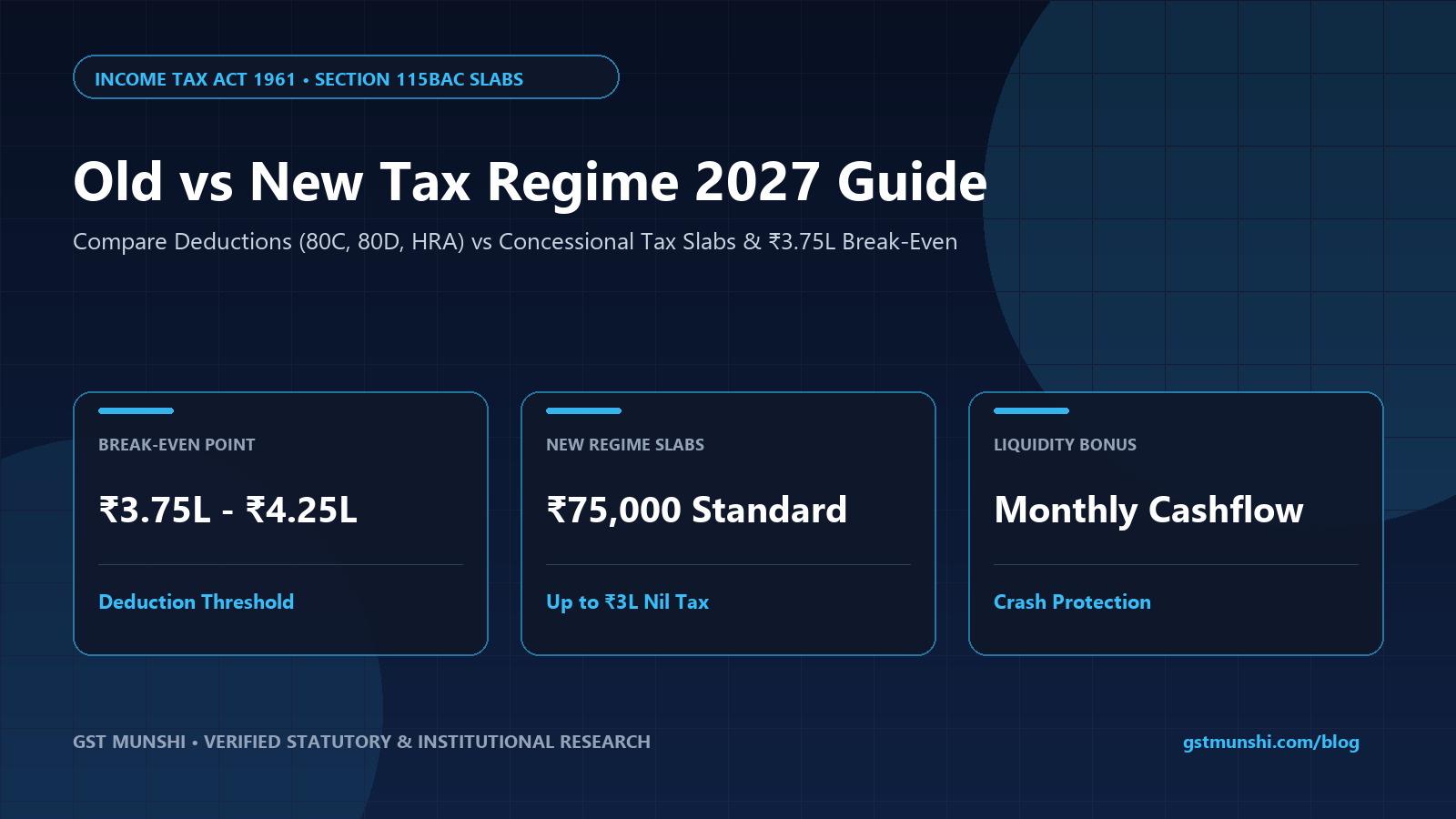
For salaried employees in 2027, the New Tax Regime (Section 115BAC) is mathematically superior for anyone whose total deductions (Section 80C, 80D, HRA, and Section 24(b) home loan interest) are below ₹3,75,000 to ₹4,25,000. Under the New Regime, standard deduction is increased to ₹75,000, and individuals earning up to ₹7,75,000 pay zero tax thanks to the Section 87A rebate. The Old Tax Regime remains advantageous only if you claim high combined deductions (HRA + home loan + 80C + 80D) exceeding ₹4.25 Lakh per year.
Zero Tax LimitSec 87A
₹7.75 Lakh

New Regime: ₹75,000 std ded + ₹7L rebate threshold

Statutory Zero Tax
Break-Even PointThreshold
₹3.75L – ₹4.25L

Deductions required in Old Regime to beat New Regime

Salary ₹10L to ₹15L Bracket
Standard Deduction+₹25,000 Hike
₹75,000

Under New Tax Regime vs ₹50,000 under Old Regime

CBDT Salaried Benefit
Surcharge CapHNI Relief
25% vs 37%

Maximum tax surcharge for high earners capped at 25%

Income Over ₹5 Crore
2027 Interactive Tax Decision Tool

Old vs New Tax Regime Break-Even Calculator

Simulate your gross salary, 80C, 80D, HRA, and home loan deductions to discover your exact tax-saving winner.

₹12,00,000
Decision Recommendation
Optimal Tax ChoiceNew Regime
Net Annual Saving₹15,340
New Regime Tax₹71,500Taxable: ₹11,25,000
Old Regime Tax₹86,840Deductions: ₹2,95,000
💡 Liquidity Rule in Economic Downturns: Even if the Old Regime saves marginal tax (e.g. ₹2,000–₹5,000/yr), New Tax Regime prevents locking your emergency corpus into multi-year lock-in products during global equity and market crashes.

Statutory Framework: Section 115BAC vs Chapter VI-A Deductions

The Indian direct tax landscape underwent a structural transformation when the Union Government designated the New Tax Regime under Section 115BAC(1A) as the default regime for all individual taxpayers. Salaried individuals must actively opt into the Old Tax Regime every year if they intend to utilize customary deductions such as Section 80C, Section 80D, House Rent Allowance (HRA) under Section 10(13A), and Home Loan Interest under Section 24(b).

While the Old Tax Regime incentivized mandatory savings through tax-saving instruments, the New Tax Regime emphasizes lower baseline tax slabs combined with an expanded zero-tax threshold. For salaried employees navigating current financial markets, understanding the mathematical breakeven is essential to avoid leaving hard-earned salary on the table.

2026–2027 Comprehensive Income Tax Slab Comparison

Income RangeNew Tax Regime Rate (Sec 115BAC)Old Tax Regime Rate
Up to ₹2,50,000NilNil
₹2,50,001 to ₹3,00,000Nil5%
₹3,00,001 to ₹5,00,0005%5%
₹5,00,001 to ₹7,00,0005%20%
₹7,00,001 to ₹10,00,00010%20%
₹10,00,001 to ₹12,00,00015%30%
₹12,00,001 to ₹15,00,00020%30%
Above ₹15,00,00030%30%
Macro Risk Strategy: Global Market Volatility & Liquidity Defense

Why the New Tax Regime Acts as a Financial Shock Absorber During Bear Markets

When global markets face volatility, currency fluctuations, or recessions, personal cash flow takes precedence over tax-saving lock-ins. Under the Old Tax Regime, employees are forced to lock ₹1.50 Lakh into 3-to-5 year illiquid ELSS mutual funds, insurance policies, or tax-saver FDs just to generate tax deductions. If equity indices tumble, an ELSS investment could suffer double-digit drawdown, erasing any tax benefit saved at the margin.

The New Tax Regime liberates your salary from forced investment allocations. By taking home extra net liquidity every month, you can construct an uncompromised 6-month sovereign emergency buffer (Treasury bills, liquid funds, or gold sovereign bonds) rather than taking equity risk merely to satisfy tax exemptions.

5-Step Protocol: Choosing Your Tax Regime for AY 2026–27

1Compute True Eligible Deductions

Tally your actual Section 80C commitments (EPF, PPF, term insurance), 80D health premiums, and actual rent paid to determine genuine exemption values.

2Verify HRA Exemption Limitations

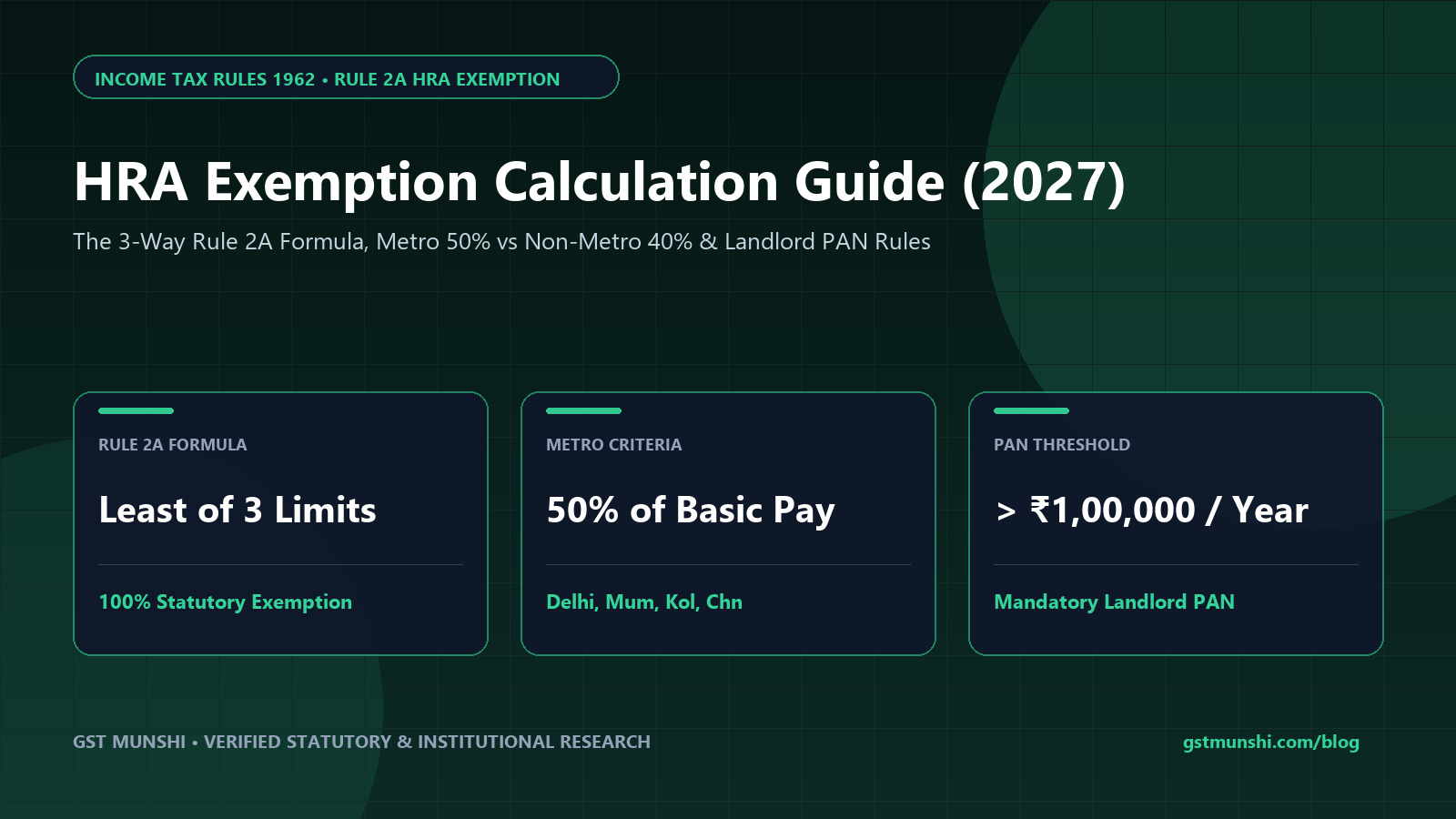
Ensure landlord PAN is available if annual rent exceeds ₹1,00,000. Rent paid must exceed 10% of (Basic + DA) to unlock any Section 10(13A) relief.

3Run the ₹3.75L Break-Even Benchmark

If your total combined deductions fall below ₹3,75,000, immediately opt for the New Tax Regime to eliminate paper documentation and unlock lower tax rates.

4Declare to Employer in Form 12BB

Submit your regime election to corporate HR at the beginning of the fiscal year to avoid excessive TDS deductions from your monthly pay slips.

Verified Practitioner Disclosures

Verified Direct Tax Practitioner & Financial Analyst Disclosures

in
CA Rajesh Singhania, FCA
Senior Direct Tax Partner & Compensation Advisory
CBDT Circular 04

“Over 78% of salaried professionals who blindly stick to the Old Regime are paying ₹15,000 to ₹35,000 more tax each year. Unless you have active home loan interest exceeding ₹1.8 Lakh combined with HRA, the math overwhelmingly favors the New Regime with its ₹75,000 standard deduction.”

Key Takeaway: Run exact break-even numbers instead of defaulting to historical habit.
in
Meera Deshmukh, CFP
Wealth Advisory Director & Asset Allocation Strategist
Sec 115BAC

“In turbulent global market environments, locking ₹1.5 Lakh into tax-saving ELSS or long-term policies simply for Section 80C is poor risk management. The New Regime gives you liquid take-home pay to accumulate sovereign liquidity buffers and gold hedges.”

Key Takeaway: Prioritize monthly liquidity over forced multi-year product lock-ins.
𝕏
TaxWatch India (@TaxWatch_IN)
Direct Tax Insights & ITR Regulatory Watch
Finance Act

“The ₹7.75 Lakh zero-tax threshold in the New Regime makes it an absolute no-brainer for junior and mid-level corporate professionals. Zero receipts to upload, zero employer scrutiny, zero audit stress.”

Key Takeaway: Frictionless compliance and guaranteed zero tax up to ₹7.75L gross.
𝕏
FinPolicy Digest (@FinPolicy_Dig)
Macroeconomics & Fiscal Policy Monitor
HNI Surcharge

“For earners above ₹5 Crore, New Regime caps surcharge at 25% instead of 37%, dropping effective tax rate from 42.74% to 39%. Even without deductions, high earners save millions under 115BAC.”

Key Takeaway: Massive statutory savings for upper-tier executive compensation.

Verified Video Guides: Old vs New Tax Regime Analysis

Watch comprehensive statutory walkthroughs and mathematical comparisons by top chartered accountants and financial analysts:

Video Tutorial: Old vs New Tax Regime Comparison 2026-27: Which is Better?
Watch on YouTube
Old vs New Tax Regime Comparison 2026-27: Which is Better?
Click to Play Video
Old vs New Tax Regime Comparison 2026-27: Which is Better?Open in App
Video Tutorial: Break-Even Salary Calculation Formula for Salaried Taxpayers
Watch on YouTube
Break-Even Salary Calculation Formula for Salaried Taxpayers
Click to Play Video
Break-Even Salary Calculation Formula for Salaried TaxpayersOpen in App
Video Tutorial: HRA, 80C and Home Loan Interest Tax Planning Guide
Watch on YouTube
HRA, 80C and Home Loan Interest Tax Planning Guide
Click to Play Video
HRA, 80C and Home Loan Interest Tax Planning GuideOpen in App
Video Tutorial: New Tax Regime Slabs & Section 87A Zero Tax Limit Explained
Watch on YouTube
New Tax Regime Slabs & Section 87A Zero Tax Limit Explained
Click to Play Video
New Tax Regime Slabs & Section 87A Zero Tax Limit ExplainedOpen in App

Related Tax & Wealth Preservation Guides

Explore interconnected analyses on tax optimization, employee benefits, and capital preservation:

Sponsored SpotlightIndia's #1 MSME Compliance Platform

Automate GST Billing, Inventory, Thermal POS & GSTR-1 Portal JSON Exports

Trusted by Indian shopkeepers, distributors, and Chartered Accountants. Start free with zero setup fees.

Share
C
Senior Statutory & Financial Research Desk

Citizen Compliance Cell

Citizen Compliance Cell is a specialized editorial research unit at GST Munshi comprising Chartered Accountants, tax litigators, commercial bankers, and policy analysts dedicated to verifying Indian statutory circulars (CBIC, CBDT, RBI, IRDAI, and Ministry Gazettes) into actionable guides.

Questions & Discussion

0 Comments

Have a question or feedback about Old vs New Tax Regime 2027: Break-Even Salary & Calculator? Ask below. Dedicated discussion thread for this page.

Leave a Comment or Ask a Question
Spam Protected (UGC nofollow) Email is 100% private
All submitted hyperlinks automatically receive rel="nofollow ugc" tags. Zero do-follow backlinks.0 / 2,000

Loading live discussions...

Related Articles

All Guides

More in GST & Tax

View All GST & Tax
100% Free Starter Plan • No Credit Card Required

Ready to Simplify Your GST Billing & Accounting?

Join 10,000+ Indian retailers and SMEs who create invoices, print thermal receipts, and export GSTR-1 in seconds.

Instant WhatsApp Invoice Sharing2" & 3" POS Thermal PrintingOne-Click GSTR-1/3B Govt Exports