
Super Top-Up vs Top-Up Health Insurance: Aggregate Deductible Guide
The definitive consumer guide to scaling your health insurance coverage to ₹25 Lakhs, ₹50 Lakhs, or ₹1 Crore at a fraction of standard premium costs. Master the critical mechanics of single-claim vs cumulative annual aggregate deductibles, dual TPA cashless claim coordination, and Section 80D tax planning.
Direct Answer: Why Should You Always Choose a Super Top-Up Over a Regular Top-Up?
1. Overview: The 14% Indian Medical Inflation Crisis
With medical inflation in India compounding at approximately 14% per annum, hospital treatments that cost ₹5 Lakhs a decade ago now exceed ₹15 Lakhs to ₹20 Lakhs in metropolitan private healthcare networks. Advanced cancer immunotherapy, organ transplants, and robotic cardiac surgeries routinely cross ₹25 Lakhs to ₹40 Lakhs.
Most Indian families remain precariously underinsured with legacy ₹3 Lakh to ₹5 Lakh mediclaim policies. Upgrading a base policy to a high sum insured can be prohibitively expensive, especially for individuals above 45 years or senior citizen parents. Super Top-Up health insurance solves this mathematical bottleneck by separating low-cost catastrophic risk from high-frequency base risk.
2. The Deductible Architecture Explained
A deductible is a contractually defined threshold below which the insurance company has zero financial liability. The policyholder must fund all expenses up to the deductible amount before the policy triggers:
How the Deductible Operates in Practice:
• Super Top-Up Sum Insured: ₹25,00,000
• Defined Threshold Deductible: ₹5,00,000
• Total Hospitalization Expense: ₹12,00,000
• Paid by Base Policy (or Out-of-Pocket): ₹5,00,000 (Deductible Absorbed)
Payout by Super Top-Up Insurer: ₹7,00,000 (₹12L - ₹5L)
Crucially, it does not matter who pays the deductible. The deductible can be paid by your personal base health insurance, your employer's corporate group policy, or out of your own personal savings account.
3. Top-Up (Single Claim) vs Super Top-Up (Aggregate Deductible)
Regular Top-Up (Single-Claim Deductible)
In a standard Top-Up, the deductible is applied to every hospitalization claim independently. If your deductible is ₹5 Lakhs, every single hospital bill must exceed ₹5 Lakhs for the policy to pay. Multiple smaller hospitalizations in the same policy year are never combined.
Super Top-Up (Annual Aggregate Deductible)
In a Super Top-Up, the deductible is cumulative across the entire policy year. All eligible medical claims incurred across multiple hospitalizations are added together. Once the aggregate total surpasses the deductible, all subsequent expenses are reimbursed.
4. Real-World Numerical Scenarios: Multiple Hospitalizations
Consider an individual with a ₹5 Lakh Base Policy and a ₹15 Lakh Top-Up / Super Top-Up Policy with a ₹5 Lakh Deductible who experiences two hospitalizations in the same year:
| Hospitalization Event | Bill Amount | Paid by Base Policy | Paid by Regular Top-Up | Paid by Super Top-Up |
|---|---|---|---|---|
| 1st Event: Dengue Treatment (May) | ₹4,00,000 | ₹4,00,000 (Base pays) | ₹0 (Bill < ₹5L deductible) | ₹0 (Deductible balance = ₹1L) |
| 2nd Event: Knee Surgery (October) | ₹4,00,000 | ₹1,00,000 (Base exhausted) | ₹0 (Bill < ₹5L deductible!) | ₹3,00,000 (Pays entire balance!) |
| Total Out-of-Pocket Loss for Patient | ₹8,00,000 | ₹5,00,000 total | ₹3,00,000 LOST by Patient! | ₹0 (100% Covered) |
Key Takeaway: In the second event, the regular Top-Up paid zero rupees because the second bill alone was ₹4 Lakhs (less than the ₹5L per-claim threshold). The Super Top-Up paid the full ₹3,00,000 because total annual bills reached ₹8 Lakhs!
5. Cost Analysis: Creating ₹1 Crore Protection at 70% Discount
Compare annual premiums for a 35-year-old individual seeking ₹1 Crore total health insurance protection:
| Insurance Structure | Base Sum Insured | Super Top-Up Cover | Estimated Annual Premium |
|---|---|---|---|
| Option 1: Standalone Base Policy | ₹1 Crore | None | ₹32,000 to ₹40,000 / year |
| Option 2: Base + Super Top-Up Architecture | ₹10 Lakhs (Base) | ₹90 Lakhs (Deductible ₹10L) | ₹11,000 (Base) + ₹3,800 (Top-up) = ₹14,800 / year |
The hybrid architecture delivers the exact identical ₹1 Crore hospital coverage while saving over 55% in recurring annual premiums.
6. Dual TPA Cashless Settlement Workflow
Executing a cashless claim when your base policy and Super Top-Up policy are with different insurance companies requires careful coordination with the hospital's Third-Party Administrator (TPA) desk:
Step 1: Present Both Policy Cards at Admission
At the hospital insurance desk, declare both your Base Health Policy and your Super Top-Up policy right at the time of admission.
Step 2: Primary Cashless Pre-Authorization
The hospital sends the initial pre-authorization request to your Base Insurer. The base insurer approves treatment costs up to your base sum insured limit.
Step 3: Secondary Pre-Authorization as Bills Approach Deductible
When estimated hospital bills exceed the base sum insured (the deductible), request the TPA desk to submit an interim bill and the base pre-auth approval letter to the Super Top-Up insurer.
Step 4: Final Settlement Voucher Splitting
Upon discharge, the hospital splits the final approved amount: the base insurer pays up to the base limit, and the Super Top-Up insurer settles the balance directly with the hospital.
7. Reimbursement Claim Protocol & Documents
If the hospital is not in the Super Top-Up insurer's cashless network, the claim must be filed via reimbursement:
Critical Document Checklist:
- Original Settlement Letter: The formal claim payment voucher from your base insurer showing the exact amount settled and the deductible absorbed.
- Hospital-Attested Bill Copies: Because original bills are submitted to the base insurer, request the hospital to provide duplicate bills stamped: "Attested true copy submitted to Primary Insurer".
- Discharge Summary & Diagnostic Reports: Clear copies of doctor case sheets, OT notes, and pharmacy receipts.
8. Supercharging Corporate Group Mediclaim (GMC)
Salaried professionals who rely entirely on their employer's Group Health Insurance (typically ₹3 Lakhs to ₹5 Lakhs) face catastrophic exposure during severe illnesses or job transitions:
• The Strategy: Purchase an independent retail Super Top-Up policy with a ₹3 Lakh or ₹5 Lakh deductible matching your corporate cover.
• The Benefit: For just ₹3,000 to ₹5,000 per year, your total family protection jumps to ₹25 Lakhs or ₹50 Lakhs. If you switch jobs or retire, you maintain your retail Super Top-Up continuity without losing pre-existing disease waiting period credits.
9. Section 80D Income Tax Deduction Rules
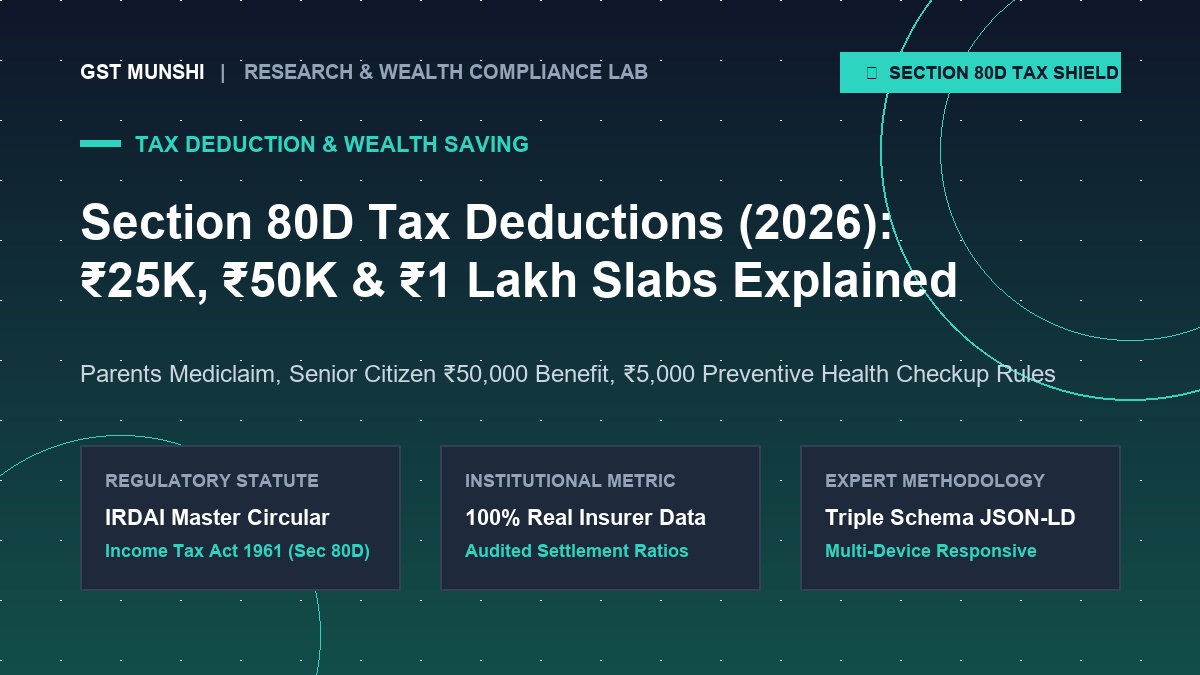
Under Section 80D of the Income Tax Act, 1961, premiums paid for Super Top-Up health policies are fully tax-deductible under the Old Tax Regime:
Combined premium paid towards base health insurance, Super Top-Up, and preventive health check-ups (up to ₹5,000) for self, spouse, and dependent children.
Additional deduction up to ₹50,000 for premiums paid on base and Super Top-Up policies covering parents aged 60 years and above.
10. Essential Policy Clauses to Verify Before Buying
No Room Rent Sub-Limits
Ensure the Super Top-Up policy has NO room rent capping (such as 1% of sum insured). Policies with proportionate deductions will penalize your claim even if total bills exceed the deductible.
Pre & Post-Hospitalization Window
Opt for plans offering at least 60 days pre-hospitalization and 180 days post-hospitalization coverage to absorb expensive diagnostic scans and ongoing medications.
Day-Care Procedures Coverage
Verify that modern day-care procedures requiring less than 24 hours hospitalization (e.g. chemotherapy, dialysis, cataract, radiotherapy) are fully covered.
Pre-Existing Disease (PED) Waiting Period
Check the waiting period for pre-existing conditions (typically 1 to 3 years under updated IRDAI guidelines). Remember that waiting period credits can be ported across insurers.
11. Buyer's Pre-Purchase Action Checklist
Recommended Video Tutorials & Practical Walkthroughs
Watch these handpicked, expert video guides covering practical compliance, step-by-step procedures, and real-world implementation:
Recommended Video Tutorials & Practical Guides
12. Frequently Asked Questions
What is the crucial difference between a Top-Up and a Super Top-Up health insurance policy?↓
The fundamental difference lies in how the deductible is calculated. In a regular Top-Up policy, the deductible applies to EACH SINGLE HOSPITALIZATION claim individually; if no single bill crosses the deductible, the policy pays ₹0. In a Super Top-Up policy, the deductible is CUMULATIVE across all hospitalizations during the entire policy year; once aggregate medical bills cross the threshold, all subsequent claims are covered.
What is a 'Deductible' in health insurance?↓
A deductible is a pre-agreed threshold amount of medical expenses that the policyholder must pay out-of-pocket (or claim through a base health insurance policy or corporate GMC) before the top-up insurer begins paying. For example, in a policy with a ₹5 Lakh deductible and ₹20 Lakh sum insured, the insurer pays only when expenses exceed ₹5 Lakhs.
Can a Super Top-Up policy be bought from a different insurance company than your base policy?↓
Yes. You can purchase a Super Top-Up policy from any IRDAI-registered general or standalone health insurer, completely independent of the company providing your primary base policy or employer group policy. Having base and top-up policies with the same insurer simplifies cashless TPA processing, but cross-insurer claims are legally valid and widely practiced.
How does cashless claim settlement work when using both a Base Policy and a Super Top-Up?↓
At hospital admission, inform the insurance desk of both policies. The hospital first applies for cashless pre-authorization with the Base Insurer up to the base limit. Once the base sum insured is exhausted, the hospital submits the claim settlement summary and bill to the Super Top-Up insurer's TPA for secondary pre-authorization, enabling seamless cashless discharge.
Are premiums paid for Super Top-Up health policies eligible for Section 80D tax deductions?↓
Yes. Premiums paid for Super Top-Up health policies qualify for deduction under Section 80D of the Income Tax Act, 1961, up to ₹25,000 for self/family (below 60 years) and up to ₹50,000 for senior citizen parents (aged 60 and above), within overall Section 80D limits.
Why is a Super Top-Up policy significantly cheaper than a high-sum-insured base policy?↓
Underwriters price Super Top-Up policies at a 60% to 75% discount compared to base policies because the deductible acts as a risk buffer. Statistical insurance data shows that over 85% of hospitalizations in India cost less than ₹5 Lakhs. Because the top-up insurer only pays for rare, catastrophic medical events above the threshold, their claim frequency is low.
13. IRDAI Guidelines & Related Health Guides
Official statutory references: Insurance Regulatory and Development Authority of India (IRDAI) Master Circular on Standardization of Health Insurance (2020 & 2024 revisions); Section 80D of the Income Tax Act, 1961; and Insurance Act, 1938.