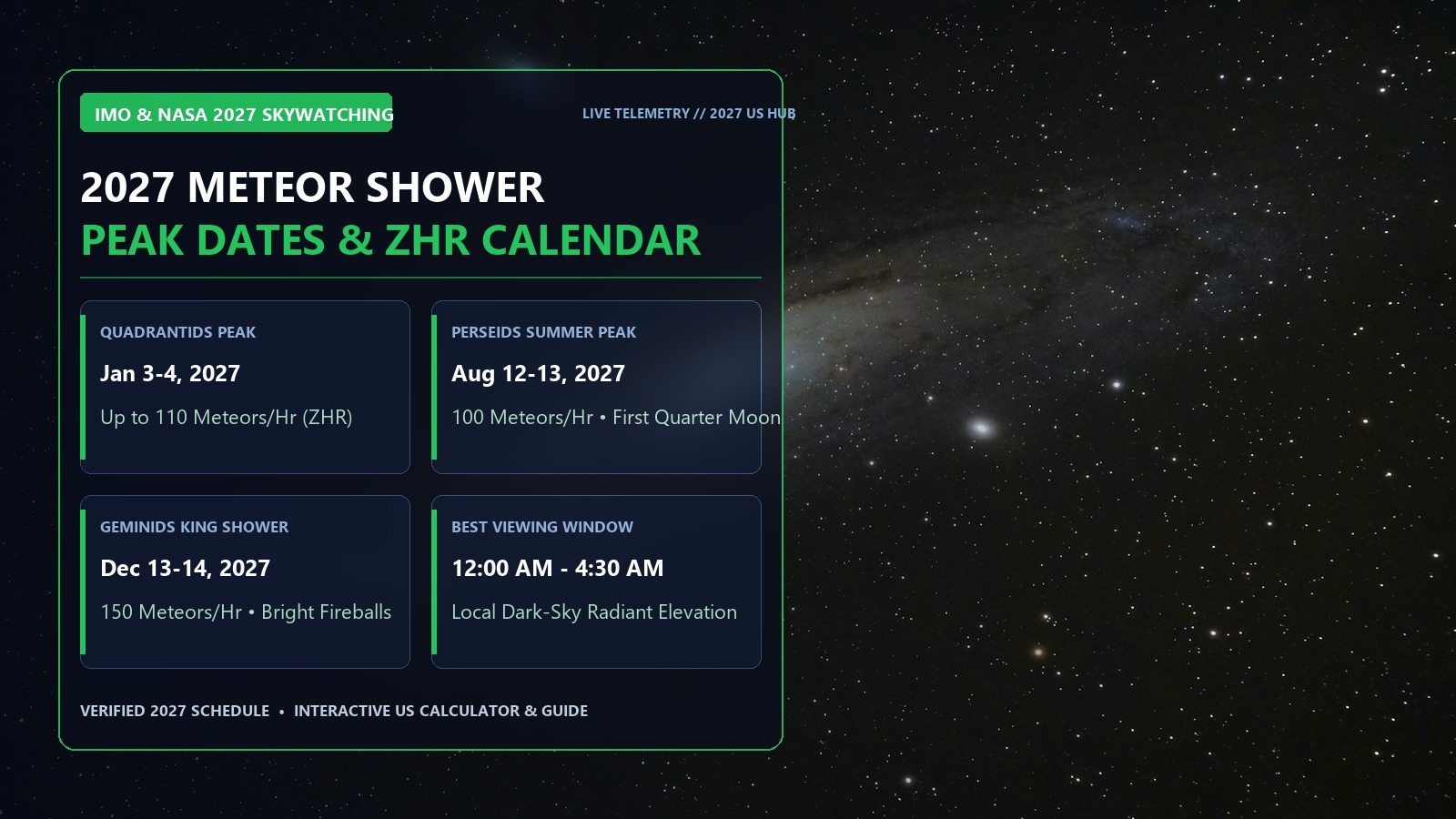
What are the best meteor showers to watch in 2027, and which peak nights have the darkest moonless skies?
According to International Meteor Organization (IMO) and NASA ephemeris calculations, the three best meteor showers of 2027 for dark-sky visibility are the Quadrantids (peaking January 3–4, 2027 with up to 110 meteors/hour under an 18% waning crescent moon), the Eta Aquariids (peaking May 5–6, 2027 with 50 meteors/hour during a 2% New Moon phase), and the Perseids (peaking August 12–13, 2027 with 100 meteors/hour after the first-quarter moon sets around 1:00 AM local time). While the Geminids (December 13–14, 2027) boast the highest theoretical Zenithal Hourly Rate (150 ZHR), a 96%-illuminated full moon in December 2027 will wash out fainter streaks, leaving mainly bright Geminid fireballs visible.
2027 Meteor Shower Peak ZHR & Local Dark-Sky Visibility Calculator
Audited against International Meteor Organization (IMO) & NASA 2027 Ephemeris Data
1The 3 Best Dark-Sky Meteor Showers of 2027: Quadrantids, Eta Aquariids & Perseids
Every year, as Earth orbits the Sun, our planet passes through dense trails of dusty debris left behind by periodic comets and asteroids. While the Zenithal Hourly Rate (ZHR) measures how many meteors a single observer would see per hour under ideal, crystal-clear Bortle 1 skies with the radiant directly overhead, the single biggest real-world variable each year is the phase of the Moon.
In 2027, lunar geometry strongly favors winter, spring, and summer skywatchers. The Quadrantids on the night of Sunday, January 3 into Monday, January 4, 2027 occur under a thin waning crescent moon (18% illumination), allowing observers in northern US states to spot 60 to 110 blue-white meteors per hour during the sharp 6-hour peak window. Even better, the Eta Aquariids—produced by debris from Halley's Comet—peak on May 5–6, 2027 simultaneously with the New Moon (0%–2% lunar glare), creating pristine dark skies across the southern United States.
- 1. Quadrantids (Peak Night: Jan 3–4, 2027): ZHR 110/hr • Radiant in Boötes (near the Big Dipper handle) • Best from 1:00 AM to dawn.
- 2. Eta Aquariids (Peak Night: May 5–6, 2027): ZHR 50/hr • New Moon (Zero Moon Glare!) • Fast 66 km/s meteors with glowing ionized trains; best from 3:00 AM to 5:15 AM local time.
- 3. Perseids (Peak Night: Aug 12–13, 2027): ZHR 100/hr • Waxing Gibbous Moon sets around 12:45 AM–1:15 AM local time, leaving nearly 3.5 hours of completely dark pre-dawn skies for warm summer viewing!
2Autumn & Winter 2027 Showers: Orionids, Taurids, Leonids & Geminids
Autumn 2027 features four overlapping meteor streams between October and December. The Southern and Northern Taurids (peaking in mid-October and mid-November) produce modest hourly counts (5–10 ZHR) but are famous among astrophotographers as the 'Halloween Fireball' showers—generating slow, brilliant orange-and-green bolides brighter than Venus.
In mid-December, the mighty Geminids—originating from rocky asteroid 3200 Phaethon rather than an icy comet—peak on the night of Monday, December 13 into Tuesday, December 14, 2027. Although a nearly full moon (96% illumination) sits high in the sky on December 13, 2027, the Geminids are uniquely rich in dense, pebble-sized meteoroids that produce colorful emerald and golden fireballs bright enough to cut right through moonlight.
- Orionids (Oct 21–22, 2027): ZHR 20/hr • Second annual stream from Comet 1P/Halley; radiant near Orion's club.
- Southern & Northern Taurids (Oct 29 – Nov 12, 2027): ZHR 5–10/hr • High percentage of slow, bright fireballs under dark early-November skies.
- Leonids (Nov 17–18, 2027): ZHR 15/hr • Fastest meteors of the year (71 km/s impact velocity).
- Geminids (Dec 13–14, 2027): ZHR 150/hr • Face away from the Moon (keep the Moon behind a building or tree line) to capture 25–45 bright Geminid fireballs per hour.
- Ursids (Dec 21–22, 2027): ZHR 10/hr • Winter Solstice shower radiating near Ursa Minor (the Little Dipper).
3Orbital Physics: Why 1:00 AM to 4:30 AM Local Time Produces 3x More Meteors
New skywatchers often step outside at 9:00 PM, see only one or two meteors, and head back indoors disappointed. The reason post-midnight hours (1:00 AM to 4:30 AM local time) deliver triple the meteor rate is pure orbital mechanics—identical to driving a car through a snowstorm.
From 6:00 PM to midnight, your location on Earth is on the 'trailing hemisphere' (the back window of the car), meaning only fast meteoroids that catch up to Earth from behind can enter the atmosphere. From midnight to 6:00 AM, your location rotates onto Earth's 'leading hemisphere' (the front windshield of the planet moving at 30 km/s around the Sun), slamming head-on into the meteoroid stream.
- 30-Minute Rhodopsin Dark Adaptation: Human eyes require 25 to 30 minutes without looking at a white smartphone screen to regenerate rhodopsin (night-vision pigment) in retinal rod cells.
- Red Flashlight Rule: Enable 'Red Color Filter' on your iPhone/Android screen or use a red LED headlamp to preserve night vision.
- Where to Look in the Sky: Do not stare directly at the constellation radiant (meteors near the radiant appear short and foreshortened); instead, recline at a 45° angle looking halfway between the radiant and the zenith (straight up).
4Top Certified International Dark Sky Parks in the United States for 2027 Viewing
Escaping urban light domes (Bortle Class 7–9) for a rural Bortle Class 1–3 sky increases visible meteor counts by 400% to 700%. Even driving 45 minutes outside a major metropolitan area doubles the number of magnitude +4 and +5 meteors you can see.
For dedicated 2027 meteor trips—especially during the warm August 12–13 Perseids peak or May 5–6 Eta Aquariids peak—America's National Parks and certified DarkSky International preserves offer unobstructed 360-degree horizons.
- Western US Dark-Sky Gems: Big Bend National Park (TX), Arches & Canyonlands National Parks (UT), Joshua Tree & Death Valley (CA), Grand Canyon (AZ), and Crater Lake (OR).
- Midwest & Eastern Dark-Sky Preserves: Cherry Springs State Park (PA), Headlands International Dark Sky Park (MI), Boundary Waters (MN), Shenandoah National Park (VA), and Big Cypress National Preserve (FL).
Complete 2027 Major Meteor Shower Calendar: Peak Nights, ZHR Rates & Moon Conditions
| Meteor Shower | 2027 Peak Night (US) | Ideal Rate (ZHR) | 2027 Moon Illumination & Sky Rating |
|---|---|---|---|
| Quadrantids | Night of Jan 3–4, 2027 | 110 / hr | 18% Waning Crescent — ★★★★★ Excellent |
| Lyrids | Night of Apr 22–23, 2027 | 18 / hr | 94% Waxing Gibbous — ★★☆☆☆ Poor (Moon Glare) |
| Eta Aquariids | Night of May 5–6, 2027 | 50 / hr | 2% New Moon — ★★★★★ Supreme Dark Sky |
| Southern Delta Aquariids | Night of Jul 29–30, 2027 | 25 / hr | 19% Waning Crescent — ★★★★☆ Very Good |
| Perseids | Night of Aug 12–13, 2027 | 100 / hr | Moon sets ~1:00 AM — ★★★★★ Dark Pre-Dawn |
| Orionids | Night of Oct 21–22, 2027 | 20 / hr | 62% Waning Gibbous — ★★★☆☆ Moderate |
| Southern / Northern Taurids | Nov 4–12, 2027 | 10 / hr (Fireballs) | 15%–35% Waxing Crescent — ★★★★☆ Good |
| Leonids | Night of Nov 17–18, 2027 | 15 / hr | 85% Waning Gibbous — ★★☆☆☆ Fair |
| Geminids | Night of Dec 13–14, 2027 | 150 / hr | 96% Full Moon — ★★★☆☆ Bright Fireballs Only |
| Ursids | Night of Dec 21–22, 2027 | 10 / hr | 38% Waning Crescent — ★★★★☆ Good |
4-Step 2027 Meteor Shower Skywatching & Astrophotography SOP
Select Your Shower & Local Bortle Sky Class in the Calculator Above
Prioritize the January 3–4 Quadrantids, May 5–6 Eta Aquariids, and August 12–13 Perseids (after 1:00 AM) for the darkest 2027 skies.
Scout a Wide-Open Location Away from City Streetlights
Use a light pollution map to find a park, beach, or rural field at least 30–45 miles outside urban centers with an unobstructed view overhead.
Bring a Zero-Gravity Reclining Chair, Sleeping Bag & Thermos
Even on August summer nights, motionless stargazing at 2:00 AM feels 15°F colder than daytime—lie flat in a reclining lawn chair so your neck doesn't strain.
Put Away Phones & Let Your Eyes Dark-Adapt for 30 Full Minutes
Commit to at least 60–90 minutes of continuous viewing between 1:00 AM and 4:00 AM local time, since meteors often arrive in clusters separated by 5-minute lulls.
Curated Expert Video Walkthroughs & Wall Street Briefings




Frequently Asked Questions (Verified Statutory Answers)
Q1: When is the Perseids meteor shower peak in 2027, and will the Moon block it?
The 2027 Perseids meteor shower peaks on the night of Thursday, August 12 into the pre-dawn hours of Friday, August 13, 2027. A waxing gibbous moon will set around 12:45 AM to 1:15 AM local time, leaving completely dark, moonless skies from 1:15 AM until dawn—the exact window when Perseid rates reach their maximum (up to 80–100 meteors per hour).
Q2: Which 2027 meteor shower has the darkest New Moon sky?
The Eta Aquariids meteor shower (created by Halley's Comet) peaks on the night of May 5–6, 2027 right alongside the New Moon (only 2% illumination), providing 100% moonless dark skies before dawn.
Q3: Do I need a telescope or binoculars to watch a meteor shower?
No! Telescopes and binoculars have a narrow field of view and actually reduce the number of meteors you will see. Your unaided eyes—lying back on a reclining chair or blanket taking in the entire overhead sky dome—are the best instruments for meteor watching.
Q4: What time of night is best to see shooting stars in 2027?
For almost every meteor shower (except early-evening Geminid earthgrazers), the optimal viewing window is between 12:30 AM and 4:30 AM local time, when your location on Earth faces directly into the oncoming meteoroid stream.