Is the US stock market open today, what are the official NYSE and NASDAQ trading hours, and what are the 2026–2027 holiday closures?
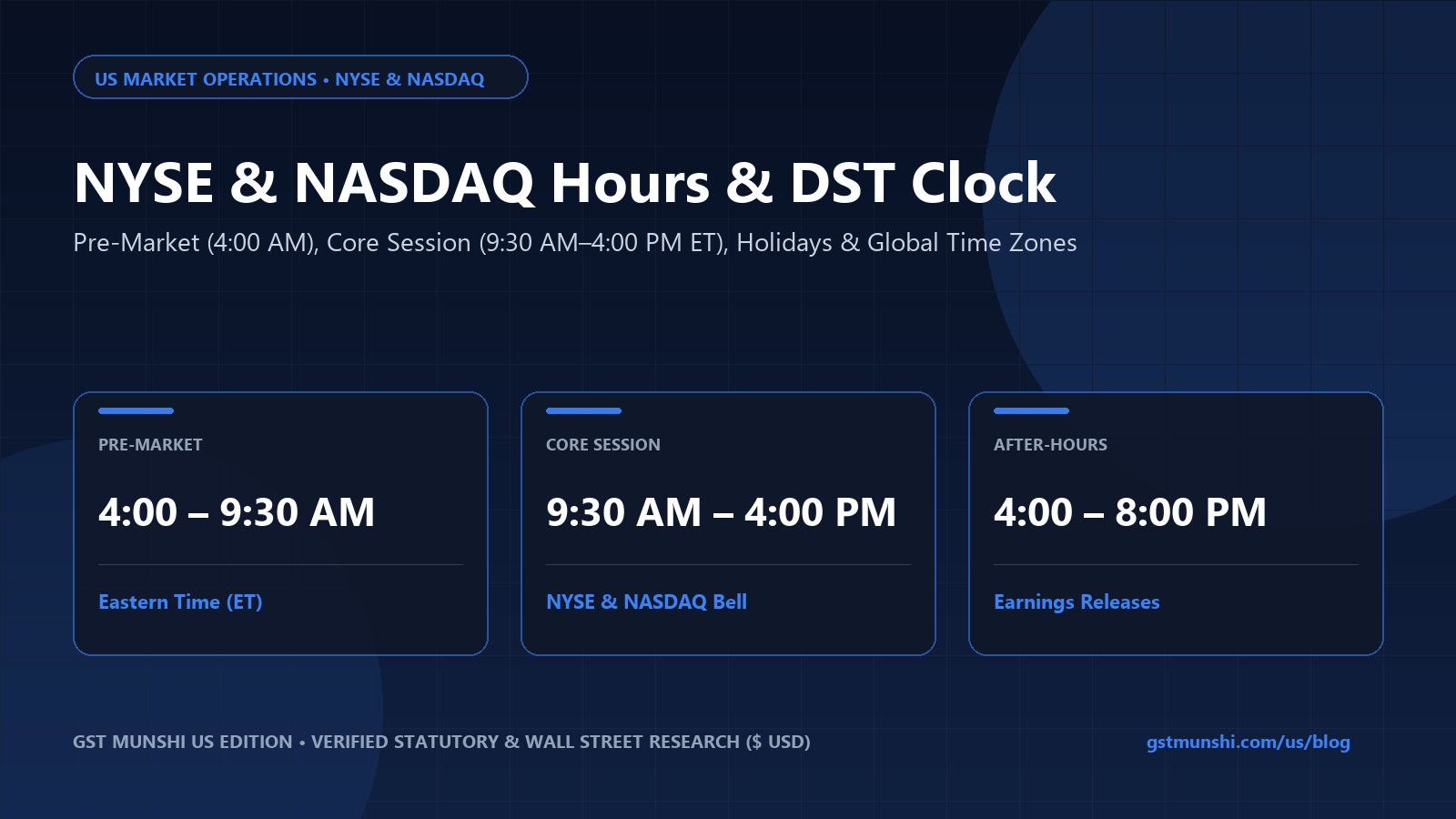
The New York Stock Exchange (NYSE) and NASDAQ are open Monday through Friday from 9:30 AM to 4:00 PM Eastern Time (ET), excluding 10 official federal market holidays per year. Electronic pre-market trading runs from 4:00 AM to 9:30 AM ET, and after-hours extended trading operates from 4:00 PM to 8:00 PM ET. Additionally, US equity markets close early at 1:00 PM ET on three scheduled days each year: the day before Independence Day, Black Friday (the Friday after Thanksgiving), and Christmas Eve (December 24).
1NYSE & NASDAQ Core Session Across US & Global Time Zones (EDT vs EST)
When investors ask 'Is the stock market open today?', the answer depends entirely on New York Eastern Time (ET). Because Wall Street operates strictly on Eastern Time, domestic traders across Pacific, Mountain, and Central zones—as well as international investors in London, Frankfurt, Mumbai, Singapore, and Tokyo—must track the semi-annual shift between Eastern Daylight Time (EDT, UTC-4, second Sunday in March to first Sunday in November) and Eastern Standard Time (EST, UTC-5, November to March).
During the core 9:30 AM to 4:00 PM ET window, designated market makers (DMMs) on the NYSE floor and electronic liquidity providers on NASDAQ maintain tight bid-ask spreads. The first 15 minutes (9:30 AM – 9:45 AM ET) and the final 15 minutes (3:45 PM – 4:00 PM ET, culminating in the Closing Auction Cross) account for over 25% of total daily equity trading volume.
- US Time Zone Equivalents (Core Session): 9:30 AM–4:00 PM ET • 8:30 AM–3:00 PM CT • 7:30 AM–2:00 PM MT • 6:30 AM–1:00 PM PT.
- Opening Cross (9:30 AM ET): Aggregates overnight limit and market-on-open (MOO) orders into a single equilibrium opening print.
- Closing Cross (4:00 PM ET): Sets the official daily closing price used to calculate net asset values (NAVs) for all S&P 500 mutual funds and ETFs.
2Official 2026 & 2027 NYSE and NASDAQ Stock Market Holiday Closure Calendar
Under NYSE Rule 7.1 and Nasdaq Equity Rule 4120, US stock exchanges observe 10 full-day holiday closures each calendar year. Under the exchange weekend-observance rule, if a fixed-date holiday (such as New Year's Day, Juneteenth, Independence Day, or Christmas Day) falls on a Saturday, the stock market closes on the preceding Friday; if it falls on a Sunday, the market closes on the following Monday.
For 2026 and 2027, investors should pay special attention to Good Friday (which is NOT a federal government holiday, yet both NYSE and NASDAQ are completely closed) and Independence Day observance (in 2026, July 4 falls on Saturday, so US stock markets close all day on Friday, July 3, 2026; in 2027, July 4 falls on Sunday, so markets close on Monday, July 5, 2027).
- 2026 Full-Day Closures: Jan 1 (New Year's), Jan 19 (MLK Day), Feb 16 (Presidents' Day), Apr 3 (Good Friday), May 25 (Memorial Day), Jun 19 (Juneteenth), Jul 3 (Independence Day Observed), Sep 7 (Labor Day), Nov 26 (Thanksgiving), Dec 25 (Christmas).
- 2027 Full-Day Closures: Jan 1 (New Year's), Jan 18 (MLK Day), Feb 15 (Presidents' Day), Mar 26 (Good Friday), May 31 (Memorial Day), Jun 18 (Juneteenth Observed), Jul 5 (Independence Day Observed), Sep 6 (Labor Day), Nov 25 (Thanksgiving), Dec 24 (Christmas Observed).
- Early 1:00 PM ET Closes: Black Friday (Nov 27, 2026 & Nov 26, 2027) and Christmas Eve (Dec 24, 2026). Equity options on Cboe close at 1:15 PM ET on early-close days.
3Pre-Market (4:00 AM ET), After-Hours (8:00 PM ET) & 24/5 Overnight Trading Mechanics
Outside the 9:30 AM to 4:00 PM ET core session, electronic communication networks (ECNs) such as NYSE Arca, Nasdaq TotalView, and Blue Ocean ATS facilitate extended-hours trading. Major retail brokerages (Interactive Brokers, Charles Schwab, Fidelity, Robinhood, and Webull) offer access to varying slices of the 4:00 AM–9:30 AM ET pre-market and 4:00 PM–8:00 PM ET post-market sessions.
Because over 90% of S&P 500 companies release their quarterly Form 10-Q/10-K earnings reports either between 4:05 PM and 4:30 PM ET (after the closing bell) or between 6:00 AM and 8:30 AM ET (before the opening bell), extended-hours sessions experience rapid price discovery. Furthermore, monthly Bureau of Labor Statistics (BLS) CPI inflation and Nonfarm Payrolls reports drop at exactly 8:30 AM ET—one full hour before the regular stock market opens.
- Strict Limit-Order Mandate: Brokerages prohibit Market Orders during pre-market and after-hours sessions to protect retail investors from thin order books and wide bid-ask spreads.
- No Stop-Loss Triggers: Standard stop-loss orders do NOT trigger during extended hours; if a stock gaps down 15% at 4:15 PM ET on an earnings miss, your stop order waits until 9:30 AM ET the next morning.
- 24/5 Overnight ATS Sessions: Select liquid ETFs (SPY, QQQ, IWM, TLT) and mega-cap stocks now trade Sunday through Friday between 8:00 PM ET and 4:00 AM ET via alternative trading systems.
4Why the US Bond Market (SIFMA) and Stock Market Have Different Holiday Schedules
Active multi-asset investors must distinguish between NYSE/NASDAQ equity holidays and the Securities Industry and Financial Markets Association (SIFMA) fixed-income schedule, which governs US Treasury bonds, agency MBS, and municipal bonds.
On Columbus Day (second Monday in October) and Veterans Day (November 11), the NYSE and NASDAQ stock markets are 100% OPEN for normal trading, whereas the Federal Reserve settlement system and US Treasury bond markets are CLOSED. Because banks and Fedwire are closed on those two days, equity trades executed on the Friday before or on the holiday itself experience a 1-day extension in their T+1 settlement cycle.
- Columbus Day & Veterans Day Divergence: Stocks and ETFs (including bond ETFs like TLT and BND) trade normally on NYSE/NASDAQ, even though underlying cash Treasury bond desks are closed.
- Extra SIFMA Early Closes (2:00 PM ET): The US bond market often closes early at 2:00 PM ET prior to Good Friday, Memorial Day, and New Year's Day when stock exchanges remain open until 4:00 PM ET.
- SEC T+1 Settlement Rule (Rule 15c6-1): Stock trades settle on the next business day when BOTH the stock exchange and federal banking system are open.
NYSE & NASDAQ Trading Hours Across US & Global Time Zones
| Time Zone | Pre-Market Open | Core Opening Bell | Core Closing Bell | After-Hours Close |
|---|---|---|---|---|
| US Eastern Time (ET — New York) | 4:00 AM ET | 9:30 AM ET | 4:00 PM ET | 8:00 PM ET |
| US Central Time (CT — Chicago) | 3:00 AM CT | 8:30 AM CT | 3:00 PM CT | 7:00 PM CT |
| US Mountain Time (MT — Denver) | 2:00 AM MT | 7:30 AM MT | 2:00 PM MT | 6:00 PM MT |
| US Pacific Time (PT — Los Angeles) | 1:00 AM PT | 6:30 AM PT | 1:00 PM PT | 5:00 PM PT |
| UK London (GMT / BST) | 9:00 AM | 2:30 PM | 9:00 PM | 1:00 AM |
| India Standard Time (IST — EDT Summer) | 1:30 PM IST | 7:00 PM IST | 1:30 AM IST | 5:30 AM IST |
| India Standard Time (IST — EST Winter) | 2:30 PM IST | 8:00 PM IST | 2:30 AM IST | 6:30 AM IST |
4-Step Execution Rules for Extended-Hours & Holiday Trading
Always Use Limit Orders in Pre-Market & After-Hours
ECN extended sessions lack market-maker obligations; never place market orders between 4:00 PM and 8:00 PM ET during earnings releases.
Account for T+1 Settlement Around Federal Holidays
Since May 2024, SEC Rule 15c6-1 mandates T+1 (next business day) trade settlement for all US equities and ETFs.
Watch Bond Market Holidays (SIFMA vs NYSE)
On Columbus Day and Veterans Day, NYSE and NASDAQ equity markets remain OPEN, while US Treasury bond markets and banks are closed.
Avoid Trading the First 5 Minutes After 9:30 AM ET
Let opening auction imbalances clear between 9:30 AM and 9:35 AM ET before executing large options or equity orders.
Curated Expert Video Walkthroughs & Wall Street Briefings




Frequently Asked Questions (Verified Statutory Answers)
Q1: Is the US stock market open on weekends?
No. Regular NYSE and NASDAQ trading is completely closed on Saturdays and Sundays. Select brokerages open overnight alternative trading system (ATS) sessions starting Sunday evening at 8:00 PM ET, which execute for Monday's trade date.
Q2: Are the NYSE and NASDAQ open on Columbus Day and Veterans Day?
Yes. Both the NYSE and NASDAQ are open for normal regular-session trading (9:30 AM – 4:00 PM ET) on Columbus Day (second Monday in October) and Veterans Day (November 11), even though federal banks and the US bond market are closed.
Q3: What are the 10 full-day NYSE and NASDAQ market holidays each year?
New Year's Day, Martin Luther King Jr. Day, Washington's Birthday (Presidents' Day), Good Friday, Memorial Day, Juneteenth National Independence Day, Independence Day, Labor Day, Thanksgiving Day, and Christmas Day.
Q4: Is the stock market open on Black Friday and Christmas Eve?
Yes, the NYSE and NASDAQ are open on Black Friday (the day after Thanksgiving) and on Christmas Eve (when December 24 falls on a weekday), but both exchanges close three hours early at 1:00 PM Eastern Time.
Q5: Why is the stock market closed on Good Friday when banks and post offices are open?
Although Good Friday is not a federal government holiday under 5 U.S.C. § 6103, both the NYSE and NASDAQ have historically designated Good Friday as a full-day exchange holiday in their rulebooks, and the SIFMA bond market also closes.
Q6: What time do options stop trading on the NYSE and Cboe?
Individual equity options stop trading at 4:00 PM ET alongside stocks, while broad-based index options and ETFs (such as SPX, SPY, QQQ, IWM, and VIX options) continue trading for an additional 15 minutes until 4:15 PM ET on regular days (and 1:15 PM ET on early-close days).