Quick Summary & Key Takeaways (Featured Snippet)
Interactive RBI ₹10 Coin Authenticity & Legal Tender Verifier
Verify all 14 RBI coin designs, debunk counterfeit rumors, and check statutory payment limits under the Coinage Act, 2011.
• Composition: Bi-metallic (Outer ring: Nickel Bronze | Center disc: Cupro-Nickel).
• Diameter: 27 mm | Weight: 7.71 grams.
• Mints: India Government Mints located in Mumbai, Kolkata, Hyderabad, and Noida.
Issued by Government of India / RBI (2009–2011)
Features 10 radiating rays/stripes above Lion Capital, numeral 10 on reverse without ₹ symbol.
Statutory Standing: The Coinage Act 2011 & RBI Clarifications
The legal framework governing coins in the Republic of India is codified under the **Coinage Act, 2011**, read alongside the currency management regulations of the **Reserve Bank of India Act, 1934**. Unlike currency notes, which are legal liabilities of the Reserve Bank of India, coins are minted directly by the Government of India at SPMCIL mints and supplied to the RBI for public distribution.
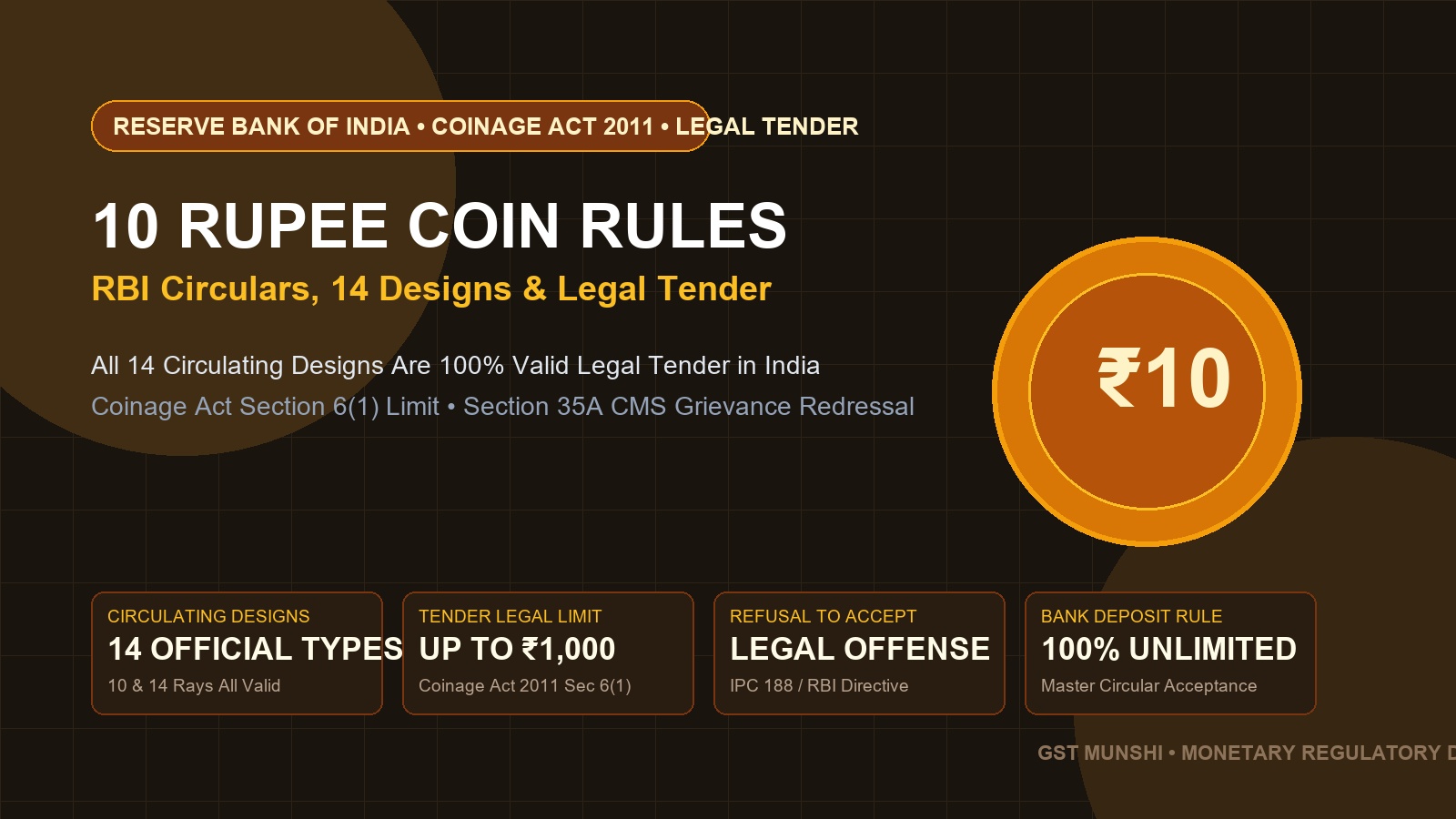
Because metal coins endure minimal physical degradation compared to paper notes, coins minted in 2009 remain in circulation alongside coins minted in 2027. Over the years, the central government has introduced 14 distinct variations of the ₹10 bi-metallic coin, featuring variations in stripes, typeface, commemorative imagery, and the adoption of the official Rupee symbol (₹).
| ₹10 Coin Design Series | Minting Period | Distinguishing Features | Legal Status |
|---|---|---|---|
| 10 Stripes Series | 2009–2011 | 10 radiating lines above Lion Capital; numeral 10 on reverse | 100% Valid Legal Tender |
| 14 Stripes Series | 2011–2012 | 14 radiating lines above Lion Capital; numeral 10 on reverse | 100% Valid Legal Tender |
| Official ₹ Symbol Series | 2011–Present | Features the official '₹10' symbol with 10 notched serrations | 100% Valid Legal Tender |
| Commemorative Editions | 2008–Present | Parliament, Homi Bhabha, Mata Vaishno Devi, AKAM 75 Years | 100% Valid Legal Tender |
The ₹1,000 Commercial Payment Ceiling: Section 6(1) Explained
Viral news stories frequently report citizens arriving at automobile showrooms with sacks of ₹10 coins to purchase a motorcycle or scooter. While showrooms sometimes accept these coins for promotional publicity, consumers must understand the statutory boundary established under Section 6(1) of the Coinage Act, 2011:
"The coins issued under the authority of section 4 shall be a legal tender in payment or on account: (a) in the case of a coin of any denomination not lower than one rupee, for any sum not exceeding one thousand rupees..."
Under Indian law, legal tender is defined with a statutory ceiling. A shopkeeper or service provider is legally bound to accept payment in coins up to ₹1,000 (100 ten-rupee coins). For amounts exceeding ₹1,000, acceptance is strictly voluntary. Merchants cannot be prosecuted or fined for refusing 10,000 coins for a ₹1 Lakh purchase.
Step-by-Step SOP: Handling Refusal of ₹10 Coins
Present the Official RBI Clarification to the Merchant
Inform the shopkeeper or trader that the Reserve Bank of India has issued multiple official circulars confirming that all 14 designs are genuine legal tender. Show them that the coin possesses bi-metallic construction with distinct ring and core metals, sharp edge milling, and correct weight.
Deposit Accumulated Coins at Any Commercial Bank Branch
If local merchants resist accepting coins in bulk, visit your bank branch (SBI, PNB, Bank of Baroda, HDFC, ICICI, etc.). Commercial banks are strictly required by the RBI to accept all valid coins over the counter for deposit into your savings or current account without any ceiling.
File an Online Complaint on the RBI CMS Portal for Bank Refusal
If a bank teller or branch manager refuses to accept your ₹10 coins, note the date, time, and branch name. Submit an official complaint on the RBI Complaint Management System (cms.rbi.org.in). The Banking Ombudsman initiates penal scrutiny against the bank for deficiency of service.
Report Commercial Anti-Currency Boycotts to Consumer Helpline
Where commercial establishments prominently display signboards stating "₹10 Coins Not Accepted Here", file an official report on the National Consumer Helpline (toll-free 1915 or consumerhelpline.gov.in). Such systematic refusal constitutes unfair trade practice and disrespect to national currency.