Quick Summary & Key Takeaways (Featured Snippet)
Interactive Home Loan Balance Transfer Savings Calculator
Compare monthly EMI reductions and net lifetime savings after deducting processing fees, legal charges, and MODT stamp duty.
The Anatomy of Loan Refinancing: EBLR vs NBFC Prime Lending Rates
In India's lending ecosystem, how your interest rate is calculated depends heavily on whether your lender is a commercial bank or a housing finance company (HFC/NBFC). Scheduled commercial banks are mandated by the Reserve Bank of India to link all floating-rate retail loans to an External Benchmark Lending Rate (EBLR), overwhelmingly the RBI Repo Rate. When the RBI lowers rates, banks must pass the benefit to borrowers in the following quarterly cycle.
Conversely, Non-Banking Financial Companies and Housing Finance Companies (such as private HFCs) benchmark their loans to their proprietary Prime Lending Rate (PLR) or Retail Prime Lending Rate (RPLR). In practice, NBFCs frequently raise PLR rapidly when rates rise, but delay passing rate reductions to existing borrowers. Refinancing an existing NBFC loan to an EBLR-linked PSU or private bank structure provides institutional rate transparency.
| Refinancing Factor | Internal Bank Repricing (Reset) | External Balance Transfer (New Bank) |
|---|---|---|
| Operational Friction | Minimal (Single branch visit or netbanking) | Full process (KYC, valuation, legal vetting) |
| Direct Financial Cost | ₹1,000 to ₹5,000 + GST | 0.25%–0.50% processing fee + MODT stamp duty |
| Processing Timeline | 2 to 4 working days | 10 to 18 working days |
| Property Document Movement | No movement (Documents remain in current vault) | Outgoing bank surrenders original deeds to new bank |
The 2027 Macroeconomic Strategy: Defending Cash Flow Against Rate Volatility
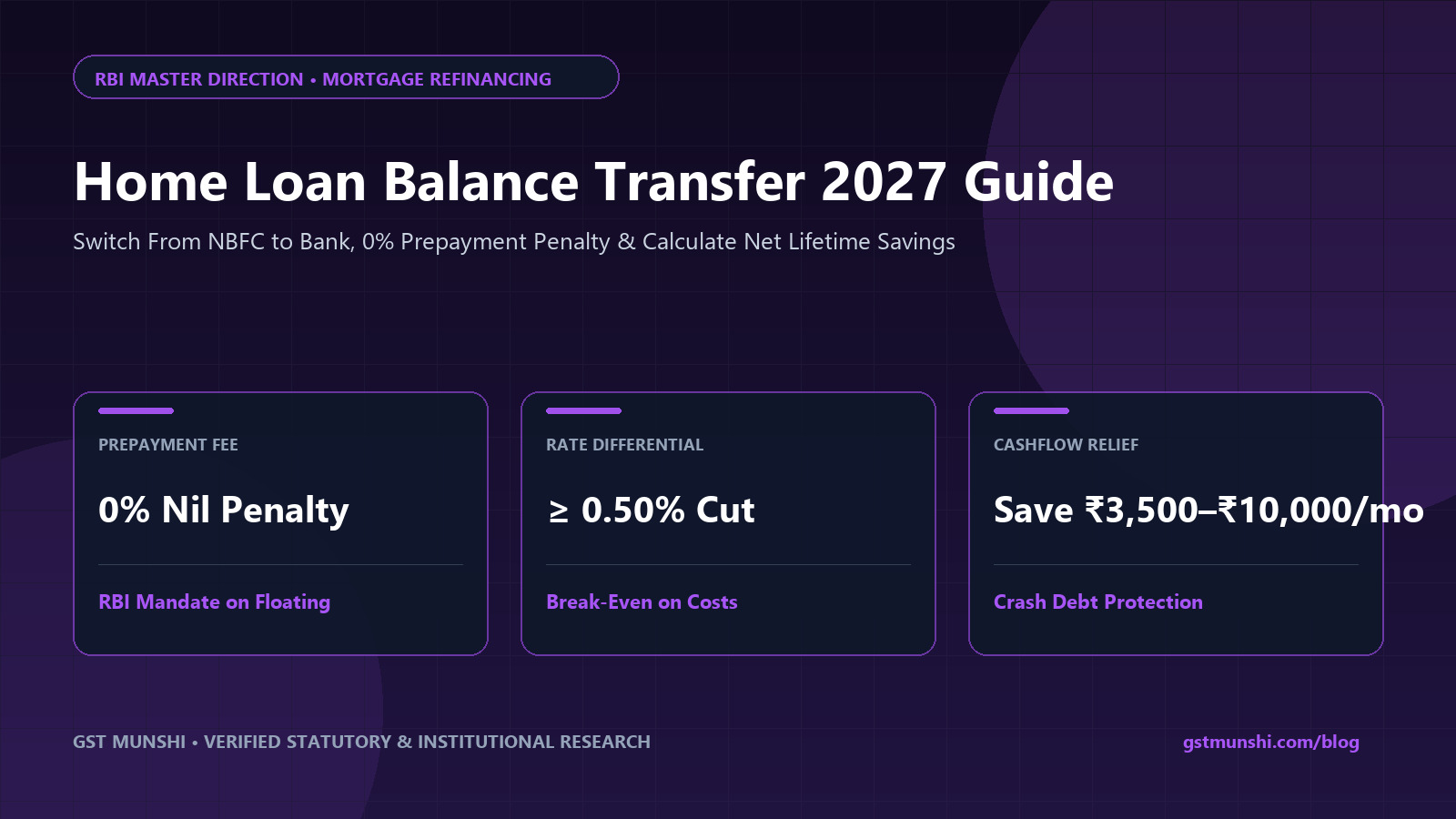
During periods of global market turbulence and tighter liquidity, preserving monthly disposable cash flow is paramount. A high home loan EMI consumes substantial income that would otherwise maintain liquid emergency reserves. Refinancing an existing ₹50 Lakh loan from 9.45% down to 8.40% frees up roughly ₹3,500 to ₹4,500 every single month while trimming over ₹8 Lakhs from total lifetime interest.
Step-by-Step SOP: Executing a Clean Home Loan Balance Transfer
Attempt Internal Rate Reset with Your Current Lender
Contact your existing bank's loan retention division. State that competitor banks have offered you a repo-linked rate lower by 60 to 100 bps and request an internal conversion. If they match the rate for a modest conversion fee of ₹2,500, take it; you save money without paying thousands in fresh title verification, valuation, and state MODT stamp duty charges.
Obtain LOD and Outstanding Foreclosure Statement
If your current lender refuses to reduce rates, submit a formal application for loan closure. Request two documents: (1) An official Foreclosure Statement stating the exact loan balance as of a future settlement date, and (2) A certified List of Documents (LOD) detailing all original title deeds held in custody.
Apply to the New Bank and Complete Legal & Valuation Vetting
Submit your KYC documents, past 6 months' salary slips, 12 months' bank statements, and copies of property documents alongside the LOD to the new lender. The incoming bank sends a panel advocate to inspect property title records at the sub-registrar office and a chartered engineer to conduct technical valuation.
Disbursement via Takeover Cheque and Handover of Original Deeds
Upon loan sanction, the new bank prepares a banker's cheque or RTGS transfer in favor of your existing bank for the exact foreclosure balance. The cheque is delivered to the old bank, which issues an official loan closure letter and schedules the release of your original title deeds within 10 to 15 working days. The new bank takes custody of the original deeds and completes Memorandum of Deposit of Title Deeds (MODT) registration.