Quick Summary & Key Takeaways (Featured Snippet)
Interactive Section 194-IA Property TDS & Form 26QB Penalty Calculator
Determine statutory TDS liabilities, Circle Rate vs Agreement value benchmarks, joint ownership splits, and Section 234E late fees.
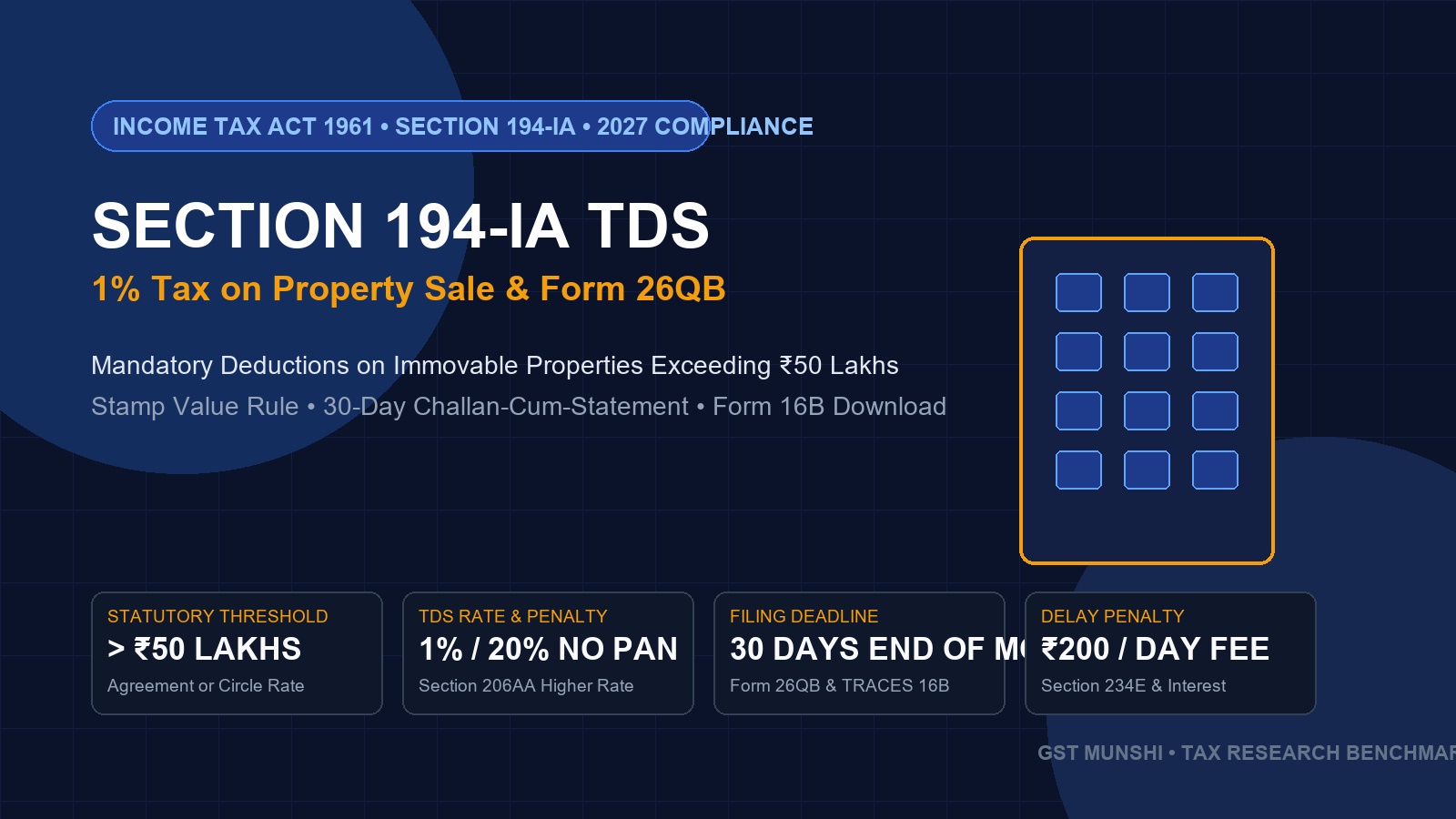
Statutory Rule: TDS applies on the higher of Agreement Value or Circle Rate.
Buyer must deduct from seller payment and deposit via Form 26QB within 30 days from month end.
Statutory Framework of Section 194-IA & The Circle Rate Benchmark
Introduced to track high-value real estate transactions and curb undisclosed wealth in property dealings, Section 194-IA of the Income Tax Act, 1961 places the legal obligation of tax withholding directly on the property buyer. If an individual or HUF acquires residential or commercial premises, a residential plot, or an office unit from a resident seller for ₹50 Lakhs or more, 1% tax must be deducted at source.
Through the statutory amendment introduced under the Finance Act, the taxable threshold is tied to the higher of the actual consideration agreed in the conveyance deed or the Stamp Duty Value (circle rate or ready reckoner rate) determined by state revenue authorities. Buyers can no longer circumvent TDS by declaring an agreement value below ₹50 Lakhs if the government valuation exceeds the statutory threshold.
| Transaction Parameter | Resident Seller (Sec 194-IA) | Non-Resident Indian Seller (Sec 195) |
|---|---|---|
| Standard TDS Rate | 1.00% (Flat) | 12.5%–20% + Surcharge & Cess (LTCG) |
| Minimum Threshold Limit | ₹50,00,000 (No TDS below ₹50L) | ₹0 (TDS applies on every single rupee) |
| Buyer TAN Required? | No (Buyer's PAN is sufficient) | Yes (Mandatory to apply for TAN) |
| Challan Form Used | Form 26QB (Challan-cum-statement) | Form 27Q & Challan ITNS 281 |
| TDS Certificate Issued | Form 16B (Downloaded via TRACES) | Form 16A |
The Joint Ownership Matrix: Handling Multiple Buyers & Sellers
One of the most frequent operational errors occurs when real estate is acquired jointly. If two brothers jointly buy an apartment worth ₹80 Lakhs (each paying ₹40 Lakhs), some buyers mistakenly assume that because each individual share is below ₹50 Lakhs, no TDS applies. The Income Tax Department CPC explicitly mandates that applicability is determined by the total aggregate value of the property asset.
Because the overall transaction is ₹80 Lakhs, Section 194-IA applies. The buyers must file separate Form 26QB statements for each combination. For example, 2 buyers purchasing from 2 sellers requires 4 separate challans: Buyer 1 to Seller 1, Buyer 1 to Seller 2, Buyer 2 to Seller 1, and Buyer 2 to Seller 2, dividing the TDS amount proportionally.
Step-by-Step SOP: How to File Form 26QB Online on the Income Tax Portal
Log In to the Official Income Tax E-Filing Portal
Visit incometax.gov.in. Log in using the buyer's PAN credentials. Navigate to e-File > e-Pay Tax > New Payment. Select the tile labeled TDS on Sale of Property (Form 26QB).
Enter Buyer, Seller & Property Information
The buyer's profile details auto-populate. Enter the seller's PAN. The portal verifies the seller's legal name against direct tax records and confirms whether their PAN is active and Aadhaar-linked. Enter complete property address, agreement date, total value, and whether multiple buyers or sellers are involved.
Calculate & Remit TDS via Net Banking or UPI
The system calculates 1% of the higher of consideration or circle rate. If filed past the 30-day window, the system automatically appends Section 234E late fees (₹200/day) and Section 201(1A) interest. Pay instantly using Net Banking, Debit Card, RTGS/NEFT, or UPI. Download the receipt with Challan Identification Number (CIN) and BSR code.
Download Form 16B from TRACES and Hand Over to Seller
After 3 to 7 working days, log in to the TRACES portal (tdscpc.gov.in) as a Taxpayer. Navigate to Downloads > Form 16B (for Buyer). Enter the assessment year, acknowledgment number, and seller's PAN. Download the digitally signed Form 16B certificate and furnish it to the seller to enable their Annual Information Statement (AIS) credit claim.