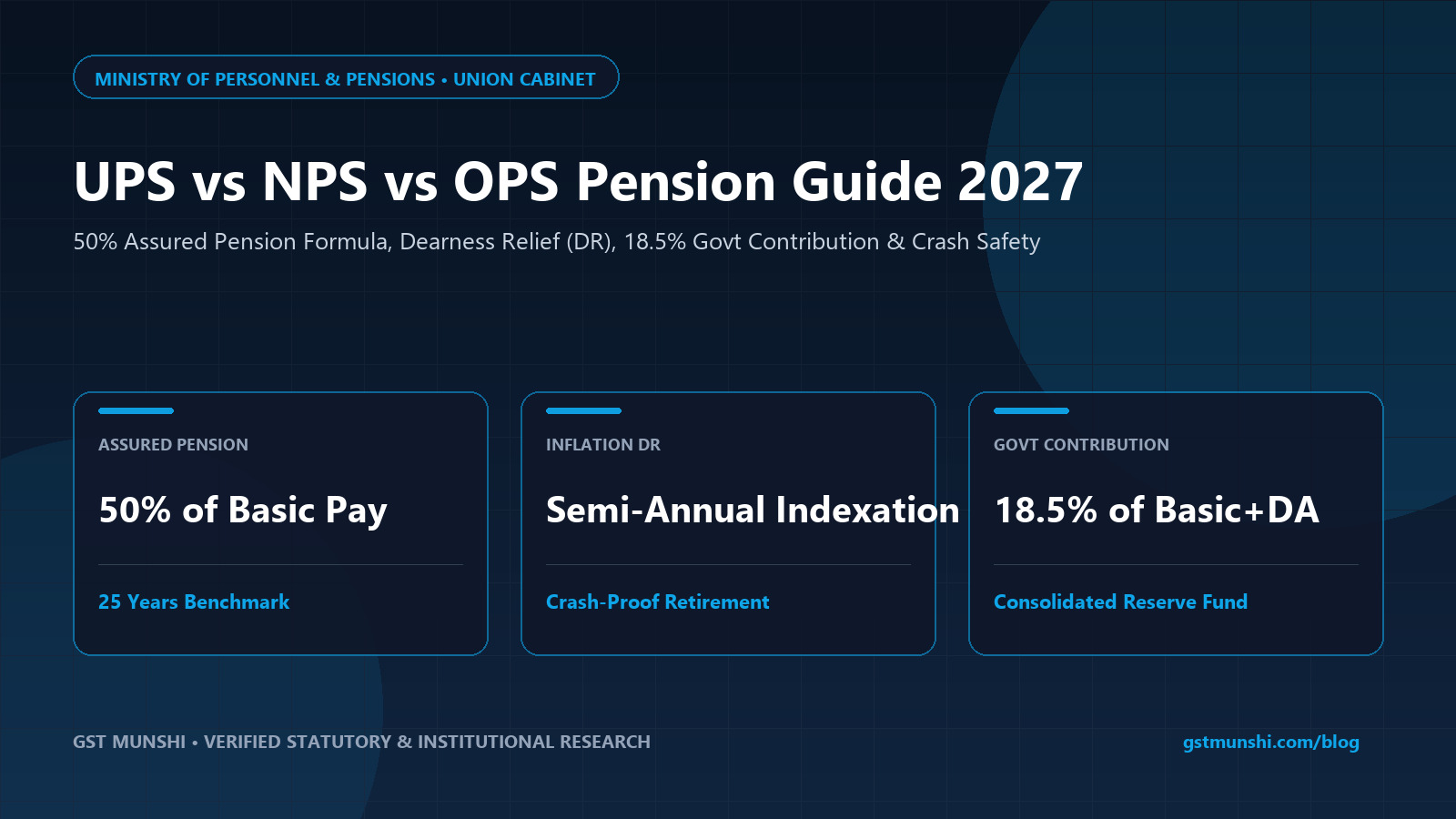
Quick Summary & Key Takeaways (Featured Snippet)
Interactive UPS vs NPS Sovereign Pension Simulator
Compare guaranteed 50% Unified Pension Scheme (UPS) payouts with market-linked National Pension System (NPS) annuities.
Guaranteed monthly pension with Dearness Relief indexation
The Pension Matrix: Head-to-Head Comparison of UPS, NPS, and OPS
The evolution of Indian civil service pension policy reflects a balance between fiscal sustainability and social security. The Old Pension Scheme (OPS) was entirely non-contributory and unfunded, placing the entire fiscal burden on general tax revenues. The National Pension System (NPS), introduced in 2004, shifted employees to defined-contribution equity and debt markets. The Unified Pension Scheme (UPS) unites both worlds: funded contributions with a sovereign 50% pension floor.
| Scheme Dimension | Old Pension Scheme (OPS) | Unified Pension Scheme (UPS) | National Pension System (NPS) |
|---|---|---|---|
| Pension Certainty | 50% of Last Basic Pay (Guaranteed) | 50% of Last 12M Avg Basic (Guaranteed) | Variable (Depends on market returns & annuity rates) |
| Employee Contribution | 0% (Nil) | 10% of (Basic + DA) | 10% of (Basic + DA) |
| Government Contribution | Full budget outgo at retirement | 18.5% of (Basic + DA) | 14% of (Basic + DA) |
| Inflation Protection (DR) | Full DR twice a year | Full DR twice a year | Zero (Annuity amount stays fixed forever) |
| Minimum Qualifying Service | 10 Years | 10 Years (Min ₹10,000/mo) | No minimum (Corpus based) |
The 2027 Macro Crash Perspective: Defending Retirement From Market Turbulence
The defining risk of the National Pension System is the "sequence of returns risk." An employee who retired during an equity bull market in 2024 accumulated an elevated corpus, yielding an acceptable initial annuity. However, an employee retiring during a severe market crash faces a shrunken capital base. Because NPS mandates that 40% of the terminal corpus be locked into fixed-rate commercial annuities, a market collapse permanently reduces life-long monthly income.
The Unified Pension Scheme insulates retirees completely from capital market crashes. Regardless of whether global stock markets plunge 30% or bond yields crash, the 50% basic pay obligation is legally guaranteed and funded by the Union Government, providing unassailable peace of mind.
Step-by-Step SOP: Choosing Between UPS and NPS
Audit Your Total Qualifying Government Service
Check your official service book or e-HRMS portal. If your qualifying service will reach 25 years or more by superannuation, you qualify for the full 50% assured pension benchmark. If your total service is between 10 and 24 years, your pension is calculated proportionately: (50% of Pay × Years) ÷ 25, guaranteed to be at least ₹10,000 per month.
Evaluate the Compounding Drag of Inflation (The DR Advantage)
Run the numbers on Dearness Relief. If you retire at age 60 with a ₹50,000 monthly pension, an NPS annuity will still be paying ₹50,000 at age 75, despite living costs doubling. Under UPS, assuming a conservative 6% annual inflation indexation via DR, your monthly pension will have grown to over ₹1,19,000 at age 75.
Submit One-Time Irrevocable UPS Option on Bhavishya Portal
Central government employees wishing to exercise the option must log in to the official pension portal (Bhavishya / CRA portal). Submit the statutory UPS option form. Note that this decision is one-time and irrevocable; once opted into UPS, you cannot revert to the standard NPS framework.