
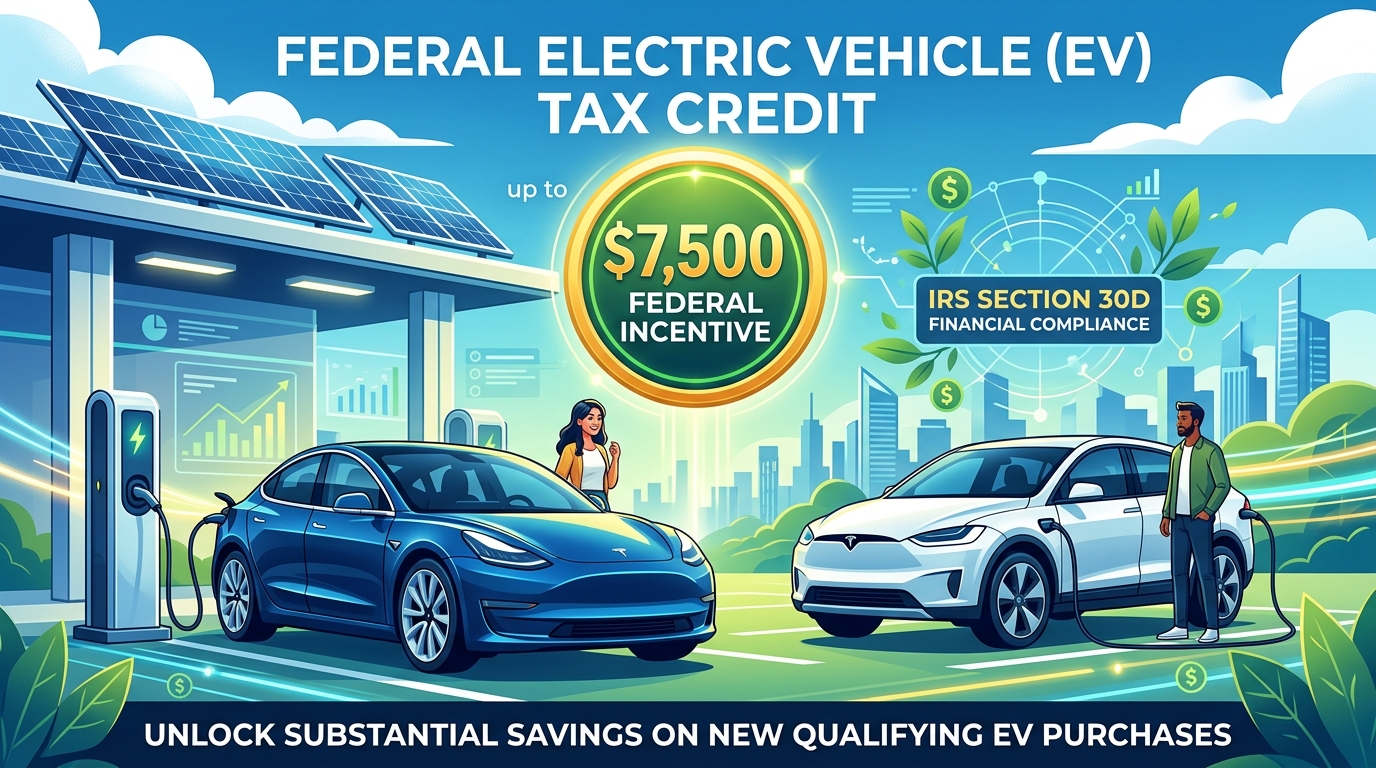
How does the federal $7,500 EV tax credit work and which vehicles qualify under IRS Section 30D rules?
Under Internal Revenue Code Section 30D, eligible buyers of qualifying new battery electric vehicles (EVs) and plug-in hybrids (PHEVs) can receive up to a $7,500 federal clean vehicle tax credit, transferred directly at the dealership as an instant point-of-sale cash discount through the IRS Energy Credits Online portal. To qualify, buyer Modified Adjusted Gross Income (MAGI) cannot exceed $300,000 for married couples filing jointly ($225,000 head of household; $150,000 single filers), vehicle manufacturer suggested retail prices (MSRP) must stay under $80,000 for SUVs and trucks ($55,000 for sedans), and the vehicle must satisfy strict North American assembly and critical battery mineral sourcing requirements.
Federal EV Tax Credit 2026-2027 Calculator & Point-of-Sale Rebate Checker
Verify whether your electric vehicle purchase qualifies for the instant $7,500 dealer cash rebate or $4,000 pre-owned credit based on IRS statutory income limits, vehicle MSRP caps, and North American critical mineral sourcing rules.
Under Treasury regulations, you can qualify using your Modified AGI from either the year you take delivery or the immediately preceding tax year. If your income spiked in 2026 or 2027, you can safely benchmark against the prior year to preserve your full $7,500 credit!
1Statutory Framework: How IRC Section 30D Structures the $7,500 Clean Vehicle Credit
The federal clean vehicle credit, established under Internal Revenue Code Section 30D through the Inflation Reduction Act and updated by Treasury regulations (TD 9995), restructured federal incentives for zero-emission transportation. Unlike earlier tax credits that phased out after a manufacturer sold 200,000 vehicles (penalizing pioneers like Tesla and General Motors), Section 30D eliminated brand caps while establishing rigorous supply chain and consumer qualification standards.
The $7,500 total incentive consists of two independent statutory components of $3,750 each. The first $3,750 requires that a minimum percentage of the applicable critical minerals contained in the vehicle's battery pack were extracted or processed in the United States or in a country with which the US has a Free Trade Agreement in effect. The second $3,750 requires that a minimum percentage of the battery components were manufactured or assembled in North America.
Furthermore, vehicles containing battery components or critical minerals extracted, processed, or recycled by a Foreign Entity of Concern (FEOC)—including state-controlled entities in China, Russia, Iran, and North Korea—are strictly disqualified from receiving the credit.
- Critical Mineral Sourcing ($3,750): Requires 50%+ to 80%+ critical battery minerals sourced from US or FTA partner nations.
- Battery Component Assembly ($3,750): Requires 60%+ to 100% of battery cell components manufactured in North America.
- Final Assembly Requirement: Final vehicle assembly must occur within North America (verified via VIN digit 1, 4, or 5).
- Vehicle Weight Rating: Gross Vehicle Weight Rating (GVWR) must be under 14,000 pounds with a minimum 7 kWh battery capacity.
2Point-of-Sale Rebate Mechanics: Instant Cash Discounts at Dealerships
One of the most transformative consumer enhancements under Treasury Decision TD 9995 is the point-of-sale (POS) transfer mechanism codified at IRC § 30D(g). Rather than purchasing a qualifying vehicle at full sticker price and waiting up to fifteen months to claim a non-refundable credit on Form 8936, buyers can elect to transfer the credit directly to a registered automotive dealer at the time of purchase.
Under this mechanism, the dealer reduces the vehicle's purchase price or down payment by the full credit value ($7,500 or $3,750), effectively providing instant government-funded cash equity. The dealer then submits the vehicle identification number (VIN) and buyer attestation through the IRS Energy Credits Online portal, receiving direct reimbursement from the US Treasury within seventy-two hours.
Crucially, Treasury regulations confirm that buyers do not need to have $7,500 in federal tax liability to benefit from the point-of-sale transfer. Even if your net tax liability at the end of the year is only $2,000, the IRS will not recapture the remaining $5,500 difference, provided your Modified AGI does not exceed statutory income limits.
3Modified AGI Limits and the Two-Year Lookback Safe Harbor Rule
To ensure federal subsidies support middle-class adoption rather than ultra-high-income households, Congress instituted strict statutory income ceilings under IRC § 30D(f)(10). For married couples filing jointly or surviving spouses, the Modified Adjusted Gross Income cap is $300,000. For head-of-household filers, the limit is $225,000, and for single filers or married individuals filing separately, the limit is $150,000.
To protect buyers whose earnings fluctuate year to year, the statute incorporates an essential safe harbor provision: you qualify for the EV tax credit if your Modified AGI is below the threshold in either the tax year you take delivery of the vehicle OR the immediately preceding tax year.
For example, if you purchase a Tesla Model Y in 2027 and your 2027 income rises to $170,000 (exceeding the $150,000 single filer cap), you can safely benchmark against your 2026 tax return. If your 2026 Modified AGI was $138,000, you are fully compliant and face zero IRS recapture penalties.
4Vehicle Classification: Navigating the $80,000 vs $55,000 MSRP Caps
The federal statute imposes strict caps on manufacturer suggested retail prices (MSRP). For vans, sport utility vehicles (SUVs), and pickup trucks, the maximum allowable MSRP is $80,000. For all other passenger vehicles, including standard sedans and hatchbacks, the MSRP cap is $55,000.
The MSRP calculation is based on the Monroney window sticker price, encompassing base vehicle price and factory-installed manufacturer options, but excluding destination freight charges, optional dealer accessories, registration fees, and state sales taxes.
Classification disputes historically caused confusion for crossover models like the Tesla Model Y or Ford Mustang Mach-E. The IRS harmonized standards with EPA Fuel Economy Regulations (40 C.F.R. § 600.002-08). Under current guidelines, high-volume electric crossovers equipped with all-wheel drive or qualifying approach angles are classified as SUVs, granting buyers the full $80,000 headroom.
5Pre-Owned Clean Vehicle Credit: Securing Up to $4,000 Under IRC Section 25E
Consumers purchasing pre-owned electric vehicles can access federal incentives under Internal Revenue Code Section 25E. The credit equals 30% of the sale price, capped at a maximum of $4,000, for used electric vehicles and plug-in hybrids purchased from a licensed automotive dealership.
To qualify under Section 25E, the used vehicle must have a model year at least two calendar years older than the calendar year of purchase (e.g., a 2024 or older model purchased in 2026/2027), carry a sales price of $25,000 or less, and have not been transferred after August 16, 2022, to an individual other than the original buyer.
Income limits for the pre-owned credit are lower: $150,000 for married couples filing jointly, $112,500 for heads of household, and $75,000 for single filers. Like the new vehicle credit, the Section 25E used credit can be transferred directly at the dealership for an instant $4,000 down payment reduction.
Federal EV Tax Credit Qualification Matrix (New IRC § 30D vs Used IRC § 25E)
| Statutory Incentive Metric | New Clean EV (IRC § 30D) | Used / Pre-Owned EV (IRC § 25E) | Leased Clean EV (IRC § 45W Commercial) |
|---|---|---|---|
| Maximum Federal Credit | Up to $7,500 ($3,750 + $3,750) | 30% of price up to $4,000 | Up to $7,500 pass-through incentive |
| Married Joint Income Cap | $300,000 Modified AGI | $150,000 Modified AGI | No income limits for lessee |
| Single Filer Income Cap | $150,000 Modified AGI | $75,000 Modified AGI | No income limits for lessee |
| Vehicle Price / MSRP Limit | $80k (SUV/Truck) / $55k (Sedan) | $25,000 Maximum Sales Price | No MSRP cap for commercial lessor |
| Battery & Assembly Rules | Strict North American & Mineral caps | Exempt from mineral & assembly caps | Exempt from domestic assembly rules |
| Dealer Point-of-Sale Transfer | Yes — Instant cash discount | Yes — Instant cash discount | Yes — Factored into lease payment |
4-Step Blueprint to Claim Your $7,500 Clean Vehicle Discount
Verify VIN Eligibility on FuelEconomy.gov
Check the exact vehicle identification number (VIN) on the official federal portal (fueleconomy.gov) to confirm North American assembly and active battery mineral qualification.
Confirm Modified AGI Compliance via Two-Year Lookback
Review your Form 1040 from the preceding tax year and current year earnings to ensure Modified AGI remains under $300k (married) or $150k (single).
Execute Point-of-Sale Credit Transfer at Dealership
Ensure the selling dealer is officially registered on IRS Energy Credits Online. Authorize the electronic credit transfer to deduct $7,500 directly from your out-the-door invoice.
Obtain IRS Confirmation Report & File Form 8936
Secure a printed copy of the IRS Energy Credits Online Time-of-Sale Report from the dealer. Attach IRS Form 8936 to your annual federal tax return to reconcile the transfer.
Curated Expert Video Walkthroughs & Wall Street Briefings




Frequently Asked Questions (Verified Statutory Answers)
Q1: Do I need $7,500 in federal tax liability to receive the EV tax credit?
No. If you transfer the credit at the dealership through the point-of-sale mechanism, the dealer provides an instant $7,500 price reduction regardless of your total annual tax liability. Under Treasury regulations, the IRS will not recapture the excess credit amount if your actual tax liability ends up lower than $7,500, as long as your Modified AGI does not exceed statutory caps.
Q2: What is the two-year income lookback safe harbor rule?
Under IRC § 30D(f)(10), you can qualify for the clean vehicle tax credit using your Modified Adjusted Gross Income from either the tax year the vehicle is delivered or the immediately preceding tax year. If your income was below the cap in either year, you meet the statutory eligibility standard.
Q3: Does the EV tax credit apply to leased electric vehicles?
Yes, through the commercial clean vehicle credit under IRC Section 45W. When you lease an electric vehicle, the $7,500 credit is claimed by the leasing company (the commercial vehicle owner), which is exempt from North American assembly and battery sourcing rules. Most major captive finance arms pass this $7,500 savings directly to the lessee as a capitalized cost reduction.
Q4: What happens if a dealership is not registered on IRS Energy Credits Online?
If a dealership is not registered with the IRS Energy Credits Online platform, it cannot offer the instant point-of-sale discount, and buyers cannot claim the credit at year-end because the IRS requires a dealer-generated Time-of-Sale report submitted within three calendar days of purchase.
Q5: Does purchasing options push my electric vehicle past the MSRP cap?
Yes. The MSRP limit ($80,000 for SUVs and trucks; $55,000 for sedans) includes the base price plus all manufacturer-installed options on the Monroney window sticker (such as upgraded wheels, paint, and interior packages). However, destination delivery charges, dealer documentation fees, and aftermarket accessories do not count toward the cap.



Curated Expert Insights & Verified Consumer Disclosures
“The point-of-sale transfer mechanism completely changed EV economics. You no longer need $7,500 in tax liability to get the full benefit. If you qualify on income, the dealer knocks $7,500 off the cash price right at the desk. Always demand your IRS Time-of-Sale confirmation printout before signing.”
“Many taxpayers believe they are disqualified if their salary exceeded $150k this year. Remember the IRC Section 30D prior-year lookback safe harbor! If your 2025 or 2026 Modified AGI was under the cap, you qualify 100% legally even if you earned $300k in 2027.”