
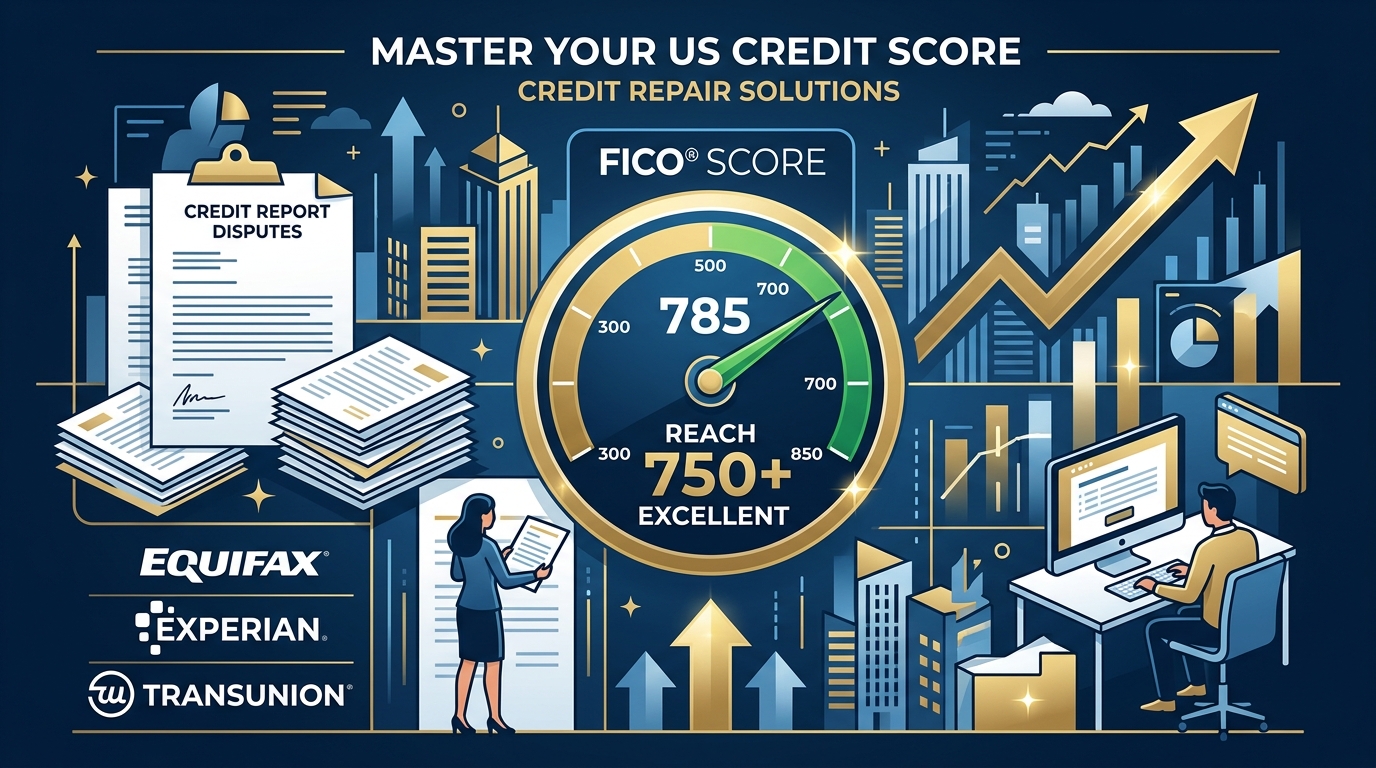
How do you formally dispute and remove inaccurate errors from Equifax, Experian, and TransUnion credit reports?
Under the Fair Credit Reporting Act (15 U.S.C. § 1681i), consumers have the statutory right to challenge inaccurate, incomplete, or unverified records with the nationwide consumer reporting agencies (Equifax, Experian, and TransUnion). Credit bureaus must conduct a free, reasonable investigation within 30 calendar days of receiving your formal written dispute. If the original creditor or collection agency fails to verify the disputed trade line with verifiable source documentation within that statutory window, the credit bureau is legally required to permanently delete the derogatory mark from your credit file.
FCRA Credit Report Dispute & FICO Score Recovery Simulator
Select your disputed negative credit mark to compute estimated FICO score recovery, examine mandatory bureau response deadlines under federal law, and generate an official FCRA dispute letter.
Furnish proof of on-time payment records, bank cleared check copies, or invoke a Goodwill Adjustment if the record is isolated. Always dispute via certified mail rather than online bureau dispute forms, because online forms frequently contain forced arbitration clauses that forfeit your right to pursue statutory damages under 15 U.S.C. § 1681n.
[Date: October 7, 2026]
To: Equifax Information Services / Experian / TransUnion
Subject: Formal Dispute of Inaccurate Credit Information under FCRA Section 609 & 611

Consumer Full Legal Name: [Your Name]
Social Security Number: [XXX-XX-XXXX]
Date of Birth: [MM/DD/YYYY]
Current Address: [Your Full Mailing Address]

Dear Dispute Investigation Department,

I am writing pursuant to my statutory rights under the Fair Credit Reporting Act (15 U.S.C. § 1681i, Section 611) to formally dispute inaccurate and unverified information appearing on my consumer credit report.

Disputed Account Name: [Name of Creditor / Collection Agency]
Account Number: [Partial Account Number from Report]
Nature of Inaccuracy: [State reason: Inaccurate late payment / Unverified collection / Obsolete item beyond 7 years / Account does not belong to me]

Under 15 U.S.C. § 1681i, you are required to conduct a reasonable investigation and verify this record with original source documentation within 30 calendar days of receiving this notice. If the data furnisher fails to verify the accurate statutory record, federal law requires you to promptly delete this item from my credit file.

Enclosed are copies of my government-issued photo ID, proof of address, and supporting verification documents.

Sincerely,
[Your Signature & Printed Name]
1Federal Legal Framework: Your Rights Under FCRA Sections 609, 611, and 623
Congress enacted the Fair Credit Reporting Act (FCRA), codified at 15 U.S.C. § 1681 et seq., to ensure that nationwide consumer reporting agencies adopt reasonable procedures to meet the needs of commerce with fairness, impartiality, and respect for the consumer's right to privacy. Inaccurate credit reporting directly inflates borrowing costs across mortgages, auto financing, personal loans, and credit card interest rates.
FCRA Section 609 (15 U.S.C. § 1681g) grants consumers the absolute legal right to inspect all information in their credit files, including the source of each entry and the identity of any business that pulled an inquiry within the previous two years. FCRA Section 611 (15 U.S.C. § 1681i) establishes the operational mechanism for disputes: once a consumer notifies a bureau of an inaccurate item, the bureau must transmit all relevant evidence to the data furnisher within five business days and complete its investigation within thirty calendar days.
FCRA Section 623 (15 U.S.C. § 1681s-2) places affirmative statutory duties upon data furnishers (banks, credit card issuers, auto lenders, and collection agencies). Furnishers are strictly prohibited from reporting information they know or have reasonable cause to believe is inaccurate. When notified of a dispute by a bureau, furnishers must review all relevant information, conduct a forensic investigation of their internal records, and report the corrected results to all nationwide credit repositories.
- Section 609 Inspection Right: Right to demand original disclosures and verification of account opening records.
- Section 611 30-Day Clock: Bureaus must delete or correct unverified records within 30 days of receiving your dispute notice.
- Section 605 Obsolete Debt Cap: Delinquent trade lines must age off credit reports after 7 years from the Date of First Delinquency (DOFD).
- Section 616/617 Private Right of Action: Allows consumers to sue willful violators for actual damages or statutory damages up to $1,000 per violation plus attorney fees.
2Certified Mail vs Online Portals: Why Paper Disputes Protect Your Rights
Major credit bureaus aggressively steer consumers toward their web-based dispute interfaces. While online submissions appear convenient, consumer protection attorneys strongly advise against using online bureau portals. When you click 'I Agree' on bureau websites, you routinely accept terms of use that subject you to binding arbitration and strip away your constitutional right to participate in federal class actions or recover statutory damages under 15 U.S.C. § 1681n.
Online forms reduce complex statutory arguments to automated two-digit dispute codes within the automated Consumer Dispute Verification (e-OSCAR) system. When you select 'Not My Account' or 'Never Late' in a drop-down menu, the bureau's optical scanners condense your multi-page legal dispute into a mechanical three-character code, bypassing meaningful human review.
Sending a typed dispute packet via United States Postal Service (USPS) Certified Mail with Return Receipt Requested (the physical green card) creates an indisputable federal evidentiary chain of custody. The date stamped on the postal delivery receipt starts the statutory 30-day countdown clock under federal law. If thirty calendar days elapse without a verified response from the credit bureau, the bureau commits a per se regulatory violation if it continues to display the unverified derogatory entry.
3Essential Supporting Documents for an Ironclad Credit Dispute
Credit reporting agencies receive thousands of automated dispute letters monthly from unauthorized third-party credit repair mills. Under 15 U.S.C. § 1681i(a)(3), bureaus have the authority to terminate an investigation early if they determine a dispute is 'frivolous or irrelevant'—often citing insufficient consumer identification. To prevent bureaus from rejecting your submission, you must include rigorous proof of identity with every postal packet.
Every certified mail packet must include four core components: a government-issued photo identification (unexpired driver's license or passport), an official proof of address (utility bill, bank statement, or lease dated within the last 60 days), proof of your Social Security Number (copy of SSN card, W-2, or Form 1099), and marked excerpts from your credit report circling the disputed line items.
Be precise regarding the specific factual defect. Do not send blanket claims stating 'all accounts are fraudulent.' Instead, clearly specify: 'Disputed Capital One trade line shows a 30-day late mark in March 2025; enclosed bank statement proves electronic payment cleared on March 12, 2025, prior to the statement due date.'
4How to Escalate When Credit Bureaus Verify Inaccurate Information
If a credit bureau responds with an automated letter stating the disputed item was 'verified as accurate' without providing original documentation, do not abandon the dispute. This boilerplate response is the standard output of the e-OSCAR algorithmic clearinghouse, where furnishers simply verify that their computer records match the bureau's record without pulling the underlying contract.
Your immediate next step is to invoke FCRA Section 611(a)(6)(B)(iii) by requesting a Method of Verification (MOV). Demand in writing the business name, address, and telephone number of each person contacted at the data furnisher, along with the specific verification procedures employed during the inquiry. Under federal law, the bureau must provide this Method of Verification within fifteen days.
Concurrently, file a formal regulatory complaint with the Consumer Financial Protection Bureau (CFPB) at consumerfinance.gov. Federal regulators monitor bureau complaint compliance rates. When a dispute is escalated through the CFPB portal, it is routed to executive management desks at Equifax, Experian, or TransUnion, resulting in manual human review and substantially higher resolution rates.
5Expected FICO Score Recovery Timeline After Derogatory Trade Line Removal
The mathematical impact of removing an erroneous negative item depends on your overall credit profile, the recency of the mark, and your existing credit utilization ratio. A single erroneous 30-day late payment reported within the past six months can depress a clean 760 FICO score by 60 to 90 points. As negative marks age, their mathematical weighting under the FICO algorithm decays exponentially.
Removing an inaccurate collection account or public record immediately lifts the ceiling on your scoring bracket. Consumers often experience a 35 to 80 point surge in FICO Score 8 within forty-eight hours of the bureau updating its core repository. To maximize your score gains once derogatory trade lines are deleted, maintain credit card revolving utilization below 9% across all open revolving accounts and refrain from applying for new credit cards during active mortgage pre-approvals.
FCRA Statutory Dispute Timelines & Credit Bureau Action Matrix
| Derogatory Item Category | Statutory Reporting Limit | Governing FCRA Provision | Bureau Response Window | Mandatory Action if Unverified |
|---|---|---|---|---|
| Inaccurate Late Payment | 7 Years from Late Date | 15 U.S.C. § 1681i / § 1681s-2 | 30 Calendar Days | Immediate correction or deletion |
| Unverified Collection Account | 7 Years from Original DOFD | 15 U.S.C. § 1681c(a)(4) | 30 Calendar Days | Complete removal of trade line |
| Identity Theft / Fraud Account | Permanent Block Mandatory | 15 U.S.C. § 1681c-2 (Sec. 605B) | 4 Business Days | Immediate statutory file block |
| Zombie Debt (>7 Years Old) | Statutory Expiration Cap | 15 U.S.C. § 1681c(a)(2) | 30 Calendar Days | Mandatory automated purge |
| Mixed Consumer File | Immediate File Separation | 15 U.S.C. § 1681e(b) | 30 Calendar Days | Unmerge SSN & delete third-party data |
4-Step Blueprint to Permanently Delete Inaccurate Credit Records
Pull Free Official Weekly Credit Reports
Access AnnualCreditReport.com to download official disclosures from Equifax, Experian, and TransUnion. Avoid third-party monitoring apps that omit critical furnisher account numbers and Date of First Delinquency entries.
Draft Targeted Section 609 Dispute Letters
Customize our certified dispute letter template. Identify the exact account name, partial account number, specific factual inaccuracy, and governing FCRA section. Never use generic credit repair templates.
Mail via USPS Certified Mail with Return Receipt
Dispatch separate packets to Equifax, Experian, and TransUnion dispute centers using USPS Certified Mail. Secure the green return receipt card as legal proof of delivery to establish the 30-day clock.
Audit Bureau Investigation Results & Escalate to CFPB
Review the bureau's written results. If derogatory items are deleted, verify updated scores. If verified without proper documentation, demand Method of Verification and file a formal CFPB complaint within 15 days.
Curated Expert Video Walkthroughs & Wall Street Briefings



Frequently Asked Questions (Verified Statutory Answers)
Q1: What is the official mailing address to dispute credit report errors?
Equifax: Equifax Information Services LLC, P.O. Box 740256, Atlanta, GA 30374. Experian: Experian Dispute Department, P.O. Box 4500, Allen, TX 75013. TransUnion: TransUnion Consumer Solutions, P.O. Box 2000, Chester, PA 19016. Always send via USPS Certified Mail with Return Receipt Requested.
Q2: Can a credit bureau refuse to investigate my dispute?
Under 15 U.S.C. § 1681i(a)(3), a bureau can only decline an investigation if it reasonably determines the dispute is frivolous or irrelevant, such as when the consumer fails to provide sufficient identification or repeatedly resubmits identical claims without new facts. If a bureau claims your dispute is frivolous, it must notify you in writing within five business days stating the specific reasons.
Q3: What happens if the data furnisher does not respond within 30 calendar days?
If the data furnisher fails to verify the accuracy of the disputed information within thirty calendar days (or forty-five days if you obtained your report via the free annual disclosures program), the credit reporting agency is legally obligated to promptly delete the disputed information from your file under 15 U.S.C. § 1681i(a)(5)(A).
Q4: Does paying an old collection account remove it from my credit report?
No. Paying a collection account updates the balance to $0 and marks the status as 'Paid Collection', but the derogatory trade line remains on your report for seven years from the original Date of First Delinquency (DOFD). To remove a valid collection early, you must negotiate a written 'Pay for Delete' agreement prior to transferring funds.
Q5: Can credit bureaus reinsert a previously deleted negative item?
Under 15 U.S.C. § 1681i(a)(5)(B), a bureau cannot reinsert deleted information unless the data furnisher certifies in writing that the information is complete and accurate. The bureau must also send you written notice of the reinsertion within five business days, including the furnisher's contact details.



Curated Expert Insights & Verified Consumer Disclosures
“Never click 'Dispute Online' on Equifax or Experian. Doing so signs away your constitutional right to sue under FCRA Section 1681n through forced arbitration clauses. Send a physical letter via Certified Mail. The 30-day statutory clock is real, enforceable, and gets results.”
“We see prospective home buyers held back from prime conventional rates by a single 4-year-old medical collection showing on TransUnion. Removing an unverified collection under the FCRA routinely moves loan applicants from 660 to 735, saving tens of thousands in mortgage interest.”