
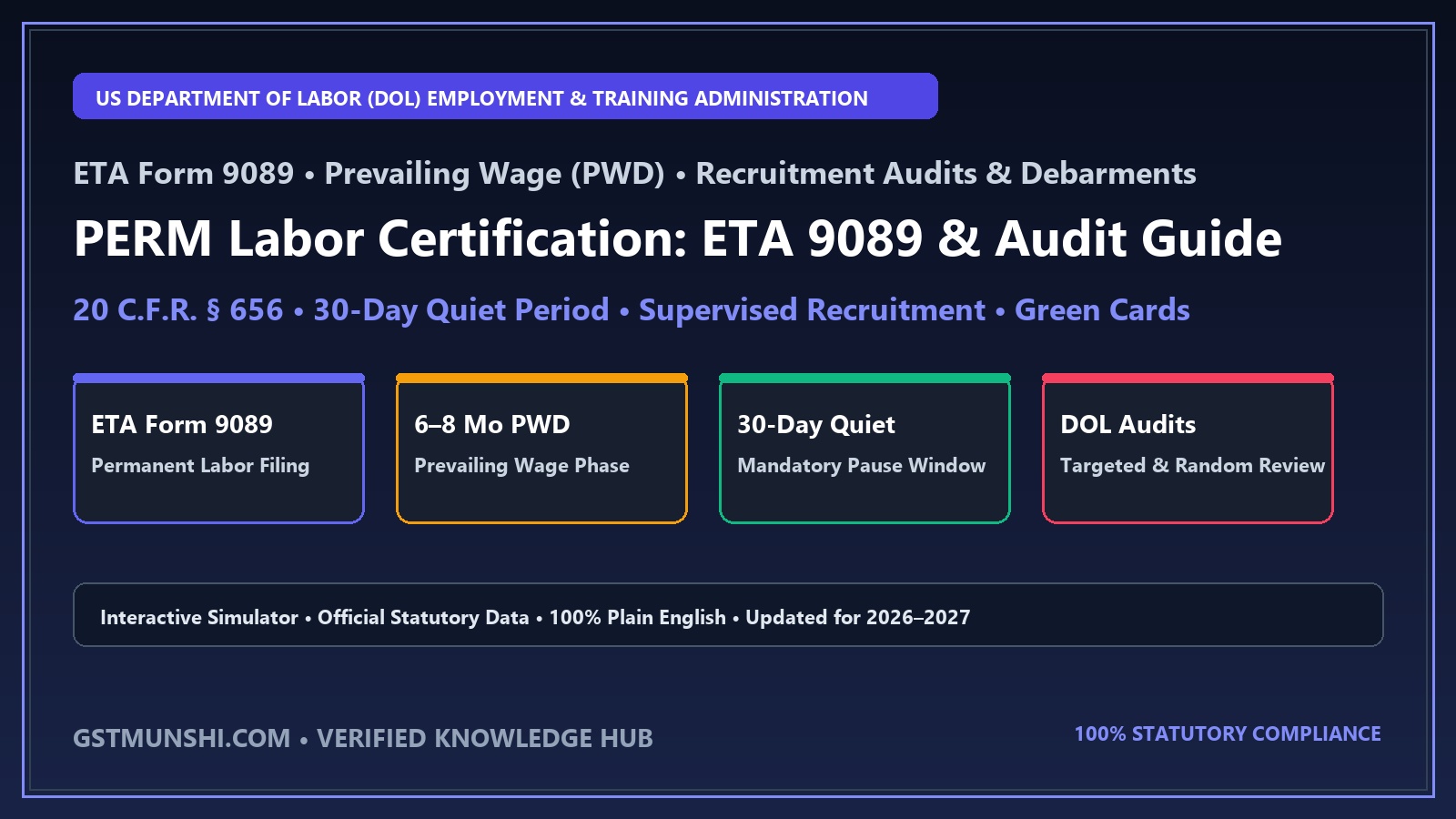
What is PERM Labor Certification and how does ETA Form 9089 work for employment green cards?
PERM (Program Electronic Review Management) is an attestation-based labor certification process administered by the US Department of Labor (DOL) under 20 C.F.R. § 656. Required for most employment-based EB-2 and EB-3 permanent residency petitions, PERM legally tests the US labor market to prove there are no able, willing, qualified, and available US workers for the open position, and that employing a foreign national will not adversely affect US wage rates. The multi-stage procedure requires securing an official Prevailing Wage Determination (PWD) from the National Prevailing Wage Center (NPWC), executing mandatory recruitment advertisements, observing a strict 30-day quiet period, and filing ETA Form 9089 via the DOL Foreign Labor Application Gateway (FLAG) system. Approved PERM certifications expire in exactly 180 days.
PERM Labor Certification Timeline & Audit Risk Simulator
Calculate end-to-end ETA Form 9089 green card processing durations, prevailing wage milestones, and DOL audit probabilities
20 C.F.R. § 656.17(k) requires notifying and considering laid-off US workers before filing.
1The Statutory Framework: INA § 212(a)(5)(A) & 20 C.F.R. Part 656
Permanent Labor Certification is the indispensable cornerstone of employer-sponsored immigration in the United States. Under Section 212(a)(5)(A) of the Immigration and Nationality Act (INA), foreign nationals seeking immigrant classification under the Second Preference (EB-2 Advanced Degree or Exceptional Ability) and Third Preference (EB-3 Professionals, Skilled Workers, and Other Workers) are inadmissible to the United States unless the Secretary of Labor issues an official certification.
This statutory certification requires the Department of Labor to make two affirmative findings: first, that there are not sufficient United States workers who are able, willing, qualified, and available at the time of application at the place where the foreign national is to perform the work; and second, that the employment of the foreign worker will not adversely affect the wages and working conditions of similarly employed United States workers. The regulations governing this procedure are codified in Title 20 of the Code of Federal Regulations, Part 656.
The modern PERM system is attestation-based, meaning employers complete and submit electronic application filings on the DOL's Foreign Labor Application Gateway (FLAG) system without initially submitting bulky supporting evidence. However, employers are legally mandated under 20 C.F.R. § 656.10(f) to construct and maintain a comprehensive 'Audit File' containing tear sheets, recruitment logs, prevailing wage determinations, and candidate resume evaluations for a minimum of five years from the date of filing, available for immediate inspection upon a DOL Audit notification.
2Prevailing Wage Determination (PWD) Strategy & OES Wage Levels
The PERM journey begins with Form ETA-9141, the Application for Prevailing Wage Determination submitted to the National Prevailing Wage Center (NPWC). The employer cannot initiate competitive recruitment or file the labor certification without establishing the prevailing wage baseline for the specific Metropolitan Statistical Area (MSA) of employment.
The NPWC assigns prevailing wages using the Occupational Employment and Wage Statistics (OEWS) wage library maintained by the Bureau of Labor Statistics, categorizing jobs across four distinct wage tiers: Level I (Entry-Level), Level II (Qualified), Level III (Experienced), and Level IV (Fully Competent/Lead). Sponsoring employers must formally agree to pay at least 100% of the certified prevailing wage from the day the foreign worker obtains permanent residence (Form I-485 approval or consular immigrant visa entry).
Strategic planning during the PWD drafting stage is critical. Sponsoring employers must ensure that the minimum education, training, and experience requirements defined for the position do not exceed the 'Specific Vocational Preparation' (SVP) parameters established in the O*NET occupational database. If an employer requires qualifications beyond the standard O*NET classification, the DOL classifies the requirements as 'Business Necessity' items, which drastically increases the likelihood of a formal audit unless substantiated with exhaustive corporate documentation.
3Mandatory Recruitment Advertising & The 30-Day Regulatory Quiet Period
To test the domestic labor market in good faith, sponsoring employers must conduct rigorous, highly structured recruitment campaigns strictly within a 180-day window prior to filing Form ETA-9089. For professional occupations (positions typically requiring a Bachelor's degree or higher), the employer must place two mandatory Sunday print advertisements in a newspaper of general circulation in the area of intended employment, place a 30-day job order with the State Workforce Agency (SWA), post an internal Notice of Filing (NOF) at the physical worksite for 10 consecutive business days, and utilize in-house electronic or internet media.
In addition to the mandatory advertisements, employers must choose and execute at least three additional recruitment steps from an authorized regulatory menu: job fairs, the employer's public career website, job search websites (such as LinkedIn, Indeed, or Monster), on-campus recruiting, trade or professional organizations, private employment search firms, employee referral incentive programs, campus placement offices, local newspapers, or radio/television ads.
Once all advertising steps conclude, the employer must enforce the mandatory 30-Day 'Quiet Period' under 20 C.F.R. § 656.17(e). During these 30 days, all active advertising must cease, allowing domestic job seekers sufficient time to review postings and submit resumes. Filing ETA Form 9089 before the 30-day quiet period has fully expired results in immediate, non-appealable denial by the DOL.
4DOL Audits, Supervised Recruitment & Corporate Debarment Risks
Following electronic submission of Form ETA-9089 via the FLAG portal, the application enters DOL adjudication. The Certifying Officer (CO) evaluates the filing and either issues a direct Certification, an Audit Notification, or a Request for Specialized Information. Audits can be triggered randomly by automated algorithmic flags or by substantive regulatory triggers: foreign language requirements, combinations of occupations, Level 1 wages for senior positions, or corporate familial relationships.
A major audit hazard in corporate America is the Layoff Rule codified in 20 C.F.R. § 656.17(k). If the sponsoring employer experienced a corporate layoff within the preceding 6 months in the area of intended employment in the same or related occupation, the employer is legally obligated to notify and consider all potentially qualified laid-off US workers for the sponsored job before filing PERM. Failing to document bona fide outreach to laid-off US workers is one of the leading causes of audit denials.
In severe cases involving pattern-and-practice violations, fraudulent recruitment, or failure to produce audit documentation within 30 days, the DOL can impose 'Supervised Recruitment'—forcing the employer to conduct all future hiring under direct DOL surveillance—or issue a formal Corporate Debarment under 20 C.F.R. § 656.31. Debarred employers (as seen in major tech enforcement actions) are legally banned from filing any permanent labor certifications, H-1B Labor Condition Applications (LCAs), or seasonal H-2B visas for up to three full calendar years.
Mandatory PERM Recruitment Advertising Steps: Professional vs. Non-Professional
| Recruitment Step Category | Professional Occupations (BS/MS/PhD) | Non-Professional Occupations | Statutory Timing & Evidence Requirements |
|---|---|---|---|
| State Workforce Agency (SWA) Job Order | Mandatory (Placed for at least 30 calendar days) | Mandatory (Placed for at least 30 calendar days) | Must be opened and closed between 30 and 180 days prior to filing |
| Sunday Newspaper Print Advertisements | Mandatory (2 separate Sunday editions) | Mandatory (2 separate Sunday editions) | Major newspaper of general circulation; full tear sheets required in audit file |
| Physical Notice of Filing (NOF) / Posting | Mandatory (10 consecutive business days) | Mandatory (10 consecutive business days) | Posted in conspicuous physical location at worksite + electronic intranet posting |
| Additional Recruitment Steps (Choice of 3) | Mandatory (Select 3 from 10 regulatory options) | NOT Required (Sunday ads + SWA sufficient) | Options include LinkedIn/Indeed, job fairs, employer website, referral programs |
| Mandatory Regulatory Quiet Period | Mandatory (30-day waiting period post-ads) | Mandatory (30-day waiting period post-ads) | Allows US applicants time to respond; one additional ad can occur during quiet period |
Typical Employment-Based Green Card (EB-2/EB-3) PERM Timeline
| Processing Milestone Phase | Administering Agency / Body | Typical Duration | Critical Regulatory Constraints |
|---|---|---|---|
| Prevailing Wage Determination (Form ETA-9141) | National Prevailing Wage Center (NPWC) | 6 to 8 Months | Validity ranges 90 days to 1 year; must initiate ads while valid |
| Mandatory Recruitment Campaign | Sponsoring Employer & Legal Counsel | 2 to 3 Months | All advertisements must occur within a 180-day window |
| Mandatory 30-Day Quiet Period | Regulatory Inactive Waiting Window | 30 Calendar Days | Premature filing before Day 31 results in automated denial |
| ETA Form 9089 Electronic Adjudication | DOL Office of Foreign Labor Certification | 12 to 14 Months | Attestation filing via the official FLAG.dol.gov portal |
| DOL Audit Response Window (If Audited) | DOL Certifying Officer Review | +5 to +8 Months | Employer must produce full audit file within 30 days of notice |
| Form I-140 Immigrant Petition Filing | US Citizenship and Immigration Services (USCIS) | 15 Days (Premium) / 6 Mos | Must be filed with USCIS within 180 days of PERM certification |
Step-by-Step SOP: Navigating the PERM Labor Certification Process
Draft Job Description and Prevailing Wage Request (ETA-9141)
Partner with corporate immigration counsel to define minimum educational requirements, job duties, and worksite locations within O*NET guidelines. File Form ETA-9141 with the NPWC.
Conduct Mandatory Competitive Recruitment Advertising
Upon receiving certified prevailing wages, place the 30-day State Workforce Agency job order, two Sunday newspaper print advertisements, physical Notice of Filing, and three additional professional ads.
Review Domestic Resumes and Complete the 30-Day Quiet Period
Hiring managers evaluate all incoming US applicants against the minimum job requirements. Disqualify applicants only for lawful job-related reasons and observe the 30-day quiet period.
Compile the Comprehensive PERM Audit File
Assemble all recruitment tear sheets, electronic posting screenshots, SWA confirmation notices, prevailing wage determination, and contemporaneous recruitment summary report into the mandatory 5-year audit file.
Submit ETA Form 9089 via the DOL FLAG Portal
Electronically submit the completed ETA Form 9089 on FLAG.dol.gov. Ensure employer and employee information, salary figures, and educational requirements match the PWD exactly.
File Form I-140 with USCIS Within the 180-Day Validity Window
Upon receiving certified Form ETA-9089 from the DOL Certifying Officer, submit Form I-140 (Immigrant Petition for Alien Workers) with USCIS before the 180-day expiration deadline.
Official Statutory Rules, Federal Codes & Bar Citations
Immigration and Nationality Act § 212(a)(5)(A)
Statutory labor certification mandate establishing legal standards to protect US workforce wages and job opportunities.
Title 20 Code of Federal Regulations Part 656
Comprehensive federal regulations governing permanent labor certification procedures, recruitment standards, and audits.
Board of Alien Labor Certification Appeals (BALCA) En Banc Decisions
Precedential administrative decisions defining lawful rejection of US workers, business necessity, and notice rules.
OFLC Frequently Asked Questions & Bulletins
Official administrative guidance clarifying layoff notification requirements, electronic filings, and quiet period calculations.
Curated Expert Video Walkthroughs & Wall Street Briefings
Frequently Asked Questions (Verified Statutory Answers)
Q1: What is PERM Labor Certification?
PERM (Program Electronic Review Management) is an electronic labor certification process administered by the US Department of Labor. It requires an employer to prove that there are no qualified, able, and willing US workers available for a permanent job position before sponsoring a foreign national for an EB-2 or EB-3 employment-based green card.
Q2: How long does the entire PERM process take in 2026–2027?
The complete PERM process currently takes between 18 and 24 months: 6 to 8 months for the Prevailing Wage Determination (PWD), 2 to 3 months for mandatory recruitment advertising, 30 days for the mandatory quiet period, and 12 to 14 months for the DOL to adjudicate ETA Form 9089. An audit adds an additional 5 to 8 months.
Q3: What is the mandatory 30-day quiet period in PERM?
The quiet period is a mandatory 30-day waiting window following the completion of recruitment advertising during which no active ads are placed (except for one optional additional professional recruitment step). It provides domestic job applicants sufficient time to apply before the employer can legally file Form ETA-9089.
Q4: What triggers a Department of Labor PERM audit?
Audits can be random or triggered by specific risk factors, including: corporate layoffs in the same or related occupation within the last 6 months, Level 1 entry-level prevailing wages, requiring a foreign language, public ownership or family relationship with the foreign employee, or job requirements exceeding standard O*NET vocational parameters.
Q5: What happens if a PERM application is audited?
The DOL issues an Audit Notification letter requiring the employer to submit its complete Audit File within 30 calendar days. The file must include prevailing wage determinations, proof of all print and online advertisements (tear sheets and screenshots), recruitment summaries, and lawful job-related reasons for disqualifying domestic applicants.
Q6: Can an employer reject a US worker if the foreign national is more qualified?
No. Under 20 C.F.R. § 656.17, an employer cannot reject a US applicant who meets the minimum qualifications specified on Form ETA-9089, even if the foreign worker holds superior degrees, higher test scores, or more years of experience. PERM tests for minimum competency, not competitive superiority.
Q7: How long is an approved PERM labor certification valid?
An approved PERM labor certification is valid for exactly 180 calendar days from the date of certification. The employer must file Form I-140 (Immigrant Petition for Alien Workers) with USCIS before this 180-day window closes, or the certification becomes permanently void.
Q8: Can an employee pay for the PERM process?
No. Under 20 C.F.R. § 656.12, the sponsoring employer is legally required to pay all attorney fees, advertising costs, and expenses associated with the PERM labor certification. The foreign employee cannot pay, reimburse, or contribute to PERM costs directly or through payroll deductions.
Q9: What is DOL Supervised Recruitment?
Supervised Recruitment is an administrative enforcement measure where the DOL takes direct control over an employer's hiring process following audit failures or pattern violations. The employer must submit draft advertisements for prior approval, and all job applications must be sent directly to the DOL before being forwarded to the employer.
Q10: What is corporate PERM debarment?
Debarment is a severe regulatory penalty under 20 C.F.R. § 656.31 prohibiting an employer or attorney from filing any permanent labor certifications, H-1B Labor Condition Applications, or seasonal worker petitions for up to three years due to fraud, willful misrepresentation, or failure to cooperate with audits.
Q11: What is the difference between EB-2 and EB-3 PERM requirements?
EB-2 PERM positions require an Advanced Degree (Master's degree or higher, or a Bachelor's degree plus 5 years of progressive post-baccalaureate experience). EB-3 PERM positions require a Bachelor's degree (Professionals) or at least 2 years of qualifying training/experience (Skilled Workers).
Q12: Can I change employers while my PERM is pending?
No. A PERM application is employer-specific and job-specific. If you change employers while your PERM is pending, the application is abandoned and your new employer must restart the entire process from the Prevailing Wage Determination stage.




Verified X (Twitter) & LinkedIn Expert Insights
“The most common pitfall we see in PERM labor certifications during tech industry slowdowns is the Layoff Rule under 20 C.F.R. § 656.17(k). Employers frequently assume that if they laid off software engineers in their cloud division, they can freely file a PERM for a data engineer without notifying the laid-off staff. The DOL takes an expansive view of 'related occupations.' If there is substantial overlap in core duties, failing to document written outreach to laid-off US workers invites an immediate audit and eventual denial.”
“Remember that the PERM labor certification process is not about finding the best candidate for the job—it is strictly about determining whether there is a minimally qualified US worker available. Sponsoring employers cannot reject a US applicant simply because the foreign worker has a higher GPA, better communication skills, or more advanced certifications. If the US worker meets the baseline degree and experience listed on Form ETA-9089, the employer cannot lawfully disqualify them.”
“Crucial reminder on PERM validity: Once the Department of Labor approves your ETA Form 9089, the certification is valid for exactly 180 calendar days. If USCIS does not receive your Form I-140 within that 180-day window, the labor certification expires permanently. You cannot get an extension from the DOL; you have to restart the entire 18-month process from scratch.”
“Never rush the 30-day quiet period. If your last Sunday newspaper ad ran on March 1st, do not file ETA 9089 on March 30th. Day 31 is the earliest legal filing date. Filing even 24 hours early results in an automated, non-appealable denial, wasting thousands of dollars in legal fees and months of recruitment effort.”