
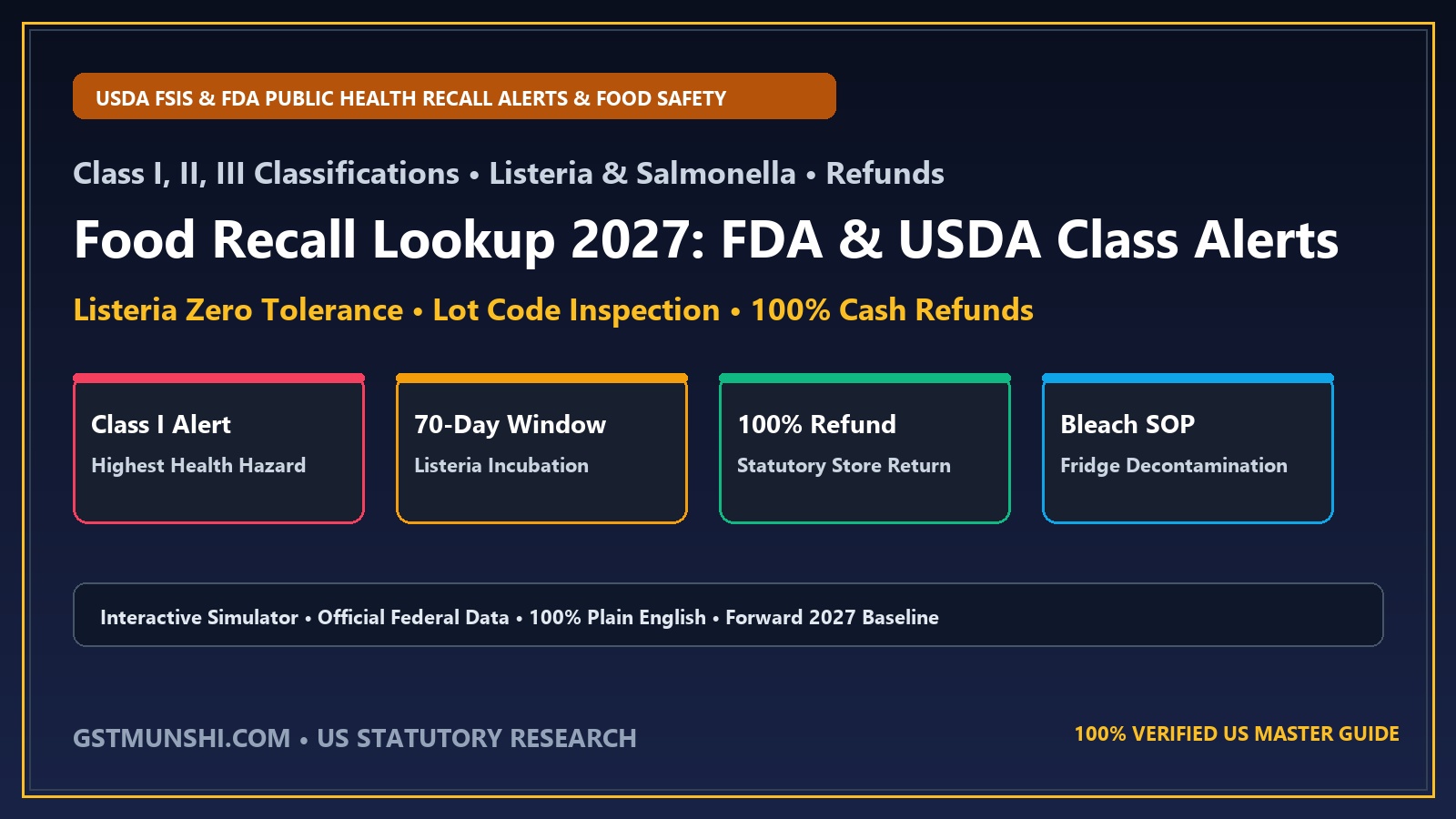
How do you check for active food recalls and what are your refund rights under FDA and USDA rules?
To check for active food recalls, search the official online databases of the USDA Food Safety and Inspection Service (FSIS) for meat, poultry, and egg products, and the FDA for all other foods (produce, dairy, snacks, baby formula, and seafood). Recalls are classified into Class I (high risk with severe health consequences or death), Class II (moderate, temporary health risk), and Class III (low risk, technical violations). Locate the lot code, 'Best If Used By' date, and establishment number ('EST' mark in USDA seal) on the product packaging. Consumers are legally entitled to a 100% full cash or card refund from any grocery retailer where the product was sold, even without a receipt. Never consume or taste recalled food; double-bag it and sanitize contact surfaces with a bleach solution.
USDA FSIS & FDA Food Recall Risk & Consumer Refund Rights Analyzer
Identify regulatory recall classifications, pathogen incubation timelines, and mandatory store refund procedures
1FDA vs. USDA FSIS Jurisdiction: Who Regulates What in Grocery Recalls?
When a contaminated food outbreak triggers emergency alerts across national news and grocery store chains, consumers often struggle to find official recall information due to a split in federal regulatory jurisdiction. In the United States, food safety oversight is bifurcated between two distinct federal departments.
The Food Safety and Inspection Service (FSIS)—an agency of the US Department of Agriculture (USDA)—operates under the statutory authority of the Federal Meat Inspection Act (21 U.S.C. § 601), the Poultry Products Inspection Act, and the Egg Products Inspection Act. The USDA FSIS holds exclusive regulatory authority over all commercial meat products (beef, pork, lamb), poultry (chicken, turkey), and processed egg products. Every USDA-regulated product carries a circular inspection mark with an establishment number (such as 'EST. 19955' or 'P-1234') stamped on the packaging.
The Food and Drug Administration (FDA)—under the Department of Health and Human Services (HHS) and governed by the FDA Food Safety Modernization Act (FSMA)—regulates everything else. This encompasses fresh produce, bagged salads, dairy products (milk, artisan cheeses, ice cream), seafood, baked goods, snacks, bottled water, infant formula, and dietary supplements. Knowing which agency oversees the product allows you to immediately pinpoint the correct federal recall notification portal.
2The Three Statutory Recall Classes: Assessing Immediate Health Hazards
Both the FDA and USDA categorize recalls into three statutory classifications based on the degree of medical and public health hazard presented by the contaminated food product.
A Class I Recall is the highest, most dangerous classification. By federal definition, a Class I recall represents a health hazard situation where there is a reasonable probability that eating the food will cause serious adverse health consequences or death. Class I recalls are triggered by deadly bacterial pathogens like Listeria monocytogenes, Salmonella enterica, and Shiga toxin-producing E. coli O157:H7, as well as products containing undeclared major food allergens (such as hidden peanuts, tree nuts, dairy, or shellfish) that pose life-threatening anaphylactic shock risks to allergic consumers.
A Class II Recall indicates a moderate health hazard where there is a remote probability of adverse health consequences or where the health consequences are temporary or medically reversible. Examples include contamination with extraneous physical matter like small plastic shavings, or undeclared allergens that typically cause mild allergic reactions. A Class III Recall involves products that violate statutory labeling or manufacturing regulations but are unlikely to cause any adverse medical consequences, such as minor packaging defects, slight net-weight discrepancies, or lack of proper bilingual labeling.
3Pathogen Profiles: Why Listeria Is the Deadliest Kitchen Contaminant
Among all bacterial foodborne pathogens, Listeria monocytogenes presents the most insidious danger in modern consumer kitchens. Unlike Salmonella or E. coli—which typically manifest with sudden vomiting, violent abdominal cramping, and watery diarrhea within 6 to 72 hours—Listeria is a slow-incubating, stealth organism.
Symptoms of invasive Listeriosis may take anywhere from 1 to 70 days to develop following ingestion of contaminated food. Furthermore, while most common bacteria stop multiplying when food is placed inside a cold refrigerator, Listeria is psychrotrophic, meaning it actively survives and multiplies at standard refrigeration temperatures (34°F to 40°F) and can even survive commercial freezing. Contaminated deli meats, hot dogs, soft cheeses (like queso fresco, brie, and feta), and pre-cut melons can contaminate adjacent food items simply by resting on the same refrigerator shelf.
Invasive Listeriosis carries a staggering 20% to 30% mortality rate among high-risk demographics, making it the leading cause of death from food poisoning in the United States. Pregnant women are approximately 10 times more likely to contract Listeria, which frequently leads to miscarriage, stillbirth, or life-threatening newborn sepsis without causing severe symptoms in the mother. Adults aged 65 and older and individuals with compromised immune systems face extreme risks of bacterial meningitis and bloodstream sepsis.
4Your Statutory Refund Rights & Refrigerator Decontamination SOP
When a food recall is announced, grocery store chains—including Walmart, Kroger, Costco, Target, Whole Foods, and Trader Joe's—are legally mandated to pull all affected inventory from their shelves immediately. Point-of-sale register software is updated to automatically block the barcode from scanning if a cashier attempts to ring it up.
For consumers who already purchased the recalled food, federal food safety regulations and store consumer protection policies grant you a guaranteed 100% full refund. Crucially, you do NOT need your original paper receipt to receive a full refund. Because public health takes precedence over commercial accounting, retailers will issue a full cash refund, card credit, or store merchandise gift card upon presentation of the recalled item or packaging showing the affected lot code.
If you discover a recalled product in your home, do not open, smell, or taste it. Immediately place the item in a sealed plastic bag, double-knot it, and take it to the store for a refund or place it in a secured outdoor trash bin. If the product was stored unwrapped or leaked juices inside your refrigerator, execute the CDC sanitization protocol: discard all exposed food items that touched the surface, wash all interior shelves and drawers with warm soapy water, and wipe down surfaces with a fresh sanitizing solution of 1 tablespoon unscented liquid chlorine bleach per 1 gallon of cool water.
Federal Food Recall Classifications: Hazards, Triggers & Examples
| Recall Classification | Health Hazard Severity | Common Biological / Physical Triggers | Required Federal Agency Response | Historical Real-World Examples |
|---|---|---|---|---|
| Class I (High Risk) | Serious adverse health consequences or death; life-threatening | Listeria monocytogenes, Salmonella, E. coli O157:H7, Undeclared Peanuts/Milk | Immediate national press release, retailer distribution list published, POS lock | Boar's Head deli meat (Listeria), bagged organic carrots (E. coli), frozen waffles |
| Class II (Moderate Risk) | Temporary or medically reversible health issues; remote serious risk | Extraneous foreign matter (metal shavings, hard plastic fragments, glass particles) | Targeted media release, mandatory distributor notification, product retrieval | Chicken nuggets with plastic bits, canned soup with glass shards, low-level allergens |
| Class III (Low Risk) | Unlikely to cause adverse health consequences; technical violation | Minor labeling omissions, off-odors/spoilage without pathogen, net weight error | Direct trade and retailer notification; public health press release optional | Canned vegetables missing minor ingredient, yeast spoilage without illness |
| Public Health Alert (PHA) | Identical to Class I risk, but product is no longer commercially available | Outbreak identified after expiration date, but consumers may have it in home freezers | Urgent consumer notification warning against eating frozen leftovers | Ground beef patties frozen by consumers past retail shelf expiration |
Major Foodborne Pathogens: Onset Timelines, High-Risk Foods & Red Flags
| Pathogen | Incubation / Onset Period | Typical High-Risk Food Vectors | Key Warning Symptoms |
|---|---|---|---|
| Listeria monocytogenes | 3 to 70 Days (Avg 2–3 weeks) | Deli meats, hot dogs, unpasteurized milk, soft cheeses | High fever, muscle aches, stiff neck, confusion, miscarriage |
| Salmonella enterica | 6 Hours to 6 Days | Raw poultry, eggs, unwashed cantaloupes, peanut butter | Diarrhea, intense fever, abdominal cramps, vomiting |
| E. coli O157:H7 (STEC) | 2 to 8 Days (Avg 3–4 days) | Undercooked ground beef, raw bagged spinach, unpasteurized cider | Severe stomach cramps, bloody diarrhea, HUS kidney failure |
| Clostridium botulinum | 18 to 36 Hours | Improperly home-canned vegetables, garlic in oil, honey (infants) | Double vision, drooping eyelids, slurred speech, paralysis |
| Norovirus | 12 to 48 Hours | Raw oysters, leafy greens, food prepared by infected worker | Sudden projectile vomiting, watery diarrhea, severe dehydration |
Step-by-Step SOP: What to Do When a Food in Your Kitchen Is Recalled
Verify the Exact Lot Code, Expiration Date and Establishment Number
Do not throw food away based on brand name alone. Compare the printed Lot Number, 'Best By' date, and USDA 'EST' mark against the official federal recall release.
Quarantine and Double-Bag the Recalled Product
Do not open, cook, or taste the food. Place the item in a sealed plastic bag, double-knot it, and label it clearly 'DO NOT EAT' to prevent family members from consuming it.
Return to Retailer for an Immediate 100% Cash Refund
Take the product back to the customer service desk of your grocery store. Even without a paper receipt, retailers are legally required to provide a full cash, card, or store credit refund.
Decontaminate Refrigerator Shelves and Food Storage Surfaces
Wash all drawers and shelves that held the recalled item with hot soapy water. Disinfect by wiping with a bleach solution (1 tablespoon unscented liquid bleach per gallon of water) and allow to air dry.
Monitor Household Members for Delayed Symptom Onset
If anyone in your household consumed the item, monitor their health closely. For potential Listeria exposure, track symptoms for up to 70 days and seek immediate medical evaluation if high fever develops.
Official Statutory Rules, Federal Codes & Bar Citations
Federal Meat Inspection Act (21 U.S.C. § 601 et seq.)
Statutory authority authorizing USDA FSIS to inspect, detain, and mandate recalls of adulterated meat products.
FDA Food Safety Modernization Act (FSMA Public Law 111-353)
Grants the FDA mandatory recall authority for contaminated food products that pose serious health risks.
USDA FSIS Directive 8080.1 (Recall of Meat and Poultry Products)
Operational protocol establishing Class I, II, and III recall definitions, health hazard evaluations, and press notices.
CDC National Outbreak Reporting System (NORS)
National epidemiological surveillance system tracking foodborne disease outbreaks and multi-state infection clusters.
Curated Expert Video Walkthroughs & Wall Street Briefings
Frequently Asked Questions (Verified Statutory Answers)
Q1: How do I check if food in my pantry or refrigerator has been recalled?
Search the official recall databases at fsis.usda.gov for meat, poultry, and egg products, and fda.gov/safety/recalls for produce, dairy, seafood, snacks, and baby formula. Compare the printed Lot Code, 'Best If Used By' date, and USDA Establishment number ('EST' mark) on your packaging against the official list.
Q2: What is the difference between a Class I, Class II, and Class III food recall?
A Class I recall is the highest danger level, presenting a reasonable probability of serious illness or death (e.g., Listeria, Salmonella, E. coli, or undeclared major allergens). A Class II recall involves moderate or temporary health risks (e.g., foreign plastic matter). A Class III recall involves minor statutory or labeling violations unlikely to cause illness.
Q3: Can I get a refund for recalled food without a receipt?
Yes. Grocery stores (such as Walmart, Costco, Kroger, Target, and Trader Joe's) are legally required under consumer safety standards to accept recalled items for a 100% full cash, card, or store credit refund even if you do not have your original purchase receipt.
Q4: What should I do if I already ate recalled food?
If you feel healthy, do not panic, but monitor yourself closely for symptoms. Note the date, product brand, and lot number consumed. If you experience high fever, severe abdominal pain, persistent diarrhea, muscle aches, or stiff neck, seek medical attention immediately and inform your doctor that you were exposed to a recalled food item.
Q5: What is Listeria monocytogenes and why is it so dangerous?
Listeria is a resilient bacterial pathogen that can survive and multiply in cold refrigerator temperatures and freezing environments. It has a long incubation period (up to 70 days) and causes severe, invasive infection (Listeriosis) with a 20% to 30% mortality rate in pregnant women, newborns, seniors 65+, and immunocompromised individuals.
Q6: Can I just cook recalled meat thoroughly to kill the bacteria?
No. You should NEVER attempt to cook and eat recalled food. While thorough cooking can kill certain live bacteria, some pathogens produce heat-stable bacterial toxins (such as Staphylococcal enterotoxins or Bacillus cereus toxins) that remain dangerous and cause severe food poisoning even after high-temperature boiling or frying.
Q7: How do I sanitize my refrigerator after having recalled meat or cheese in it?
Discard all unwrapped or exposed foods that came in contact with the recalled package. Remove drawers and shelves, wash them with warm soapy water, and wipe down all interior refrigerator surfaces with a sanitizing solution made of 1 tablespoon unscented liquid chlorine bleach mixed in 1 gallon of cool water. Allow surfaces to air dry.
Q8: What is the difference between an FDA recall and a USDA recall?
The USDA Food Safety and Inspection Service (FSIS) has regulatory authority over meat (beef, pork), poultry (chicken, turkey), and processed egg products. The Food and Drug Administration (FDA) regulates all other foods, including fruits, vegetables, dairy, cheese, fish, snacks, bottled water, and infant formula.
Q9: What is a USDA Establishment Number (EST) and where do I find it?
An Establishment Number is a unique code assigned to the specific slaughterhouse or processing facility where meat or poultry was packaged. It is found inside the circular USDA inspection mark printed on the package (e.g., 'EST. 19955' or 'P-5842'). Recalls always specify exact establishment numbers.
Q10: Are pet foods regulated under the same recall rules as human food?
Yes. Commercial pet food and animal treats are regulated by the FDA's Center for Veterinary Medicine under the Federal Food, Drug, and Cosmetic Act. Recalls for pet food contaminated with Salmonella, Listeria, or excessive levels of aflatoxins or Vitamin D follow identical Class I, II, and III safety classifications.
Q11: What is a Public Health Alert (PHA)?
A Public Health Alert is issued by the USDA or FDA when an outbreak or contamination risk is discovered in a product that is no longer being sold on retail shelves (such as meat that was sold months ago and may now be frozen in consumers' home freezers), warning the public not to consume frozen leftovers.
Q12: How can I report a foodborne illness or suspected contaminated product?
You can report suspected foodborne illness to your local county or city health department, report non-meat food issues through the FDA Consumer Complaint Coordinator in your state, or report meat/poultry issues online at the USDA Electronic Consumer Complaint Form (usda.gov).





Verified X (Twitter) & LinkedIn Expert Insights
“When consumers hear about a Class I Listeria recall, the most dangerous assumption they make is: 'I ate that deli meat four days ago and felt fine, so I dodged a bullet.' Listeria monocytogenes does not behave like standard stomach flu. It has an incubation period of up to 70 days. It can cross the intestinal wall, enter the bloodstream, and cross the blood-brain barrier weeks later. If you ate recalled food and experience a persistent fever, muscle stiffness, or confusion anytime in the next two months, tell your doctor immediately about the food recall exposure.”
“Grocery store return desks are not doing you a special favor when they refund recalled items without a receipt. Under federal public health agreements, retailers are legally mandated to accept contaminated recalled inventory to keep it out of the food supply. You do not need a receipt, you do not need the original box, and you do not need to feel embarrassed. Returning recalled items is a civic duty that ensures contaminated food is removed from circulation.”
“Quick tip for meat and poultry recalls: Never search solely by the retail brand name on the front of the package. Look for the small circular USDA Inspection Mark on the back or side. The establishment number inside that circle (e.g., EST. 19955) identifies the actual slaughterhouse or processing plant where the meat was packed. That EST number is the true indicator of whether your food is contaminated.”
“If you had recalled cheese or deli meat in your fridge, simply tossing the package in the trash is NOT enough. Listeria thrives in cold temperatures and spreads across glass shelves. Discard any open foods that touched the packaging, wash drawers with soapy water, and wipe down with 1 tablespoon of bleach per gallon of water. Don't skip the sanitization step.”