
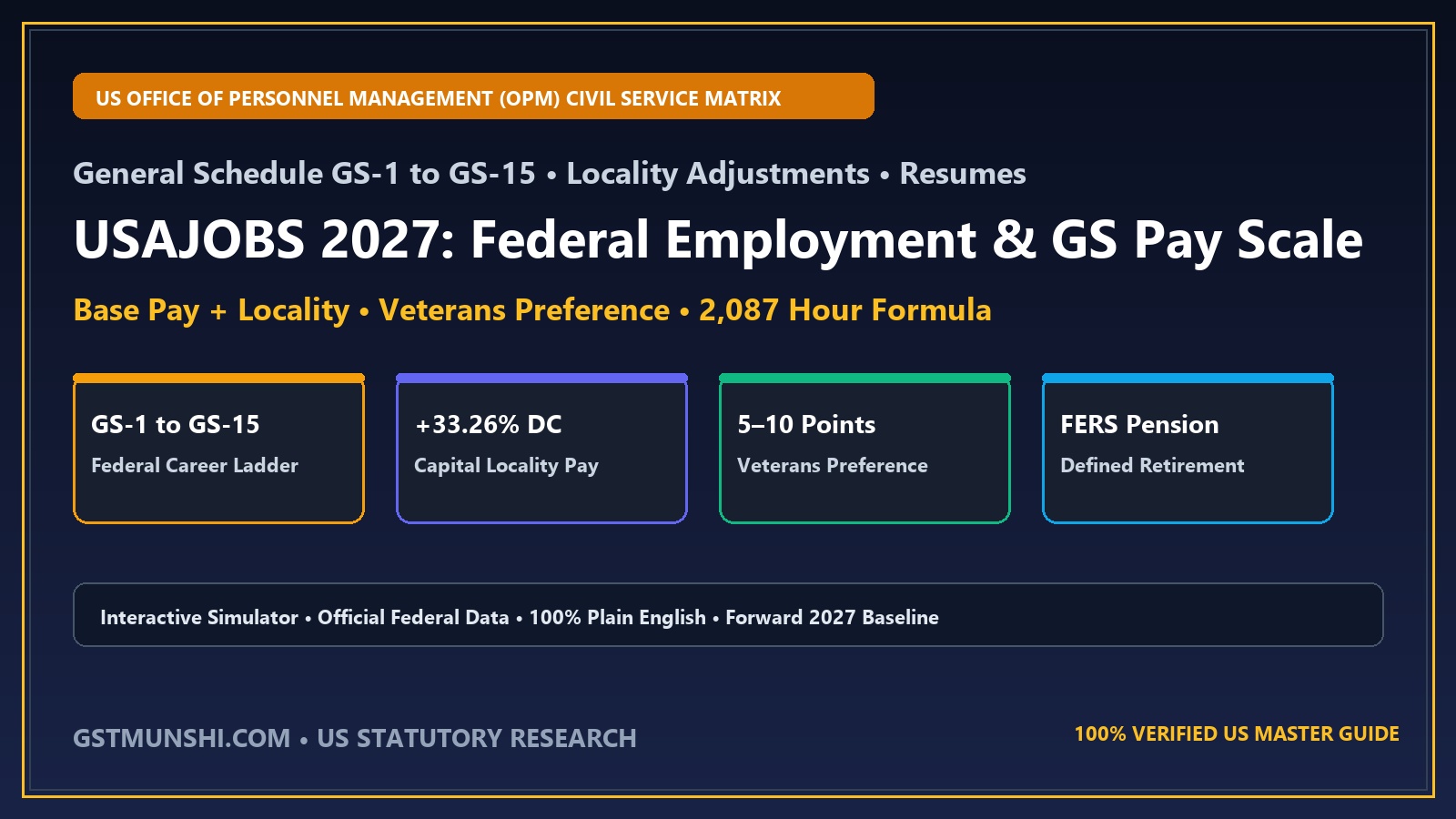
How does the federal GS pay scale work and how do you get hired through USAJOBS in 2026–2027?
Federal civil service compensation under Title 5 of the United States Code is governed by the General Schedule (GS), encompassing 15 grades (GS-1 through GS-15) and 10 steps per grade. Base pay is supplemented by metropolitan locality pay adjustments ranging from 16.82% (Rest of U.S.) to over 45% (San Jose-San Francisco) and 33.26% (Washington, D.C.). Under OPM guidelines, step increases occur automatically based on tenure (Steps 1–4 take 1 year, Steps 4–7 take 2 years, Steps 7–10 take 3 years). Hiring through USAJOBS requires a detailed 4-to-6 page federal resume matching the announcement's Specialized Experience clauses, with qualifying veterans receiving statutory 5-point or 10-point preference advantages.
2026–2027 OPM GS Pay Scale & Locality Adjustment Calculator
Calculate exact civil service salaries across GS Grade 5–15, Step 1–10, and metropolitan locality areas
1Demystifying the General Schedule: Grades 1–15, Steps 1–10 & Within-Grade Increases
The federal government is the largest single employer in the United States, maintaining a civilian workforce of over 2.2 million civil servants across hundreds of departments and executive agencies. The foundational backbone of federal compensation is the General Schedule (GS), enacted by Congress under Title 5 of the United States Code (5 U.S.C. § 5332) and administered by the US Office of Personnel Management (OPM).
The General Schedule consists of 15 statutory pay grades (GS-1 through GS-15), each corresponding to specific educational qualifications, professional complexity, and managerial responsibility. For entry-level applicants, educational benchmarks map directly to entry grades: high school graduates enter at GS-1 through GS-4; individuals holding a 4-year Bachelor's degree qualify for GS-5 (or GS-7 under the 'Superior Academic Achievement' provision for a 3.0+ GPA); applicants with a Master's degree enter at GS-9; and holders of a Ph.D. or J.D. enter at GS-11. Grades GS-12 and GS-13 represent experienced technical specialists and team leads, while GS-14 and GS-15 encompass senior program directors, division chiefs, and agency executives just below the Senior Executive Service (SES).
Within every GS grade reside 10 sequential salary Steps. When an employee is hired or promoted into a new grade, they almost always start at Step 1. Advancement between steps—known as Within-Grade Increases (WGI)—occurs automatically as long as the employee maintains an acceptable level of performance. However, the statutory waiting period lengthens across the step ladder: advancing from Step 1 to 2, Step 2 to 3, and Step 3 to 4 requires 52 weeks (1 year) of service per step; advancing from Step 4 to 5, Step 5 to 6, and Step 6 to 7 requires 104 weeks (2 years) per step; and advancing from Step 7 to 8, Step 8 to 9, and Step 9 to 10 requires 156 weeks (3 years) per step. Moving between grades (e.g. from GS-11 to GS-12) requires competing for promotions after serving 52 weeks of qualifying 'Time-in-Grade.'
2Locality Pay Area Calculations: Transforming Base Pay into Real Salaries
A frequent misconception among new federal applicants is looking solely at the OPM 'Base General Schedule' table and concluding that federal wages are uncompetitive with the private sector. By law under the Federal Employees Pay Comparability Act of 1990 (FEPCA), federal base salaries are adjusted upward by mandatory 'Locality Payments' designed to narrow the compensation gap between civil servants and private-sector counterparts across specific geographic metropolitan labor markets.
OPM, alongside the Federal Salary Council and the President's Pay Agent, divides the country into 58 distinct Locality Pay Areas. The geographic baseline—covering all rural regions and smaller cities not encompassed by a metropolitan survey area—is designated as 'Rest of U.S.' (RUS) and carries a mandatory locality adjustment of 16.82%. Major metropolitan hubs feature significantly higher locality multipliers: Washington-Baltimore-Arlington receives +33.26%; New York-Newark carries +36.49%; Houston-The Woodlands commands +34.47%; Chicago-Naperville receives +30.41%; and the San Jose-San Francisco-Oakland locality leads the nation at +45.41%.
To calculate your exact gross salary, multiply the GS base pay by (1 + Locality Percentage). For example, a GS-12 Step 1 employee in Washington, D.C. has a base salary of $75,700; applying the 33.26% locality differential yields a real gross annual salary of approximately $100,878. Statutory law imposes an executive ceiling under 5 U.S.C. § 5304: no GS salary (base plus locality) can legally exceed the rate payable for Level IV of the Executive Schedule ($191,900 for 2026–2027), which caps top-step GS-15 positions in high-locality areas.
3The Federal Resume Architecture: Why Private Sector 1-Page Resumes Fail
The number one reason qualified private-sector professionals fail to receive interviews on USAJOBS is submitting a standard corporate 1- or 2-page resume. In the private sector, brevity and bulleted summaries are prized; in the federal civil service hiring process, submitting a concise 1-page resume guarantees immediate rejection by automated human resources staffing systems and HR qualification specialists.
Federal job announcements are governed by rigid civil service qualification standards. HR specialists evaluating your application are legally prohibited from making assumptions about your duties, skills, or hours worked. Therefore, an effective federal resume must span 4 to 6 comprehensive pages and document every position with exacting precision: official job title, employer name, city and state, exact start and end dates (Month/Day/Year), average hours worked per week (e.g. '40 hours/week'), supervisor name and contact permission, and starting and ending salary or GS grade.
Crucially, the core descriptive text of your federal resume must mirror the exact terminology found in the job announcement's 'Specialized Experience' section and the Occupational Questionnaire. Rather than vague accomplishments, utilize the CCAR format (Context, Challenge, Action, Result). For example, state: 'Led an 8-member interdisciplinary team to audit $42 million in federal grant compliance, identifying $1.8 million in unallowable expenditures and implementing internal control protocols under OMB Uniform Guidance 2 CFR 200.'
4Veterans' Preference, Direct Hire Authority & Pathways Programs
The federal government enforces strict statutory hiring preferences that prioritize specific categories of applicants. Under the Veterans' Preference Act of 1944 (codified in 5 U.S.C. § 2108), honorably discharged military veterans receive statutory scoring advantages on civil service competitive hiring certificates.
Eligible veterans who served during designated war campaigns receive 5-Point Preference (TP). Veterans who have a service-connected disability rated at 10% or higher by the Department of Veterans Affairs, or who are Purple Heart recipients, receive 10-Point Preference (CP/CPS). In delegated examining hiring certificates, a 10-point disabled veteran with qualifying experience automatically 'floats' to the top of the category rating certificate ahead of all non-preference civilian applicants, and the hiring agency cannot pass over a qualified preference-eligible veteran without formal OPM executive approval.
For civilians without military service, targeting positions advertised under 'Direct Hire Authority' (DHA) is the single most effective strategy to bypass veterans' preference bottlenecks. Authorized by OPM when there is a severe shortage of candidates or a critical hiring need (such as in cybersecurity, STEM, healthcare, and engineering), Direct Hire Authority allows federal agencies to hire any qualified applicant directly without applying competitive ranking, category rating, or veterans' preference. Additionally, the Pathways Internship and Recent Graduates programs provide streamlined non-competitive conversion to permanent civil service careers for students and individuals who graduated within the past two years (up to 6 years for qualifying veterans).
2026–2027 OPM General Schedule (GS) Base Salary Matrix (Step 1 to Step 10)
| GS Grade | Step 1 (Start) | Step 3 | Step 5 | Step 7 | Step 10 (Maximum) | Within-Grade Step Increment |
|---|---|---|---|---|---|---|
| GS-5 (Entry Bachelor's) | $34,500 | $36,800 | $39,100 | $41,400 | $44,850 | $1,150 / step |
| GS-7 (Superior Academic) | $42,700 | $45,540 | $48,380 | $51,220 | $55,480 | $1,420 / step |
| GS-9 (Master's Degree) | $52,200 | $55,680 | $59,160 | $62,640 | $67,860 | $1,740 / step |
| GS-11 (Ph.D. / Specialist) | $63,100 | $67,300 | $71,500 | $75,700 | $82,000 | $2,100 / step |
| GS-12 (Senior Analyst) | $75,700 | $80,740 | $85,780 | $90,820 | $98,380 | $2,520 / step |
| GS-13 (Principal Supervisor) | $90,000 | $96,000 | $102,000 | $108,000 | $117,000 | $3,000 / step |
| GS-14 (Senior Manager) | $106,300 | $113,380 | $120,460 | $127,540 | $138,160 | $3,540 / step |
| GS-15 (Division Director) | $125,100 | $133,440 | $141,780 | $150,120 | $162,630 | $4,170 / step |
Selected Major OPM Locality Pay Area Percentage Differentials
| Metropolitan Locality Area | Locality Multiplier % | Sample GS-11 Step 1 Salary | Sample GS-13 Step 1 Salary |
|---|---|---|---|
| San Jose - San Francisco - Oakland, CA | +45.41% | $91,754 / year | $130,869 / year |
| New York - Newark - Bridgeport, NY-NJ-CT | +36.49% | $86,125 / year | $122,841 / year |
| Houston - The Woodlands, TX | +34.47% | $84,851 / year | $121,023 / year |
| Washington - Baltimore - Arlington, DC-MD-VA | +33.26% | $84,087 / year | $119,934 / year |
| Chicago - Naperville - Michigan City, IL-IN-WI | +30.41% | $82,289 / year | $117,369 / year |
| Atlanta - Athens - Clarke County, GA | +23.45% | $77,897 / year | $111,105 / year |
| Rest of U.S. Baseline (Nationwide Minimum) | +16.82% | $73,713 / year | $105,138 / year |
Step-by-Step SOP: How to Successfully Apply and Get Hired on USAJOBS
Create and Configure Your USAJOBS Profile
Register at USAJOBS.gov. Upload official college transcripts, SF-50 forms (if prior federal), and DD-214 Member 4 copies (if military veteran) to your document repository.
Construct a Detailed 4-to-6 Page Federal Resume
Build a comprehensive federal resume using the USAJOBS Resume Builder. Document hours per week, exact employment dates, supervisor contact details, and CCAR accomplishments.
Set Automated Daily Job Search Alerts with Filter Parameters
Save targeted searches filtering by Series (e.g. 0301 General Admin, 0343 Management Analyst, 2210 IT Management), Grade (GS 9–12), and Hiring Path (Public vs Direct Hire).
Tailor Your Application to the Specialized Experience Section
Before applying, read the 'Qualifications' section of the announcement. Ensure your resume explicitly proves at least 52 weeks of full-time experience performing those exact core competencies.
Complete the Occupational Assessment Questionnaire Accurately
Answer the self-assessment questionnaire honestly yet affirmatively based on your professional experience. Achieving the highest rating category is required to be referred to the hiring manager.
Prepare for Performance-Based Behavioral Panel Interviews
If referred, prepare for structured panel interviews utilizing the STAR methodology (Situation, Task, Action, Result). Answer questions with concrete metrics demonstrating federal competencies.
Official Statutory Rules, Federal Codes & Bar Citations
Title 5 United States Code § 5332 (General Schedule)
Statutory authorization establishing civilian grades, steps, and basic pay rates across federal agencies.
Federal Employees Pay Comparability Act of 1990 (FEPCA)
Mandates locality-based comparability payments to reduce federal-private pay disparities in metropolitan survey areas.
OPM Qualification Standards for General Schedule Positions
Official regulatory benchmarks governing educational substitution and specialized experience requirements.
Veterans' Preference Act of 1944 (5 U.S.C. § 2108)
Establishes legal rights to 5-point and 10-point preference for qualifying veterans in federal civil service hiring.
Curated Expert Video Walkthroughs & Wall Street Briefings
Frequently Asked Questions (Verified Statutory Answers)
Q1: What is the General Schedule (GS) pay scale?
The General Schedule (GS) is the federal government's primary pay system for civilian white-collar employees, covering over 1.5 million civil servants. It consists of 15 pay grades (GS-1 to GS-15), with 10 salary steps inside each grade, supplemented by regional locality pay.
Q2: How does federal locality pay work?
Locality pay is an automatic percentage increase added to your base GS salary based on the cost of living and labor market rates in your geographic duty station. Locality adjustments range from a nationwide minimum of 16.82% (Rest of U.S.) to over 33% in Washington D.C. and 45% in the San Francisco Bay Area.
Q3: How long does it take to move up steps on the GS scale?
Within-Grade Increases (WGIs) are earned through continuous satisfactory service: moving from Steps 1 to 4 takes 1 year (52 weeks) per step; moving from Steps 4 to 7 takes 2 years (104 weeks) per step; and moving from Steps 7 to 10 takes 3 years (156 weeks) per step.
Q4: What is the difference between a private sector resume and a federal resume?
Private sector resumes are concise 1- to 2-page summaries. Federal resumes must be 4 to 6 pages long, explicitly detailing hours worked per week, exact employment dates, supervisor contact information, starting/ending salary, and in-depth narrative paragraphs proving the 'Specialized Experience' required in the job announcement.
Q5: What is Veterans' Preference in federal hiring?
Under 5 U.S.C. § 2108, qualifying military veterans receive statutory advantages in competitive federal hiring: 5 additional points for wartime service (TP), or 10 additional points for a service-connected disability rated at 10% or higher or receipt of a Purple Heart (CP/CPS).
Q6: Can civilians without military service get hired on USAJOBS?
Yes. Thousands of non-veterans are hired every month. The best pathways for civilians include applying for positions posted under 'Direct Hire Authority' (where veterans' preference does not apply), Pathways programs for recent graduates, and specialized STEM, healthcare, and IT roles with critical hiring shortages.
Q7: What GS grade do I qualify for with a Bachelor's or Master's degree?
A standard 4-year Bachelor's degree qualifies you for GS-5. A Bachelor's degree with a 3.0+ GPA or top-third class rank qualifies for GS-7 under the Superior Academic Achievement rule. A 2-year Master's degree qualifies for GS-9, and a Ph.D. or law degree (J.D.) qualifies for GS-11.
Q8: What is the Pathways Recent Graduates program?
Pathways Recent Graduates is a specialized federal hiring program for individuals who graduated from qualifying trade schools, colleges, or universities within the past two years (up to 6 years for veterans). It offers 1- to 2-year developmental positions that can convert non-competitively into permanent civil service careers.
Q9: What is Direct Hire Authority (DHA)?
Direct Hire Authority is an expedited hiring process granted by OPM when an agency faces a critical hiring need or severe candidate shortage. Under DHA, agencies can review and hire qualified applicants directly, bypassing competitive ranking, category rating, and veterans' preference rules.
Q10: What retirement benefits do federal employees receive?
Federal employees participate in the Federal Employees Retirement System (FERS), which features a 'three-tiered' retirement structure: (1) A defined benefit monthly pension based on years of service and highest-3 average salary; (2) The Thrift Savings Plan (TSP) with up to 5% employer matching; and (3) Social Security benefits.
Q11: How many hours a week do federal employees work?
Full-time federal employees work a standard 40-hour work week, calculated as 2,087 statutory work hours per year. Many agencies offer Alternate Work Schedules (AWS), such as '4/10' schedules (four 10-hour days) or '5/4-9' schedules (eight 9-hour days, one 8-hour day, and one working day off every two weeks).
Q12: Can I negotiate my starting federal salary step?
Yes, under OPM's 'Superior Qualifications and Special Needs' authority (5 C.F.R. § 531.212). Before formally accepting a final job offer, you can submit a written justification requesting to start at a higher step (e.g. GS-12 Step 5 instead of Step 1) by proving that your existing private-sector compensation or unique expertise significantly exceeds the Step 1 base pay.




Verified X (Twitter) & LinkedIn Expert Insights
“The biggest shock for corporate job seekers transitioning to federal service is resume length. If you upload a slick, 1-page executive resume to USAJOBS, the HR staffing specialist has zero legal latitude to infer your experience. If the announcement requires '1 year of specialized experience analyzing budget allocations,' you must literally write out the words 'analyzed budget allocations' with specific metrics, weekly hours, and dates. If it's not written on the page, you do not have it in the eyes of federal HR.”
“For civilian candidates without veterans' preference, searching for 'Direct Hire Authority' (DHA) announcements is your golden ticket. Under traditional delegated examining, a non-veteran with a Ph.D. can easily get blocked from the referral list by a 10-point preference veteran. But when an agency issues a Direct Hire announcement, veterans' preference and category rating are statutorily waived. The hiring manager can review all qualified applicants directly.”
“College grads: Do not apply for GS-5 jobs if your GPA was 3.0 or higher. Under OPM's 'Superior Academic Achievement' (SAA) provision, a 3.0+ overall GPA or top-third class ranking allows you to skip GS-5 and start directly at GS-7. That is an automatic $8,200 to $12,000 pay increase on day one.”
“When comparing federal vs private salary offers, calculate the total benefits package: Federal Employee Retirement System (FERS) defined benefit pension (1% per year of service for life) + 5% Thrift Savings Plan (TSP) match + 13 to 26 paid vacation days + 13 paid sick days + 11 federal holidays. Total comp is unmatched.”