
What are the official 2026–2027 Medicaid income limits and eligibility requirements?
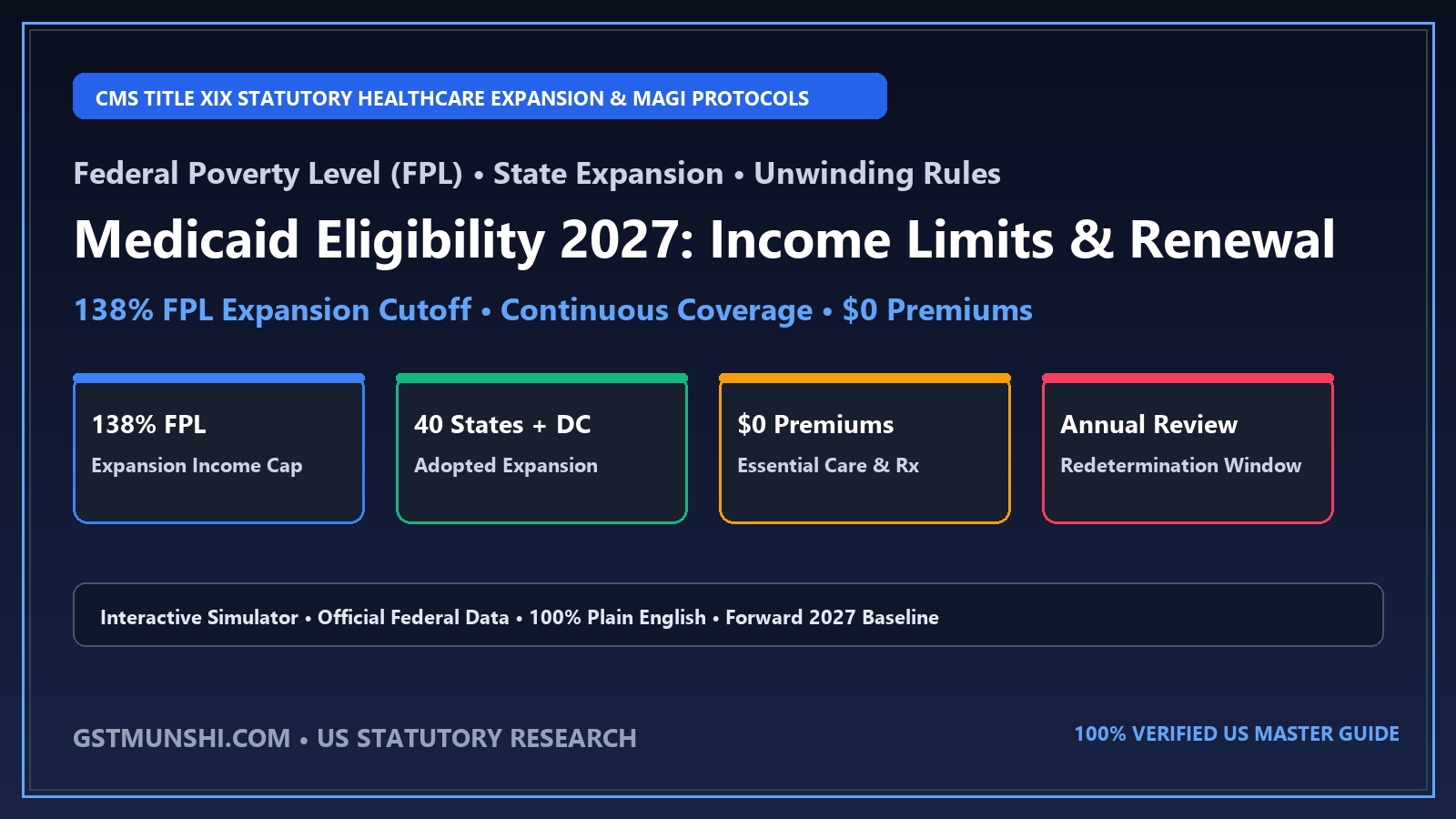
Medicaid eligibility under the Affordable Care Act (ACA) is based on Modified Adjusted Gross Income (MAGI). In the 40 states plus Washington, D.C. that adopted Medicaid expansion, low-income adults aged 19 to 64 qualify if their household income is at or below 138% of the Federal Poverty Level (FPL)—which includes a statutory 5% income disregard under 42 C.F.R. § 435.603. For 2026–2027, this equals approximately $21,600 per year ($1,800/month) for a single individual, and $44,500 per year ($3,708/month) for a family of four. Expansion states have zero asset tests. In non-expansion states (like Texas, Florida, and Georgia), childless non-disabled adults are generally ineligible, and parents face extremely restrictive income caps. Annual redetermination forms must be submitted on time to prevent coverage lapses.
2026–2027 Medicaid MAGI Eligibility & Redetermination Checker
Instant statutory check against state expansion thresholds and Modified Adjusted Gross Income (MAGI) guidelines
1Understanding Modified Adjusted Gross Income (MAGI) & the 138% FPL Rule
Title XIX of the Social Security Act, established in 1965, created Medicaid as a joint federal-state public health insurance entitlement program. Prior to 2014, qualifying for Medicaid required not only impoverishment but also membership in a specific statutory category: pregnant women, children, low-income parents, the blind, or individuals with severe permanent disabilities.
The Affordable Care Act fundamentally overhauled this framework by establishing Medicaid expansion for all low-income adults aged 19 to 64 with household incomes up to 133% of the Federal Poverty Level. Furthermore, under federal regulation 42 C.F.R. § 435.603, the federal government applies a mandatory 5% standard income disregard across all MAGI calculations, effectively raising the real statutory income eligibility ceiling to exactly 138% of the Federal Poverty Level.
Medicaid Modified Adjusted Gross Income (MAGI) is calculated using federal tax income rules. It starts with your IRS Adjusted Gross Income (Line 11 on Form 1040) and adds back tax-exempt interest, non-taxable Social Security benefits, and foreign earned income. Crucially for working adults, MAGI Medicaid rules do not enforce any asset or resource tests. You can own a primary home, a reliable motor vehicle, and have money saved in a bank account or 401(k) plan without jeopardizing your healthcare eligibility—only your monthly earned and unearned income matters.
2The State Divide: Medicaid Expansion vs. Non-Expansion States
Following the landmark 2012 Supreme Court ruling in NFIB v. Sebelius, Medicaid expansion was rendered optional for individual states. As of 2026–2027, 40 states and the District of Columbia have enacted ACA Medicaid expansion, providing comprehensive medical, dental, and prescription drug coverage to low-income residents with zero monthly premiums and minimal copays.
In stark contrast, the 10 remaining non-expansion states—primarily concentrated in the Southeast, including Texas, Florida, Georgia, Mississippi, Alabama, and South Carolina—maintain pre-ACA restrictive eligibility criteria. In non-expansion states, able-bodied adults without dependent children are completely barred from Medicaid coverage, regardless of how little income they earn, unless they meet strict disability definitions under Supplemental Security Income (SSI).
This dynamic produces the notorious 'Coverage Gap.' Low-income individuals in non-expansion states who earn below 100% of the Federal Poverty Level are ineligible for Medicaid, yet they are simultaneously disqualified from receiving premium tax subsidies on the ACA Healthcare.gov Marketplace (which require a minimum income of 100% FPL). Parents in these states face punishingly low income thresholds: in Texas, for example, a parent in a family of three loses Medicaid eligibility if their income exceeds approximately 16% of the FPL ($350 to $400 per month).
3Annual Redetermination & Preventing Coverage Termination
Every Medicaid beneficiary must undergo an annual redetermination process (also called 'recertification') to prove that their income still falls below statutory thresholds. During the COVID-19 Public Health Emergency, Congress enacted continuous enrollment provisions that prohibited states from terminating Medicaid coverage. However, the subsequent 'Medicaid Unwinding' process resulted in millions of Americans losing coverage—the vast majority due to procedural paperwork snags rather than actual income ineligibility.
State Medicaid agencies initiate the redetermination process by attempting 'ex parte' automated renewals using state wage databases, quarterly tax filings, and SNAP/TANF records. If the state's computers confirm that your income remains below 138% FPL, your Medicaid is renewed automatically without requiring any action on your part, and you will receive an approval letter by mail.
However, if the state cannot verify your income automatically, they will mail an official Yellow or Blue renewal packet to your address on file, providing a strict 30- to 60-day deadline to respond. Beneficiaries must complete the paperwork, attach recent paystubs or tax returns, and return it via the state online benefits portal, mail, or in person at the local Department of Social Services. Failing to respond by the deadline triggers automated procedural termination, leaving your family uninsured overnight.
4Children's Health Insurance Program (CHIP) & Dual-Eligible Seniors
Income limits for children and pregnant women are significantly more generous than adult expansion thresholds. Under Title XXI of the Social Security Act, the Children's Health Insurance Program (CHIP) provides comprehensive medical and dental care to children in families whose income exceeds standard Medicaid limits but who cannot afford private employer coverage.
In most states, children qualify for Medicaid or CHIP at household income levels up to 200%, 250%, or even 300%+ of the Federal Poverty Level (reaching over $75,000 to $90,000 for a family of four in states like New York, California, and Pennsylvania). Pregnant women qualify for Medicaid coverage through 60 days to 12 months postpartum at income thresholds typically ranging from 185% to 220% of the FPL.
For seniors aged 65 and older and individuals with permanent disabilities, Medicaid intersects with Medicare to create 'Dual Eligible' status. Unlike MAGI expansion Medicaid, traditional senior Medicaid (institutional nursing home care and Medicare Savings Programs like QMB, SLMB, and QI) strictly enforces both income limits and strict asset limits ($2,000 for an individual, $3,000 for a married couple). Dual-eligible beneficiaries receive Medicare for primary hospital/doctor care while Medicaid covers Medicare Part B premiums ($185+ monthly), deductibles, and long-term custodial nursing home care.
2026–2027 Projected Federal Poverty Guidelines & Medicaid Income Limits
| Household Size | 100% FPL (Base Guideline) | 138% FPL (Medicaid Expansion Monthly) | 138% FPL (Annual Income Cap) | 200% FPL (CHIP / Pregnancy Cutoff) | 250% FPL (Enhanced ACA Silver Tier) |
|---|---|---|---|---|---|
| 1 Person (Individual) | $15,650 / year | $1,800 / month | $21,597 / year | $31,300 / year | $39,125 / year |
| 2 Persons (Couple) | $21,130 / year | $2,430 / month | $29,159 / year | $42,260 / year | $52,825 / year |
| 3 Persons (Small Family) | $26,610 / year | $3,060 / month | $36,722 / year | $53,220 / year | $66,525 / year |
| 4 Persons (Family of 4) | $32,090 / year | $3,690 / month | $44,284 / year | $64,180 / year | $80,225 / year |
| 5 Persons | $37,570 / year | $4,320 / month | $51,847 / year | $75,140 / year | $93,925 / year |
| 6 Persons | $43,050 / year | $4,951 / month | $59,409 / year | $86,100 / year | $107,625 / year |
| Each Additional Person | +$5,480 / year | +$630 / month | +$7,562 / year | +$10,960 / year | +$13,700 / year |
Medicaid Expansion Policy Status by Selected Major States
| State | Expansion Status | Adult 19–64 Income Limit | Asset / Savings Test? | Postpartum Coverage |
|---|---|---|---|---|
| California (Medi-Cal) | Adopted (Expanded) | 138% FPL ($1,800/mo) | Zero Asset Test | 12 Months Postpartum |
| New York (Medicaid) | Adopted (Expanded) | 138% FPL + Essential Plan up to 250% | Zero Asset Test | 12 Months Postpartum |
| Pennsylvania (Medicaid) | Adopted (Expanded) | 138% FPL ($1,800/mo) | Zero Asset Test | 12 Months Postpartum |
| Texas (Texas Medicaid) | NOT Adopted | Parents ~16% FPL / Adults 0% | Strict Asset Limits Enforced | 12 Months Postpartum |
| Florida (Florida Medicaid) | NOT Adopted | Parents ~29% FPL / Adults 0% | Strict Asset Limits Enforced | 12 Months Postpartum |
| Ohio (Ohio Medicaid) | Adopted (Expanded) | 138% FPL ($1,800/mo) | Zero Asset Test | 12 Months Postpartum |
Step-by-Step SOP: How to Apply for and Protect Your Medicaid Coverage
Verify Your State's Medicaid Expansion Status
Determine whether your state has adopted ACA Medicaid expansion. If in an expansion state, your sole criterion is income under 138% FPL; if in a non-expansion state, evaluate categorical rules.
Calculate Your Monthly Household MAGI
Assemble your last 4 consecutive paystubs, W-2 forms, or self-employment net profit records. Subtract allowable pre-tax deductions (like HSA contributions and student loan interest) to determine your exact MAGI.
Submit Application via State Health Portal or HealthCare.gov
Complete your online application at your official state health portal (e.g. Covered California, NY State of Health) or HealthCare.gov. Upload proof of identity, citizenship/legal residency, and income verification.
Select a Medicaid Managed Care Organization (MCO)
Once approved, select an insurance plan network (such as Molina, Centene/Ambetter, UnitedHealthcare Community Plan, or Blue Cross) that includes your preferred primary care doctors and hospitals.
Update Contact Information and Monitor for Renewal Packets
Keep your mailing address, phone number, and email updated with your local Department of Social Services. When your annual redetermination packet arrives, return it within 30 days to prevent coverage loss.
Transition to $0 Premium ACA Silver Plan if Income Rises
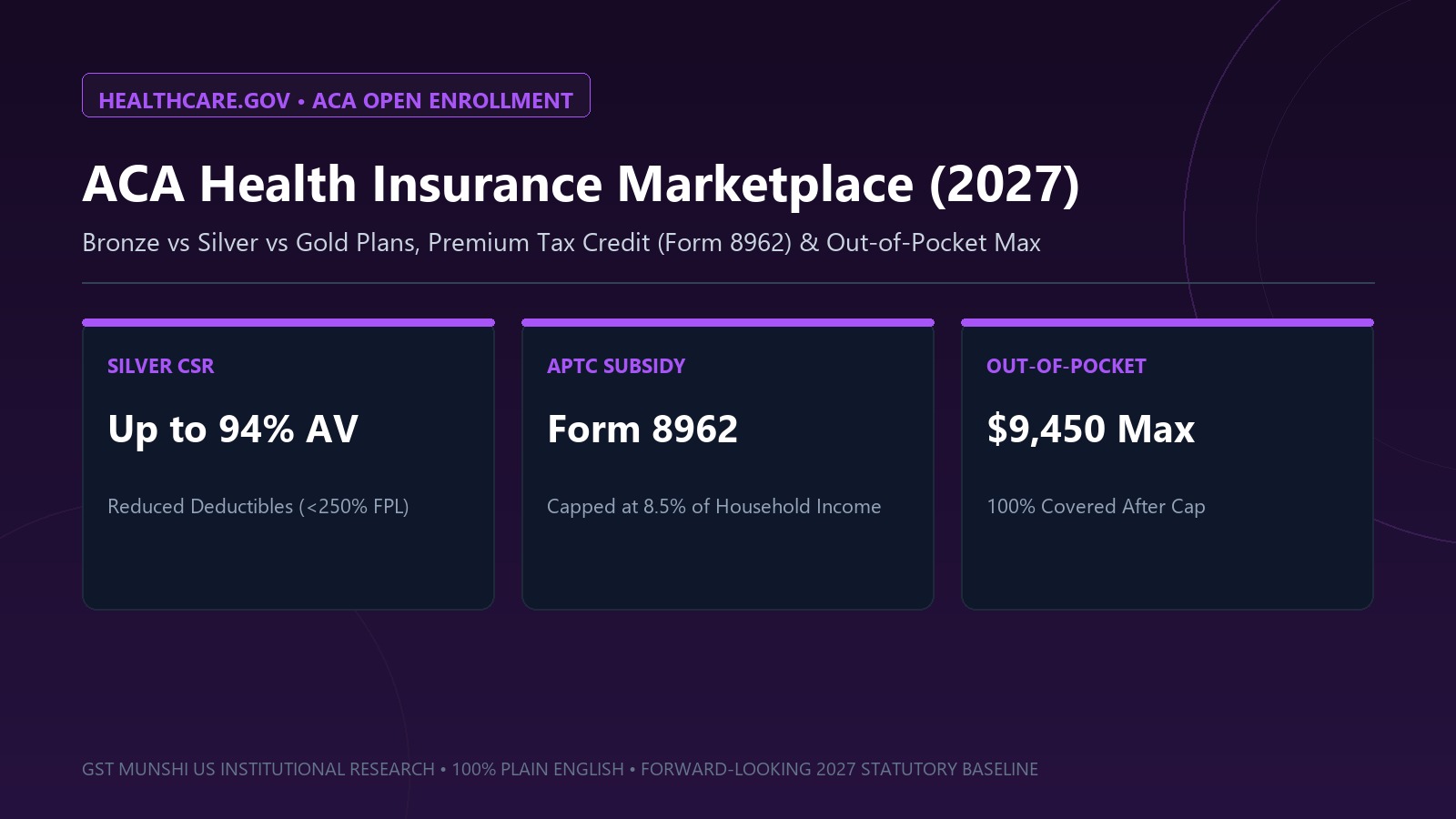
If your income increases above 138% FPL, do not panic. You qualify for a 60-day Special Enrollment Period on HealthCare.gov to enroll in an ACA Silver plan with near-$0 monthly premiums and cost-sharing reductions.
Official Statutory Rules, Federal Codes & Bar Citations
Title XIX of the Social Security Act (42 U.S.C. § 1396)
Statutory authorization for federal grants to states for medical assistance programs.
42 C.F.R. § 435.603 (MAGI Rules)
Codifies Modified Adjusted Gross Income methodologies and the mandatory 5% FPL income disregard.
HHS Annual Federal Poverty Guidelines
Official annual poverty thresholds used to determine statutory eligibility for federal healthcare programs.
CMS State Health Official Letters on Redetermination
Federal guidance governing procedural terminations, ex parte automated renewals, and fair hearing requirements.
Curated Expert Video Walkthroughs & Wall Street Briefings
Frequently Asked Questions (Verified Statutory Answers)
Q1: What is the maximum income to qualify for Medicaid in 2026–2027?
In the 40 states plus Washington D.C. that expanded Medicaid, the maximum income limit for adults aged 19 to 64 is 138% of the Federal Poverty Level. For 2026–2027, this is approximately $21,600/year ($1,800/month) for a single individual, $29,160/year for a couple, and $44,500/year ($3,708/month) for a family of four.
Q2: Does Medicaid have an asset or savings test for adults?
No, not for ACA expansion adults. Under federal MAGI rules, eligibility is based solely on your taxable household income. You can have savings in a bank account, own a home, have a 401(k), and own vehicles without affecting your eligibility. Only traditional Medicaid (for seniors 65+ and institutional nursing home care) enforces strict asset tests ($2,000 for individuals).
Q3: Which states have NOT expanded Medicaid?
As of 2026–2027, the 10 states that have not expanded Medicaid are: Texas, Florida, Georgia, Mississippi, Alabama, South Carolina, Tennessee, Kansas, Wyoming, and Wisconsin. In these states, childless non-disabled adults are generally ineligible, and parents face extremely low income caps.
Q4: What is the difference between Medicaid and Medicare?
Medicare is a federal health insurance program primarily for individuals aged 65 and older or people with certain permanent disabilities (like ESRD or ALS), regardless of income. Medicaid is a joint federal and state program providing free or low-cost health coverage to low-income individuals and families of all ages based on financial need.
Q5: What does Medicaid cover?
Federal law mandates that Medicaid cover: inpatient and outpatient hospital services, physician visits, laboratory and X-ray services, early and periodic screening for children, family planning, and home health services. Most states also cover optional benefits including prescription drugs, dental care, physical therapy, and eye exams.
Q6: How does the annual Medicaid redetermination process work?
States are required by federal law to check your eligibility every 12 months. They first attempt an automated 'ex parte' review using state wage and tax records. If they cannot verify your income automatically, they will mail you a renewal packet that you must complete and return within 30 to 60 days with proof of current income to avoid losing coverage.
Q7: What should I do if my Medicaid coverage is canceled?
If canceled procedurally for missing paperwork, contact your state Medicaid office immediately—states have a 90-day grace period to reinstate coverage upon receipt of documents. If canceled because your income is too high, you have a 60-day Special Enrollment Period to sign up for heavily subsidized health insurance on HealthCare.gov.
Q8: What is the Medicaid coverage gap in non-expansion states?
The coverage gap refers to low-income adults in non-expansion states who earn too much to qualify for their state's restrictive Medicaid rules (often capped at 16% to 30% FPL), but earn too little to qualify for ACA marketplace premium tax credits (which require a minimum income of 100% FPL).
Q9: Can college students qualify for Medicaid?
Yes, provided they live in an expansion state, earn under $1,800/month, and are NOT claimed as a tax dependent on their parents' tax return. If claimed as a dependent, their eligibility is determined by their parents' household income.
Q10: What is CHIP and who qualifies?
The Children's Health Insurance Program (CHIP) provides low-cost health coverage to children in families that earn too much to qualify for Medicaid but cannot afford private insurance. In most states, CHIP covers children in families earning up to 200% to 250% of the FPL ($64,000 to $80,000+ for a family of four).
Q11: How long does Medicaid postpartum coverage last for new mothers?
Under the American Rescue Plan and bipartisan federal legislation, almost all states have enacted permanent 12-month postpartum Medicaid coverage, ensuring mothers maintain full healthcare coverage for a full year after giving birth.
Q12: Can I qualify for Medicaid if I am self-employed or a gig worker?
Yes. Self-employed individuals, 1099 contractors, and gig economy workers qualify based on their Net Business Profit (gross revenue minus allowable business expenses on Schedule C), not their gross revenue.



Verified X (Twitter) & LinkedIn Expert Insights
“The biggest tragedy of the post-pandemic Medicaid redetermination unwinding was that over 70% of coverage terminations were procedural—meaning beneficiaries were dropped not because their income was too high, but because renewal packets were mailed to outdated addresses or returned without a single required document. If you receive a letter from your state Medicaid agency, open it immediately. If you were terminated procedurally, states are legally required to provide a 90-day reconsideration window to reinstate your benefits without filing a brand new application.”
“Parents frequently assume that because they earn too much to qualify for adult Medicaid, their children are also ineligible. That is completely incorrect. Under federal Title XXI CHIP statutes, child eligibility thresholds in most states extend up to 200% to 250% FPL—which translates to $65,000 to $80,000+ for a family of four. Your kids can have full medical, dental, and vision coverage even if you buy your own insurance through an employer or the exchange.”
“Reminder: If you live in an expansion state, you qualify for Medicaid up to 138% FPL, NOT 133%. The ACA statute states 133%, but 42 CFR § 435.603 mandates a 5% standard income disregard across the board. That extra 5% disregard shelters approximately $800 to $1,600 in annual income, saving thousands of families from losing coverage.”
“Lost Medicaid because of a salary increase? Don't panic. You qualify for an immediate 60-day Special Enrollment Period on HealthCare.gov. With income just above 138% FPL, an ACA Silver plan with Cost-Sharing Reductions (CSR) gives you a $0 to $15 monthly premium and a deductible under $100. Smooth bridge.”