
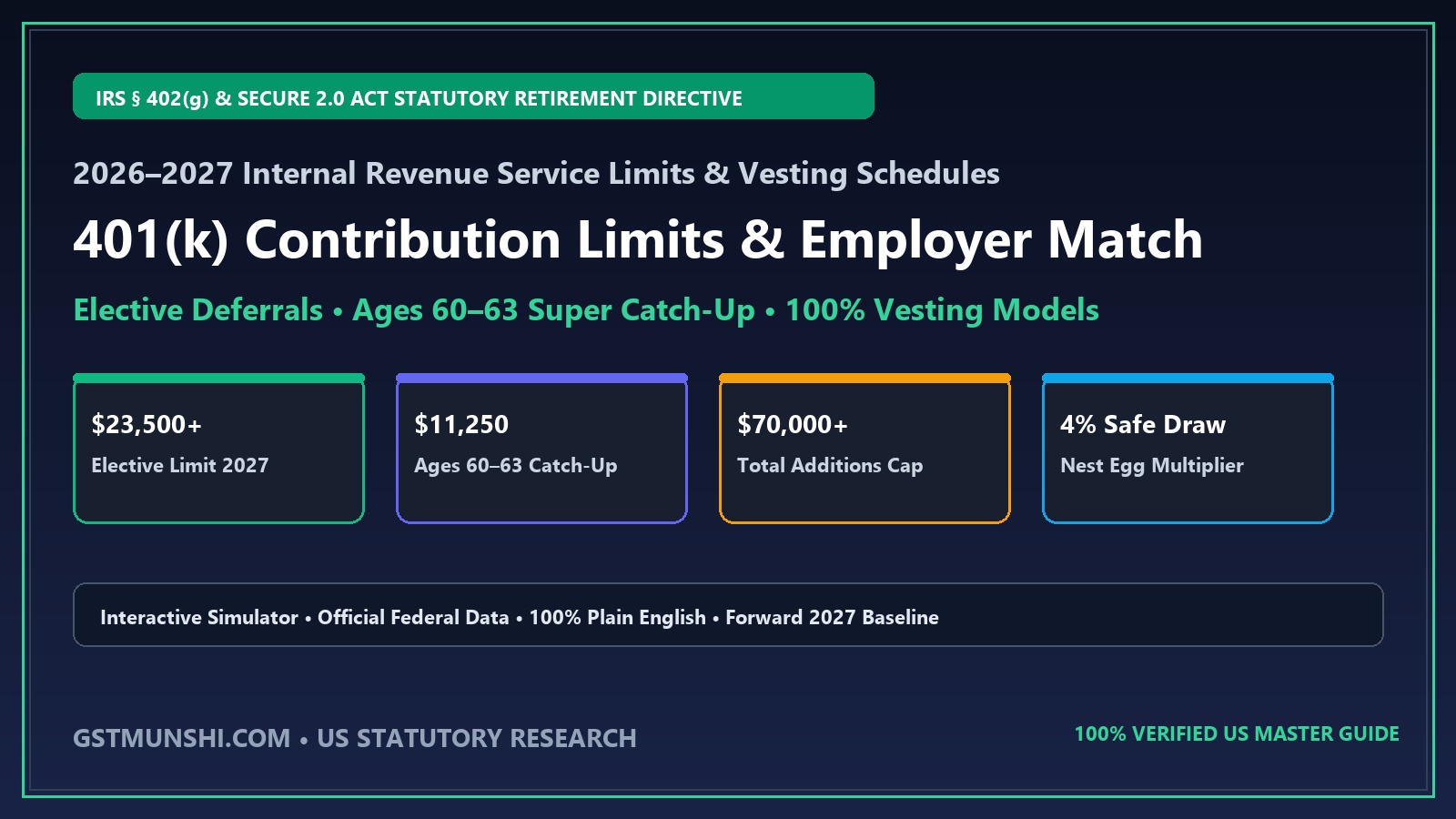
What are the official 2026–2027 401(k) contribution limits and SECURE 2.0 catch-up rules?
Under Internal Revenue Code § 402(g), the 401(k) employee elective deferral limit is projected at $23,500 to $24,000 for 2026–2027, indexed for CPI inflation. Under the SECURE 2.0 Act, individuals aged 50 and older can make standard catch-up contributions of $7,500, while workers aged 60, 61, 62, and 63 qualify for a higher 'super catch-up' limit of $11,250 (or 150% of the standard catch-up). The combined limit for employee plus employer contributions under IRC § 415(c) rises to $70,000 to $71,000. Employer matching contributions must follow statutory vesting schedules, and individuals earning over $145,000 must make catch-up contributions as after-tax Roth dollars.
401(k) Compound Growth & SECURE 2.0 Match Simulator
Calculate your projected nest egg at retirement under IRS § 402(g) limits and employer matching
Employer match modeled as 50% on first 6% of salary ($2,850/yr free money).
1Statutory Elective Deferral Limits: Traditional vs. Roth 401(k)
The cornerstone of American employer-sponsored retirement planning is Section 401(k) of the Internal Revenue Code. Each calendar year, the Internal Revenue Service calculates cost-of-living adjustments based on the third-quarter Consumer Price Index for All Urban Consumers (CPI-U). For 2026 and 2027, the baseline employee elective deferral ceiling under IRC § 402(g) ranges between $23,500 and $24,000. This ceiling applies to the sum total of all pre-tax traditional and designated Roth contributions across all 401(k), 403(b), and federal Thrift Savings Plan (TSP) accounts held by a single taxpayer.
Choosing between traditional pre-tax contributions and designated Roth contributions depends entirely on your current marginal tax bracket compared to your expected tax bracket in retirement. Traditional 401(k) deferrals reduce your current-year Adjusted Gross Income (AGI) dollar-for-dollar, providing immediate federal and state tax relief during your peak earning years. However, all distributions taken after age 59½—both principal contributions and decades of accumulated compound investment gains—are taxed as ordinary income. In contrast, Roth 401(k) contributions are made with after-tax earnings today, allowing your capital to grow entirely tax-free and be withdrawn completely income-tax-free in retirement.
High earners must also navigate the total additions limit governed by IRC § 415(c). This overarching ceiling encompasses your elective employee contributions, your employer's matching contributions, discretionary profit-sharing allocations, and any voluntary after-tax contributions. For the 2026–2027 cycle, this combined threshold reaches $70,000 or 100% of the employee's compensation, whichever is lower. Savvy corporate professionals take advantage of this high ceiling through the 'Mega Backdoor Roth' strategy, rolling after-tax non-Roth contributions into a Roth IRA or in-plan Roth conversion immediately upon contribution.
2SECURE 2.0 Act Overhaul: Ages 60–63 Super Catch-Up & Roth Mandate
The Setting Every Community Up for Retirement Enhancement (SECURE) 2.0 Act of 2022 fundamentally restructured how older workers can accelerate their retirement savings during their highest-earning decades. Historically, all participants turning age 50 or older by the end of the tax year were permitted a single uniform catch-up contribution ($7,500). Beginning under the phased statutory implementation, Congress created a specialized four-year window under Section 109 for participants who attain age 60, 61, 62, or 63 during the calendar year.
For these qualifying workers, the higher catch-up contribution is legally pegged to 150% of the standard age-50 catch-up limit, or $10,000 adjusted for inflation, resulting in an authorized 2026–2027 super catch-up of $11,250. Once an employee turns 64, their authorized catch-up limit reverts to the standard $7,500 threshold. This structural design offers pre-retirees an unprecedented window to shelter more than $35,000 annually in employee-directed retirement accounts when combined with baseline elective deferrals.
However, high-income professionals must comply with Section 603 of the SECURE 2.0 Act. Under this statutory mandate, any employee whose wages from the sponsoring employer exceeded $145,000 (indexed to CPI-U) in the preceding calendar year can no longer make catch-up contributions on a pre-tax basis. Instead, all catch-up contributions must be designated as after-tax Roth contributions. While this eliminates the immediate front-end tax deduction for high-earning managers and corporate executives, it generates tax-free distributions throughout their retirement years.
3Employer Matching Formulations & Statutory Vesting Schedules
Employer matching contributions represent guaranteed, zero-risk returns that no public financial market instrument can match. The most prevalent corporate matching formulation in the United States is the standard 50% match on employee deferrals up to 6% of base compensation, effectively handing the employee an automatic 3% salary bonus. Other competitive technology, consulting, and financial firms offer dollar-for-dollar matching up to 4% or 5% of compensation, or adopt non-elective 3% Safe Harbor contributions that are deposited regardless of whether the employee contributes a single cent.
To retain key talent and protect corporate capital, employers frequently subject matching contributions to formal vesting schedules regulated under the Employee Retirement Income Security Act (ERISA). While employee elective deferrals are always 100% immediately vested by federal law, employer matching dollars can be structured either as a 'Cliff Vesting' schedule or a 'Graded Vesting' schedule. Under a 3-Year Cliff, the employee owns 0% of the employer's matching contributions until completing 3 full years of qualifying service, at which moment they become 100% vested overnight.
Alternatively, under a 6-Year Graded Vesting schedule, the employee earns ownership incrementally: 0% in Year 1, 20% after Year 2, 40% after Year 3, 60% after Year 4, 80% after Year 5, and 100% after Year 6. Leaving your employer before reaching full vesting causes all unvested matching funds to be forfeited back into the plan's general forfeiture pool. When evaluating a new career opportunity or deciding when to resign, calculating your exact vesting anniversary is critical to preventing thousands of dollars in lost corporate match benefits.
4Distribution Rules: Age 59½, Rule of 55 & Early Withdrawal Exceptions
The Internal Revenue Code strictly safeguards 401(k) assets for retirement through Section 72(t), which levies a punitive 10% additional excise tax on distributions taken before reaching age 59½, alongside regular state and federal income taxes. Once you celebrate your 59½ birthday, you can withdraw any portion of your vested traditional or Roth 401(k) balance without penalty, subject only to ordinary income tax on pre-tax balances.
For employees facing early corporate retirement, downsizing, or career transitions, the statutory 'Rule of 55' serves as a critical financial lifeline. Under IRC § 72(t)(2)(A)(v), if you separate from service with your employer during or after the calendar year in which you turn age 55 (or age 50 for qualifying public safety employees like law enforcement and firefighters), you can take penalty-free distributions directly from that specific former employer's 401(k) plan. Crucially, this exemption does not apply to assets previously rolled over into an Individual Retirement Account (IRA), making premature 401(k)-to-IRA rollovers a costly trap for early retirees.
Additionally, the IRS authorizes penalty-free early distributions under narrowly defined hardship categories: qualified first-time homebuyer expenses (up to $10,000 from IRAs), un-reimbursed medical expenses exceeding 7.5% of AGI, total and permanent disability, active military reservist duty, and emergency personal expense distributions up to $1,000 annually enacted under SECURE 2.0. However, borrowing against your nest egg via a 401(k) plan loan (up to $50,000 or 50% of your vested balance) is generally far more advantageous than an early withdrawal, because interest payments flow directly back into your own account.
2026–2027 401(k) Statutory Limits vs. IRA & Roth Benchmarks
| Retirement Vehicle | Employee Elective Cap | Standard Catch-Up (Age 50+) | SECURE 2.0 Super Catch-Up (60–63) | Total Combined Ceiling | MAGI Income Phase-Out Limits |
|---|---|---|---|---|---|
| Traditional 401(k) / 403(b) | $23,500 – $24,000 | $7,500 | $11,250 | $70,000 (IRC § 415(c)) | No income limits to contribute |
| Designated Roth 401(k) | $23,500 – $24,000 | $7,500 (Mandatory Roth if >$145k) | $11,250 | $70,000 | No income limits (unlike Roth IRA) |
| Traditional IRA | $7,000 – $7,500 | $1,000 | Not Applicable ($1,000 only) | $8,000 – $8,500 | Deduction phases out if covered by 401k |
| Roth IRA | $7,000 – $7,500 | $1,000 | Not Applicable ($1,000 only) | $8,000 – $8,500 | Phase-out $146k–$161k (Single) / $230k–$240k (MFJ) |
| SEP-IRA (Self-Employed) | 25% of Net Adjusted Profit | Not Applicable | Not Applicable | $70,000 | Based entirely on net business profits |
| Solo 401(k) (Owner-Only) | $23,500 + 25% Employer Profit Share | $7,500 | $11,250 | $70,000 (Combined) | Zero phase-out; ideal for freelancers |
Standard ERISA 401(k) Employer Vesting Schedule Comparison
| Service Duration | 3-Year Cliff Vesting % | 6-Year Graded Vesting % | Safe Harbor 401(k) % |
|---|---|---|---|
| Less than 1 Year | 0% Vested | 0% Vested | 100% Immediately Vested |
| 1 Full Year Completed | 0% Vested | 0% Vested | 100% Immediately Vested |
| 2 Full Years Completed | 0% Vested | 20% Vested | 100% Immediately Vested |
| 3 Full Years Completed | 100% Vested (Cliff Hit) | 40% Vested | 100% Immediately Vested |
| 4 Full Years Completed | 100% Vested | 60% Vested | 100% Immediately Vested |
| 5 Full Years Completed | 100% Vested | 80% Vested | 100% Immediately Vested |
| 6+ Years Completed | 100% Vested | 100% Vested | 100% Immediately Vested |
Step-by-Step Blueprint to Maximize Your 401(k) and Employer Match
Capture 100% of Employer Match Immediately
Contribute at least enough to capture your employer's full matching threshold (e.g. 6% of salary). Leaving matching dollars on the table is equivalent to rejecting a guaranteed 50% to 100% immediate return on your capital.
Select Between Traditional Pre-Tax and Roth Allocations
Examine your federal marginal tax bracket. If you are in the 24%, 32%, or 35%+ brackets, maximize traditional pre-tax 401(k) deferrals to slash current income taxes. If you are early in your career in the 10% or 12% brackets, select designated Roth 401(k).
Activate Automatic Escalation and Catch-Up Settings
Configure your corporate HR benefits portal to automatically increase your savings rate by 1% to 2% every year upon receiving your annual performance merit raise until reaching the statutory $23,500+ ceiling.
Optimize Low-Cost Index Funds and Avoid High Expense Ratios
Review your plan's investment menu. Allocate your portfolio across low-cost broad-market index funds (such as S&P 500, Total US Stock Market, and Total International Index) with expense ratios under 0.05%, avoiding actively managed funds charging 0.75%+ fees.
Leverage the Rule of 55 or Roll Over Upon Job Changes
When departing a company, never cash out your 401(k). Execute a direct custodian-to-custodian rollover into a rollover IRA or your new employer's 401(k) to preserve uninterrupted tax-deferred compound growth.
Official Statutory Rules, Federal Codes & Bar Citations
Internal Revenue Code § 402(g)
Codifies annual limitation on elective deferrals under qualified cash or deferred arrangements.
SECURE 2.0 Act of 2022 (Public Law 117-328)
Enacted Section 109 higher catch-up limits for individuals aged 60–63 and Section 603 Roth catch-up mandate.
Employee Retirement Income Security Act (ERISA)
Establishes minimum vesting standards and fiduciary responsibilities for corporate retirement plan sponsors.
IRS Notice & Cost-of-Living Adjustments
Sets forth statutory dollar limits for pension plans and other retirement accounts based on third-quarter CPI indices.
Curated Expert Video Walkthroughs & Wall Street Briefings
Frequently Asked Questions (Verified Statutory Answers)
Q1: What is the maximum 401(k) contribution limit for 2026–2027?
Under IRS § 402(g), the employee elective deferral limit is projected at $23,500 to $24,000 for 2026–2027. If you are age 50 or older, you can add a standard catch-up contribution of $7,500 (totaling $31,000–$31,500). If you are aged 60 through 63, the SECURE 2.0 super catch-up allows an extra $11,250 (totaling up to $34,750–$35,250).
Q2: Does the employer matching contribution count toward the $23,500 employee limit?
No. Your employer's matching contributions and profit-sharing allocations do not count toward your personal elective deferral limit ($23,500). Instead, employer contributions count toward the overall Section 415(c) limit, which caps total employee plus employer contributions at $70,000 (or $77,500+ with catch-up) for 2026–2027.
Q3: Can I contribute to both a 401(k) and a Traditional or Roth IRA in the same year?
Yes. You can contribute the statutory maximum to your employer's 401(k) ($23,500) and also contribute up to $7,000 ($8,000 if age 50+) to an IRA in the same year. However, having an active 401(k) at work introduces income phase-out limits on deducting Traditional IRA contributions on your tax return, while Roth IRA contributions are subject to household MAGI eligibility ceilings.
Q4: What is the SECURE 2.0 high-earner Roth catch-up mandate?
Under Section 603 of the SECURE 2.0 Act, any employee who earned more than $145,000 in Social Security FICA wages from their sponsoring employer in the preceding calendar year must make all catch-up contributions as after-tax Roth contributions. They are legally barred from making pre-tax catch-up contributions.
Q5: What is the difference between a Traditional 401(k) and a Roth 401(k)?
A Traditional 401(k) uses pre-tax dollars, lowering your current taxable income today, but all withdrawals in retirement are taxed as ordinary income. A Roth 401(k) uses after-tax dollars, providing no immediate tax deduction today, but all qualified withdrawals in retirement (including all capital gains and dividends) are 100% tax-free.
Q6: How does 401(k) employer vesting work?
Your own contributions are always 100% immediately yours. However, employer matching contributions may be tied to a vesting schedule. Under a 3-Year Cliff, you receive 0% of the company match if you leave before 3 years, and 100% after 3 years. Under a 6-Year Graded schedule, you gain ownership gradually (20% per year starting in Year 2 until reaching 100% at Year 6).
Q7: What is the Rule of 55 for 401(k) plans?
The Rule of 55 allows employees who separate from their employer (via layoff, retirement, or resignation) during or after the calendar year in which they reach age 55 to withdraw funds from that specific employer's 401(k) without incurring the standard 10% early withdrawal penalty. Taxes still apply to pre-tax distributions.
Q8: Can I take a loan from my 401(k) instead of an early withdrawal?
Yes. Most plan sponsors permit 401(k) loans of up to 50% of your vested account balance or $50,000, whichever is less. Loans must be repaid with interest within 5 years (longer for a primary home purchase). The interest is paid back into your own account, and the loan is not subject to income taxes or penalties as long as it remains in good standing.
Q9: What happens to my 401(k) if I leave my job?
You have four primary options: (1) Leave the funds in your former employer's plan (if your balance exceeds $5,000–$7,000); (2) Roll over the balance directly into your new employer's 401(k); (3) Execute a direct rollover into an Individual Retirement Account (Traditional or Roth IRA); or (4) Cash it out, which triggers income taxes plus a 10% penalty if you are under age 59½.
Q10: What is a Safe Harbor 401(k)?
A Safe Harbor 401(k) is a plan design that automatically satisfies IRS non-discrimination compliance tests (ADP/ACP tests) by requiring the employer to make mandatory contributions to all eligible employees. Employers typically provide either a 100% match on the first 3% plus 50% on the next 2% of salary, or a non-elective 3% contribution to everyone. All Safe Harbor contributions are 100% immediately vested.
Q11: What is the Mega Backdoor Roth 401(k)?
The Mega Backdoor Roth is an advanced strategy where an employee contributes after-tax (non-Roth) dollars beyond the $23,500 limit up to the total $70,000 Section 415(c) limit, and then immediately converts those after-tax dollars to a Roth IRA or in-plan Roth 401(k). This allows high earners to shelter up to an additional $40,000+ per year in tax-free accounts.
Q12: When must I start taking Required Minimum Distributions (RMDs) from my 401(k)?
Under the SECURE 2.0 Act, the age for Required Minimum Distributions (RMDs) is 73 for individuals who reached age 72 after December 31, 2022, and increases to age 75 starting in 2033. However, if you are still actively employed at the company sponsoring your 401(k) and do not own more than 5% of the business, you can delay RMDs from that specific plan until you actually retire.




Verified X (Twitter) & LinkedIn Expert Insights
“The biggest 401(k) mistake we see executive clients make in their early 60s is failing to capitalize on the SECURE 2.0 super catch-up window. For ages 60 through 63, the statutory limit expands to $11,250 over the baseline $23,500. If your employer provides a match and your cash flow allows it, you can shelter nearly $35,000 annually. Keep in mind: if your prior-year FICA compensation exceeded $145,000, those catch-up dollars must be directed into Roth, giving you zero immediate deduction but massive tax-free upside in retirement.”
“Do not overlook 401(k) vesting schedules when considering a mid-career resignation. A 3-year cliff or 6-year graded vesting schedule can cost an exiting employee tens of thousands of dollars if they leave even two weeks before their anniversary date. Unlike your own paycheck deferrals—which belong to you 100% from day one—unvested company matching dollars are legally swept back into the employer forfeiture reserve the moment you leave.”
“Important reminder for pre-retirees: If you leave your job in or after the calendar year you turn 55, you can take penalty-free distributions directly from THAT employer's 401(k) under IRC § 72(t). But the moment you roll that money over to an IRA, the Rule of 55 vanishes and you are locked out until age 59½ without triggering the 10% penalty. Leave it in the 401k!”
“Step 2 of the Financial Order of Operations is employer match for a reason. If your company offers a 50% match on the first 6%, that is a guaranteed 50% return on investment before your index funds even trade. No hedge fund, private equity deal, or high-yield savings account on earth delivers guaranteed 50% day-one returns. Max that match before paying down low-interest debt.”