
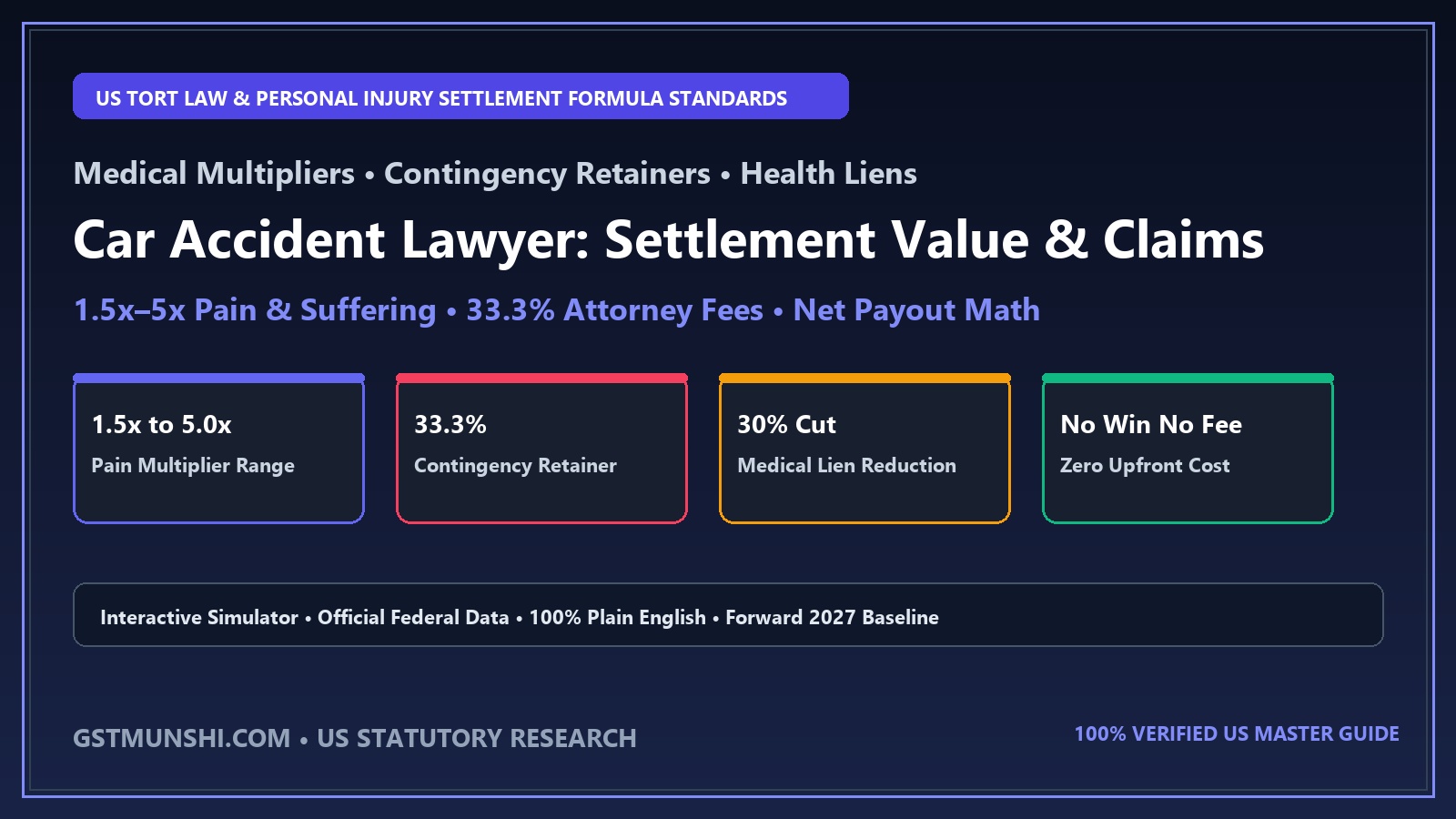
How is a car accident settlement calculated and what percentage do personal injury lawyers charge?
A car accident bodily injury settlement is calculated by combining economic damages (past and future medical bills, lost wages, and property damage) with non-economic damages (pain, suffering, and emotional distress). Insurance adjusters and attorneys calculate pain and suffering using a multiplier formula ranging from 1.5x (minor soft-tissue whiplash) to 5.0x or higher (severe fractures, spinal trauma, or permanent disability) applied against total medical costs. Personal injury lawyers operate on a contingency fee agreement, charging 33.3% (one-third) of the gross settlement if resolved pre-litigation, and 40% if a formal lawsuit is filed or goes to trial. Health insurance liens and case expenses are subtracted before the client receives their net payout.
Auto Accident Settlement & Legal Multiplier Calculator
Estimate gross settlement value, pain & suffering damages, attorney contingency fees, and net in-pocket recovery
1The Insurance Settlement Formula: Economic vs. Non-Economic Damages
When an auto accident occurs, insurance claims adjusters do not evaluate bodily injury claims based on emotion or empathy. They utilize standardized software algorithms—such as Colossus, Claims Outcome Advisor, and Guidewire—to quantify bodily injury liability. To maximize your financial recovery, you must understand how tort damages are segmented under American civil law.
Every personal injury settlement is split into two primary buckets: Economic Damages (often referred to as 'Special Damages') and Non-Economic Damages ('General Damages'). Economic damages encompass every tangible, invoiceable dollar lost due to the crash: emergency room charges, ambulance transportation, diagnostic imaging (MRI, CT scans), physical therapy, surgical fees, prescription medications, repair or fair market total loss valuation of your vehicle, and verified lost wages from missed work. Non-economic damages compensate the injured victim for physical agony, chronic pain, psychological trauma, loss of consortium, and inability to engage in normal life activities.
To quantify non-economic damages, attorneys and claims adjusters apply the Multiplier Method. Total medical special damages are multiplied by an injury severity factor ranging between 1.5 and 5.0. Minor neck and back strains (whiplash) treated conservatively with chiropractic therapy typically settle at 1.5x to 2.0x medical bills. Moderate injuries requiring MRIs, epidural steroid injections, or broken bones typically justify 2.5x to 3.5x multipliers. Severe, life-altering trauma—such as traumatic brain injuries (TBI), spinal fusion surgeries, permanent nerve damage, or extensive scarring—command 4.0x to 5.0x multipliers or trigger policy-limit demand packages.
2How Personal Injury Contingency Fees & Case Expenses Work
One of the greatest protections for accident victims in the American legal system is the contingency fee agreement, governed by Rule 1.5 of the American Bar Association (ABA) Model Rules of Professional Conduct. Under a contingency arrangement, the client pays zero upfront retainer fees and zero hourly billing rates. The personal injury law firm assumes 100% of the financial risk of litigation; if the attorney fails to secure a financial settlement or court verdict, the client owes nothing in legal fees.
The standard industry contingency fee is 33.33% (one-third) of the gross settlement amount for cases resolved before a formal lawsuit is filed with the court clerk. If the liability insurer refuses to make a fair offer and your attorney must file a formal complaint, initiate civil discovery, depose witnesses, or proceed to jury trial, the contingency fee agreement typically escalates to 40% (or occasionally 45% in complex multi-vehicle appellate litigation).
It is critical to distinguish between attorney legal fees and case expenses. Case expenses represent hard costs advanced by the law firm during the representation: fees to obtain certified hospital records, police crash report fees, court filing fees ($300–$500), private investigator asset checks, accident reconstructionist retainer fees, and expert medical witness testimony fees. In the final settlement distribution statement, these advanced costs are reimbursed to the law firm from the gross settlement proceeds before net funds are disbursed to the client.
3Subrogation & Medical Liens: Why Your Payout Gets Reduced
A frequent shock for injury victims is learning that a $100,000 settlement does not result in a $100,000 cashier's check in their bank account. Under federal and state subrogation laws, if your private health insurance (such as Blue Cross, UnitedHealthcare, or Kaiser), Medicare, Medicaid, or a hospital's statutory lien paid for your crash-related treatment, they hold a legal right to be reimbursed from your third-party liability settlement.
If you were treated at a hospital without health insurance, the medical facility may file a formal Hospital Lien with the county recorder of deeds under state statutory lien laws. If you are covered by an employer-sponsored self-funded healthcare plan governed by the Employee Retirement Income Security Act (ERISA), federal law grants the insurer powerful subrogation rights that can preempt state consumer protection statutes, as affirmed in landmark US Supreme Court precedents like Montanile v. Board of Trustees.
This is where skilled personal injury attorneys generate massive additional value beyond negotiating with the auto insurer. Personal injury lawyers routinely negotiate health insurance subrogation claims and hospital liens down by 20% to 50% using common law doctrines like the 'Common Fund Doctrine' (which requires the health insurer to reduce its lien by one-third to share in the attorney's fees) and the 'Made Whole Doctrine' (which argues the lienholder cannot recover until the injured victim is fully compensated for all losses). Every dollar saved in lien negotiations goes directly into the client's pocket.
4Immediate Post-Accident SOP: Protecting Your Claim from Day One
The actions you take in the first 72 hours following an automobile collision dictate whether your injury claim succeeds or gets devalued by the at-fault driver's insurance carrier. The primary defense strategy used by auto insurers is to argue that your injuries were pre-existing or that a 'gap in medical treatment' proves you were not truly injured in the crash.
First, never leave the scene without a formal police collision report. The responding patrol officer documents driver identities, insurance policy numbers, vehicle damage vectors, traffic citations issued, and statements made by parties and eyewitnesses. Second, seek immediate medical evaluation at an emergency department or urgent care center within 24 to 48 hours—even if you believe you only have minor stiffness. Adrenaline masks internal injuries, herniated spinal discs, and micro-concussions, and insurance algorithms automatically slash payout valuations if the initial medical visit occurs more than 7 days post-collision.
Third, photograph all vehicle damage, license plates, skid marks, road debris, traffic control signals, and your visible bodily bruises before leaving the scene. Fourth, under no circumstances should you provide a recorded statement or sign medical authorization forms for the at-fault driver's insurance adjuster. Adjusters are trained to ask leading questions designed to extract statements that minimize your pain or imply shared comparative fault. Instruct the adjuster that all communication must go through your legal counsel.
Auto Accident Settlement Multipliers by Injury Category
| Injury Classification | Typical Medical Diagnostics | Pain & Suffering Multiplier | Average Settlement Range | Key Documentation Required |
|---|---|---|---|---|
| Minor Soft Tissue (Whiplash) | X-rays (negative for fractures), physical therapy, urgent care | 1.5x – 2.0x | $5,000 – $25,000 | Urgent care notes, 6–8 weeks physical therapy logs, wage slip |
| Moderate Spinal Disc Bulge / Herniation | MRI showing disc protrusion, nerve impingement, steroid injections | 2.5x – 3.5x | $35,000 – $100,000 | High-field MRI report, orthopedic pain management records, injection bills |
| Bone Fractures (Extremities / Ribs) | CT scans, surgical pins/plates (ORIF), cast immobilization | 3.0x – 4.0x | $50,000 – $175,000 | Operative reports, orthopedist prognosis of permanent stiffness or arthritis |
| Severe / Surgical Trauma (Spinal Fusion) | Multi-level spinal fusion, cervical discectomy, ICU admission | 4.0x – 5.0x+ | $150,000 – $500,000+ | Neurosurgeon narrative, vocational expert earnings report, life care plan |
| Catastrophic TBI / Paralysis | Traumatic brain injury, permanent cognitive deficit, quadriplegia | 5.0x+ or Policy Limits | $1,000,000+ (Policy Limits) | Neuropsychological testing, 24/7 attendant care cost projections |
Typical $100,000 Gross Settlement Distribution Breakdown
| Distribution Line Item | Percentage of Gross | Dollar Amount | Explanation / Recipient |
|---|---|---|---|
| Gross Settlement from Auto Insurer | 100.0% | $100,000.00 | Total policy settlement achieved by lawyer |
| Attorney Contingency Fee (Pre-Suit) | 33.33% | $33,333.33 | Law firm legal fee earned (No win, no fee) |
| Litigation Case Expenses | 1.2% | $1,200.00 | Reimbursement for police reports, medical records, filing |
| Negotiated Health Insurance Lien | 18.0% | $18,000.00 | Reduced from $28,000 original hospital/subrogation bill |
| Outstanding Diagnostic Imaging Bill | 4.0% | $4,000.00 | Direct payment to MRI facility under Letter of Protection (LOP) |
| Net Cash Paid to Injured Client | 43.47% | $43,466.67 | 100% Tax-Free cash check deposited directly to client |
Step-by-Step SOP: Navigating an Auto Injury Claim from Crash to Settlement
Secure Scene Evidence and Call Law Enforcement
Call 911 immediately. Obtain the police incident report number, photograph vehicle license plates, roadway skid marks, and obtain contact details from neutral eyewitnesses.
Obtain Immediate Emergency Medical Treatment
Go to an emergency room or urgent care center within 48 hours. Describe every pain symptom from head to toe to create a contemporaneous medical record linking all trauma to the collision.
Retain a Qualified Personal Injury Attorney
Execute a standard contingency fee agreement. Your attorney sends formal Letters of Representation to all insurers, terminating aggressive adjuster phone calls immediately.
Complete Medical Treatment to Maximum Medical Improvement (MMI)
Never settle a bodily injury claim while still actively treating. Wait until your treating physicians declare Maximum Medical Improvement (MMI) so all future care costs can be quantified.
Issue Comprehensive Policy Limits Demand Package
Your legal team compiles medical records, billing ledgers, lost wage affidavits, and narrative injury reports into a formal demand letter giving the insurer 30 days to pay.
Negotiate Subrogation Liens and Disburse Net Funds
Upon securing the settlement check, your attorney negotiates reductions on health insurance liens and doctor LOP bills, maximizing your final net cash recovery.
Official Statutory Rules, Federal Codes & Bar Citations
ABA Model Rules of Professional Conduct (Rule 1.5)
Regulates attorney contingency fee agreements, reasonableness standards, and written disclosure requirements.
Internal Revenue Code § 104(a)(2)
Provides that compensatory damages received on account of personal physical injuries or sickness are 100% exempt from gross income taxes.
Restatement (Third) of Torts: Physical and Emotional Harm
Authoritative codification of tort duty of care, proximate causation, and economic/non-economic injury recovery.
ERISA Subrogation & Reimbursement Standards (29 U.S.C. § 1132)
Governs equitable liens by agreement enforced by self-funded employee health insurance plans against personal injury recoveries.
Curated Expert Video Walkthroughs & Wall Street Briefings
Frequently Asked Questions (Verified Statutory Answers)
Q1: How much does it cost to hire a car accident lawyer?
Hiring a personal injury lawyer costs $0 upfront. Attorneys work on a contingency fee agreement, meaning they only get paid if they win your case. The standard fee is 33.3% (one-third) of the gross settlement if resolved before filing a lawsuit, and 40% if formal litigation or trial is required.
Q2: Are car accident settlements taxable by the IRS?
No. Under Internal Revenue Code § 104(a)(2), compensatory damages received for personal physical injuries or physical sickness (including pain and suffering, medical expenses, and emotional distress stemming from the physical injury) are 100% exempt from federal and state income taxes. Only punitive damages or separate interest awards are taxable.
Q3: What is the pain and suffering multiplier in auto injury cases?
The pain and suffering multiplier is a calculation method used by insurers and attorneys to determine non-economic damages. Your total medical bills are multiplied by a number typically ranging from 1.5x (minor soft tissue/whiplash) to 5.0x or higher (severe fractures, spinal disc herniations requiring surgery, or permanent disabilities).
Q4: How long does it take to receive a settlement check after a car accident?
Most straightforward auto injury claims settle within 4 to 10 months after completing medical treatment. Complex cases involving disputed liability, commercial trucking policies, or catastrophic injuries requiring formal litigation can take 12 to 24 months. Once a settlement agreement is signed, the check usually arrives within 30 to 45 days.
Q5: Should I accept the insurance company's first settlement offer?
Almost never. The insurance company's initial offer is virtually always a lowball offer designed to close the claim before you understand the full extent of your injuries or consult an attorney. Once you sign a liability release and cash the check, you forfeit all rights to seek additional compensation even if you require surgery later.
Q6: What is a Letter of Protection (LOP)?
A Letter of Protection (LOP) is a legally binding agreement sent by your attorney to medical providers (such as orthopedists, MRI centers, or physical therapists) guaranteeing that their medical bills will be paid directly out of the future settlement proceeds. This allows injured clients without health insurance to receive treatment with zero upfront out-of-pocket costs.
Q7: What if the at-fault driver has no insurance or low policy limits?
If the at-fault driver is uninsured or their bodily injury coverage is insufficient to cover your damages, your attorney can file a claim under your own policy's Uninsured/Underinsured Motorist (UM/UIM) coverage. UM/UIM steps into the shoes of the at-fault driver and pays your medical bills and pain and suffering up to your purchased policy limits.
Q8: What is comparative negligence and how does it affect my settlement?
Under comparative fault rules (adopted in most states), your compensation is reduced by your percentage of fault. In a 'pure comparative fault' state (like California or Florida), if you are awarded $100,000 but were 20% at fault for speeding, you receive $80,000. In 'modified comparative fault' states (like Texas or Ohio), you can recover only if you are 50% or 51% or less at fault.
Q9: Can I still recover damages if I had a pre-existing condition?
Yes. Under the well-established legal 'Eggshell Skull Rule,' a defendant must take the victim as they find them. If a car crash aggravated, worsened, or accelerated an asymptomatic pre-existing condition (such as degenerative disc disease in your spine), the insurance company is legally liable for the full extent of the aggravation caused by the collision.
Q10: What is the statute of limitations for filing a car accident lawsuit?
The statute of limitations varies by state, typically ranging from 2 to 3 years from the date of the accident (e.g., 2 years in Texas, California, and Illinois; 3 years in New York; but only 1 year in Kentucky, Louisiana, and Tennessee). If you miss this statutory deadline, your legal right to pursue compensation is permanently extinguished.
Q11: Do I have to pay back my health insurance company from my settlement?
Yes, in most cases. If your private health insurance, Medicare, or Medicaid paid for your crash-related medical care, they possess a legal subrogation lien requiring reimbursement from your third-party settlement. However, your attorney can negotiate these liens down significantly under the Common Fund Doctrine and state lien reduction statutes.
Q12: What documents do I need to give my car accident lawyer?
You should provide: (1) The police crash report or exchange of information sheet; (2) Photographs of vehicle damage and injuries; (3) Contact information for witnesses; (4) Names of all hospitals, doctors, and physical therapists visited; (5) Auto insurance declaration pages for both drivers; and (6) Paystubs or tax returns documenting lost income.










Verified X (Twitter) & LinkedIn Expert Insights
“The biggest tactical error injured motorists make is speaking to the at-fault driver's insurance adjuster before consulting an attorney. Insurance adjusters are trained corporate negotiators whose performance metrics depend on keeping reserves low. When they ask friendly questions like 'How are you feeling today?' and you politely answer 'I'm okay, just a little sore,' that recorded statement is entered into Colossus as evidence of minimal soft-tissue injury. Always decline recorded interviews until you have counsel.”
“Winning the liability fight against the insurance company is only half the battle. The second half is lien resolution. If a client receives a $150,000 policy limit check, health insurance subrogation claims and hospital liens can easily swallow $60,000. Applying the Common Fund Doctrine and state-specific statutory lien caps to force health insurers to discount their liens by 33% to 50% is how we put thousands of additional net dollars into our clients' hands.”
“Insurance adjusters LOVE gaps in treatment. If you crash on Monday, feel stiff on Wednesday, but wait until 3 weeks later to see a doctor, the insurance company will argue you got injured playing softball over the weekend. Go to urgent care within 48 hours, even if you think you just have minor soreness. Create the paper trail immediately.”
“A major financial advantage people forget: Under IRC § 104(a)(2), compensatory settlements for physical injuries and sickness are 100% exempt from federal and state income taxes. A $75,000 net injury recovery is worth more than a $110,000 taxable salary bonus. Only punitive damages and pre-judgment interest are taxable.”