Which is the best way to invest in gold in India, and what are the new tax rules?
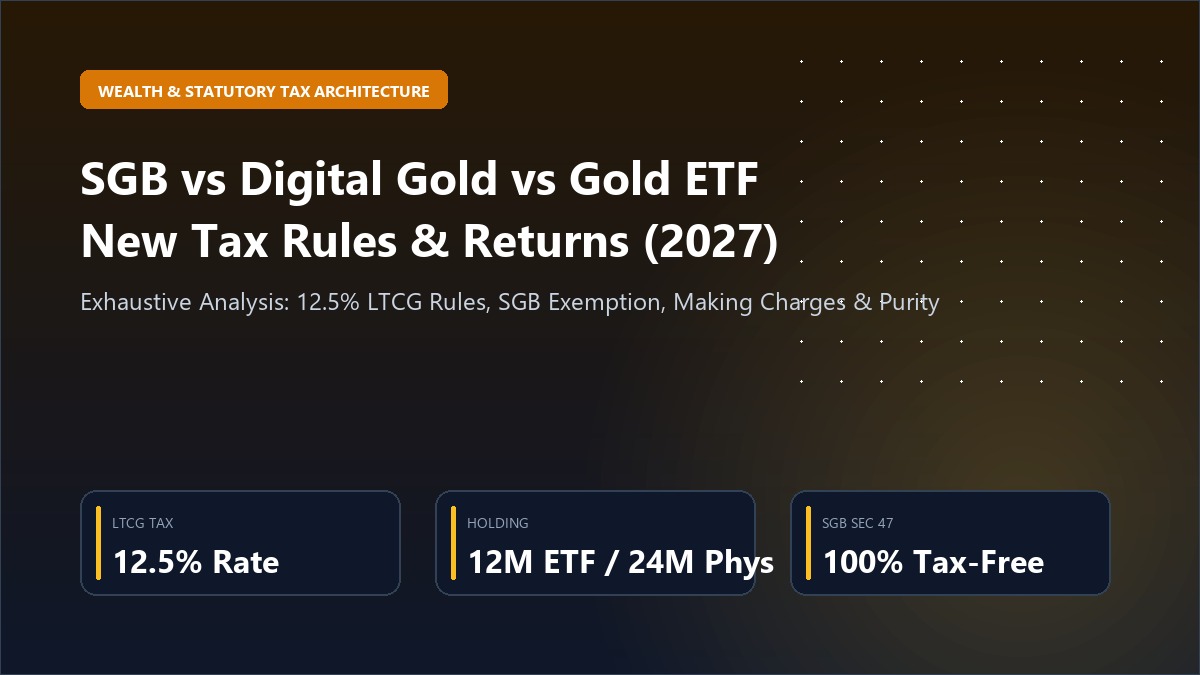
For pure investment and wealth creation, Gold ETFs and Sovereign Gold Bonds (SGB) are mathematically superior to Physical and Digital Gold. Under the rationalized capital gains regime, Gold ETFs qualify for a flat 12.5% LTCG tax after just 12 months (with zero GST on purchase and 0.40% annual expense ratio). SGBs redeemed upon maturity are 100% tax-free under Section 47(viic) and pay an extra 2.50% annual coupon. Conversely, Physical Gold incurs a heavy 3% GST + 8%–20% non-recoverable making charges and requires 24 months to qualify for LTCG.
1. Interactive Gold Returns, GST & Capital Gains Tax Simulator
Test different holding periods and investment amounts to see the exact post-tax net take-home return across all 5 gold instruments:
Gold Investment Returns, GST & Capital Gains Tax Simulator (2027)
Simulate true net take-home profit after making charges, GST, tracking drag, and Section 112 12.5% LTCG
2. Master Architecture Comparison: SGB vs ETF vs Digital vs Physical Gold
Detailed structural parameters governing purity, costs, sovereign safety, and regulatory supervision:
| Key Dimension | Sovereign Gold Bonds (SGB) | Gold ETFs / Mutual Funds | Digital Gold (Apps) | Physical Gold (Jewelry/Bars) |
|---|---|---|---|---|
| Purity Standard | 999 Sovereign Backed | 99.5% LBMA Good Delivery | 99.9% Vault Assayed | 916 (22K) or 999 (24K) HUID |
| GST on Purchase | 0% (Nil) | 0% (Nil) | 3.0% (Non-refundable) | 3% on Gold + 5% on Making |
| Additional Cash Flow | +2.50% p.a. (Semi-annual) | None | None | Negative (Safe Locker Rent) |
| Annual Expense Drag | 0.0% (Zero Drag) | 0.30% to 0.55% TER | Vault charge after 2–5 yrs | ₹2,000–₹8,000/yr Bank Locker |
| LTCG Holding Period | 12 Months (Exchange Sale) | 12 Months (Shortest) | 24 Months | 24 Months |
| Capital Gains Tax Rate | 0% on Maturity (Sec 47) | 12.5% Flat LTCG | 12.5% Flat LTCG | 12.5% Flat LTCG |
| Regulatory Authority | Reserve Bank of India (RBI) | SEBI | Unregulated by SEBI/RBI | Bureau of Indian Stds (BIS) |
3. Complete Capital Gains Tax Architecture under Finance Act (2027)
The landmark Finance Act overhauled Section 2(42A), Section 111A, and Section 112 of the Income Tax Act 1961, eliminating second-schedule cost inflation indexation (CII) and creating a harmonized 12.5% LTCG rate:
Because Gold ETFs are listed securities traded on NSE and BSE, their classification threshold for long-term status is strictly 12 months.
- Holding < 12 months: STCG taxed at your marginal slab rate (up to 39% with highest surcharge).
- Holding > 12 months: LTCG taxed at a flat 12.5% without indexation.
Physical bullion, coins, bars, jewelry, and app-based Digital Gold are classified as unlisted physical capital assets. Their threshold is 24 months.
- Holding < 24 months: STCG added to your taxable income and taxed at slab rates.
- Holding > 24 months: LTCG taxed at a flat 12.5% without indexation.
4. Sovereign Gold Bonds (SGB) Secondary Market Arbitrage & Maturity Rules
While the Government has moderated fresh primary SGB tranches to manage fiscal borrowing costs, millions of existing SGB units trade actively on NSE and BSE across series maturing between 2027 and 2032 (e.g. SGBMAY27, SGBJUN28, SGBFEB30):
Due to fragmented retail liquidity on the stock exchange, seasoned SGB tranches frequently trade at a 3% to 8% discount to the prevailing spot price of pure 24K gold on MCX. Astute investors who buy discounted secondary SGBs in their Demat accounts enjoy:
- Immediate Capital Discount: Acquiring pure gold at an effective discount to live physical spot rates.
- 2.50% Sovereign Interest: Paid directly into the linked bank account every 6 months calculated on the original issue price.
- Full Tax Exemption on Final RBI Redemption: Section 47(viic) applies to any individual holding the bond till RBI maturity redemption, even if purchased from the secondary exchange.
5. Why Financial Planners Advise Against "Digital Gold" Apps
Promoted aggressively by fintech payment apps, Digital Gold (offered by private vaulting companies like Augmont or MMTC-PAMP) carries structural disadvantages that erode investment returns:
When you buy ₹1,00,000 of Digital Gold, ₹3,000 is immediately lost to GST. Gold must rise by 3% just for you to break even.
If the buy price is ₹9,000/g, the sell price quoted by the app is typically ₹8,600/g. This spread constitutes a hidden 4% transaction friction.
Digital gold is neither a security regulated by SEBI nor a deposit under RBI jurisdiction. Trusteeship relies solely on private vault audits.
6. Physical Gold Hallmarking (6-Digit HUID) & Section 54F Capital Gains Exemption
For cultural, matrimonial, or jewelry purchases, always adhere to statutory hallmarking protocols and explore legal capital gains exemptions:
Never purchase gold jewelry without the laser-etched 6-digit Hallmarking Unique Identification (HUID). Verify the code via the official BIS CARE app to confirm the certified purity (22K 916 or 18K 750) and registered assay center.
Liquidating ancestral or physical gold creates significant LTCG liabilities. Under Section 54F, you can claim 100% tax exemption on the capital gains by reinvesting the entire net sale proceeds into the purchase or construction of a single residential house property in India.
7. Verified Video Tutorials: Returns Comparison & Tax Calculation
Watch comprehensive expert financial analyses on returns calculations, digital gold comparisons, and SGB trading:




8. Frequently Asked Questions (FAQ)
How much physical gold can an individual legally hold in India without proof of income?
Under CBDT Circular guidelines (Instruction No. 1916), during income tax search/scrutiny operations, jewelry up to 500 grams for a married woman, 250 grams for an unmarried woman, and 100 grams for a male family member will not be seized, even without purchase invoices. There is no statutory upper limit on gold holding if purchased with legitimate, tax-disclosed income.
Can I do a monthly Systematic Investment Plan (SIP) in Gold ETFs?
Yes. You can start a stock-SIP in Gold ETFs (such as Nippon India ETF Gold BeES) directly through your discount broker (Zerodha, Groww, AngelOne) starting with as little as 1 unit (~₹65–₹75). Alternatively, you can invest in a Gold Fund-of-Funds (FoF) without requiring a Demat account.
Is gold received as an inheritance or matrimonial gift taxable under Section 56(2)(x)?
No. Gold jewelry received from defined relatives (parents, spouse, siblings) or on the occasion of marriage is completely exempt from income tax under Section 56(2)(x). However, when the inherited gold is subsequently sold in the future, capital gains tax is applicable, with the holding period and acquisition cost determined from the original purchaser's holding date.