Quick Summary & Key Takeaways (Featured Snippet)
The Statutory Tax Architecture for FY 2026-27 (AY 2027-28)
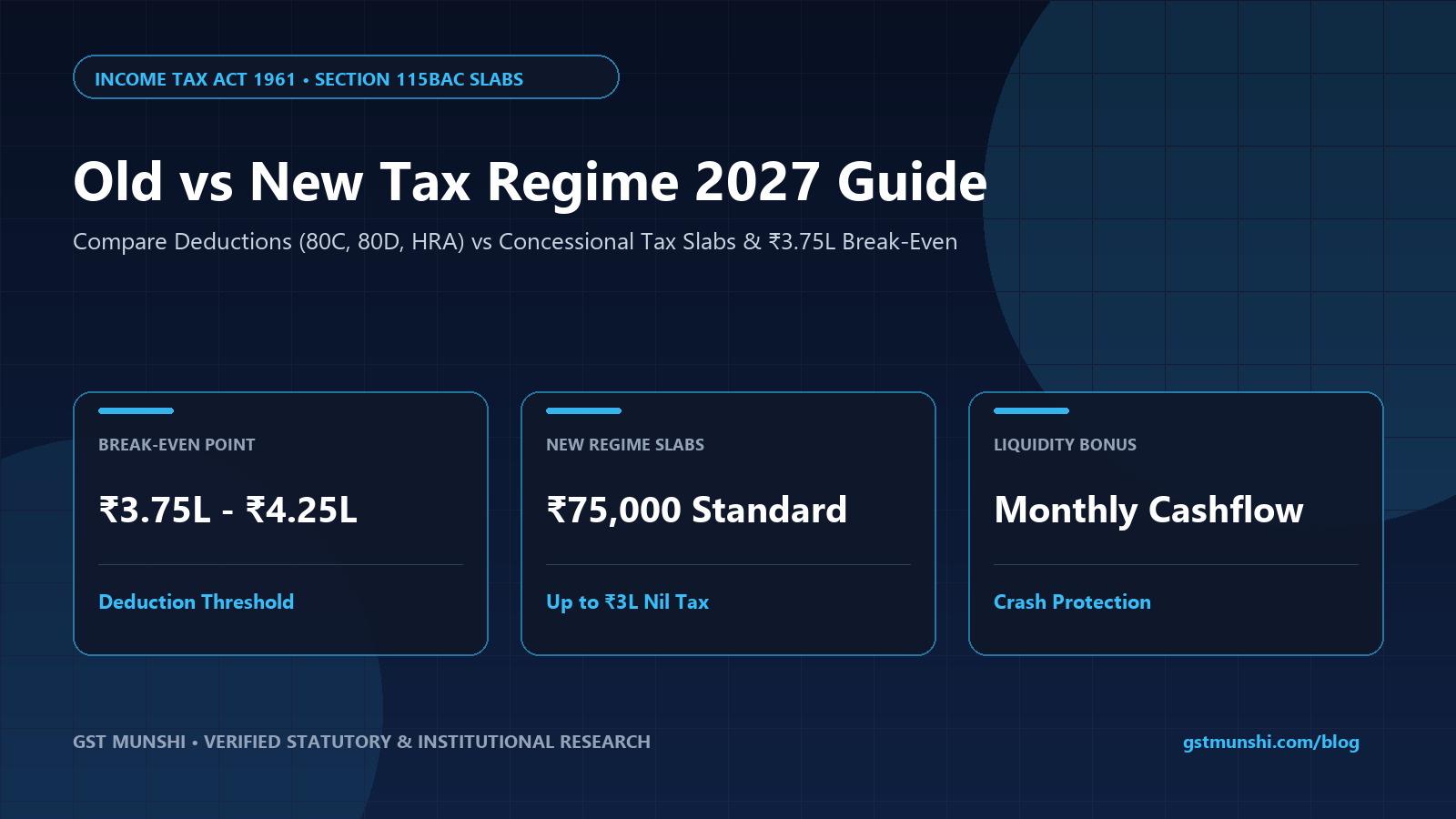
Navigating personal taxation in India requires mastering two parallel systems: the New Tax Regime under Section 115BAC (the statutory default) and the traditional Old Tax Regime. Under the Finance Act framework, the New Tax Regime features lower progressive slab rates and an enhanced Standard Deduction of ₹75,000 for salaried employees and pensioners, offset by the elimination of common Chapter VI-A deductions such as Section 80C, 80D, and House Rent Allowance (HRA).
Crucially, for Financial Year 2026-27, the Assessment Year is AY 2027-28. This distinction is the single most common stumbling block for taxpayers: the Financial Year represents the period in which wealth is generated (April 1, 2026, to March 31, 2027), while the Assessment Year represents the window in which that wealth is scrutinized, taxed, and reported on official returns.
FY 2026-27 Income Tax & e-Pay Challan Calculator
Assessment Year 2027-28 • Section 115BAC Slabs • Section 87A Marginal Relief Included
Applies only to Old Regime (New Regime provides flat ₹75,000 standard deduction).
Std Ded: ₹75,000 | Taxable: ₹12,50,000
Std Ded: ₹50,000 | Taxable: ₹10,75,000
e-Pay Tax Challan Generation SummaryAY 2027-28
incometax.gov.in under Assessment Year 2027-28 with Minor Head (300) Self-Assessment Tax.Master Slab Rates: New Tax Regime vs. Old Tax Regime
Under Section 115BAC(1A), the New Tax Regime applies automatically to all individual taxpayers, Hindu Undivided Families (HUFs), Association of Persons (AOPs), and Bodies of Individuals (BOIs) unless an affirmative election is made to opt into the Old Regime. The table below outlines the comparative tax slabs for FY 2026-27 (AY 2027-28):
| New Tax Regime Slabs (Default) | New Regime Tax Rate | Old Tax Regime Slabs (< 60 Yrs) | Old Regime Tax Rate |
|---|---|---|---|
| Up to ₹4,00,000 | Nil (0%) | Up to ₹2,50,000 | Nil (0%) |
| ₹4,00,001 to ₹8,00,000 | 5% | ₹2,50,001 to ₹5,00,000 | 5% |
| ₹8,00,001 to ₹12,00,000 | 10% | ₹5,00,001 to ₹10,00,000 | 20% |
| ₹12,00,001 to ₹16,00,000 | 15% | ||
| ₹16,00,001 to ₹20,00,000 | 20% | Above ₹10,00,000 | 30% |
| ₹20,00,001 to ₹24,00,000 | 25% | ||
| Above ₹24,00,000 | 30% |
The ₹12.75 Lakh Zero-Tax Formula & Section 87A Marginal Relief
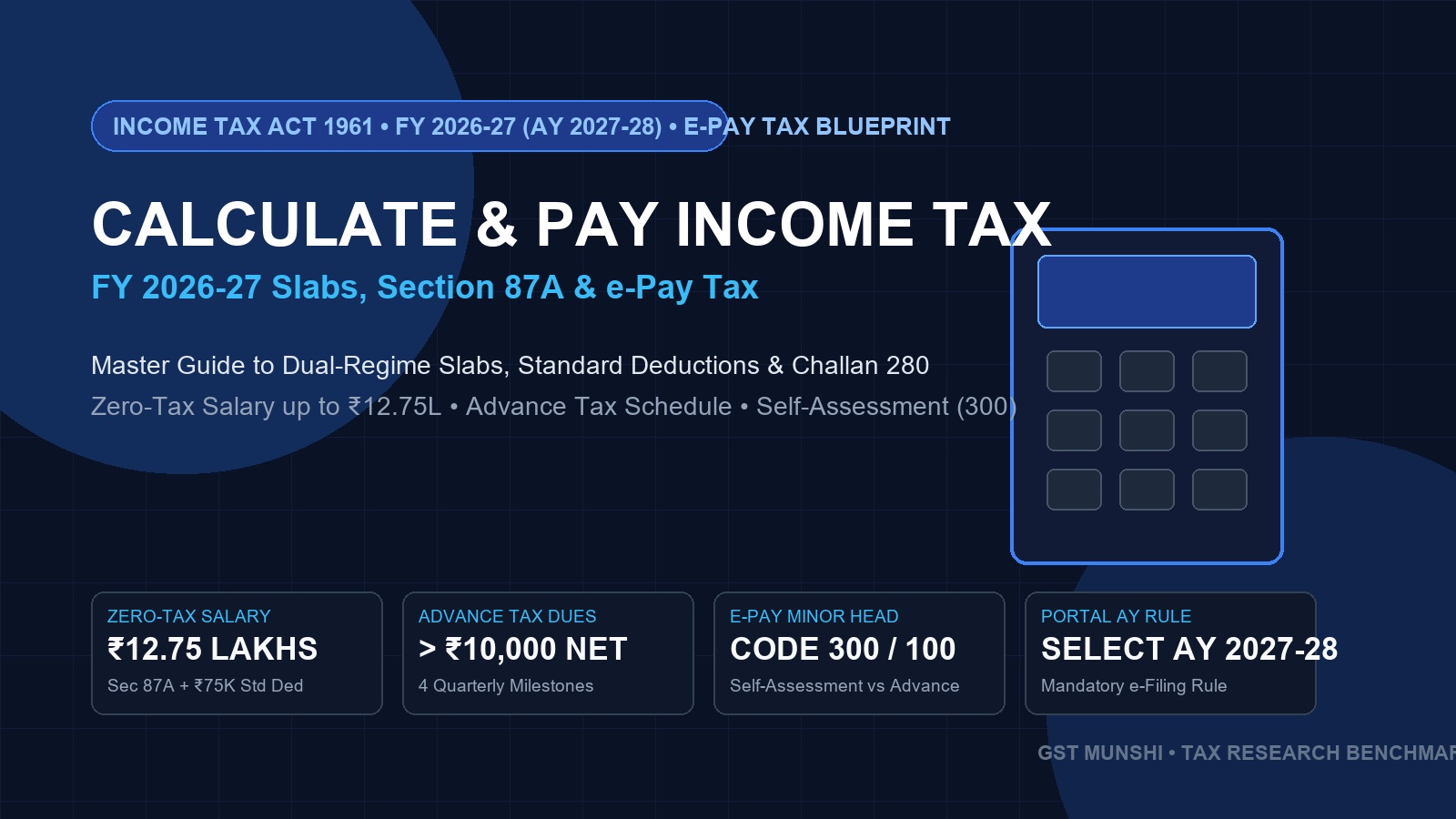
A flagship provision of the New Tax Regime is the enhanced rebate under Section 87A. For resident individuals whose net taxable income does not exceed ₹12,00,000, a statutory tax rebate of up to ₹60,000 is credited, wiping out total tax liability entirely.
For salaried employees, adding the Section 16(ia) standard deduction of ₹75,000 raises the gross salary zero-tax threshold to exactly ₹12,75,000.
The Mathematical Proof of Zero Tax at ₹12,75,000 Gross Salary
- • Gross Salary: ₹12,75,000
- • Less: Section 16(ia) Standard Deduction: (-₹75,000)
- • Net Taxable Income: ₹12,00,000
- • Tax on ₹0 to ₹4,00,000 (0%): ₹0
- • Tax on ₹4,00,001 to ₹8,00,000 (5% on ₹4,00,000): ₹20,000
- • Tax on ₹8,00,001 to ₹12,00,000 (10% on ₹4,00,000): ₹40,000
- • Total Computed Tax Liability: ₹60,000
- • Less: Section 87A Tax Rebate (Max ₹60,000): (-₹60,000)
- • Net Tax Payable: ₹0.00
How Section 87A Marginal Relief Eliminates the "Tax Cliff"
Prior to statutory marginal relief, a taxpayer earning ₹12,05,000 would breach the ₹12,00,000 rebate threshold and suddenly forfeit the entire ₹60,000 rebate, facing an absurd situation where ₹5,000 in additional earnings triggered ₹60,750 in taxes.
Under Section 87A marginal relief, the tax payable on income exceeding ₹12,00,000 cannot exceed the incremental amount earned above ₹12 Lakhs. For example, if your net taxable income is ₹12,10,000 (excess of ₹10,000), your total tax payable is strictly capped at ₹10,000 plus 4% cess, guaranteeing that your post-tax take-home pay never drops below ₹12,00,000.
Benchmark Salary Comparison: New vs. Old Tax Regime
The table below demonstrates net income tax payable across representative salary brackets, factoring in standard deductions and typical family deductions (₹1.5L Section 80C and ₹50,000 Section 80D under the Old Regime):
| Gross Salary | New Regime Taxable | New Regime Net Tax | Old Regime Taxable (₹2.5L Ded) | Old Regime Net Tax | Winning Strategy |
|---|---|---|---|---|---|
| ₹7,50,000 | ₹6,75,000 | ₹0 | ₹5,00,000 | ₹0 | Equal (Zero Tax) |
| ₹10,00,000 | ₹9,25,000 | ₹0 | ₹7,50,000 | ₹65,000 | New Regime saves ₹65,000 |
| ₹12,75,000 | ₹12,00,000 | ₹0 | ₹10,25,000 | ₹1,24,800 | New Regime saves ₹1,24,800 |
| ₹15,00,000 | ₹14,25,000 | ₹97,500 | ₹12,50,000 | ₹1,95,000 | New Regime saves ₹97,500 |
| ₹20,00,000 | ₹19,25,000 | ₹2,05,400 | ₹17,50,000 | ₹3,51,000 | New Regime saves ₹1,45,600 |
| ₹30,00,000 | ₹29,25,000 | ₹4,96,600 | ₹27,50,000 | ₹6,63,000 | New Regime saves ₹1,66,400 |
Advance Tax Compliance Calendar & Section 234C Penalties
Under Section 208 of the Income Tax Act, every individual, professional, and corporate entity whose net tax liability exceeds ₹10,000 during the financial year must pay advance tax in four structured installments. Failing to meet cumulative milestone percentages triggers mandatory simple interest penalties of 1% per month under Section 234C.
| Statutory Due Date | Installment Target | Cumulative Tax Payable | Penalty Section for Shortfall |
|---|---|---|---|
| June 15, 2026 | 15% of Estimated Tax | At least 15% of net tax dues | Section 234C (1% p.m. for 3 months) |
| September 15, 2026 | 45% of Estimated Tax | Cumulative 45% of net tax dues | Section 234C (1% p.m. for 3 months) |
| December 15, 2026 | 75% of Estimated Tax | Cumulative 75% of net tax dues | Section 234C (1% p.m. for 3 months) |
| March 15, 2027 | 100% of Estimated Tax | 100% full settlement of dues | Section 234C (1% p.m. for 1 month) |
| March 31, 2027 | 90% Assessed Tax Threshold | Year-end statutory baseline | Section 234B triggers if < 90% paid |
Step-by-Step SOP: How to Pay Income Tax Online on the e-Filing Portal
Follow this 5-step blueprint to generate an authentic Challan ITNS 280 on the official government portal (`incometax.gov.in`) without technical errors:
Access the Official Portal & Navigate to e-Pay Tax
Visit incometax.gov.in. Log in using your PAN and password. From the top navigation bar, select e-File > e-Pay Tax. Alternatively, you can click the quick link "e-Pay Tax" on the homepage to initiate payment without logging in (requires PAN and OTP verification).
Initiate New Payment & Select Tax Category
Click the blue button labeled "New Payment". You will see several payment tiles. Locate the tile titled "Income Tax" (applicable to individual taxpayers, HUFs, and firms) and click "Proceed".
Strictly Select Assessment Year (AY 2027-28) & Minor Head
From the Assessment Year dropdown, select 2027-28. Then select the appropriate Type of Payment (Minor Head):
• Choose Advance Tax (100) if paying installments between April 1, 2026, and March 31, 2027.
• Choose Self-Assessment Tax (300) if paying residual tax balance when filing your ITR (after March 31, 2027).
Enter Tax Breakdown & Select Preferred Payment Mode
Enter your exact tax figures into the designated fields: Basic Tax, Surcharge, Health & Education Cess (4%), and Interest under Section 234A/B/C (if paying after the deadline). Then select your preferred payment mode: Net Banking, Debit Card, UPI / Credit Card (via Payment Gateway), or RTGS/NEFT.
Download Challan ITNS 280 & Reconcile in AIS/26AS
Complete the transaction through your bank or UPI app. Upon successful processing, the system will generate an official Challan Receipt with your BSR Code, Challan Number (CIN), CRN, and Tender Date. Save this PDF. Verify within 24 to 48 hours that the payment reflects in your Form 26AS and Annual Information Statement (AIS) before submitting your return.
Common Challan Errors & How to Fix Them Online
If you accidentally paid tax under the wrong Minor Head (e.g., selected Minor Head 100 instead of 300) or selected the previous Assessment Year (AY 2026-27), the Income Tax Department provides a self-service Challan Correction Service directly within your e-filing portal. Navigate to Services > Challan Correction, submit a correction request with your Challan Reference Number (CRN), and track its approval by your Jurisdictional Assessing Officer (JAO).
Step-by-Step Income Tax Video Walkthroughs
Executive Practitioner & Tax Counsel Insights
“The most widespread compliance error on the e-filing portal is taxpayers selecting AY 2026-27 instead of AY 2027-28 when paying Self-Assessment Tax for FY 2026-27. This results in the payment mapping to the prior financial year, leaving current tax liabilities unpaid and triggering Section 143(1) demand notices with 1% monthly interest under Section 234B.”
“Taxpayers frequently fear the 'cliff effect' under the New Regime—worrying that earning ₹12,80,000 will cost them ₹60,000+ in tax. The statutory marginal relief mechanism ensures you never pay more in tax than the incremental income earned above ₹12,00,000. For an excess salary of ₹15,000, your tax cannot exceed ₹15,000.”
“Salaried employees who also receive substantial interest from bank FDs or mutual fund capital gains must not assume employer TDS settles their taxes. If residual tax exceeds ₹10,000, advance tax installments on June 15, Sept 15, Dec 15, and March 15 are legally compulsory. Delaying payment until return filing incurs unnecessary Section 234C penal interest.”
“Unless a salaried professional can prove more than ₹4.25 Lakhs in combined deductions under Section 80C, 80D, HRA, and home loan interest, the New Tax Regime is mathematically superior for incomes up to ₹50 Lakhs. The ₹75,000 standard deduction coupled with streamlined slabs makes deductions chasing unviable for most households.”
Frequently Asked Questions: FY 2026-27 Income Tax
What is the difference between FY 2026-27 and AY 2027-28?
Financial Year (FY) 2026-27 represents the 12-month period between April 1, 2026, and March 31, 2027, during which your income is earned. Assessment Year (AY) 2027-28 represents the subsequent year (April 1, 2027, to March 31, 2028) in which that income is evaluated, assessed, and reported via your Income Tax Return (ITR). When paying taxes on income earned in FY 2026-27, you must strictly select AY 2027-28 on the e-filing portal.
Why is salary income up to ₹12.75 Lakhs completely tax-free under the New Tax Regime?
Under Section 115BAC of the Income Tax Act, salaried employees receive a flat Standard Deduction of ₹75,000 under Section 16(ia). Subtracting ₹75,000 from a gross salary of ₹12,75,000 leaves a Net Taxable Income of exactly ₹12,00,000. Under the New Tax Regime slabs, tax on ₹12,00,000 is calculated at ₹60,000 (0% on 4L, 5% on 4L-8L = ₹20,000, 10% on 8L-12L = ₹40,000). Section 87A provides a full rebate of up to ₹60,000 for taxable income up to ₹12 Lakhs, reducing the final tax liability to zero.
What happens if my salary slightly exceeds ₹12.75 Lakhs (e.g., ₹13,00,000)?
Under the statutory marginal relief provisions of Section 87A, you are protected from an unfair tax spike. Without marginal relief, an individual earning ₹12,85,000 would pay over ₹60,000 in tax for earning just ₹10,000 extra. The marginal relief rule dictates that the total tax payable on income marginally exceeding ₹12 Lakhs (after standard deduction) cannot exceed the incremental income earned above the threshold.
What is the difference between Minor Head 100 and Minor Head 300 on e-Pay Tax?
Minor Head (100) represents Advance Tax, which is paid in quarterly installments during the financial year (on or before June 15, Sept 15, Dec 15, and March 15). Minor Head (300) represents Self-Assessment Tax, which is paid after the financial year ends (after March 31) when calculating your final balance tax liability prior to submitting your ITR. Selecting Minor Head (400) is reserved for Regular Assessment Tax paid in response to official demand notices from the department.
What should I do if I mistakenly selected the wrong Assessment Year when paying income tax?
If you paid tax under the incorrect Assessment Year (for example, selecting AY 2026-27 instead of AY 2027-28), do not make a duplicate payment immediately. Log in to the Income Tax e-filing portal, navigate to Services > Challan Correction, and submit an online request to change the Assessment Year. For challans generated through OLTAS/e-Pay Tax, the department allows online correction within specified time limits provided the challan has not already been consumed in a processed return.
Who is legally obligated to pay Advance Tax for FY 2026-27?
Under Section 208 of the Income Tax Act, every taxpayer (salaried employee, freelancer, professional, business owner) whose estimated total tax liability for the financial year exceeds ₹10,000—after accounting for TDS and TCS—must pay advance tax in four prescribed installments. Resident senior citizens (aged 60 or older) who do not have any income from business or profession are statutorily exempt from paying advance tax.
What are the penal interest consequences of missing advance tax deadlines?
Defaulting on advance tax triggers two mandatory interest penalties: Section 234C levies simple interest at 1% per month for 3 months on the shortfall amount for each deferred quarterly installment. Section 234B levies simple interest at 1% per month starting from April 1 of the Assessment Year until the date of payment if you fail to pay at least 90% of your total assessed tax liability before March 31.
Can I choose the Old Tax Regime for FY 2026-27, and how do I exercise that choice?
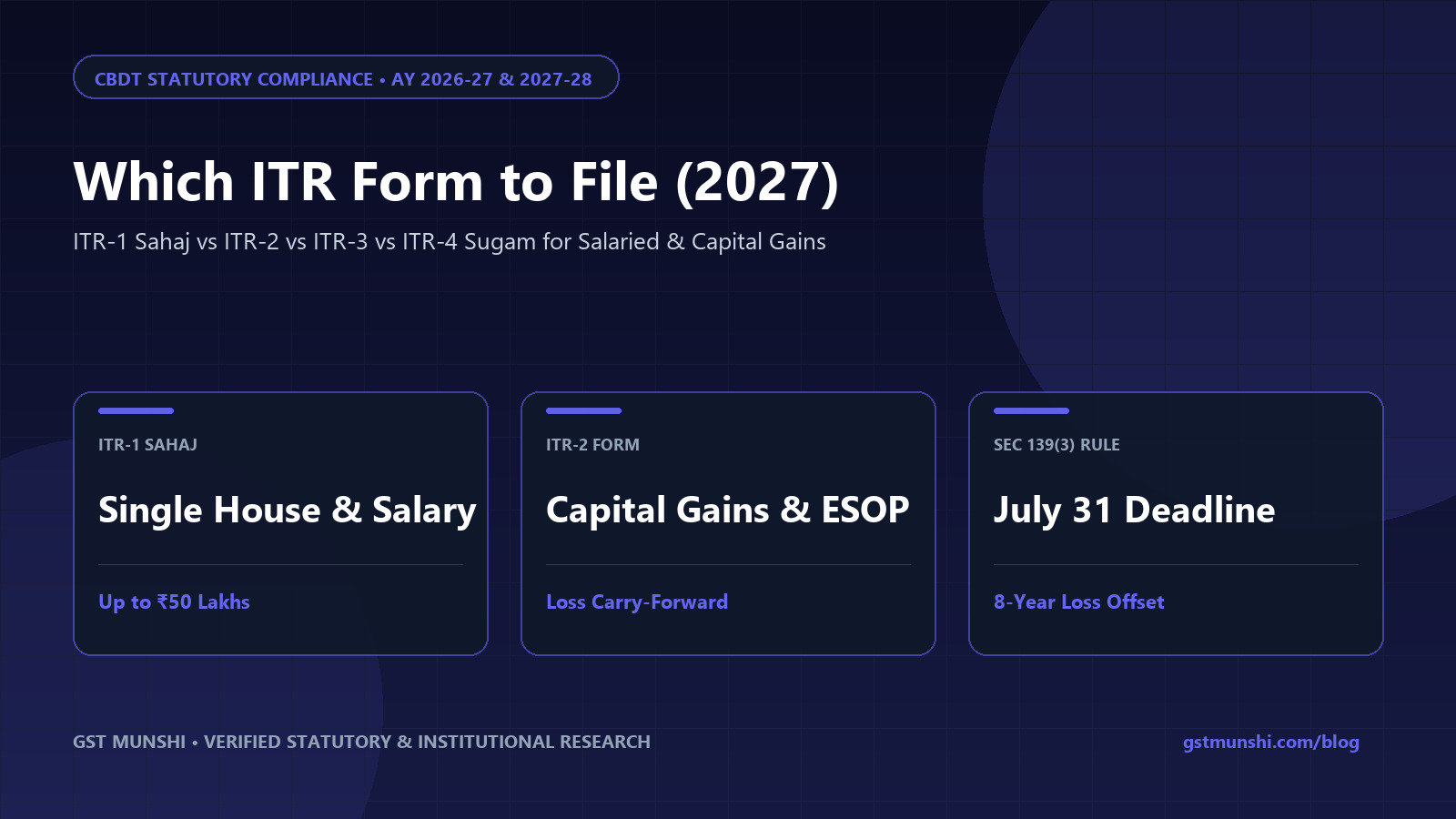
Yes. Although the New Tax Regime under Section 115BAC is the statutory default, taxpayers can opt for the Old Tax Regime. Salaried individuals with no business income can simply select the Old Regime when filing their annual ITR (ITR-1 or ITR-2) on or before the due date (July 31, 2027). Individuals with income from business or profession must submit Form 10-IEA electronically on or before the due date to opt into the Old Regime.
What are the accepted payment modes on the e-Pay Tax portal?
The Income Tax portal supports five primary payment channels: (1) Net Banking with authorized public and private sector banks (free of charge); (2) Debit Card of authorized banks; (3) Payment Gateway supporting UPI (Google Pay, PhonePe, Paytm, BHIM) and Credit Cards; (4) RTGS/NEFT by generating a mandate form with an RBI virtual account number; and (5) Over-the-Counter (Pay at Bank) by generating a Challan Reference Number (CRN) for cash or cheque deposit at bank branches.
How long does it take for an online tax payment to reflect in Form 26AS and AIS?
Upon successful payment on `incometax.gov.in`, a Challan Receipt with the Challan Identification Number (CIN), BSR Code, and CRN is generated immediately. The payment typically updates in your e-filing portal payment history instantly, while reflecting in Form 26AS, AIS (Annual Information Statement), and TIS (Taxpayer Information Summary) within 24 to 48 banking hours once the receiving bank uploads the scrolls to the Central Accounts Section of the RBI.
What should I do if my bank account was debited but the portal shows 'Payment Initiated' or failed?
If funds were deducted from your bank or card but the challan receipt was not generated, do not initiate a second payment immediately. Wait 30 to 60 minutes and check the 'Payment History' tab under e-Pay Tax. Most payment gateways perform an automated end-of-day reconciliation with the bank. If the status remains unresolved after 24 hours, the deducted money is typically credited back by the payment aggregator within 3 to 5 working days.
Do freelancers and professionals under presumptive taxation (Section 44ADA) need to pay 4 advance tax installments?
No. Taxpayers opting for presumptive taxation under Section 44AD (businesses with turnover up to ₹2-3 Crores) or Section 44ADA (specified professionals with gross receipts up to ₹50-75 Lakhs) are granted special relief under Section 211(1)(b). They are exempt from the June, September, and December installments and can pay 100% of their estimated advance tax liability in a single installment on or before March 15 of the financial year.
Are Health and Education Cess charges included in the income tax slab percentages?
No. The income tax slab percentages (5%, 10%, 15%, 20%, 25%, 30%) represent the base statutory tax rate. After calculating the base income tax and any applicable surcharge, a mandatory 4% Health and Education Cess is computed on the aggregate of (Income Tax + Surcharge). The final amount payable is always the sum of base tax, surcharge, and the 4% cess.
Can I pay income tax online without logging into my e-filing account?
Yes. You can use the 'e-Pay Tax' quick link available directly on the homepage of `incometax.gov.in` without entering a password. You must input your PAN/TAN, confirm it by re-entering, provide any valid mobile number, and verify through a 6-digit One-Time Password (OTP). Once verified, you select the Assessment Year and Minor Head to complete payment and download Challan ITNS 280.