How do I check my Ladli Behna ₹1,250 payment status, and what causes payment failures?
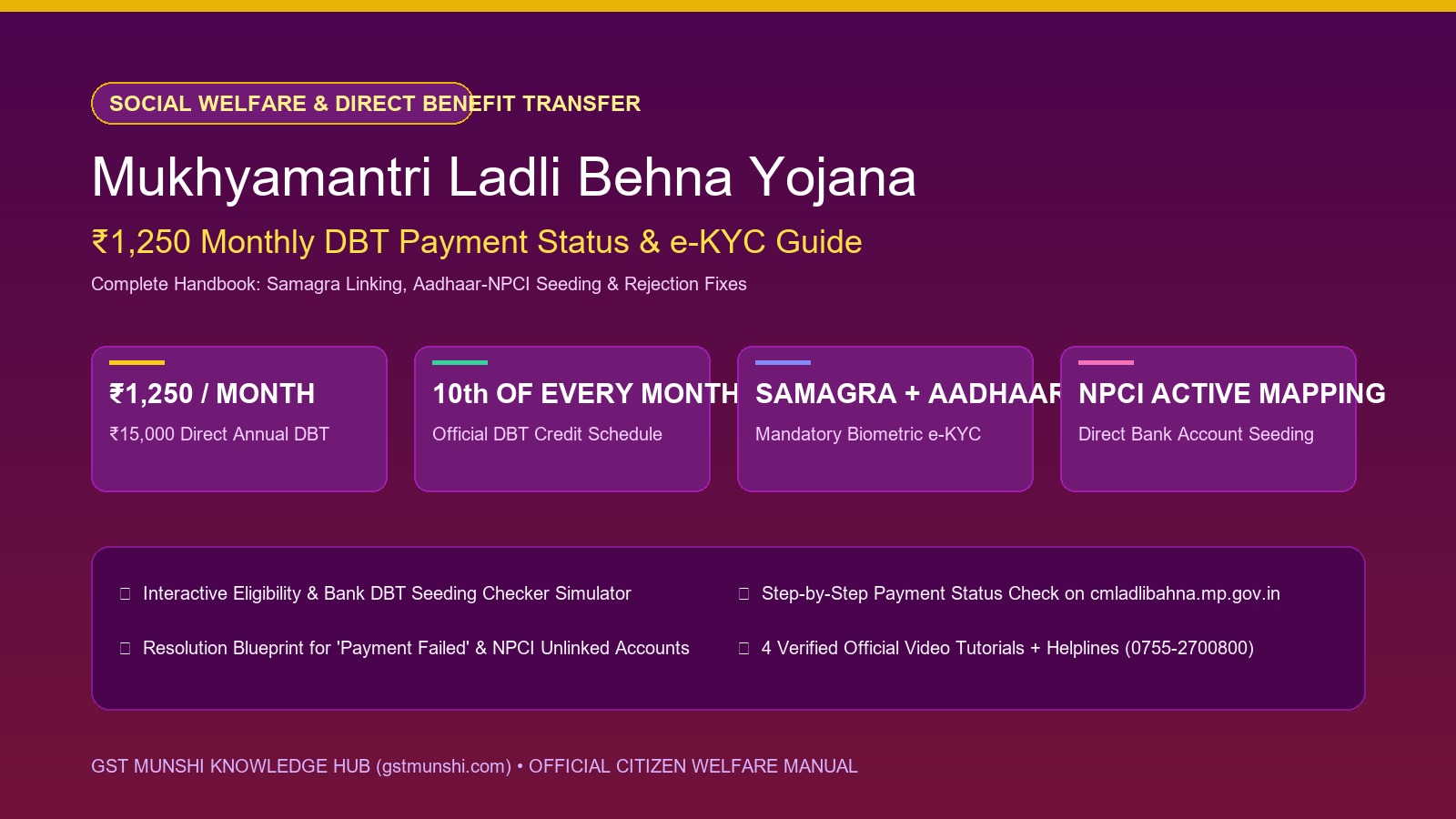
To check your payment status, visit the official portal at cmladlibahna.mp.gov.in and navigate to 'Application & Payment Status' (आवेदन एवं भुगतान की स्थिति). Enter your 9-digit Samagra Member ID and submit the mobile OTP. The ₹1,250 monthly DBT is transferred on the 10th of every month. Payment failures occur almost exclusively due to inactive NPCI Aadhaar bank account seeding or demographic mismatches between Samagra and Aadhaar records.
₹15,000 annual sovereign financial entitlement per eligible woman
Automated electronic batch clearance via Reserve Bank of India / NPCI
Includes widows, divorcees, and abandoned women residing in MP
Dedicated WCD support desk or dial 181 for MP CM Helpline
1. Interactive Eligibility & Bank DBT Readiness Checker
Verify your eligibility status and diagnose potential payment blockage reasons before the upcoming 10th monthly installment cycle:
Ladli Behna Eligibility & DBT Payment Readiness Diagnostic (2026–2027)
Test your demographic, land, income, and bank parameters against official MP Government guidelines
100% Eligible & Ready for ₹1,250 Monthly DBT Credit
All demographic, income, land, and banking prerequisites are fully satisfied.
2. The ₹1,250 Monthly DBT Payment Framework & Escalation Path
The Mukhyamantri Ladli Behna Yojana represents one of India's largest state-level Direct Benefit Transfer programs, covering over 1.29 crore beneficiaries across Madhya Pradesh. The financial architecture operates on a predictable monthly rhythm:
Phase 1: Batch Creation (1st–5th)
District Women and Child Development offices run automated algorithmic validation of the beneficiary registry against the Samagra civil registration database to filter deceased or out-migrated beneficiaries.
Phase 2: Treasury Clearance (6th–9th)
The Directorate of WCD issues unified electronic payment advice to the State Bank of India (SBI) nodal clearing branch, funding the National Payments Corporation of India (NPCI) APBS gateway.
Phase 3: Direct Credit (10th)
Beneficiary bank accounts receive the exact ₹1,250 credit via Aadhaar Payment Bridge. Beneficiaries receive an automated bank transaction SMS indicating sender code 'MPGOVT' or 'DBT-WCD'.
3. Step-by-Step SOP: Checking Payment & Application Status on cmladlibahna.mp.gov.in
Follow this 4-step verified procedure to inspect your official electronic payment ledger and track transaction reference numbers:
Navigate to Official Portal
Open your web browser and navigate directly to cmladlibahna.mp.gov.in. Beware of fraudulent duplicate domains or mobile APK download links circulating on messaging platforms.
Select 'Application & Payment Status'
On the top navigation bar, click on 'आवेदन एवं भुगतान की स्थिति' (Application and Payment Status).
Input Samagra Member ID & Verify Mobile OTP
Enter your 9-digit Samagra Member ID (समग्र सदस्य आईडी) or the Application Number from your registration receipt. Enter the on-screen captcha and click 'Send OTP' (ओटीपी भेजें). Enter the 6-digit verification code received on your registered mobile number.
Audit Month-by-Month Transaction Ledger
The portal displays a comprehensive ledger showing: Installment Number, Billing Month, Transaction Amount (₹1,250), Bank Name, Account Number (masked), UTR Reference Number, and Status (Success / Failed).
4. Samagra Portal e-KYC: The Essential Anchor
The Madhya Pradesh Samagra Social Security Mission (samagra.gov.in) maintains the foundational citizen registry for the state. If your Samagra profile is unverified or has demographic discrepancies, your Ladli Behna benefits will be halted:
Online Mode (Via Aadhaar OTP)
If your active mobile number is linked with your Aadhaar Card, log into samagra.gov.in > click 'e-KYC करें' > input your 9-digit Samagra ID > verify via Aadhaar OTP > approve demographic details. e-KYC updates within 24 to 48 hours.
Offline Mode (Biometric Fingerprint)
If your mobile number is not linked to Aadhaar or OTP verification fails, visit any local Gram Panchayat office, Ward Office, MP Online Kiosk, or CSC Center. Biometric fingerprint authentication is completely free of charge.
5. Aadhaar-NPCI Bank Seeding Mandate: Understanding Direct Benefit Transfer
Many applicants mistakenly believe that simply giving an account number to their bank is sufficient. In modern public finance, government subsidies do not travel via simple NEFT/RTGS to an account number; they travel through the Aadhaar Payment Bridge System (APBS) managed by NPCI:
Critical Difference: 'Aadhaar Linked' vs 'Aadhaar Seeded (NPCI Enabled)'
Aadhaar Linked (KYC): Your bank merely attaches your Aadhaar copy to satisfy anti-money laundering (AML) laws. This does NOT enable incoming government DBT payments.
Aadhaar Seeded (NPCI DBT Mapped): The bank explicitly uploads your 12-digit Aadhaar to the NPCI national mapper server. When the MP Government releases funds to your Aadhaar number, NPCI automatically routes the ₹1,250 directly to this specific account.
6. Rejection Codes & Resolution Blueprint
If your installment fails to arrive on the 10th of the month, match your portal status message with the official troubleshooting blueprint below:
| Error Status Message | Root Cause | Actionable Resolution Step |
|---|---|---|
| Payment Failed: Inactive A/C | Bank savings account has become dormant due to zero transactions over 12 months. | Visit branch with passbook and Aadhaar card; make a ₹100 cash deposit to reactivate account. |
| NPCI Mapping Not Found | Account is not linked to NPCI mapper or has been unmapped due to opening a new account elsewhere. | Fill out physical 'Aadhaar Seeding Mandate Form' at bank; insist on biometric authentication. |
| Demographic Mismatch | Name spelling, date of birth, or husband/father name differs between Samagra and Aadhaar. | Update Aadhaar details first via UIDAI Enrolment Center, then execute fresh Samagra e-KYC. |
| Income / Land Ceiling Flagged | Land registry or vehicle registration database flags family with > 5 acres or four-wheeler. | Submit an appeal before the Tehsildar / Gram Panchayat grievance committee with certified revenue records. |
7. Verified Social Welfare Expert Disclosures
Official administrative perspectives from social welfare directors and banking ombudsman officers regarding public program delivery:
Directorate of Women & Child Development MP
State Welfare Administration"Over 98% of all rejected payment transactions in Ladli Behna Yojana originate from secondary bank accounts becoming dormant or citizens opening new private bank accounts without updating NPCI seeding. Beneficiaries must ensure their primary Aadhaar-seeded account remains active with regular balance checks."
State Level Bankers' Committee (SLBC) MP
Banking Ombudsman & Financial Inclusion Desk"Under RBI Master Directions on Financial Inclusion, basic savings accounts (BSBD) holding Ladli Behna DBT funds cannot be penalized for non-maintenance of minimum balance. Banks are strictly prohibited from deducting government welfare DBT money against previous loan dues without explicit customer consent."
@MP_SarkariYojana
Public Policy Tracker"If your Ladli Behna status shows 'Success' on cmladlibahna.mp.gov.in but money didn't hit your bank, check your other bank accounts! In 85% of cases, the money landed in a post office account, Jan Dhan account, or Airtel Payments Bank account where NPCI was mapped years ago."
@JanSevaKendraMP
Citizen Services Network"Reminder to all citizens: Samagra e-KYC is 100% free at Gram Panchayat offices and Ward offices. If any kiosk demands ₹50–₹100 for Ladli Behna biometric authentication, register an immediate complaint on CM Helpline 181."
8. Verified Video Walkthroughs: Status Check & e-KYC Tutorials
Watch official and expert procedural guides demonstrating portal navigation, bank seeding, and grievance registration:
9. Frequently Asked Questions (FAQ)
How much financial assistance is provided under Mukhyamantri Ladli Behna Yojana?
Eligible women receive ₹1,250 per month, directly credited into their Aadhaar-linked bank accounts via Direct Benefit Transfer (DBT). This amounts to ₹15,000 per year. The state government has also laid out a policy roadmap to progressively increase the monthly allowance in increments up to ₹3,000 per month.
On which date of the month is the Ladli Behna installment credited?
The monthly installment is transferred on the 10th day of every calendar month. In special circumstances, such as state festivals or public holidays, the transfer may be preponed by 1 to 2 days upon official notification by the Chief Minister.
How can I check my Ladli Behna payment and application status online?
Visit the official portal at cmladlibahna.mp.gov.in and click on 'Application & Payment Status' (आवेदन एवं भुगतान की स्थिति). Enter your 9-digit Samagra Member ID or Application Registration Number, enter the captcha, and click 'Send OTP'. After verifying the 6-digit OTP sent to your registered mobile number, your complete installment payment history, bank credit status, and rejection reasons (if any) will be displayed.
What are the mandatory eligibility criteria for Ladli Behna Yojana?
The applicant must be a permanent resident of Madhya Pradesh, aged between 21 and 60 years, and married (including widows, divorcees, and legally abandoned women). The total annual family income must not exceed ₹2.5 Lakh, and the family must not own more than 5 acres of agricultural land, a four-wheeler vehicle (excluding tractors), or include any income tax payees or government employees.
Why is Samagra Portal e-KYC mandatory, and how can I complete it?
Samagra e-KYC links your Aadhaar data with your Samagra Family and Member ID to eliminate duplicate or phantom beneficiaries. You can complete e-KYC online for free on samagra.gov.in using Aadhaar OTP (if your mobile is linked to Aadhaar) or offline via biometric fingerprint verification at any Common Service Center (CSC), MP Online Kiosk, or Gram Panchayat office.
What should I do if my payment status shows 'Payment Failed' or 'DBT Inactive'?
A 'Payment Failed' status almost always indicates that your bank account is not mapped to NPCI (National Payments Corporation of India) for Aadhaar-based DBT. To resolve this: 1) Visit your bank branch in person, 2) Submit a physical 'Aadhaar Seeding / NPCI Mapping Consent Form', 3) Request the bank officer to enable DBT on your account, and 4) Verify status on the UIDAI portal under 'Check Aadhaar & Bank Account Linking Status'.
Can unmarried women apply for Ladli Behna Yojana?
Under statutory scheme guidelines, unmarried women are not eligible. The scheme specifically mandates that the applicant must be married, widowed, divorced, or abandoned, and aged between 21 and 60 years.
Are women who already receive widow pension or disability pension eligible?
Yes. If an eligible woman is already receiving a social welfare pension (such as widow pension or disability pension) of less than ₹1,250 per month (e.g. ₹600 or ₹1,000), the state government pays the differential amount so that her total monthly receipt equals ₹1,250 per month.
Can I provide a joint bank account for receiving Ladli Behna installments?
No. Joint bank accounts are strictly prohibited because DBT automated clearing systems require individual Aadhaar-to-account mapping. Every applicant must maintain an active, single-operated savings bank account opened in her own name with Aadhaar seeding and DBT active.
What is the official helpline number for Ladli Behna Yojana grievances?
Beneficiaries can contact the official state helpline at 0755-2700800 between 08:30 AM and 08:30 PM on all working days, or email grievances directly to ladlibahna.wcd@mp.gov.in. Alternatively, you can register a complaint via the MP CM Helpline by dialling 181.
What happens if a beneficiary turns 60 years old?
Upon reaching 60 years of age, the beneficiary is automatically transitioned out of the Ladli Behna Yojana and transitioned into the National Social Assistance Programme (NSAP) Old Age Pension Scheme to guarantee uninterrupted monthly financial assistance without needing fresh documentation.
Does owning a tractor disqualify a family from Ladli Behna Yojana?
No. The scheme rules explicitly state that owning a tractor does not disqualify an applicant. Only four-wheeler passenger vehicles (such as cars, SUVs, and commercial trucks) attract disqualification under the vehicle ownership ceiling.