Which child investment account is best in the US: a 529 Plan, a Custodial Roth IRA, or a UGMA/UTMA brokerage account?
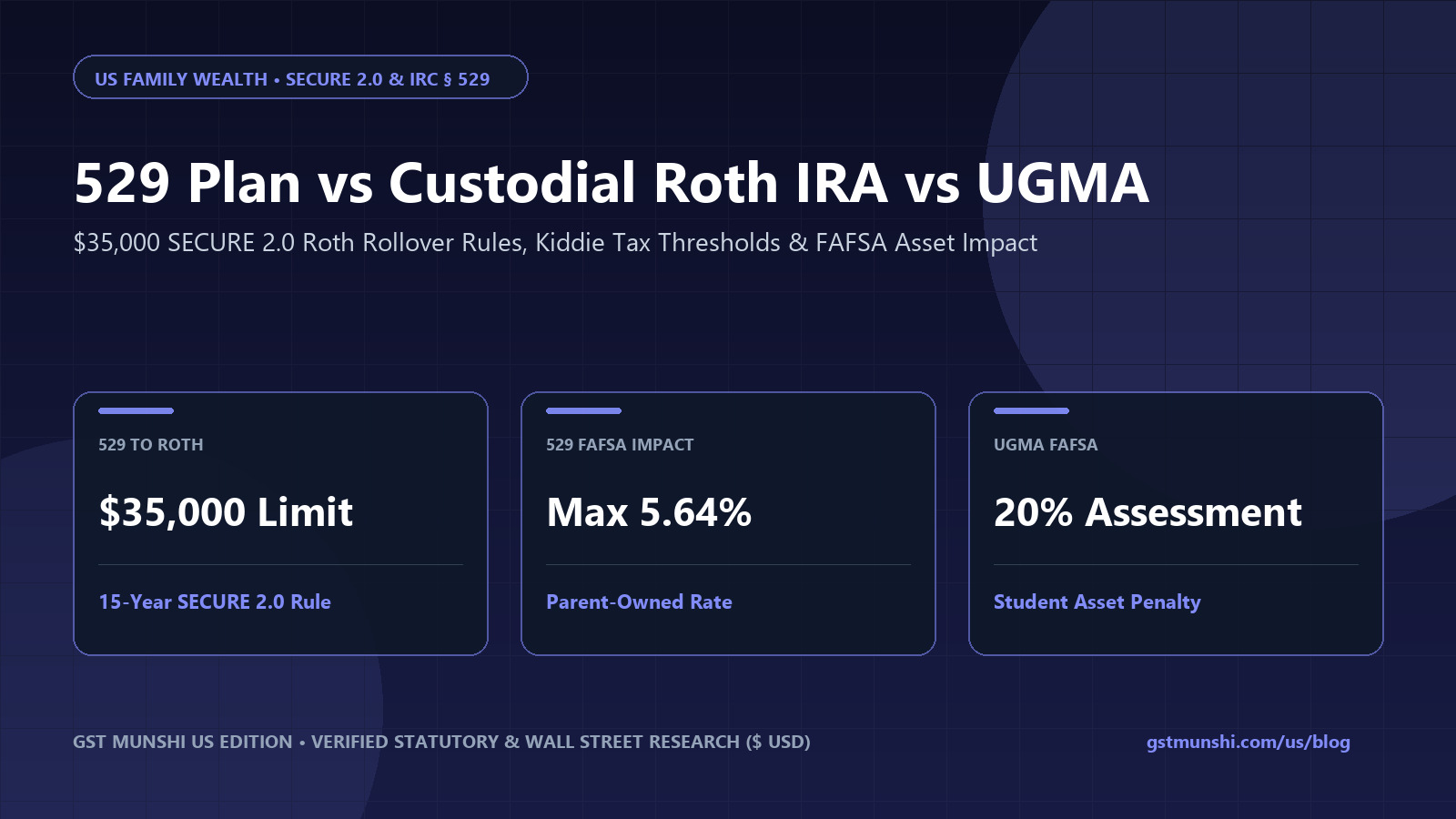
For education and flexible wealth building, a 529 Plan is the gold standard: contributions grow 100% federal tax-free for college, trade schools, and K–12 tuition ($10,000/yr), are assessed at a maximum 5.64% parental rate on FAFSA (0% if owned by grandparents), and under SECURE 2.0 Act Section 126, up to $35,000 of unused 529 funds can be rolled tax-and-penalty-free into the child's Roth IRA after 15 years. A Custodial Roth IRA is unbeatable if the child has legitimate earned income, while UGMA/UTMA accounts offer unrestricted spending flexibility but suffer a harsh 20% FAFSA student asset penalty and IRS Kiddie Tax rules.
Compare Tax-Free 529 Growth vs UGMA Student Aid Penalty
1How the SECURE 2.0 Act Eliminated the 'Unused 529 Penalty' Fear
Historically, parents hesitated to overfund a 529 account because non-qualified withdrawals face ordinary income tax plus a 10% IRS penalty on the earnings portion. Under Section 126 of the SECURE 2.0 Act, beneficiaries can roll over up to $35,000 lifetime from a 529 account into a Roth IRA in their name, provided the 529 has been open for at least 15 years and annual rollovers stay within the yearly IRA contribution limit.
529 College Savings Plan vs Custodial Roth IRA vs UGMA/UTMA Brokerage Comparison
| Feature | 529 Education Savings Plan | Custodial Roth IRA | UGMA / UTMA Custodial Account |
|---|---|---|---|
| Tax Treatment | Tax-Free Growth & Withdrawals for Education + $35K Roth Rollover | 100% Tax-Free Growth; Contributions Withdrawable Anytime | Taxable Annually (Subject to IRS Form 8615 Kiddie Tax) |
| Child Earned Income Required? | No (Anyone Can Contribute) | Yes (Capped at Child's Earned Income or Annual IRA Limit) | No |
| FAFSA Student Aid Penalty | Low (Max 5.64% if Parent-Owned; 0% if Grandparent-Owned) | 0% (Retirement Assets Excluded from FAFSA) | Severe (20% Assessed as Student Asset Every Year) |
| Can You Change the Beneficiary? | Yes (Transferable to Siblings, Parents, or Future Grandchildren) | No (Irrevocably Belongs to the Named Child) | No (Irrevocable Gift to the Child at Age 18–21) |
4-Step Generational Wealth Strategy for Your Child
Open a 529 Plan at Birth to Start the 15-Year SECURE 2.0 Clock
Even a $50 initial deposit at birth starts the mandatory 15-year seasoning period required for future tax-free 529-to-Roth IRA rollovers.
Claim Your State Income Tax Deduction First
Over 30 US states offer a state income tax deduction or credit for contributing to your home state's 529 plan.
Use the Grandparent 529 Loophole Under the Simplified FAFSA
Under the FAFSA Simplification Act, distributions from grandparent-owned 529 plans are no longer reported as untaxed student income—resulting in a 0% FAFSA penalty.
Fund a Custodial Roth IRA Once Your Teen Has Part-Time W-2 Income
When your child earns summer or part-time W-2 wages, parents can match their earnings dollar-for-dollar inside a Fidelity, Vanguard, or Schwab Custodial Roth IRA.
Curated Expert Video Walkthroughs & Wall Street Briefings




Frequently Asked Questions (Verified Statutory Answers)
Q1: What happens if my child receives a full-ride scholarship and doesn't need the 529 funds?
Under IRC Section 529(c)(6), if your child earns a tax-free scholarship, appointment to a US military academy, or veteran's educational assistance, the 10% federal penalty is completely waived on withdrawals up to the exact dollar amount of the scholarship (you only pay ordinary income tax on the investment earnings portion), or you can roll up to $35,000 to their Roth IRA.
Q2: What is the IRS Kiddie Tax on UGMA/UTMA accounts?
Under IRC Section 1(g) (Form 8615), a child's unearned income (dividends, interest, and realized capital gains inside a UGMA/UTMA account) receives a small standard deduction (~$1,300–$1,350), the next tier is taxed at the child's 10% rate, and any unearned income above ~$2,600–$2,700 is taxed at the parents' marginal federal tax rate (up to 37%).