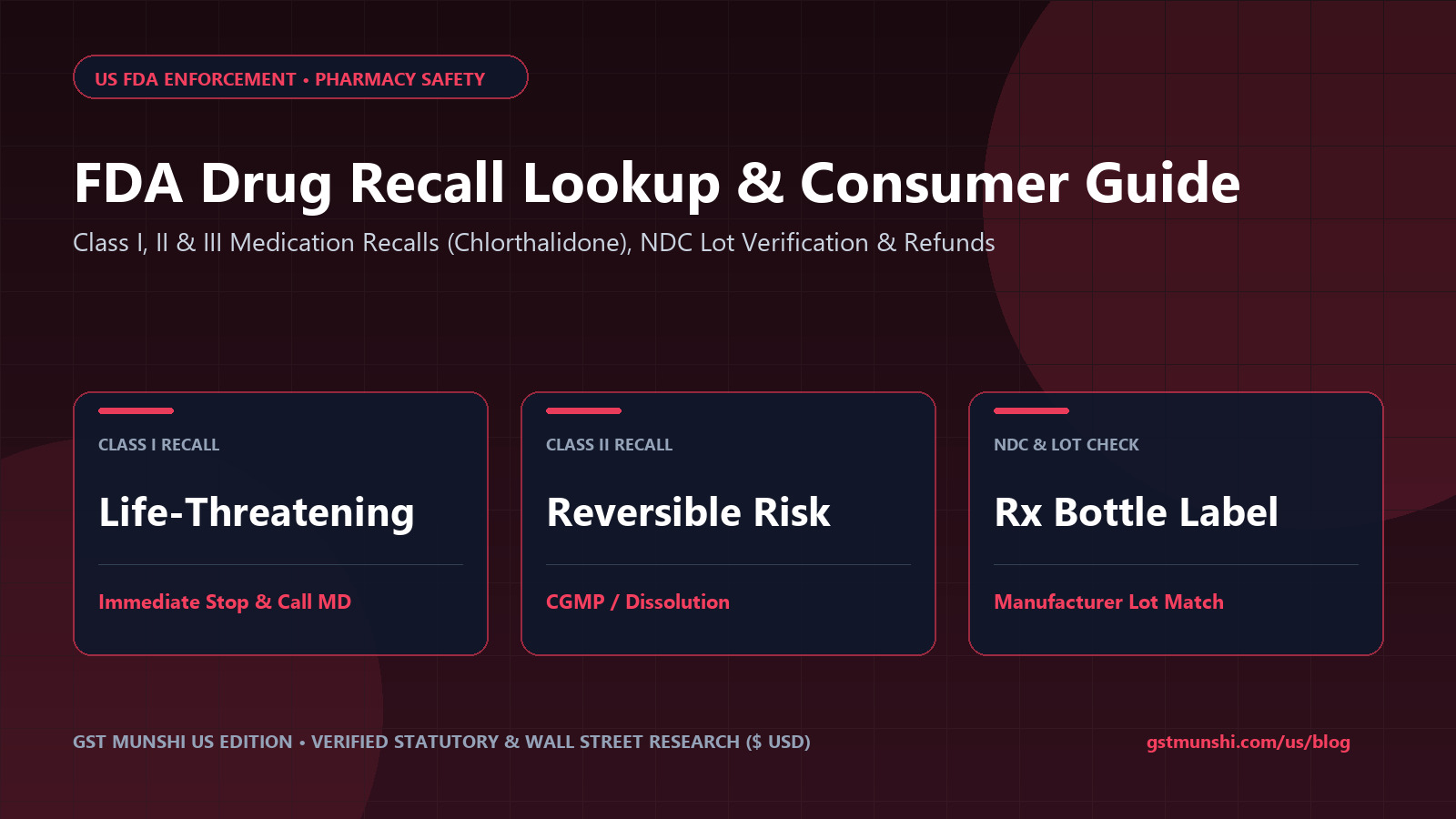
What should you do if your prescription medication (such as Chlorthalidone blood pressure tablets) is recalled by the FDA?
Under US FDA guidelines (21 CFR Part 7), NEVER abruptly stop taking a maintenance cardiovascular or blood pressure medication (such as Chlorthalidone, Losartan, or Metoprolol) without consulting your prescribing physician or pharmacist, as sudden discontinuation can trigger rebound hypertension. First, check the 10-or-11-digit National Drug Code (NDC), Manufacturer Name, and Lot Number printed on your pharmacy vial against the official FDA Enforcement Report. Only bottles matching the specific recalled Lot Numbers are affected, and your dispensing pharmacy will provide a replacement lot at $0 cost.
1Understanding Class II CGMP & Dissolution Recalls (Why Specific Lots Are Recalled)
Many recent generic blood pressure and diuretic recalls—such as voluntary recalls of specific lots of Chlorthalidone 25 mg and 50 mg tablets—are classified by the FDA as Class II recalls due to Current Good Manufacturing Practice (CGMP) deviations, such as out-of-specification dissolution test results or trace nitrosamine impurities.
Because multiple pharmaceutical manufacturers produce generic Chlorthalidone for the US market, a recall issued by one manufacturer affects ONLY the specific NDC and Lot Numbers listed in that firm's FDA notice—not the entire drug molecule nationwide.
US FDA Recall Classifications Under 21 CFR § 7.3
| FDA Recall Class | Statutory Risk Definition | Common Pharmaceutical Examples | Recommended Patient Action |
|---|---|---|---|
| Class I Recall | Reasonable probability of serious adverse health consequences or death | Microbial contamination of sterile injectables; wrong active ingredient label | Contact pharmacy/MD immediately for urgent replacement; report reactions to FDA MedWatch |
| Class II Recall | May cause temporary/medically reversible adverse effects, or remote probability of serious harm | Chlorthalidone CGMP dissolution deviations; trace NDMA impurity above daily intake limit | Do not abruptly stop maintenance Rx; verify Lot # with pharmacy and swap for unaffected lot |
| Class III Recall | Not likely to cause any adverse health consequences | Minor carton printing typo; broken outer plastic seal with intact blister pack | Exchange at pharmacy during your next visit if Lot # matches |
4-Step Patient SOP to Verify a Recalled Prescription Bottle
Locate the Manufacturer & NDC Number on Your Pharmacy Label
Look at the bottom corner of your CVS, Walgreens, Walmart, or local pharmacy label for 'MFR:' (Manufacturer) and the 11-digit NDC code.
Call Your Dispensing Pharmacy to Check the Internal Lot Number
If the manufacturer's bulk bottle Lot Number isn't printed on your amber patient vial, your pharmacy's computer system tracks the exact lot dispensed to you.
Request a $0 Lot-Replacement Fill From Your Pharmacist
If your medication matches the recalled lot, your pharmacy will replace the remaining tablets from an unaffected manufacturer lot at no charge.
File an FDA MedWatch Form 3500B If You Experienced Side Effects
Patients can report adverse events or product quality issues directly to the FDA at accessdata.fda.gov/scripts/medwatch.
Curated Expert Video Walkthroughs & Wall Street Briefings



Frequently Asked Questions (Verified Statutory Answers)
Q1: Where do I find the Lot Number if my pharmacy put pills into a standard orange prescription bottle?
When retail pharmacies dispense tablets from a 500-count or 1,000-count manufacturer stock bottle into a patient vial, the Lot Number is recorded in the pharmacy's dispensing software. Call your pharmacy with your Rx number and they can verify the lot in 30 seconds.
Q2: Am I entitled to a free replacement or refund if my prescription lot is recalled?
Yes. Manufacturers reimburse pharmacies for recalled inventory returned through reverse distributors, and pharmacies provide affected patients with a replacement fill from an un-recalled manufacturer or issue a copay refund.