
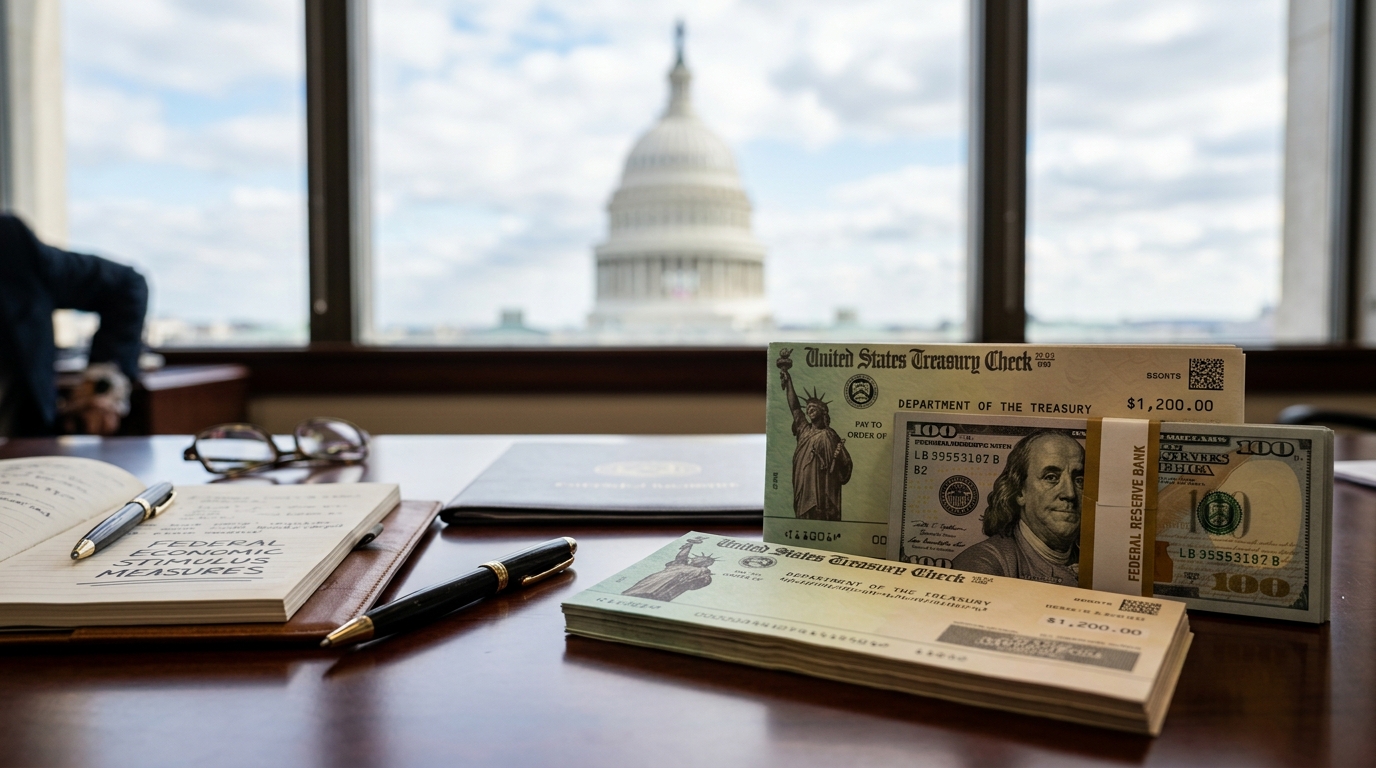
Is the federal government or Donald Trump sending a $5,000 stimulus check to Americans in 2026–2027?
No. There is NO approved federal law, executive order, or IRS authorization issuing a $5,000 stimulus check to American citizens in 2026 or 2027. The viral online rumors stem from three conflated proposals: economic concepts of a universal tariff dividend funded by import duties, think-tank proposals for a $5,000 newborn 'baby bonus' trust account, and social media clickbait. Under Article I of the U.S. Constitution, only Congress can authorize and fund stimulus payments.
Proposed $5,000 Federal Stimulus & Tariff Dividend Reality Calculator
Simulate the real-world mathematical impact of proposed universal tariff dividends versus consumer price increases under Congressional Budget Office (CBO) pass-through models.
Direct family cost increase on goods under 78% importer pass-through.
If Congress enacted a $1,250 per-capita tariff revenue distribution bill.
Combined balance after paying higher retail import costs.
No federal agency (IRS, Treasury, or SSA) is currently issuing a $5,000 stimulus check. Article I of the U.S. Constitution strictly reserves appropriations powers for Congress. Anyone demanding a processing fee, gift card, or bank password to "claim" this check is a cybercriminal running an advance-fee scam.
1Executive Fact Check: Is There a $5,000 Federal Stimulus Check Going Out Today?
Over recent months, search engines and social video platforms have been flooded with viral headlines claiming: 'New $5,000 Stimulus Check Approved by Trump', 'IRS Payout Dates Announced', or 'Claim Your $5,000 Federal Rebate Today'. Millions of Americans navigating elevated living costs have questioned whether emergency federal relief is arriving.
The definitive statutory answer is NO. The Internal Revenue Service (IRS), the U.S. Department of the Treasury, and the White House have enacted no legislation, executive directive, or administrative regulation authorizing a fourth direct stimulus payment of $5,000 or any other amount. The three historical Economic Impact Payments (EIP 1 for $1,200 under the CARES Act, EIP 2 for $600 under the Consolidated Appropriations Act, and EIP 3 for $1,400 under the American Rescue Plan) expired years ago and required explicit bipartisan congressional statutes.
- No Pending Legislation: Neither the U.S. House of Representatives nor the U.S. Senate has passed a $5,000 direct payment bill.
- No IRS Distribution Schedule: The IRS does not maintain a portal or registration link for fourth stimulus checks.
- No Presidential Unilateral Authority: A U.S. President cannot legally order the Treasury to disburse unappropriated public funds via executive fiat.
2Dissecting the Viral Origin: Tariff Dividends vs Newborn Child Endowments
Where did the widespread $5,000 figure originate? Investigative analysis reveals that viral creators and clickbait websites spliced together three distinct economic discussions to fabricate the claim:
First, during campaign speeches and economic policy forums, former President Donald Trump proposed implementing universal baseline tariffs—ranging from 10% to 20% on all imported foreign goods, and up to 60% on goods from China. In subsequent commentary, conservative economic commentators floated the theoretical idea of distributing a portion of new federal tariff revenues back to American households as a 'Tariff Dividend' check (comparable to the Alaska Permanent Fund). However, this concept has never been drafted into formal statutory legislation.
Second, conservative and centrist policy think tanks have periodically debated establishing a $5,000 newborn 'Baby Bonus' or child trust fund (often modeled after Senator Cory Booker's 'Baby Bonds' or pro-family tax credits). Under these academic proposals, the federal government would seed a $5,000 locked investment account at birth to compound until age 18. Viral social media accounts stripped out the 'newborn at age 18' restriction and falsely broadcasted it as an immediate $5,000 check for all taxpayers.
3Constitutional & Statutory Mechanics: Why Executive Orders Cannot Create Stimulus
A foundational principle of American governance is the separation of powers codified in the U.S. Constitution. Under Article I, Section 9, Clause 7 (the Appropriations Clause): 'No Money shall be drawn from the Treasury, but in Consequence of Appropriations made by Law.'
This constitutional safeguard ensures that the power of the purse rests exclusively with the legislative branch. While a President can sign executive orders directing agencies to reallocate limited discretionary administrative funds (such as the temporary Lost Wages Assistance program during 2020), disbursing a universal $5,000 check to roughly 160 million adult Americans would require a staggering $800 billion appropriation.
An expenditure of this magnitude requires a full legislative bill introduced in Congress, passed by both the House and Senate, and signed into federal law—which has not occurred.
4Macroeconomic Reality: How Universal Tariffs Actually Impact Household Budgets
Advocates of tariff-funded dividends argue that foreign exporters would pay the bill. However, non-partisan empirical research from the Congressional Budget Office (CBO), the Tax Foundation, and the Peterson Institute for International Economics (PIIE) demonstrates that import tariffs function mathematically as domestic consumption excise taxes.
When the federal government levies a 20% tariff on imported electronics, footwear, furniture, and automobile components, American importing companies pay the duty to U.S. Customs and Border Protection upon entry. The importing firms subsequently pass roughly 75% to 90% of these elevated costs directly onto American consumers through higher retail shelf prices.
- Annual Consumer Burden: A universal 20% tariff is projected to increase average US household living expenses by $1,800 to $2,600 annually.
- Regressive Tax Structure: Lower- and middle-income families spend a substantially higher percentage of their disposable income on retail goods than wealthy households.
- Net Household Math: Even if a hypothetical $1,250 tariff rebate check were enacted, the higher retail cost of living would virtually wipe out the financial benefit.
5Legitimate Federal Tax Credits You Can Actually Claim (CTC, EITC & Clean Energy)
While no $5,000 stimulus check exists, American families can maximize several genuine, statutory tax credits codified within the Internal Revenue Code (IRC) when filing Form 1040:
1. Child Tax Credit (CTC - IRC § 24): Eligible parents can claim up to $2,000 per qualifying child under age 17, with up to $1,700 refundable via the Additional Child Tax Credit (ACTC).
2. Earned Income Tax Credit (EITC - IRC § 32): Lower- to moderate-income working families can receive refundable tax credits exceeding $7,800 depending on earned income and qualifying dependent count.
3. Child and Dependent Care Credit (IRC § 21): Offsets up to 35% of eligible childcare expenses up to $3,000 for one dependent or $6,000 for two or more dependents.
6Urgent Cybersecurity Alert: Identifying & Reporting $5,000 Stimulus Phishing Scams
Whenever rumors of government stimulus checks gain viral traction, criminal syndicates deploy sophisticated phishing portals, SMS smishing campaigns, and automated robocalls. The Treasury Inspector General for Tax Administration (TIGTA) and the Federal Trade Commission (FTC) caution taxpayers against common fraudulent indicators:
- Upfront Fee Demands: Scammers claim you must pay a $49.99 'processing fee', 'verification deposit', or gift card to unlock your $5,000 funds. Legitimate federal agencies NEVER charge a fee to issue statutory refunds.
- Direct Deposit 'Verification': Fraudulent websites mimic IRS.gov or Treasury.gov logos and ask you to enter your online banking credentials, Social Security Number, and mother's maiden name.
- Unsolicited Text Messages: Any SMS stating: 'Your $5,000 federal economic relief check is waiting for confirmation—click here' is 100% fraudulent.
- Reporting Scams: Report deceptive messages immediately to phishing@irs.gov, the FTC at ReportFraud.ftc.gov, or TIGTA at tigta.gov.
Federal Economic Stimulus & Rebate Proposals Comparison Matrix
| Stimulus / Rebate Concept | Statutory Status (2026–2027) | Target Amount ($ USD) | Legal Authority & Funding Source |
|---|---|---|---|
| Viral '$5,000 Trump Stimulus Check' | FALSE (Rumor / Unapproved Concept) | $5,000.00 one-time | None. No bill passed, no IRS authorization. Fabricated by viral social media posts. |
| Universal Tariff Dividend Proposal | Hypothetical Academic / Policy Proposal | ~$1,000 – $1,500/yr per household | Would require comprehensive congressional statute enacting tariffs under Title 19 U.S.C. |
| Proposed Newborn Trust Account (Baby Bonus) | Think-Tank Concept / Bipartisan Bills | $5,000 seeded at birth (Locked to age 18) | Requires congressional authorization (e.g. American Opportunity Accounts proposal). Not an immediate check. |
| Historical EIP 1 (CARES Act) | EXPIRED (March 2020) | $1,200 per adult + $500 per child | Public Law 116-136, IRC Section 6428. Funded via direct Congressional emergency appropriations. |
| Historical EIP 3 (American Rescue Plan) | EXPIRED (March 2021) | $1,400 per eligible individual | Public Law 117-2, IRC Section 6428B. Fully funded by Congress. Final deadline for filing expired. |
| Statutory Child Tax Credit (CTC) | ACTIVE LAW (IRC § 24) | Up to $2,000/child (up to $1,700 refundable) | Codified in the Internal Revenue Code. Claimed legally each year on annual Form 1040 federal tax returns. |
4-Step Protocol to Verify Federal Benefits & Protect Your Family from Scams
Check Official IRS.gov & Treasury.gov Press Rooms
All authorized federal direct payments and tax rebates are published officially on IRS.gov/newsroom. If it does not appear on official .gov domains, it does not exist.
Verify Legislative Tracking on Congress.gov
Search bill statuses on Congress.gov. A federal payment cannot exist without a bill number (e.g., H.R. or S.) that successfully passes both chambers and receives presidential signature.
Never Share Bank Logins or Pay Upfront Processing Fees
The IRS conducts official business through U.S. Postal Service correspondence. The agency will never text, DM, or call demanding debit card details or cryptocurrency.
Report Deceptive Stimulus Solicitations to Federal Authorities
Forward fraudulent text messages to SPAM (7726) and report advance-fee scams to the Federal Trade Commission at ReportFraud.ftc.gov.
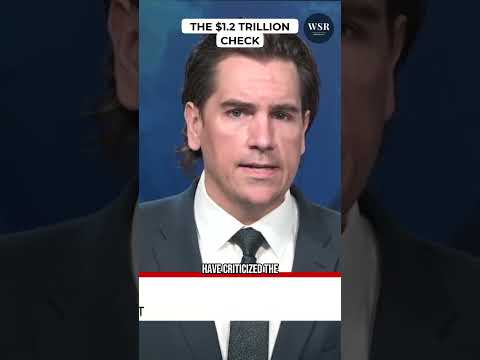
Curated Expert Video Walkthroughs & Wall Street Briefings
Frequently Asked Questions (Verified Statutory Answers)
Q1: Why are so many websites and videos claiming a $5,000 stimulus check is approved?
Unscrupulous content creators generate sensationalized headlines for advertising revenue and affiliate lead generation, while cybercriminals create fake claim portals to steal personal financial data, Social Security Numbers, and bank credentials.
Q2: Could Congress pass a $5,000 stimulus check in late 2026 or 2027?
It is extraordinarily improbable. Direct stimulus payments are emergency macroeconomic tools deployed during severe nationwide recessions (such as the 2008 Great Recession or 2020 pandemic). In standard economic conditions, pumping $800 billion into consumer circulation would exacerbate inflationary pressures.
Q3: What is the proposal for a $5,000 newborn 'Baby Bonus'?
Various pro-family think tanks have proposed 'Baby Bonds' or child endowment funds where the government would deposit $5,000 into a government-managed index fund when an American child is born. The funds would be locked and inaccessible until the child turns 18 to pay for college tuition or a home down payment.
Q4: Are tariffs paid by foreign countries like China?
No. Tariffs are paid directly by American businesses that import goods into the United States. While tariffs can pressure foreign manufacturers to lower wholesale prices, economic data proves that importing companies pass most of the tariff cost onto American consumers via higher shelf prices.
Q5: How can I verify if I am actually owed money by the IRS?
Check your official tax account transcript at IRS.gov/account or use the official 'Where's My Refund?' tool for recent tax returns. You can also search your state's unclaimed property registry at MissingMoney.com for legitimate forgotten funds.
Q6: What should I do if I entered my Social Security Number on a fake stimulus website?
Act immediately: (1) Freeze your credit with all three major bureaus (Experian, Equifax, TransUnion); (2) File an identity theft report at IdentityTheft.gov; (3) Contact your bank to secure your checking accounts; and (4) Obtain an Identity Protection PIN (IP PIN) from the IRS to block fraudulent tax returns.




Curated Expert Insights & Verified Consumer Disclosures
“Please caution your parents and friends: There is no $5,000 stimulus check being mailed out by the IRS or Donald Trump. Every election cycle, bad actors weaponize campaign proposals into clickbait. Remind your family that the IRS will never text you a link to claim free money.”
“Article I, Section 9 of the Constitution makes it plain: No executive can authorize an $800 billion check disbursement without a formal act of Congress. While tariff debates and newborn accounts are genuine policy concepts, an active $5,000 check is pure fiction.”