What are the official Social Security 2027 announcements, COLA benefit increases, taxable wage limits, and key payment dates?
Every mid-October, the Social Security Administration (SSA) releases its official annual announcement setting the next year's Cost-of-Living Adjustment (COLA), Maximum Taxable Earnings cap, Earnings Test thresholds, and Quarter of Coverage credit values based on Q3 CPI-W inflation and the National Average Wage Index (NAWI). For 2027, the COLA is projected between 2.5% and 2.8% (taking effect with January 2027 benefits and December 31, 2026 SSI payouts), while the maximum wage base subject to the 6.2% OASDI payroll tax rises above $176,100+. Monthly retirement checks continue on the second, third, and fourth Wednesdays based on your birth date.
Social Security Claiming Age (62 vs 67 FRA vs 70) & COLA Benefit Calculator
1Social Security 2027 Official Announcements: Key Statutory Changes, Taxable Cap & Work Credits
The Social Security Administration's annual October Fact Sheet announcement governs far more than just the headline COLA percentage for current retirees. Under Title II of the Social Security Act, the SSA simultaneously updates five critical financial parameters that affect over 72 million beneficiaries and 180 million working taxpayers who pay FICA/SECA payroll taxes.
First, the Maximum Taxable Earnings limit (the OASDI contribution and benefit base) adjusts upward in step with the National Average Wage Index (NAWI), rising from $176,100 toward the $181,800–$183,600 range for 2027. Workers earning at or above the cap pay the maximum 6.2% employee share (matched by 6.2% from employers, or 12.4% for self-employed individuals), while all earnings above the cap are exempt from Social Security tax (though the 1.45%–2.35% Medicare Hospital Insurance tax continues on unlimited earnings). Second, the SSA announces the updated earnings requirement for one 'Quarter of Coverage' (Work Credit)—wherein workers earn up to 4 credits per year toward the 40 credits required for retirement eligibility.
- Mid-October COLA Announcement Date: Triggered immediately at 8:30 AM ET on the morning the Bureau of Labor Statistics publishes the September CPI report.
- December mySocialSecurity COLA Notices: Personalized 2027 benefit verification letters post inside ssa.gov/myaccount message centers starting in early December.
- Maximum Monthly Benefit at Full Retirement Age: Exceeds $4,018+/month at FRA (and exceeds $5,108+/month for workers who earned above the taxable maximum for 35 years and delay claiming until age 70).
2The Breakeven Math: Claiming at Age 62 vs Age 67 (FRA) vs Age 70
Your Social Security Primary Insurance Amount (PIA) is computed using your 35 highest-earning years adjusted for national wage indexing (AIME). The decision of when to claim represents one of the most critical retirement calculations in American personal finance.
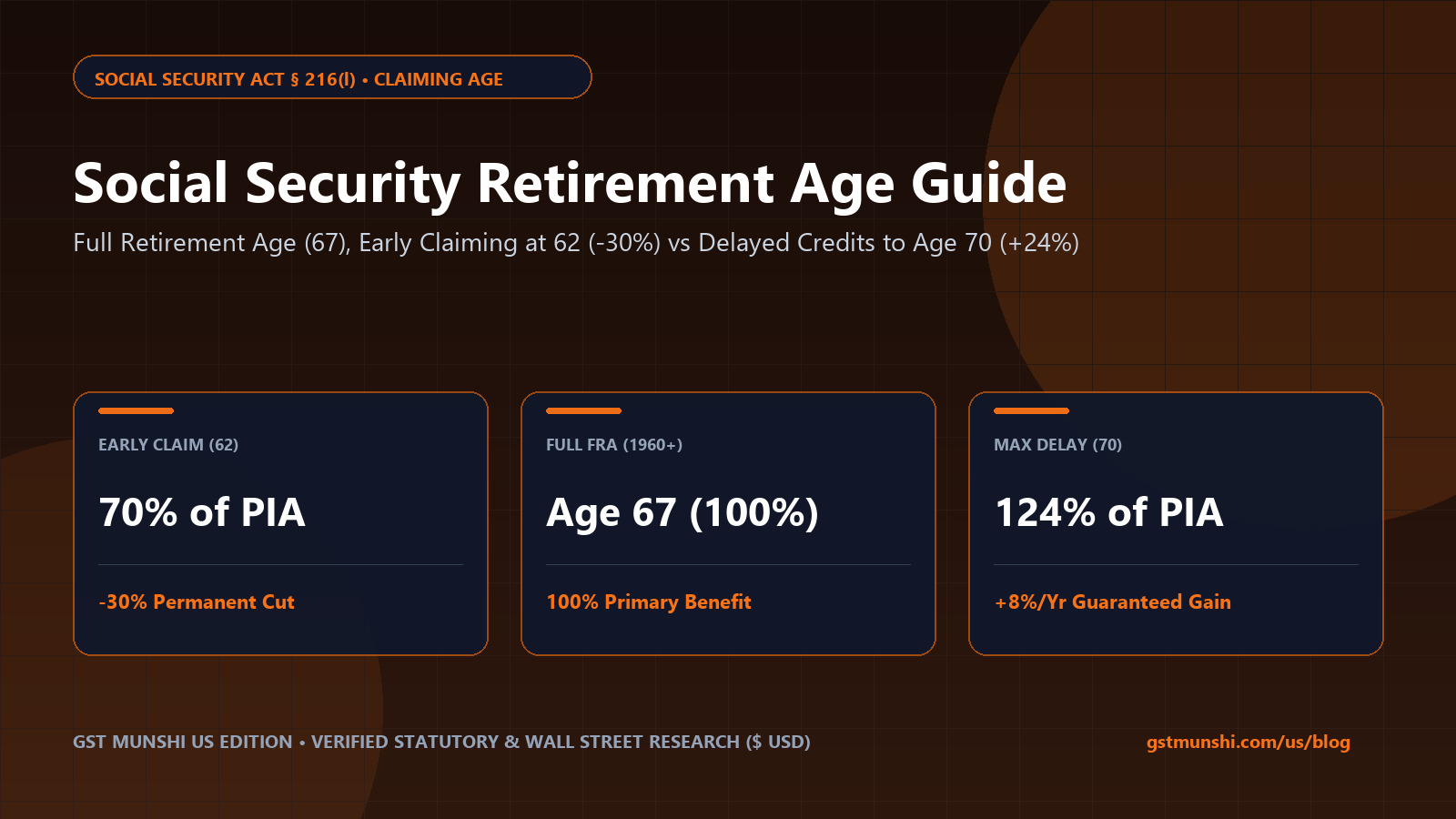
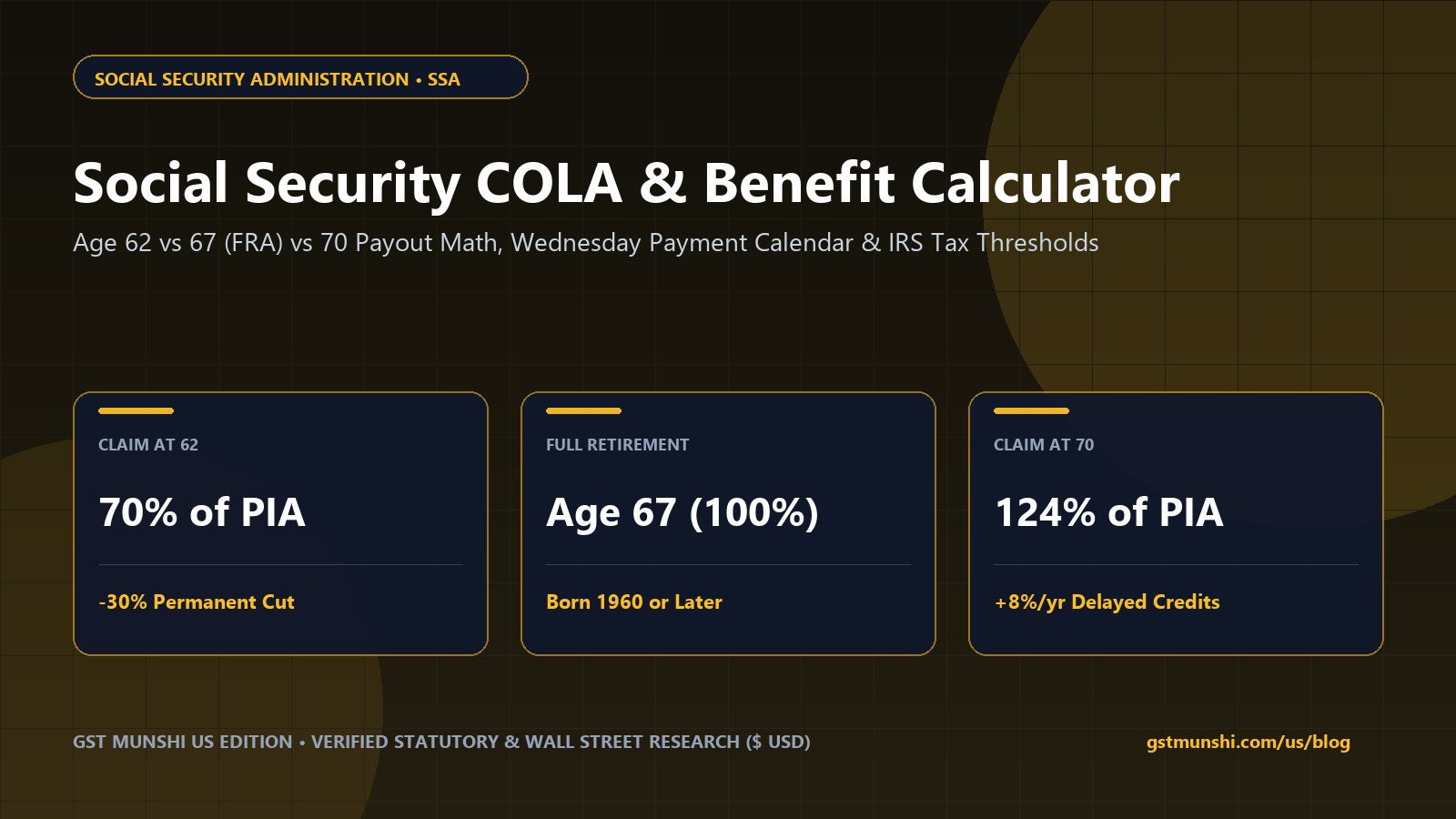
Claiming at age 62 provides income five years earlier, but permanently locks in a 30% reduction. Conversely, delaying past FRA (age 67) earns a guaranteed, inflation-adjusted return of 8% per year (2/3 of 1% each month) up to age 70. Mathematically, the cumulative cash-flow breakeven point between claiming at 62 versus 67 occurs around age 78 to 79. For retirees who live past age 82, delaying to 70 yields hundreds of thousands of dollars in cumulative lifetime benefits.
- Cumulative Dollar Breakeven: Age 78.5 (claiming at 62 vs 67) • Age 82.3 (claiming at 67 vs 70).
- Longevity & Survivor Benefits: A surviving spouse is entitled to 100% of the deceased spouse's actual monthly benefit; by delaying to age 70, the higher-earning spouse locks in the maximum possible survivor protection.
- Earnings Test Penalty Before Age 67: If you work while collecting benefits before reaching FRA, SSA withholds $1 of benefits for every $2 earned above the annual statutory limit ($23,400+).
3How the 2027 COLA is Determined: CPI-W Inflation Formula & Trust Fund Projections
Under Section 215(i) of the Social Security Act, the annual COLA is non-discretionary—it cannot be set arbitrarily by the President or Congress. It is calculated by averaging the monthly CPI-W index values for July, August, and September, comparing that average to the third-quarter average of the prior year, and rounding the percentage increase to the nearest tenth of one percent.
If the CPI-W third-quarter average is flat or negative, the COLA is 0.0%—benefits are never legally reduced due to deflation. For 2027, stabilizing housing, energy, and medical care costs project an estimated adjustment of 2.5% to 2.8%, adding approximately $48 to $54 per month to the average retired worker's monthly benefit.
- Statutory Q3 Window: Only July, August, and September CPI-W inflation figures dictate the January benefit increase.
- Medicare Part B Premium Offset: Because Medicare Part B standard premiums are automatically deducted from Social Security checks, increases in Medicare Part B absorb a portion of the net COLA gain.
- Hold Harmless Rule: Under federal law, your net Social Security check cannot decrease from one year to the next due to a standard Medicare Part B premium hike.
4Protecting Your Social Security Benefits from Direct Deposit Fraud & Identity Theft
Federal law enforcement agencies, including the SSA Office of the Inspector General (OIG), have reported a significant surge in fraudulent direct deposit rerouting. Cybercriminals obtain seniors' leaked Social Security numbers and personal identifiable information from dark-web data breaches, log into or create fake mySocialSecurity profiles, and redirect monthly direct deposits to prepaid debit cards or fraudulent fintech accounts.
To combat this threat, the Social Security Administration has implemented mandatory Login.gov and ID.me credentialing with biometric identity verification and real-time SMS/email alerts whenever direct deposit routing or address records are modified.
- Claim Your mySocialSecurity Account Early: Even if you are years away from claiming, create your official ssa.gov/myaccount profile immediately to prevent an identity thief from establishing it in your name.
- Direct Deposit Change Freeze: Request an official Direct Deposit Fraud Lock with the SSA, requiring in-person field office verification with a physical REAL ID before any bank routing changes are processed.
- Reporting Benefit Theft Immediately: If your monthly check does not arrive on your scheduled Wednesday, contact the SSA Fraud Hotline (1-800-269-0271) and your bank's fraud unit within 24 hours to initiate an electronic payment trace and reissue.
5Beating the 85% Provisional Income Tax Torpedo on Social Security Benefits
Many retirees are shocked to discover that up to 85% of their Social Security benefits become taxable under Internal Revenue Code Section 86 once their income exceeds modest federal thresholds that have never been adjusted for inflation since 1984.
Your tax liability is determined by your 'Provisional Income' (also known as Combined Income), defined as: Adjusted Gross Income (AGI) + Tax-Exempt Municipal Bond Interest + 50% of your annual Social Security benefits. When required minimum distributions (RMDs) from traditional 401(k)s or IRAs push your provisional income over $34,000 (Single) or $44,000 (Married Filing Jointly), every additional dollar of ordinary income causes up to 85 cents of Social Security to be taxed—creating an effective marginal tax spike known as the 'Tax Torpedo.'
- Provisional Income Thresholds: Single: <$25K (0% taxable), $25K–$34K (up to 50% taxable), >$34K (up to 85% taxable) • Married: <$32K (0%), $32K–$44K (50%), >$44K (85%).
- Roth IRA Conversion Buffer: Qualified Roth IRA distributions do NOT count toward Provisional Income, allowing retirees to withdraw funds completely tax-free without triggering taxes on their Social Security checks.
- Municipal Bond Trap: Municipal bond interest is exempt from federal income tax, but federal law explicitly mandates that tax-exempt interest IS included when calculating Social Security Provisional Income.
Social Security Claiming Age Payout & 2026–2027 Wednesday Payment Calendar
| Claiming Age / Birth Date Group | Payout % of FRA Benefit | Example ($2,600 FRA PIA) | Monthly Direct Deposit Day |
|---|---|---|---|
| Age 62 (Earliest Eligibility) | 70.0% (-30% Permanent Reduction) | $1,820 / month | Based on Birth Date Below |
| Age 65 (Medicare Eligibility) | 86.7% (-13.3% Reduction) | $2,254 / month | Based on Birth Date Below |
| Age 67 (Full Retirement Age — 1960+) | 100.0% Full Primary PIA | $2,600 / month | Based on Birth Date Below |
| Age 70 (Maximum Delayed Credits) | 124.0% (+24% Guaranteed Bonus) | $3,224 / month | Based on Birth Date Below |
| Birth Date: 1st – 10th of Month | Retirees & Spousal Beneficiaries | Direct Deposit / Direct Express | Second Wednesday of Every Month |
| Birth Date: 11th – 20th of Month | Retirees & Spousal Beneficiaries | Direct Deposit / Direct Express | Third Wednesday of Every Month |
| Birth Date: 21st – 31st of Month | Retirees & Spousal Beneficiaries | Direct Deposit / Direct Express | Fourth Wednesday of Every Month |
| SSI Recipients & Pre-1997 Claimants | Supplemental Security Income | Direct Deposit / Direct Express | 1st of the Month (or Preceding Friday) |
4-Step Social Security Optimization & Fraud Defense Blueprint
Audit Your 35-Year Earnings Record Annually on mySocialSecurity
Log in to ssa.gov/myaccount to ensure all W-2 wages and Schedule SE earnings are accurately recorded. A single missing year of earnings permanently drags down your lifetime Primary Insurance Amount.
Coordinate Spousal & Survivor Strategy with Longevity Modeling
Because a surviving spouse inherits 100% of the deceased higher-earner's check, having the higher earner delay claiming until age 70 acts as the ultimate cost-effective joint survivor annuity.
Activate Multi-Factor Identity Protection & Direct Deposit Freeze
Set up login credentials via Login.gov or ID.me with biometric authenticator apps, and establish an in-person direct deposit change freeze to prevent unauthorized account diversion.
Execute Strategic Roth Conversions Between Ages 60 and 70
Fill lower tax brackets before Full Retirement Age by converting traditional 401(k)/IRA assets to Roth IRAs, eliminating future RMDs that would otherwise trigger the 85% Provisional Income Tax Torpedo.
Curated Expert Video Walkthroughs & Wall Street Briefings



Frequently Asked Questions (Verified Statutory Answers)
Q1: When does the Social Security Administration make the official 2027 COLA announcement?
The SSA releases its official 2027 COLA and taxable wage base announcement in mid-October 2026 (immediately following the Bureau of Labor Statistics' 8:30 AM ET release of the September Consumer Price Index). The new COLA rate takes effect with January 2027 Social Security payments and December 31, 2026 Supplemental Security Income (SSI) payments.
Q2: How can I view my official 2027 Social Security COLA notice online before it arrives in the mail?
Log in to your personal mySocialSecurity account at ssa.gov/myaccount and open the 'Message Center' tab in early December. Beneficiaries who opt in to digital alerts receive their official Form SSA-1099 and annual COLA benefit verification notice weeks before paper mailings finish.
Q3: Are Social Security benefits completely tax-free once you reach age 70?
No. Federal income taxation of Social Security benefits under IRC Section 86 depends strictly on your annual Provisional Income (Adjusted Gross Income + tax-exempt bond interest + 50% of your Social Security benefits), regardless of your age.
Q4: When are Supplemental Security Income (SSI) payments deposited?
SSI payments are deposited on the 1st of each month (or the preceding Friday if the 1st falls on a weekend or federal holiday).
Q5: What should I do if my Social Security direct deposit check was stolen or diverted?
Immediately contact the SSA at 1-800-772-1213 (or visit your local field office) to report the payment as missing. Then, report the theft to the SSA Office of the Inspector General (oig.ssa.gov) and file a complaint at IdentityTheft.gov. SSA will trace the ACH trace number and issue a replacement check.
Q6: Can I undo my Social Security claiming decision if I claimed early at 62?
Yes, under SSA Form SSA-521 (Withdrawal of Application), you have a once-in-a-lifetime right to reset your claiming decision within 12 months of approval. However, you must repay all benefits received by you and your family, allowing your future benefit to resume growing at 8% per year up to age 70.