Can everyday investors buy SpaceX or Anthropic stock before an official IPO?
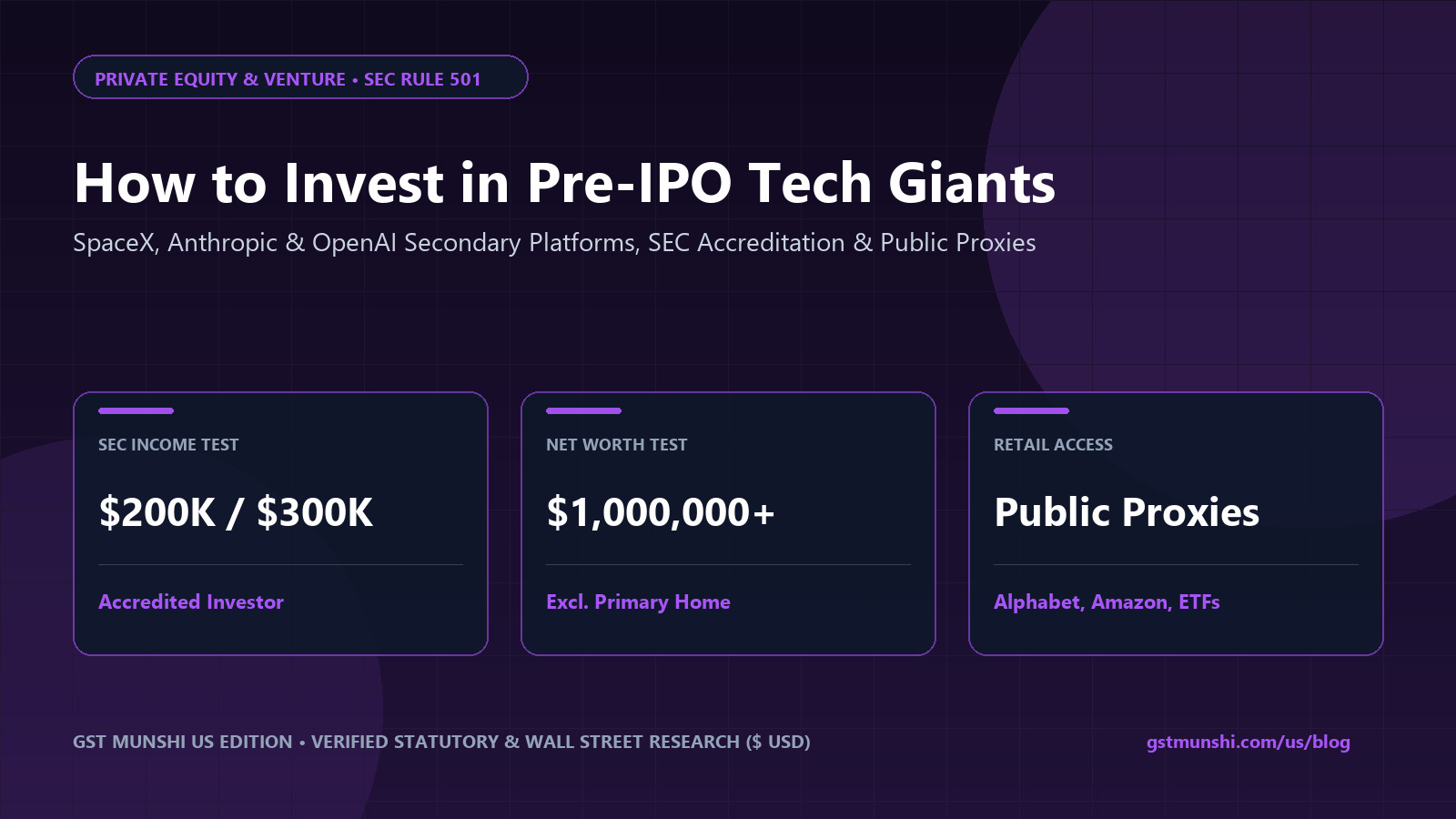
Because SpaceX and Anthropic are privately held corporations, their shares do not trade on the NYSE or NASDAQ. Direct secondary market purchases via platforms like Forge Global, Hiive, or EquityZen are legally restricted under SEC Regulation D (Rule 501(a)) to Accredited Investors ($200,000+ individual income, $300,000+ joint income, or $1,000,000+ net worth excluding primary residence, or Series 7/65/82 license holders). Non-accredited retail investors can gain indirect exposure through publicly traded venture interval funds (such as ARK Venture Fund) or strategic corporate shareholders like Alphabet (GOOGL) and Amazon (AMZN).
1SEC Regulation D Rule 501(a): Who Qualifies for Direct Secondary Shares?
Private technology leaders such as SpaceX, Anthropic, OpenAI, Stripe, and Databricks raise capital under exemptions from SEC public registration. To purchase employee tender shares or Special Purpose Vehicle (SPV) units on secondary marketplaces, investors must pass third-party verification under Rule 501(a) of Regulation D.
- Direct Share Transfer vs SPV: Companies like SpaceX enforce strict Right of First Refusal (ROFR) clauses in their bylaws, meaning most secondary investors buy units in a multi-member LLC (SPV) that holds the underlying shares.
- Fee Vigilance: Beware of closed-end funds trading at massive 200%+ premiums to Net Asset Value (NAV). Always verify the implied private valuation per share before committing capital.
US Pre-IPO Secondary Marketplaces & Retail Proxy Comparison
| Platform / Vehicle | Investor Eligibility | Minimum Investment | Fee Structure & Liquidity |
|---|---|---|---|
| Hiive | SEC Accredited Investors Only | $25,000 – $100,000+ | 0% buyer fee on many direct listings; seller-paid commission |
| Forge Global (NYSE: FRGE) | SEC Accredited Investors Only | $50,000 – $100,000+ | 2% – 4% transaction brokerage fee; institutional block access |
| EquityZen | SEC Accredited Investors Only | $10,000 – $20,000 | 5% one-time placement fee via curated SPV structures |
| ARK Venture Fund (ARKVX) | All US Retail & Accredited | $500 minimum | 2.90% total expense ratio; quarterly 5% NAV repurchase windows |
| Alphabet (GOOGL) & Amazon (AMZN) | All Retail Investors ($1+) | 1 Share / Fractional | 0% fund fee; instant T+1 NASDAQ liquidity + core cloud cash flows |
4-Step Due Diligence Checklist Before Buying Pre-IPO Tech Equity
Verify Implied Valuation Against Latest Tender Offer
Compare the SPV's per-share price against SpaceX's or Anthropic's most recent primary round or semi-annual employee tender offer.
Audit SPV Management Fees & Carried Interest
Avoid layered SPVs charging 2% annual management fees plus 20% carried interest, which can erode 35%+ of your eventual IPO upside.
Confirm Lock-Up Restrictions (180-Day Post-IPO Rule)
Even if a company completes an IPO, private secondary shares are subject to a mandatory 180-day underwriter lock-up period before you can sell.
Consider Liquid Public Hyperscaler Proxies First
Evaluate whether owning NVIDIA (NVDA), Microsoft (MSFT), Alphabet (GOOGL), and Oracle (ORCL) captures AI infrastructure economics without private illiquidity.
Curated Expert Video Walkthroughs & Wall Street Briefings



Frequently Asked Questions (Verified Statutory Answers)
Q1: Can a non-accredited investor pass an exam to qualify as an SEC Accredited Investor?
Yes. Following the SEC's 2020 modernization of Rule 501(a), individuals holding a valid FINRA Series 65 (Uniform Investment Adviser Law Exam) license in good standing qualify as accredited investors without meeting the $200K income or $1M net worth thresholds.
Q2: Why is buying closed-end pre-IPO funds on the NYSE risky?
Publicly traded closed-end funds that hold pre-IPO shares can trade at extreme premiums (sometimes 2x to 5x their actual Net Asset Value) due to low float and retail speculation, exposing buyers to sharp valuation compression.