What affects current mortgage rates in 2026–2027, how do you compare lender offers, and is a 30-year or 15-year fixed loan better?
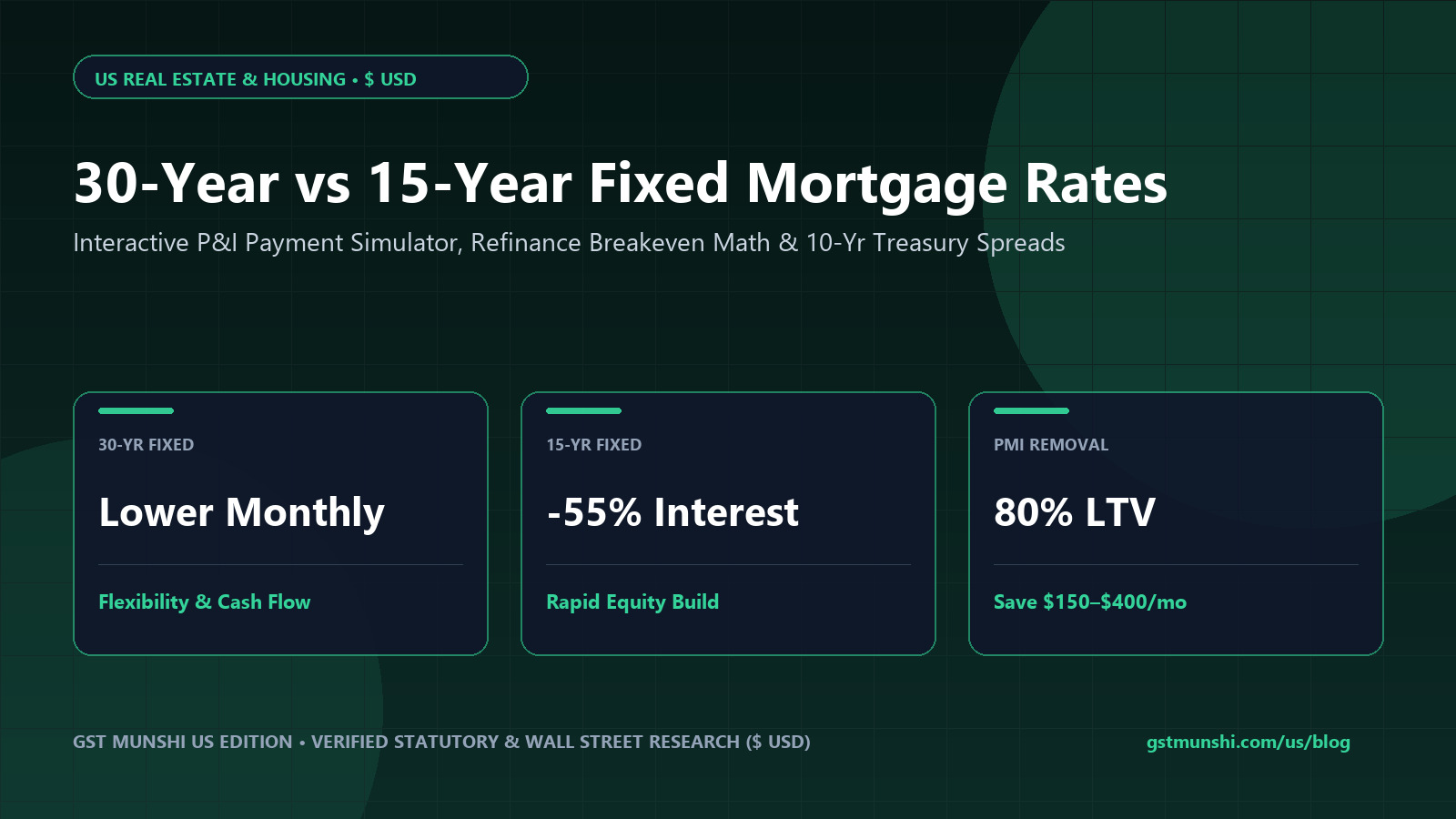
Current mortgage rates are driven primarily by the 10-Year US Treasury yield plus a secondary Mortgage-Backed Securities (MBS) spread of 170–240 basis points, alongside borrower-specific Loan-Level Price Adjustments (LLPAs) such as FICO credit score, Loan-to-Value (LTV) ratio, and property type. When comparing mortgage offers across lenders, always evaluate Page 1 and Page 2 of the standardized CFPB Loan Estimate—comparing Annual Percentage Rate (APR), Box A origination charges, and discount points rather than headline interest rates alone. A 15-year fixed loan offers a 0.50%–0.85% lower interest rate and cuts total lifetime interest by over 55%, while a 30-year fixed loan preserves monthly cash-flow flexibility.
30-Year Fixed vs 15-Year Fixed Monthly Payment & Lifetime Interest Calculator
1What Affects Current Mortgage Rates: 10-Year Treasury Yields, MBS Spreads & FICO LLPAs
A widespread misconception among American homebuyers is assuming that whenever the Federal Reserve cuts the overnight Federal Funds Rate by 25 or 50 basis points, current mortgage rates drop by that exact amount the next morning. In practice, 30-year fixed conforming mortgages have an average actual life of 7 to 10 years because borrowers move, sell, or refinance early.
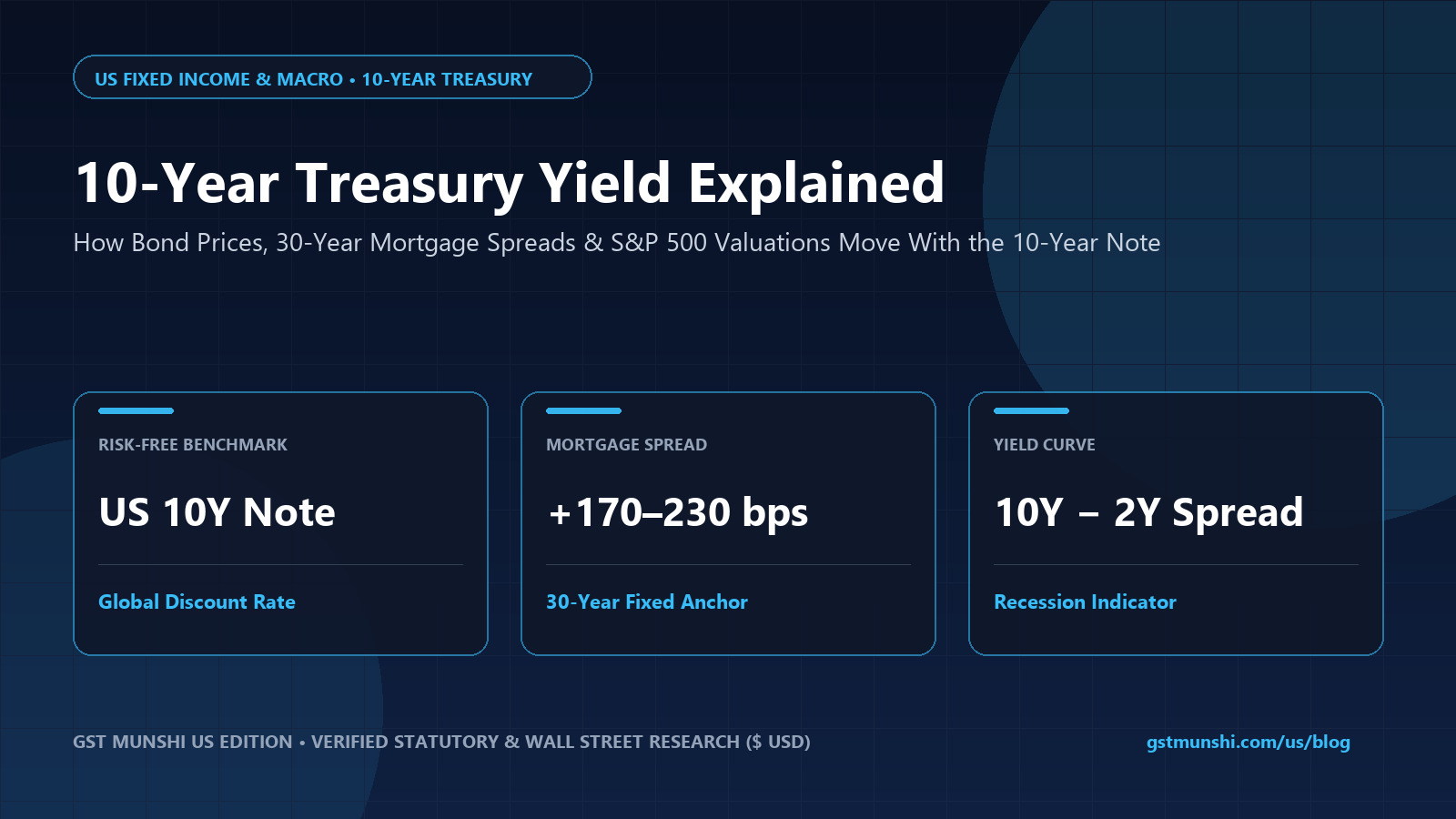
Consequently, secondary market Agency Mortgage-Backed Securities (MBS) guaranteed by Fannie Mae and Freddie Mac are priced against the 10-Year US Treasury Note yield plus a secondary market spread (typically 170 to 240 basis points). On top of macro bond yields, Fannie Mae and Freddie Mac enforce Loan-Level Price Adjustments (LLPAs)—statutory risk matrices that adjust your personal interest rate based on your FICO score tier (780+ vs 680), down payment LTV ratio, debt-to-income (DTI) ratio, and occupancy status (primary residence vs investment property).
- 10-Year Treasury Yield Benchmark: Acts as the foundational risk-free floor for 30-year fixed residential mortgage pricing.
- MBS Secondary Spread (170–240 bps): Compensates MBS investors for prepayment risk, servicing overhead, and Fannie/Freddie guarantee fees (G-fees).
- Borrower LLPA Matrix: A buyer with a 780+ FICO score and 20% down payment typically secures a rate 0.375% to 0.75% lower than a borrower with a 660 FICO score on the exact same day.
2How to Compare Mortgage Offers Like an Institutional Underwriter (CFPB Loan Estimate Breakdown)
Under the CFPB TILA-RESPA Integrated Disclosure (TRID) rule (12 CFR § 1026.37), every mortgage lender in the United States is legally required to issue an identical, standardized 3-page Loan Estimate within three business days of receiving your loan application. Never compare mortgage offers using informal email rate quotes or marketing worksheets, which frequently conceal mandatory discount points.
To compare current mortgage rates accurately across three or more lenders, lock or request quotes on the exact same morning (since bond markets reprice intra-day) and ask each lender to quote the exact same base note rate (for example, 6.000% with zero discount points). Then, turn to Page 2, Section A ('Origination Charges') of each Loan Estimate. Subtract any Section J 'Lender Credits' from Section A charges to isolate which lender has the lowest net underwriting and origination cost.
- Interest Rate (Note Rate) vs APR: The Note Rate determines your actual monthly Principal & Interest check; the Annual Percentage Rate (APR) incorporates upfront lender fees, discount points, and mortgage insurance to reveal the true annualized cost of borrowing.
- Discount Points Math (1 Point = 1% of Loan): Paying $4,000 (1 point on a $400,000 loan) typically lowers your rate by 0.25% (~$66/month savings), requiring 60.6 months (~5 years) just to break even.
- Zero-Tolerance Fee Protection: Under federal TRID law, lenders are legally prohibited from increasing Box A Origination Charges or transfer taxes between the Loan Estimate and your final Closing Disclosure unless a valid Changed Circumstance occurs.
32026–2027 Mortgage Rate Projections: Fed Easing Cycle, Inflation & Conforming Limits
Entering 2026 and 2027, institutional forecasts from the Mortgage Bankers Association (MBA), Fannie Mae Economic & Strategic Research (ESR), and Freddie Mac indicate that 30-year fixed current mortgage rates are projected to oscillate between 5.75% and 6.25%, with 15-year fixed loans averaging 5.10% to 5.50%.
Concurrently, the Federal Housing Finance Agency (FHFA) baseline conforming loan limit (projected to remain above $800,000 in standard counties and exceeding $1,200,000 in designated high-cost housing markets) allows buyers in California, New York, and Washington to secure prime conventional financing without triggering higher jumbo loan interest rate premiums.
- Target Conforming Rate Band (2026–2027): 30-Year Fixed ~5.75%–6.25% • 15-Year Fixed ~5.10%–5.50%.
- Conforming Loan Ceilings: Enables conventional financing with as little as 3%–5% down payment for first-time buyers via Fannie Mae HomeReady or Freddie Mac Home Possible.
- Jumbo Mortgage Thresholds: Loans exceeding FHFA limits require higher reserve assets (6–12 months PITI) and minimum credit scores of 700+.
4The Mathematical Refinance Rule: Calculating Real Breakeven Months After Closing Costs
Refinancing is not free. Conventional rate-and-term refinances carry upfront closing costs averaging 2% to 4% of the loan amount ($6,000 to $12,000 on a $300,000 to $400,000 loan) comprising lender origination fees, appraisal fees, title insurance, and escrow reserves.
To determine if a refinance is economically sound, divide your total out-of-pocket and financed closing fees by your monthly Principal and Interest savings. If your breakeven horizon is under 30 months and you plan to remain in the property past that window, refinancing creates verifiable net wealth.
- Breakeven Formula: Total Refinance Closing Costs ($) ÷ Monthly P&I Savings ($) = Breakeven Horizon in Months.
- Beware Resetting the 30-Year Clock: Refinancing year 7 of a 30-year mortgage into a brand-new 30-year mortgage resets your amortization schedule, front-loading interest all over again unless you maintain your previous payment amount.
- No-Cost Refinance Reality: Lenders offering 'zero closing cost' loans simply increase your interest rate by 0.25%–0.375% or roll lender credits into a higher principal balance.
5How the Federal Homeowners Protection Act Automatically Cancels PMI at 78% LTV
Private Mortgage Insurance (PMI) protects the lender—not the borrower—when purchasing a home with less than a 20% down payment. On a $400,000 home purchase with 5% down ($380,000 loan), monthly PMI costs between $120 and $250 per month, adding zero equity.
Under the federal Homeowners Protection Act of 1998 (12 U.S.C. § 4901), you possess two statutory rights to terminate PMI: (1) Borrower-requested cancellation at 80% Loan-to-Value (LTV) based on your original amortization schedule or verified through a certified appraisal if your home has appreciated, and (2) Automatic lender termination at 78% LTV based strictly on the original amortization date.
- 80% LTV Written Request: You must submit a written cancellation request to your loan servicer with a good payment history (no 30-day late payments in the past 12 months).
- 78% LTV Mandatory Cutoff: Federal law legally mandates that the loan servicer must terminate PMI automatically on the exact date your principal balance is scheduled to hit 78% of the original purchase price.
- FHA Loan Exception: Unlike conventional loans, FHA loans with less than 10% down require Mortgage Insurance Premiums (MIP) for the ENTIRE life of the 30-year loan; the only way to remove FHA MIP is by refinancing into a conventional conforming loan once you accumulate 20% equity.
30-Year Fixed vs 15-Year Fixed vs 7/6 SOFR ARM Mortgage Comparison ($400,000 Loan)
| Loan Feature | 30-Year Fixed Conforming | 15-Year Fixed Conforming | 7/6 SOFR ARM |
|---|---|---|---|
| Representative APR (2026–2027) | 6.125% Fixed | 5.375% Fixed | 5.625% Initial (7 Yrs), then Variable |
| Monthly Principal & Interest | $2,431 / month | $3,242 / month | $2,302 / month (Years 1–7) |
| Total Cumulative Interest Paid | $475,028 | $183,560 (Saves $291,468) | Variable based on 30-day SOFR index |
| Prepayment Penalty | $0 (Federal QM Law Prohibits) | $0 (Federal QM Law Prohibits) | $0 on Agency ARMs |
| Best Strategy For | Long-term cash flow flexibility & discretionary prepayments | Rapid equity buildup & debt-free retirement | Homeowners planning to sell or relocate within 5–7 years |
4-Step Mortgage Offer Comparison & Refinance Breakeven SOP
Shop 3+ Lenders Within a 45-Day Credit Window
Submit applications to a major bank, a local credit union, and an independent mortgage broker on the same day. FICO treats all mortgage inquiries within 45 days as a single credit pull.
Audit Box A + Box B Fees on Your CFPB Loan Estimates
Compare Section A (Origination Charges, underwriting fees, and discount points) line-by-line across competing 3-page Loan Estimates at an identical base interest rate.
Calculate Your Exact Closing Cost Breakeven Month
Divide total Box A + Box B + Box C lender, title, and recording fees on your CFPB Loan Estimate by your monthly P&I reduction. Target a breakeven under 30 months.
Submit a Written PMI Removal Notice at 80% Loan-to-Value
Under 12 U.S.C. § 4901, once your principal balance drops to 80% of original property value (or verified market value via an approved BPO or appraisal), send a certified PMI removal letter to your servicer.
Curated Expert Video Walkthroughs & Wall Street Briefings



Frequently Asked Questions (Verified Statutory Answers)
Q1: What is the difference between a mortgage interest rate and APR when comparing offers?
Your mortgage interest rate (note rate) is the annual percentage charged solely on the principal loan balance to calculate your monthly Principal & Interest payment. The Annual Percentage Rate (APR) is a broader statutory measure under the Truth in Lending Act (Regulation Z) that combines your interest rate with upfront lender origination fees, discount points, and mortgage insurance—showing the true effective cost of the loan.
Q2: Does applying with multiple mortgage lenders hurt my FICO credit score?
No, provided you complete your rate shopping within a 45-day window. Under FICO scoring algorithms, all mortgage-related hard credit inquiries made within a 45-day period are deduplicated and scored as a single credit inquiry so consumers can compare competing Loan Estimates without penalty.
Q3: Can I deduct mortgage interest on my US federal income tax return in 2026–2027?
Under IRC Section 163(h), homeowners who itemize deductions on Schedule A can deduct mortgage interest paid on up to $750,000 of qualified acquisition indebtedness ($375,000 if married filing separately). However, it only lowers your tax liability if total itemized deductions exceed the standard deduction ($15,000+ Single / $30,000+ Married).
Q4: Does paying off a 30-year conforming mortgage early carry any prepayment penalty?
No. Under the federal Dodd-Frank Wall Street Reform and Consumer Protection Act (CFPB 12 CFR § 1026.43), prepayment penalties are strictly prohibited on all standard conforming Fannie Mae, Freddie Mac, FHA, and VA residential mortgages.
Q5: How does the Federal Reserve rate cut cycle affect existing fixed mortgages?
Existing fixed-rate mortgages never change when the Federal Reserve raises or lowers rates; your monthly Principal & Interest payment remains permanently locked. A rate cut cycle only benefits existing homeowners if market mortgage rates decline sufficiently to justify refinancing into a brand-new loan.
Q6: Can I eliminate FHA Mortgage Insurance Premiums (MIP) without refinancing?
Only if you originally put down 10% or more (MIP automatically cancels after 11 years). If you put down less than 10% on an FHA loan, annual MIP persists for all 30 years; the only way to remove it is by refinancing into a conventional conforming loan once your equity reaches 20%.