Start Free

Invesco QQQ vs QQQM ETF: Holdings & Expense Ratio

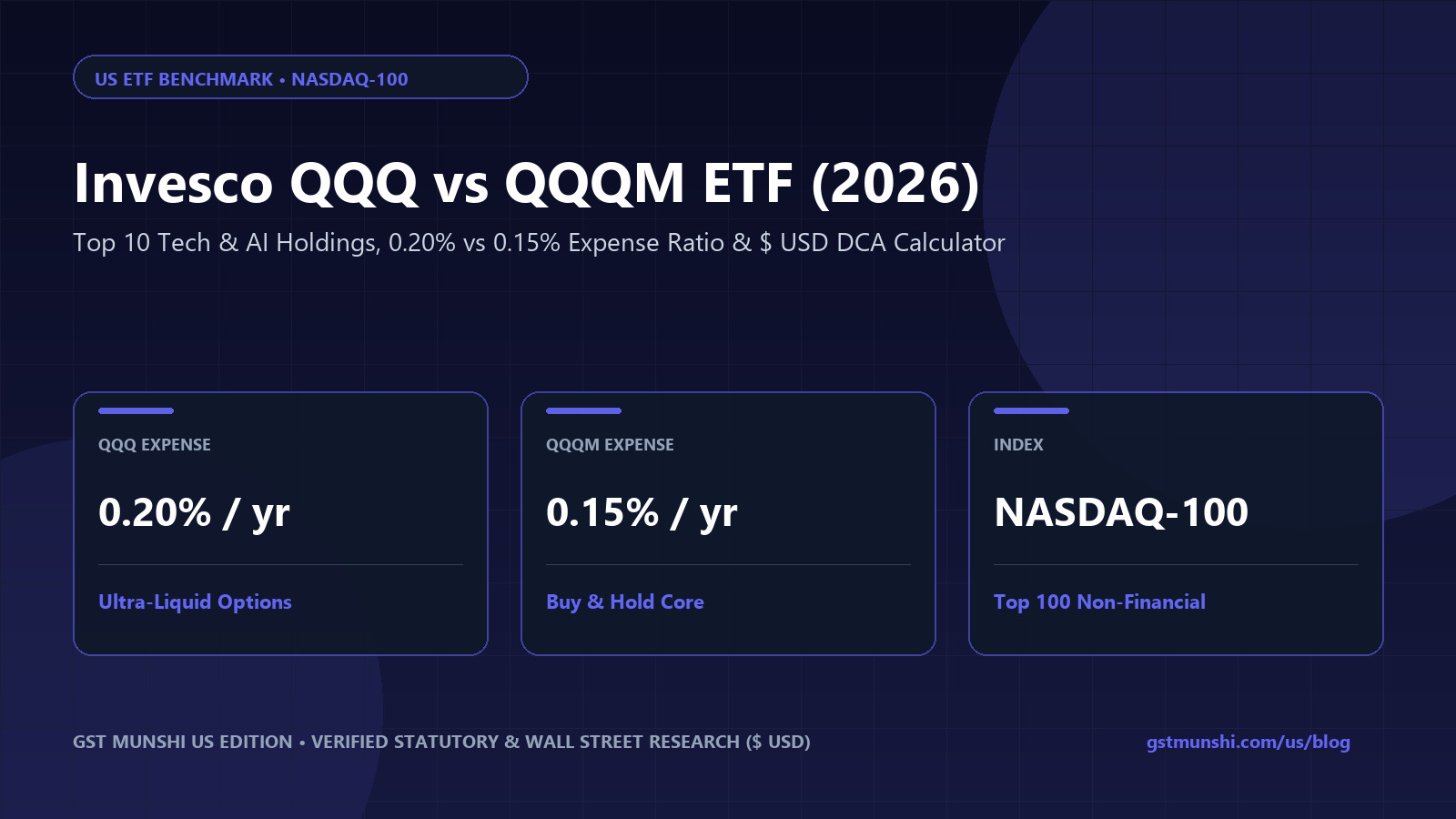
Invesco QQQ vs QQQM NASDAQ-100 ETF comparison: Compare 0.20% vs 0.15% expense ratio savings, top AI tech holdings, liquidity, and long-term DCA returns.

GBy GST Munshi US Quantitative & Statutory Desk•Published: September 2026•17 min read
Audited against Invesco QQQ Trust Series 1 Prospectus, Invesco NASDAQ 100 ETF (QQQM) SEC Form N-1A & Nasdaq Global Indexes Methodology
Share
Invesco QQQ vs QQQM ETF: Holdings & Expense Ratio
NASDAQ-100 ETF Master Guide — Verified US Statutory & Quantitative Analysis ($ USD)
Read in Your Regional Language:
Table of Contents (10 Sections)
Quick Answer & Key Takeaways

Should long-term investors buy Invesco QQQ or Invesco QQQM for NASDAQ-100 exposure?

Both QQQ and QQQM track the exact same NASDAQ-100 Index of the 100 largest non-financial companies listed on Nasdaq. However, Invesco QQQM (NASDAQ-100 ETF) is superior for long-term buy-and-hold investors because it charges a 0.15% expense ratio (saving 5 basis points annually over QQQ's 0.20% fee) and is structured as a modern open-end ETF that can reinvest dividends internally. QQQ remains the preferred vehicle for active swing traders and institutional options desks due to its tighter $0.01 bid-ask spreads and deep daily options chain.

Invesco QQQM Expense Ratio: 0.15% ($15 per $10,000 invested annually) — Best for IRAs & long-term DCA
Invesco QQQ Expense Ratio: 0.20% ($20 per $10,000 invested annually) — Best for options & liquidity
Top Holdings Concentration: ~50% in Technology & AI leaders (AAPL, NVDA, MSFT, AVGO, AMZN, META, TSLA)
Zero Financial Sector Exposure: Excludes commercial and investment banks by Nasdaq-100 rulebook
Executive Statutory & Financial KPI Snapshot
Audited against Invesco QQQ Trust Series 1 Prospectus
Underlying IndexInvesco QQQ
NASDAQ-100 Index
Invesco QQQM: NASDAQ-100 Index
Expense RatioInvesco QQQ
0.20% ($20 / $10K)
Invesco QQQM: 0.15% ($15 / $10K)
Legal StructureInvesco QQQ
Unit Investment Trust (UIT)
Invesco QQQM: Open-End ETF
Number of HoldingsInvesco QQQ
100 Non-Financial Companies
Invesco QQQM: 100 Non-Financial Companies
NASDAQ-100 Compounding & Expense Ratio Simulator ($ USD)

Invesco QQQ (0.20%) vs QQQM (0.15%) Wealth & Fee Savings Calculator

Total Principal Invested
$385,000
Invesco QQQM Value (0.15% ER)
$1,847,599
Fee Savings with QQQM vs QQQ
+$13,377
5 bps lower annual drag compounded

1Structural Architecture: Unit Investment Trust (QQQ) vs Modern Open-End ETF (QQQM)

Launched in 1999, Invesco QQQ Trust (QQQ) is legally organized as a Unit Investment Trust (UIT) under the Investment Company Act of 1940. Because UITs cannot reinvest cash dividends between quarterly distributions or lend securities to offset management expenses, Invesco launched QQQM in October 2020 as a standard open-end ETF.

With a 25% lower management fee (0.15% vs 0.20%) and a lower share price that facilitates whole-share dollar-cost averaging, QQQM delivers identical portfolio holdings with superior long-term net tracking.

2Inside the NASDAQ-100 Engine: AI, Cloud & Semiconductor Weightings

The NASDAQ-100 uses a modified market-capitalization methodology that caps individual constituent weights during quarterly rebalances to prevent extreme single-stock dominance while preserving exposure to secular compounders like Apple (AAPL), NVIDIA (NVDA), Microsoft (MSFT), and Broadcom (AVGO).

Invesco QQQ vs Invesco QQQM vs Vanguard VOO Benchmark Matrix

MetricInvesco QQQInvesco QQQMVanguard VOO (S&P 500)
Underlying IndexNASDAQ-100 IndexNASDAQ-100 IndexS&P 500 Index
Expense Ratio0.20% ($20 / $10K)0.15% ($15 / $10K)0.03% ($3 / $10K)
Legal StructureUnit Investment Trust (UIT)Open-End ETFOpen-End ETF
Number of Holdings100 Non-Financial Companies100 Non-Financial Companies500 US Large-Cap Companies
Options LiquidityUltra-Deep (0DTE / Weekly)ModerateStandard Monthly/Weekly
Ideal Investor ProfileActive Traders & Covered Call SellersLong-Term Buy & Hold / Roth IRACore Broad-Market Retirement

4-Step NASDAQ-100 Core-and-Satellite Allocation Blueprint

STEP 01

Select QQQM for Tax-Advantaged & Buy-and-Hold Accounts

In Roth IRAs, 401(k) brokerage windows, and long-term taxable accounts, choose QQQM to capture the 0.05% annual fee reduction.

STEP 02

Pair with VOO to Balance Tech Volatility

Combine 60%–70% Vanguard S&P 500 (VOO) with 30%–40% QQQM to maintain healthcare, financial, and industrial ballast during tech rate-hike drawdowns.

STEP 03

Enable Automatic Dividend Reinvestment (DRIP)

Although QQQ/QQQM yields ~0.60%, automatic reinvestment compounds fractional shares tax-efficiently during market pullbacks.

STEP 04

Harvest Tax Losses Between Correlated Growth Benchmarks

In taxable US brokerage accounts, investors can tax-loss harvest during corrections while respecting the IRS 30-day Section 1091 wash-sale rule.

Curated Expert Video Walkthroughs & Wall Street Briefings

Invesco US: QQQ vs QQQM: Which Nasdaq-100 ETF Should You Buy?
Watch on YouTube
QQQ vs QQQM: Which Nasdaq-100 ETF Should You Buy?
Click to Play Video
QQQ vs QQQM: Which Nasdaq-100 ETF Should You Buy?Open in App
Principles by Ray Dalio: How Index Funds & Tech Weightings Drive Compounding
Watch on YouTube
How Index Funds & Tech Weightings Drive Compounding
Click to Play Video
How Index Funds & Tech Weightings Drive CompoundingOpen in App
Ben Felix: Understanding ETF Expense Ratios & Tracking Error
Watch on YouTube
Understanding ETF Expense Ratios & Tracking Error
Click to Play Video
Understanding ETF Expense Ratios & Tracking ErrorOpen in App
Nasdaq: NASDAQ-100 Rebalancing Rules Explained
Watch on YouTube
NASDAQ-100 Rebalancing Rules Explained
Click to Play Video
NASDAQ-100 Rebalancing Rules ExplainedOpen in App

Frequently Asked Questions (Verified Statutory Answers)

Q1: Does switching from QQQ to QQQM trigger a wash sale or capital gains tax?

Selling appreciated QQQ shares in a taxable brokerage account to buy QQQM realizes a taxable capital gain. Furthermore, because QQQ and QQQM track the identical NASDAQ-100 index, selling QQQ at a loss and buying QQQM within 30 days may be scrutinized under IRS Section 1091 wash-sale rules.

Q2: Are QQQ and QQQM dividends taxed as qualified dividends?

Yes, the vast majority of distributions paid by QQQ and QQQM are classified as Qualified Dividends by the IRS (taxed at 0%, 15%, or 20% depending on your taxable income bracket), provided you satisfy the 60-day holding period requirement.

Wall Street Desk • $ USDNASDAQ & NYSE Institutional Equity Research

Analyze 10 Major US Stocks (NVDA, AAPL, MSFT, TSLA, AVGO, ORCL, QCOM, INTC, HPE, BE) in Real $ USD

Complete SEC 10-K/10-Q valuation multiples, DCF fair value models, and multi-agent AI committee ratings.

Share
US

Our US Quantitative & Statutory Research Desk audits every guide against primary federal sources — including SEC EDGAR 10-K/10-Q filings, CBOE Exchange rules, Federal Reserve H.15 rate releases, Social Security Administration (SSA) actuarial tables, CMS Medicare notices, USDA FNS standards, and FDA enforcement reports. All figures are strictly denominated in $ USD.

Related US Master Guides & $ USD Calculators

All US Guides

Questions & Discussion

0 Comments

Have a question or feedback about Invesco QQQ vs QQQM ETF: Holdings & Expense Ratio? Ask below. Dedicated discussion thread for this page.

Leave a Comment or Ask a Question
Spam Protected (UGC nofollow) Email is 100% private
All submitted hyperlinks automatically receive rel="nofollow ugc" tags. Zero do-follow backlinks.0 / 2,000

Loading live discussions...

US Institutional Edition • 100% Denominated in $ USD

Explore Live Wall Street Equity Research & Federal Financial Simulators

Access SEC 10-K/10-Q fundamental tearsheets, DCF valuation models, and Multi-Agent AI Committee ratings for top NASDAQ & NYSE stocks (NVDA, AAPL, MSFT, TSLA, AVGO, ORCL, QCOM, INTC, HPE, BE), alongside statutory US guides on Social Security COLA, Medicare IRMAA, and Federal Reserve mortgage rates.