How do you legally audit and reduce an inflated US hospital bill?
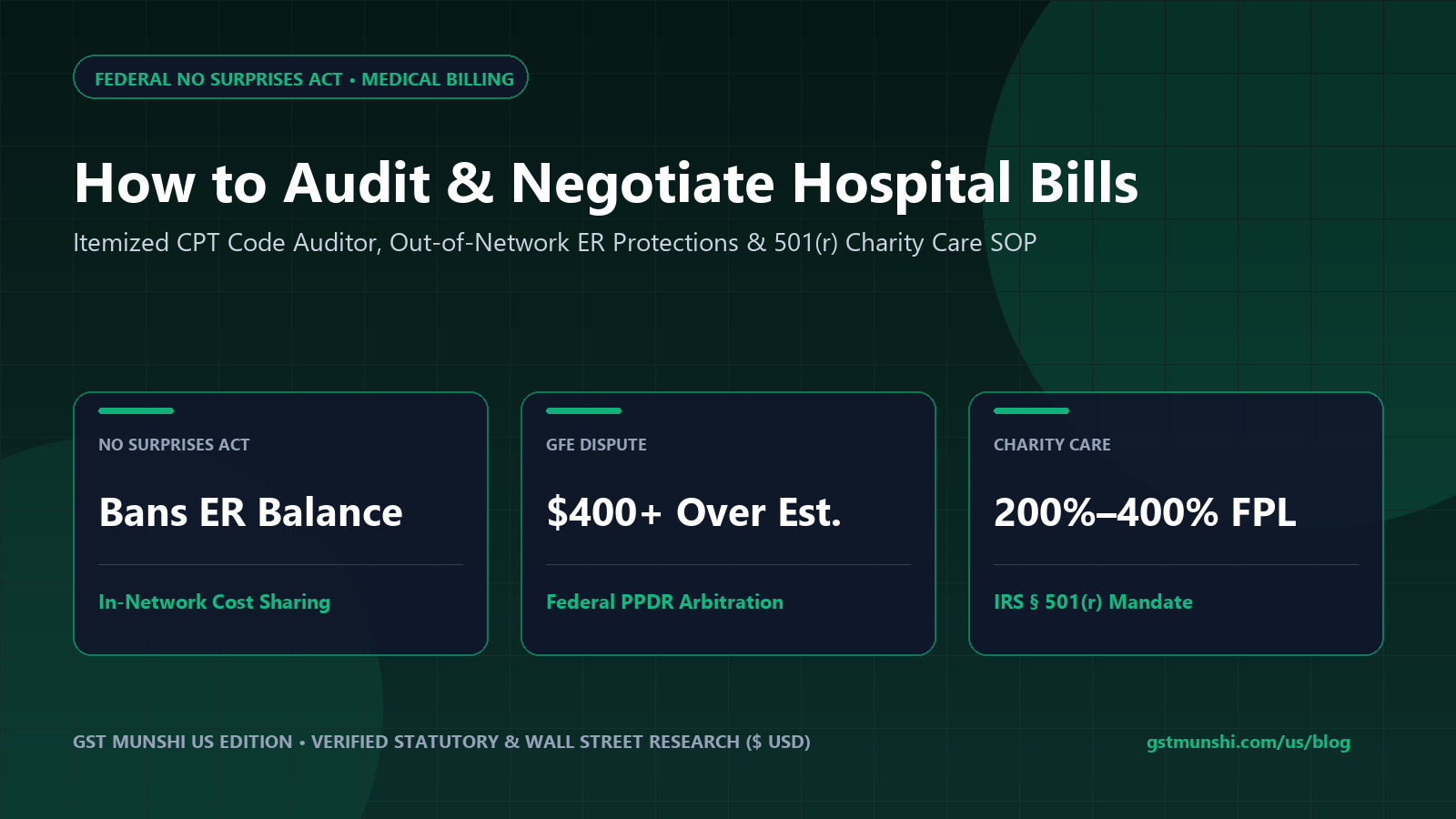
Never pay a summary hospital statement that only lists broad categories like 'Laboratory' or 'Pharmacy.' First, demand a complete itemized bill (UB-04 / CMS-1500) showing every 5-digit CPT and HCPCS procedure code. Second, verify protection under the federal No Surprises Act, which bans out-of-network balance billing for all emergency room visits and out-of-network providers (anesthesiologists, radiologists) at in-network hospitals. Third, check if the hospital is a 501(c)(3) nonprofit required under IRS Section 501(r) to offer Financial Assistance (Charity Care) to households earning 200%–400% of the Federal Poverty Level.
Estimate Your Itemized CPT Audit & Cash-Pay Settlement Target
1Spotting Common CPT Upcoding & Chargemaster Markups
US hospital 'Chargemaster' prices are arbitrary list prices often marked up 300% to 800% above actual Medicare reimbursement rates. When auditing your itemized statement, compare the 5-digit CPT codes against your insurer's Explanation of Benefits (EOB) and look up the fair local price on FAIR Health Consumer (fairhealthconsumer.org) or the CMS Medicare Physician Fee Schedule.
Federal Patient Billing Protections & Negotiation Leverage Matrix
| Federal Statute / Rule | Who It Protects | Core Legal Right | How to Invoke It |
|---|---|---|---|
| No Surprises Act (Balance Billing Ban) | Insured Patients (ER & In-Network Facilities) | Limits your cost-sharing to In-Network deductible/copay even if ER or doctor is Out-of-Network | Call CMS No Surprises Help Desk (1-800-985-3059) or file online at cms.gov/nosurprises |
| No Surprises Act (Good Faith Estimate) | Uninsured & Self-Pay Patients | Right to trigger federal Patient-Provider Dispute Resolution (PPDR) if bill exceeds GFE by $400+ | Initiate PPDR within 120 calendar days of the initial bill |
| IRS Section 501(r)(4) Financial Assistance | Insured & Uninsured at Nonprofit Hospitals | Free or sliding-scale discounted care (typically up to 200%–400% Federal Poverty Level) | Submit the hospital's Financial Assistance Policy (FAP) application within 240 days of first bill |
| HIPAA Right of Access (45 CFR § 164.524) | All US Patients | Right to receive complete medical & billing records within 30 days | Demand itemized UB-04 / CMS-1500 billing statement in writing |
4-Step SOP to Audit & Negotiate Any US Medical Bill by 30%–80%
Put Account on 'Audit Hold' & Demand Itemized CPT/UB-04 Statement
Call the billing department, request a 30-day billing hold, and ask for a fully itemized bill with all 5-digit CPT/HCPCS and revenue codes.
Match Every Line Item Against Your Medical Chart & EOB
Verify that your insurance company didn't deny a claim due to a simple diagnosis coding typo (ICD-10 mismatch) and check for duplicate room/pharmacy charges.
Apply for IRS Section 501(r) Nonprofit Hospital Charity Care
Under federal law, nonprofit hospitals must pause collection actions while evaluating a Financial Assistance application submitted within 240 days of the first post-discharge bill.
Offer a Lump-Sum Settlement Anchored to 125%–150% of Medicare Rates
If you do not qualify for charity care, offer an immediate lump-sum prompt-pay settlement of 40%–60% off the balance, or request a 0% interest monthly payment plan.
Curated Expert Video Walkthroughs & Wall Street Briefings



Frequently Asked Questions (Verified Statutory Answers)
Q1: Can I still qualify for hospital Charity Care if I have health insurance?
Yes! IRS Section 501(r) Financial Assistance Policies apply to both uninsured patients AND insured patients facing high out-of-pocket deductibles and coinsurance, provided your household income falls within the hospital's eligibility guidelines (often 200% to 400% of the Federal Poverty Level).
Q2: Do unpaid medical bills under $500 hurt my FICO credit score?
The three nationwide US credit bureaus (Equifax, Experian, and TransUnion) removed paid medical collection debt, medical collections under $500, and medical bills less than 365 days past due from consumer credit reports.