What is the legal and operational difference between a flight delay and a flight cancellation under US DOT rules?
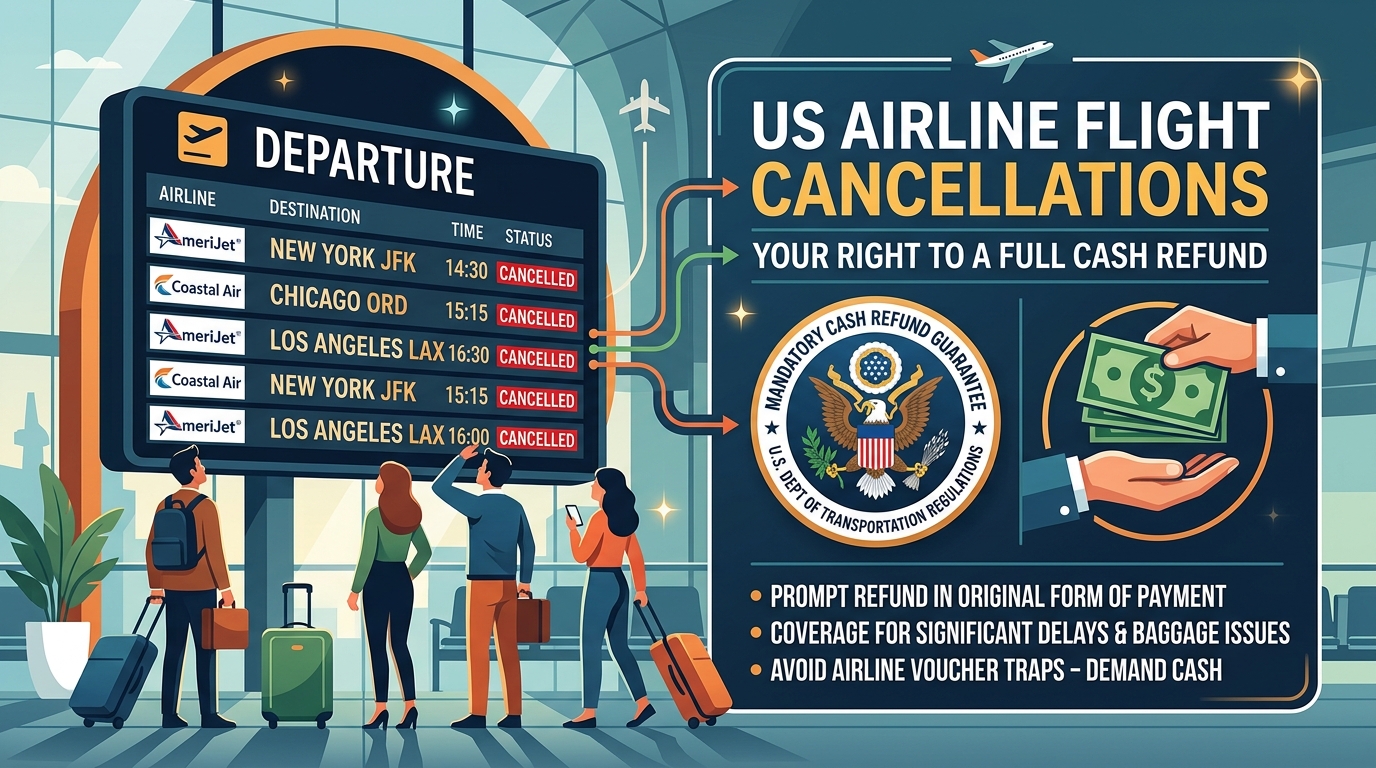
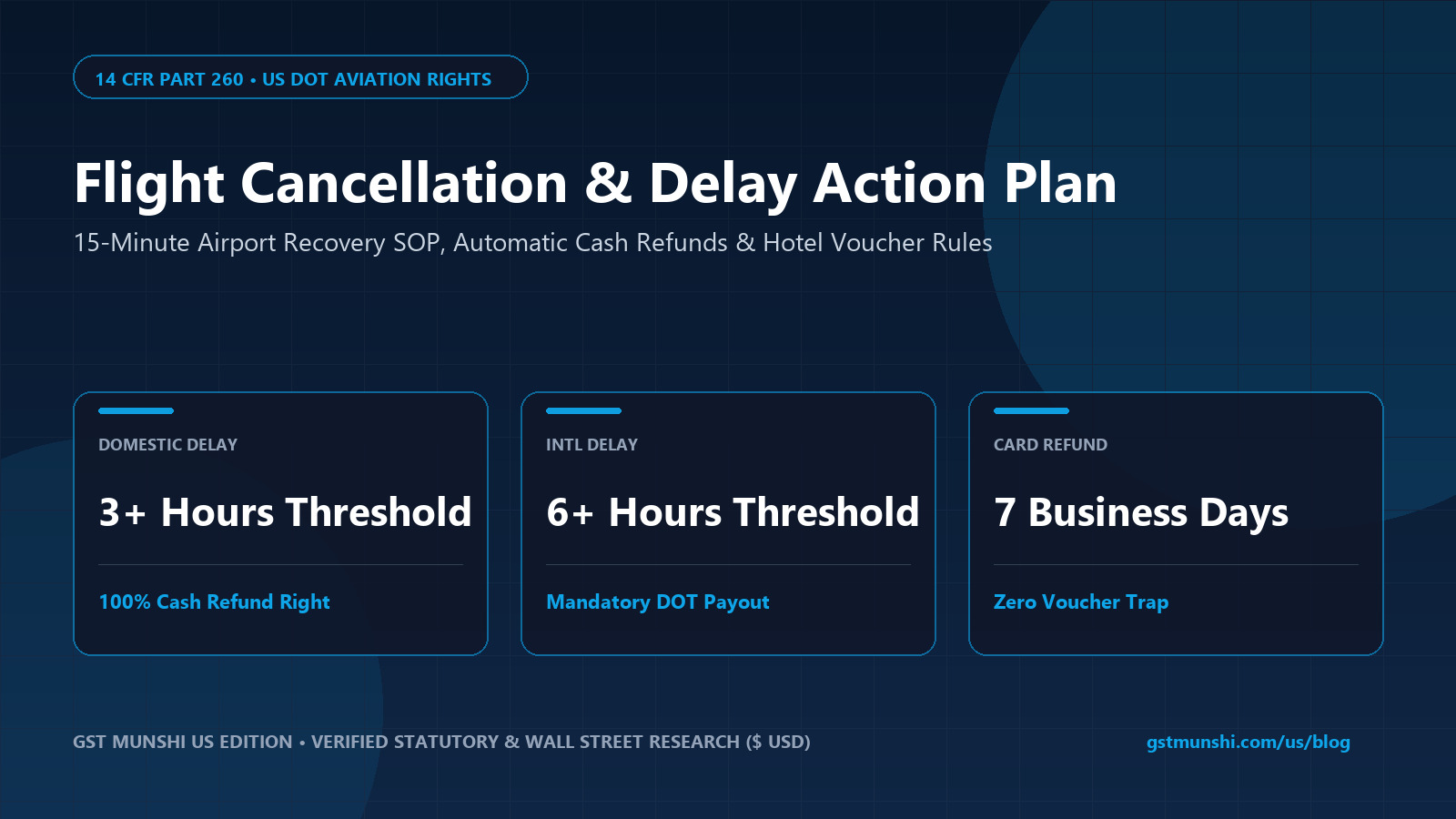
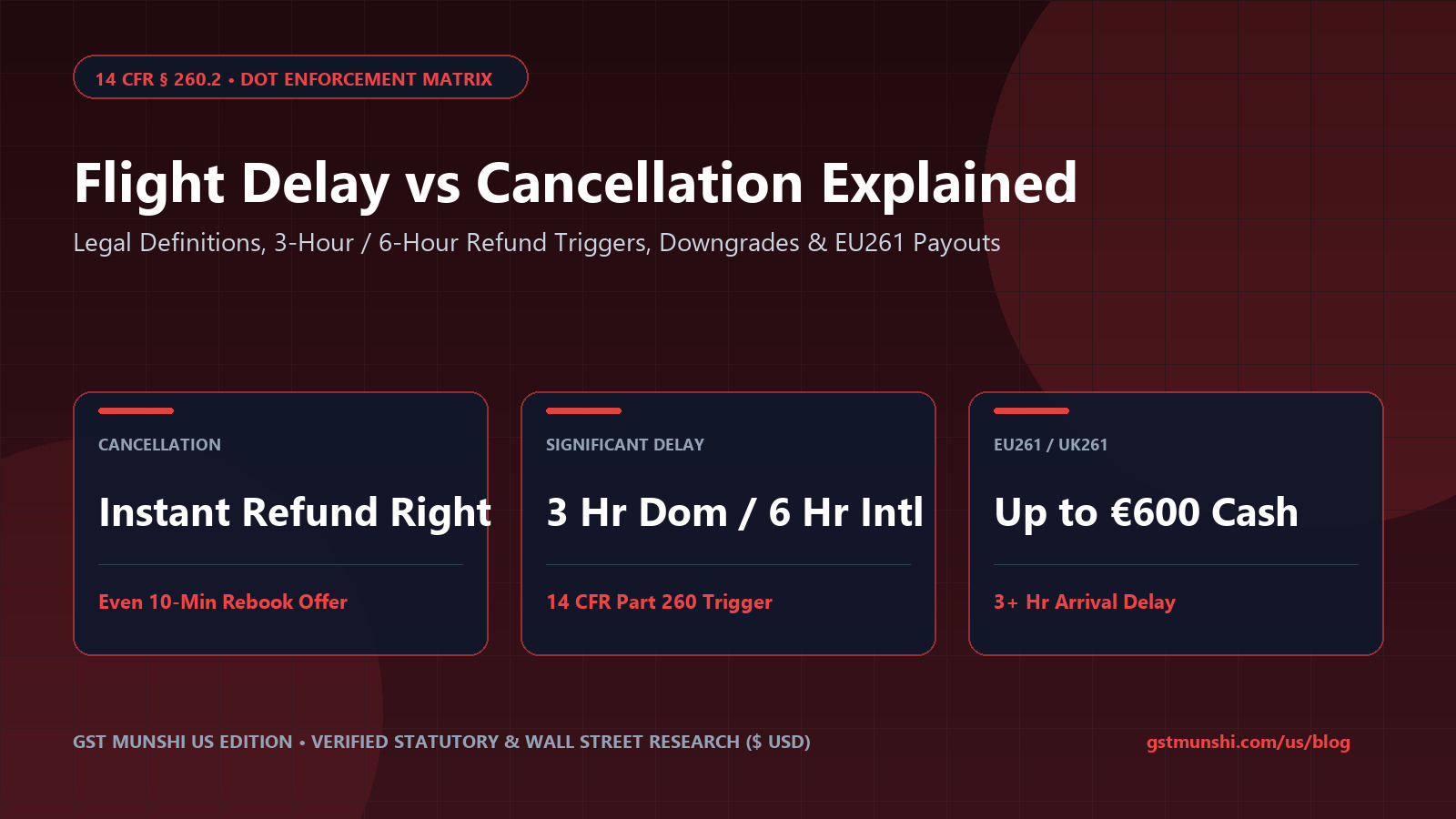
Operationally, a flight delay means your scheduled flight number will still operate using a delayed aircraft or crew, whereas a flight cancellation means the airline has permanently terminated that flight leg for the day. Legally, however, under the US Department of Transportation Final Rule (14 C.F.R. Part 260), once a flight delay reaches 3 hours or more for a domestic flight (or 6 hours or more for an international flight), it triggers the exact same 100% automatic cash refund right as an outright flight cancellation if you choose not to travel.
Airline Delay & Cancellation Rights Checker (Rebooking, Hotels & Cash Refunds)
Select your US airline, disruption cause, and delay duration to check your exact entitlement under 14 C.F.R. Part 260 and the official US DOT Airline Customer Service Dashboard.
“Hello, my flight was cancelled. Under the US DOT Customer Service Dashboard commitment for Delta Air Lines and 14 C.F.R. § 260.6, please let me know: (1) Can you rebook me at no extra cost on the next available flight including partner/interline carriers, or (2) issue an immediate 100% cash refund to my original payment method? Because this is a controllable operational disruption, I also request my complimentary hotel voucher and meal voucher.”
1Operational vs. Statutory Difference: How Airlines & the US DOT Classify Delays vs. Cancellations
To a traveler stranded at an airport gate, a six-hour flight delay and a cancelled flight feel nearly identical—yet inside the airline's dispatch system and federal aviation law, they operate under different mechanics until the statutory refund threshold is crossed. When a flight is classified as 'Delayed', the flight number remains active in the FAA Air Traffic Control system, your boarding pass stays tied to that aircraft, and the airline intends to operate the route once the late inbound jet lands, the mechanical fault is cleared, or the FAA ground stop lifts.
When a flight is classified as 'Cancelled', airline dispatch formally withdraws the flight plan from the FAA, voids the active departure leg, and unseats every passenger on the manifest. Once cancelled, the airline's automated recovery system (such as United's ConnectionSaver/auto-rebooker or Delta's VIPER engine) immediately attempts to assign you a new boarding pass on the next available flight with open seats—which may be later the same day or the following day.
Historically, airlines used 'rolling delays' (pushing a flight back by 45 minutes five times in a row) to prevent passengers from claiming a cancellation refund. The US Department of Transportation closed that loophole permanently under 14 C.F.R. Part 260: the moment a cumulative schedule delay reaches 3 hours (domestic) or 6 hours (international), the law treats your refund right identically to an outright cancellation.
- Under-3-Hour Domestic Delay: Your ticket remains non-refundable (unless you purchased a refundable fare), though you can ask for free Same-Day Standby if an earlier flight is departing.
- 3+ Hour Domestic / 6+ Hour International Delay: You gain the unilateral legal right to walk away from the flight and receive a 100% cash refund within 7 business days—even if the plane eventually takes off.
- Outright Cancellation (At Any Time): Even if the airline offers a replacement flight departing only 45 minutes later, you still have the legal right to decline rebooking and take a 100% cash refund if you prefer not to fly.
2Why Rolling Flight Delays Turn Into Sudden Cancellations (FAR Part 117 Crew Duty Limits)
The most frustrating scenario for passengers is watching a flight delay creep from 30 minutes to 2 hours, 3 hours, and 4 hours—only for the gate agent to announce at 11:00 PM that the flight is cancelled. Why does this happen? Under Federal Aviation Administration (FAA) Federal Aviation Regulations Part 117 (14 C.F.R. Part 117), commercial airline pilots and flight attendants are subject to strict, non-negotiable maximum Flight Duty Period (FDP) limits (typically 9 to 14 hours depending on start time and number of flight segments) to prevent fatigue accidents.
Pilots are legally prohibited from taking off if the projected flight time plus current ground delay will push them even one minute past their federal duty-time cap. When a mechanical issue or thunderstorm delays a flight late in the crew's workday, dispatch posts rolling delays while attempting to locate a reserve pilot crew at the hub. If no legal reserve crew is available before the current crew 'times out', the delayed flight abruptly converts into a controllable cancellation.
3On-Board Tarmac Delays: Your Rights Under the Federal 3-Hour / 4-Hour Rule (14 C.F.R. § 259.4)
A specialized category of flight delay occurs after you have already boarded the airplane and the cabin doors have closed, or after the plane has landed and is waiting for an open gate—known as a 'Tarmac Delay'. Under the US DOT Tarmac Delay Rule (14 C.F.R. § 259.4), airlines face massive federal fines (up to $27,500+ per passenger) if they hold an aircraft on the tarmac without giving passengers the opportunity to deplane within strict time limits.
For all domestic US flights, the airline must return to the gate or provide remote stairs/buses to let passengers deplane before the tarmac delay exceeds 3.0 hours. For international flights departing or arriving at a US airport, the maximum tarmac limit is 4.0 hours (unless the pilot-in-command determines there is a safety/security threat or Air Traffic Control advises that returning to the gate would significantly disrupt airport operations).
- Mandatory 2-Hour Food & Water Rule: No later than 2 hours after the aircraft leaves the gate (or touches down) during a tarmac delay, the airline must provide complimentary drinking water and snack food to all passengers.
- Working Lavatories & Medical Care: Throughout any tarmac delay, the airline must maintain operable onboard restrooms, comfortable cabin temperature/ventilation, and immediate emergency medical attention if needed.
- 30-Minute Status Announcements: The flight crew must update passengers every 30 minutes regarding the status of the delay and the specific reason if known.
4US DOT Rules vs. European EU261 / UK261 Cash Compensation Explained
Many American travelers confuse the US DOT Cash Refund Rule with Europe's famous EU Regulation 261/2004 (and UK261). Under US law, if your flight is delayed 3+ hours or cancelled and you still choose to take the delayed flight or a free rebooked flight to your destination, the airline does not owe you extra punitive cash compensation (only free meal vouchers at 3+ hours and a free hotel room overnight if the cause was controllable). You only receive a 100% cash refund in the US if you choose not to fly.
However, if you are flying out of any European Union or UK airport (on any airline, including Delta, United, or American) OR flying into the EU/UK on an EU/UK carrier (like British Airways, Lufthansa, or Air France), EU261/UK261 applies! Under EU261, if you arrive at your final destination 3+ hours late due to a non-extraordinary (controllable) delay or cancellation, the airline must fly you to your destination AND pay you €250 to €600 ($270 to $650 USD) in extra statutory cash compensation.
Head-to-Head Comparison: Flight Delay vs. Flight Cancellation (US DOT Rules)
| Legal / Operational Dimension | Minor Delay (<3 Hrs Domestic) | Significant Delay (3+ Hrs Dom / 6+ Hrs Intl) | Outright Flight Cancellation |
|---|---|---|---|
| 100% Cash Refund Right (14 CFR § 260.6) | No (Unless holding a refundable fare) | YES — 100% cash refund if you decline to fly | YES — 100% cash refund if you decline rebooking |
| Ticket & Seat Status | Keep original boarding pass & seat | Keep original seat OR switch to earlier flight | Original flight voided; auto-rebooked on new flight |
| Free Meal Voucher (Controllable Cause) | No | YES — Guaranteed on all 10 major US airlines at 3+ hrs | YES — Guaranteed if rebooked wait exceeds 3+ hrs |
| Free Overnight Hotel + Shuttle (Controllable) | No | YES — Guaranteed on 9 of 10 US airlines if overnight | YES — Guaranteed on 9 of 10 US airlines if overnight |
| Interline Rebooking on Competitor Airline | Rarely offered | Offered on DL, UA, AA, AS, B6 for controllable delays | Offered on DL, UA, AA, AS, B6 for controllable cancellations |
4-Step Decision Tree: Should You Wait Out a Delay, Rebook, or Cancel for Cash?
Check If the Delay Has Crossed the 3-Hour (Domestic) or 6-Hour (Intl) Line
Once a delay reaches 3 hours domestically (6 hours internationally), you unlock the exact same 100% cash refund and free rebooking rights as an outright cancellation.
Verify Crew Timeout Risk on Late-Night Rolling Delays
If a flight after 8:00 PM has been pushed back 3+ times due to maintenance or late inbound crew, check alternative flights immediately before the crew hits FAA Part 117 duty limits.
Compare Rebooking vs. Booking a Walk-Up Ticket Using Your Cash Refund
If Southwest or Spirit cancels your flight and has no seats for 2 days, invoke your 100% DOT cash refund and use the money to book an open seat on Delta, United, or American.
Claim EU261 (€600 / $650) When Departing European or UK Airports
If your delayed or cancelled flight departed from an EU/UK airport (or flew to Europe on an EU carrier) and arrived 3+ hours late for non-weather reasons, file an EU261 cash claim.
Curated Expert Video Walkthroughs & Wall Street Briefings


Frequently Asked Questions (Verified Statutory Answers)
Q1: How many hours does a flight have to be delayed to count as a cancellation for a refund?
Under the US Department of Transportation Final Rule (14 C.F.R. § 260.2), a flight delay of 3 hours or more for a domestic US flight, or 6 hours or more for an international flight, is legally classified as a 'significant schedule change.' At that threshold, you have the exact same legal right to cancel your reservation and receive a 100% automatic cash refund as if the flight had been cancelled outright.
Q2: If my flight is delayed 4 hours and I still get on the plane and fly, do I get a refund?
No. Under US federal rules, you cannot both take the flight to your destination and receive a full ticket refund. If you choose to remain on the delayed flight (or accept a free rebooked flight), you do not get a ticket refund, though you are entitled to free meal vouchers (and an overnight hotel if applicable) if the delay was controllable by the airline.
Q3: What is the US 3-hour tarmac delay rule?
Under 14 C.F.R. § 259.4, if you are sitting inside an airplane on the airport tarmac, the airline must provide free food and drinking water within 2 hours, maintain working restrooms and cabin temperature, and return to the gate to let passengers deplane before the tarmac delay exceeds 3 hours for domestic flights (or 4 hours for international flights).
Q4: Why do airlines keep delaying a flight by 30 minutes at a time instead of cancelling it?
Rolling 30-to-45-minute delays usually occur when airline maintenance technicians are actively troubleshooting a mechanical warning light or when dispatch is waiting for an inbound aircraft or reserve flight crew to arrive. If the crew exceeds FAA Part 117 maximum daily duty hours before the issue is resolved, the rolling delay converts into a cancellation.
Q5: Does the US have a $600 cash compensation law for 3-hour flight delays like Europe's EU261?
Currently, US federal law guarantees 100% cash ticket refunds (if you choose not to travel) plus airline-specific hotel/meal vouchers for controllable delays, rather than EU261's extra €250–€600 punitive cash payout. However, US passengers flying out of any European or UK airport on a US airline (like Delta, United, or American) ARE covered by EU261/UK261 and can claim up to €600 (~$650) for controllable 3+ hour arrival delays.