What is Los Angeles weather like by month and when is the best time to visit?
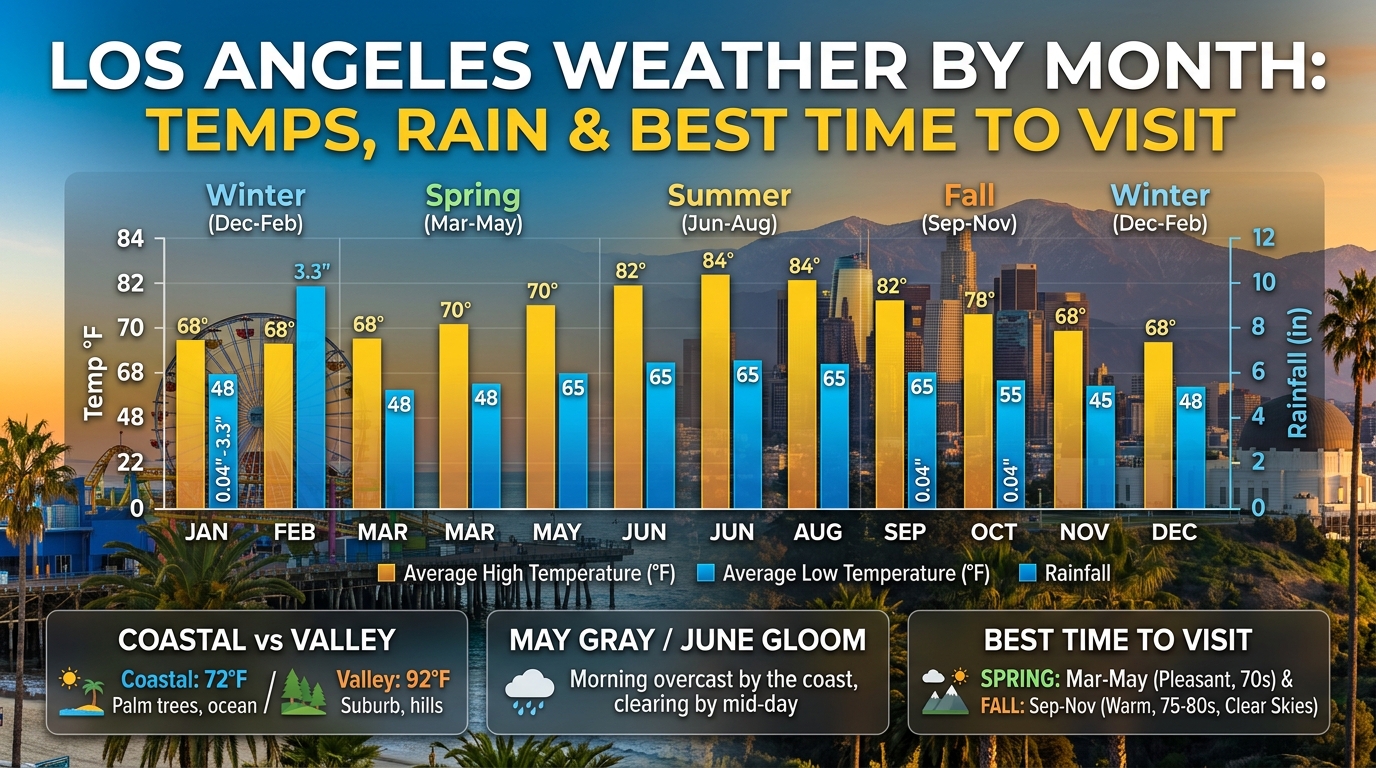
Los Angeles features a warm-summer Mediterranean climate averaging 284 sunny days per year, with daytime highs ranging from 68°F in January to 84°F in August and September. The absolute best months to visit Los Angeles are September through November and March through April, when skies are clear, beaches are warm (75°F–82°F), rainfall is scarce, and hotel rates drop below peak summer highs.
Interactive Los Angeles Weather by Month: Beach vs. Downtown vs. Valley Planner
1Understanding Los Angeles's 4 Distinct Microclimates Before You Pack
Checking a single citywide forecast for 'Los Angeles weather' can easily mislead travelers because the Greater Los Angeles Basin spans four dramatically different topographic microclimates separated by the Santa Monica Mountains and Verdugo Hills. Cold water from the California Current flowing southward along the Pacific coast keeps ocean temperatures between 57°F in winter and 68°F in late summer, acting as a natural air conditioner for coastal communities.
Consequently, during summer and early autumn (July through October), a steep 15°F to 22°F temperature gradient develops over just 15 miles of driving. While beach neighborhoods like Santa Monica, Venice, Malibu, and Manhattan Beach enjoy breezy 72°F to 75°F afternoons, mid-city neighborhoods (Beverly Hills, West Hollywood, Miracle Mile) sit around 81°F to 84°F, Downtown Los Angeles and Pasadena reach 86°F to 90°F, and the San Fernando Valley (Universal Studios Hollywood, Burbank, Woodland Hills) regularly climbs to 94°F to 102°F.
In winter (December through February), this pattern flattens out: daytime highs hover near a pleasant 66°F to 70°F across both the coast and basin, though clear desert-like radiation cooling drops nighttime lows into the 45°F to 49°F range, making a warm jacket essential after sunset.
- Coastal Zone (Santa Monica, Venice, Malibu, LAX): Mildest year-round (65°F winter / 75°F summer); highest morning marine layer cloud cover in May and June.
- Central Basin & Hollywood (Beverly Hills, West Hollywood, DTLA): Classic Mediterranean warmth (68°F winter / 84°F summer); sunny by 10 AM even during spring marine layer months.
- San Fernando & San Gabriel Valleys (Burbank, Universal City, Pasadena): Hot dry summers (92°F–98°F+ in July–September) and cooler winter nights (44°F).
- Mountain & Desert Fringe (Griffith Observatory, Angeles Crest, Palm Springs): 15°F cooler at high mountain elevations; 105°F+ summer heat in Palm Springs.
2May Gray, June Gloom & Autumn Santa Ana Winds: Seasonal Weather Quirk Guide
Two seasonal atmospheric phenomena define the Los Angeles calendar: the late-spring marine layer ('May Gray' and 'June Gloom') and autumn offshore 'Santa Ana Winds'. In May and June, inland deserts across the Mojave and Coachella Valley heat up rapidly while the coastal Pacific Ocean remains a chilly 60°F. Rising hot air inland creates a thermal low that sucks cool, moist marine air onshore underneath a strong temperature inversion, forming a persistent deck of gray stratus clouds along the coast every night and morning.
By contrast, September and October deliver Los Angeles's warmest, sunniest beach weather—often called 'Second Summer'. As surface high pressure builds over the Great Basin (Nevada and Utah), air flows clockwise and rushes southwestward through mountain passes (Cajon, Newhall, and Santa Ana canyons) toward the coast. As these **Santa Ana winds** descend from high desert elevations to sea level, adiabatic compression heats the air by 5.5°F per 1,000 feet and drops relative humidity below 10%, pushing coastal temperatures to a crystal-clear 85°F+ right up to the surf line.
3Winter Atmospheric Rivers (Dec–Mar) vs. Best Months for Theme Parks & Beaches
Los Angeles is virtually rain-free from May through October, averaging less than 0.2 inches of total rainfall across that entire six-month span. However, between December and March, the Pacific storm track shifts southward, delivering an average of 4 to 6 rainy days per month. During El Niño winters or strong 'Pineapple Express' Atmospheric River events, Southern California can receive 3 to 6 inches of rain in 48 hours, accompanied by heavy mountain snow above 6,000 feet at Big Bear and Mount Baldy.
For travelers balancing sunshine, comfortable theme-park walking temperatures (Disneyland and Universal Studios), warm Pacific ocean swimming, and shoulder-season airfare, **September through early November** is the undisputed #1 window to visit Los Angeles, followed closely by **March and April** when hills are emerald green and desert wildflowers bloom.
Official Los Angeles Weather by Month: Highs, Lows, Rain Days & Ocean Temp (NOAA 30-Yr Normals)
| Month | Avg High (DTLA / Coast) | Avg Low (°F) | Avg Rain (Inches / Days) | Pacific Water Temp | Crowd & Weather Verdict |
|---|---|---|---|---|---|
| January | 68°F / 65°F | 49°F | 3.29 in. (6 days) | 58°F (Wetsuit Needed) | Cool, crisp & clear between winter storms; low hotel rates |
| February | 69°F / 65°F | 50°F | 3.64 in. (6 days) | 58°F | Peak winter rain month, yet still 70%+ sunny days |
| March | 71°F / 66°F | 52°F | 2.23 in. (5 days) | 59°F | Green hills, blooming wildflowers & ideal 70°F sightseeing |
| April | 73°F / 67°F | 54°F | 0.69 in. (2 days) | 60°F | Prime spring shoulder season; dry, sunny & comfortable |
| May | 75°F / 68°F | 58°F | 0.32 in. (1 day) | 62°F | 'May Gray' morning clouds at beach; sunny inland for theme parks |
| June | 79°F / 71°F | 61°F | 0.09 in. (0 days) | 65°F | 'June Gloom' morning coastal fog; zero rain & long daylight |
| July | 83°F / 74°F | 65°F | 0.02 in. (0 days) | 68°F (Swimmable) | Peak summer sun & tourist crowds; hot in Valley (95°F) |
| August | 85°F / 75°F | 66°F | 0.01 in. (0 days) | 70°F (Warmest Surf) | Warmest ocean water & classic sunny California beach weather |
| September | 84°F / 76°F | 65°F | 0.13 in. (1 day) | 69°F | #1 Best Month Overall: warm ocean, sunny skies & lower crowds |
| October | 79°F / 73°F | 60°F | 0.58 in. (2 days) | 66°F | Golden autumn beach days, Halloween theme parks & Santa Ana warmth |
| November | 73°F / 69°F | 53°F | 0.78 in. (3 days) | 62°F | Crystal-clear skies, mild 73°F afternoons & cool evenings |
| December | 68°F / 65°F | 48°F | 2.48 in. (5 days) | 59°F | Festive mild days (68°F), chilly 48°F nights & early winter rain |
4-Step Packing & Microclimate Planning Guide for a Los Angeles Trip
Pack Light Layers Regardless of the Month (The 25°F Diurnal Swing)
Even when Los Angeles hits 82°F at 2:00 PM, dry air and cold ocean breezes drop temperatures to 58°F–62°F within an hour after sunset. Always pack a denim jacket, hoodie, or light sweater.
Schedule Beach Time After 12:30 PM If Visiting in May or June
During 'May Gray' and 'June Gloom', spend mornings inland at Hollywood, museums, or theme parks where the sun breaks out early, then head to Santa Monica or Malibu after lunch when coastal clouds burn off.
Check Separate Forecasts for 'Santa Monica' vs. 'Universal City / Burbank'
Never rely on a single 'LAX' airport temperature readout if your itinerary includes Universal Studios or Pasadena, which run 12°F to 18°F hotter than the coast from June through October.
Bring a Wetsuit (or Spring Suit) for Pacific Surfing From November to May
Unlike Florida's warm Gulf Stream waters, the Pacific Ocean off Los Angeles ranges from 57°F to 63°F outside of July–October, requiring a 3/2mm wetsuit for extended swimming or surfing.
Curated Expert Video Walkthroughs & Wall Street Briefings



Frequently Asked Questions (Verified Statutory Answers)
Q1: What is the best month to visit Los Angeles for great weather?
September and October are widely considered the best months to visit Los Angeles. The spring 'June Gloom' marine layer is gone, daytime highs sit between 76°F at the beach and 84°F downtown, Pacific ocean water is still warm (66°F–70°F), and summer tourist crowds have departed.
Q2: What is 'June Gloom' in Los Angeles and does it ruin beach trips?
June Gloom (along with May Gray) is a natural late-spring weather pattern where cool Pacific air gets trapped beneath warm inland air, creating overcast skies and mist along the coast every morning. It usually burns off to sunshine between 12:00 PM and 2:00 PM, and inland areas like Hollywood and Downtown LA clear up much earlier.
Q3: Does it ever rain in Los Angeles in the summer?
Almost never. July and August average 0.01 to 0.02 inches of rain across the entire month. Nearly 85% of Los Angeles's annual rainfall occurs during the winter months between December and March.
Q4: Is the ocean water warm enough to swim in Los Angeles?
From mid-July through early October, surf temperatures at Santa Monica, Venice, and Huntington Beach reach 67°F to 71°F, which is refreshing and swimmable without a wetsuit. From November through May, water temperatures dip to 57°F–62°F, so surfers and swimmers wear a 3/2mm wetsuit.