How do you prepare for a 10-to-18-hour long-haul flight to maximize comfort, sleep in Economy, and prevent jet lag?
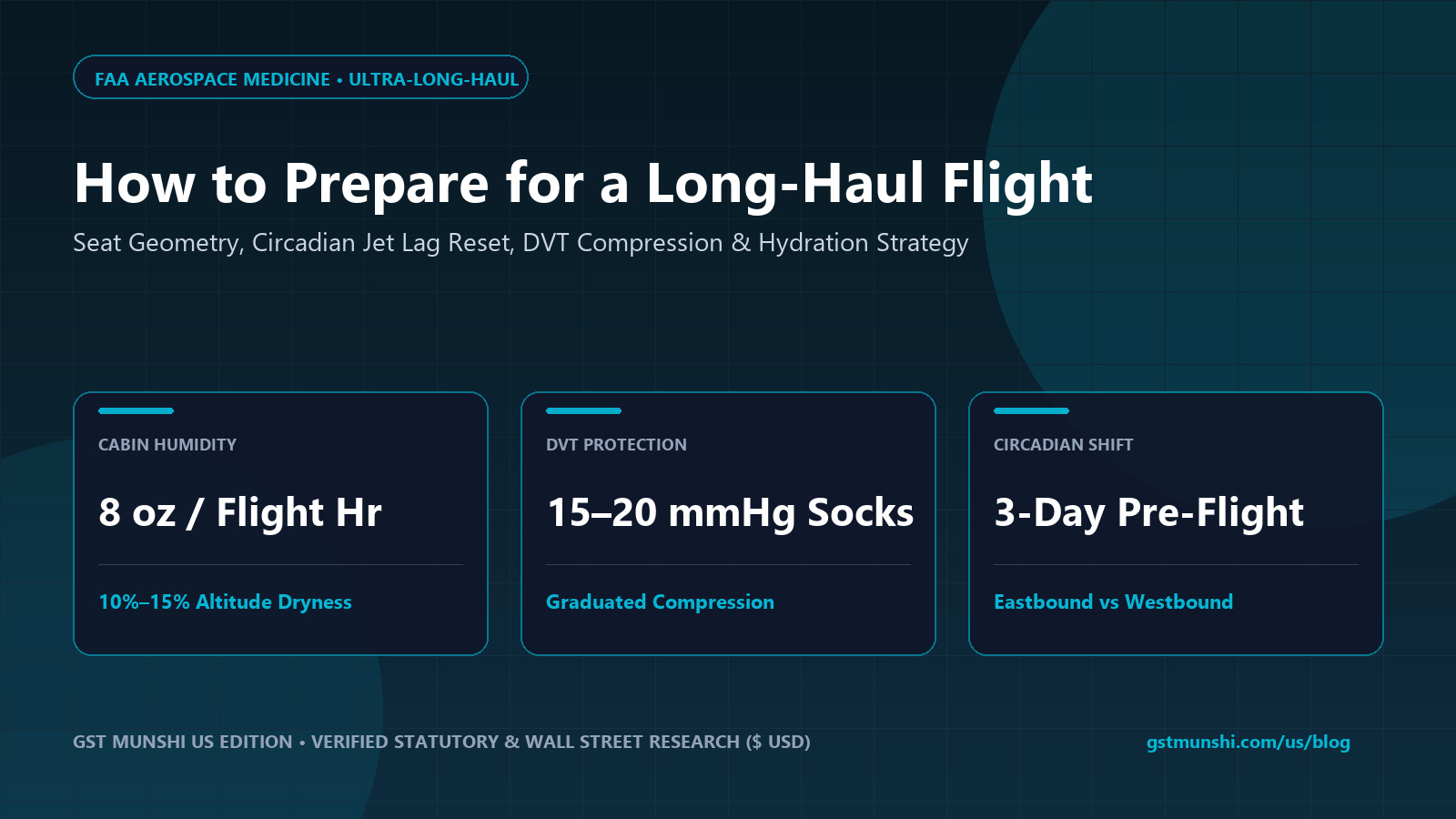
Preparing for a long-haul flight centers on four physiological and logistical adjustments: (1) audit aircraft cabin diagrams on Aerolopa.com to select a seat away from lavatory queues and non-reclining bulkheads (preferring the Boeing 787 Dreamliner or Airbus A350 for their lower 6,000-foot cabin altitude and higher humidity), (2) wear graduated 15–20 mmHg compression socks before takeoff to prevent leg swelling and Deep Vein Thrombosis (DVT), (3) drink 8 ounces (240 ml) of water per flight hour while avoiding alcohol and high-sodium meals, and (4) shift your watch and sleep/light exposure to destination time the moment you board.
6-Month Passport Rule, Cabin Hydration & Jet Lag Recovery Calculator
Enter your long-haul flight duration, remaining passport validity months, and time zones crossed to generate your custom international readiness and circadian adjustment plan.
1Step 1: Choosing the Best Aircraft (A350 / B787) & Auditing Seat Maps on Aerolopa
Comfort on a 12-to-18-hour transoceanic flight is determined days or weeks before you step into the airport—starting with the specific widebody aircraft type and seat location you book. Traditional aluminum widebody jets (such as older Boeing 777-200/300ERs and Airbus A330s) pressurize the cabin to an equivalent altitude of 8,000 feet above sea level with bone-dry 8% to 12% cabin humidity. By contrast, modern carbon-fiber composite jets—specifically the Airbus A350-900/1000 and Boeing 787-8/9/10 Dreamliner—pressurize the cabin to 5,600–6,000 feet with higher humidity and advanced HEPA hospital-grade filtration, noticeably reducing post-flight headaches, dry eyes, and fatigue.
Before paying for a seat assignment, look up your airline's exact layout on Aerolopa.com (which uses scale architectural floor plans showing true window positions, unlike outdated SeatGuru diagrams). If your priority is uninterrupted sleep, select a Window Seat away from the galley kitchens and lavatories—where light, flushing noise, and congregating passengers disrupt rest. If your priority is stretching your legs every two hours without climbing over sleeping neighbors, choose an Aisle Seat in the middle section of a 3-3-3 or 3-4-3 widebody cabin (since the middle passenger has two exits and only disturbs you 50% of the time).
- Avoid the Last Row of Any Cabin Section: Seats directly in front of a bulkhead wall or lavatory often have restricted recline and constant foot traffic.
- Check for Bulkhead Bassinet Positions: While bulkhead rows offer extra knee room, they are also where airlines mount infant bassinets—check seat map icons carefully.
- Premium Economy Sweet Spot: On flights exceeding 10 hours, upgrading from Economy (31-inch pitch, 17-inch width) to Premium Economy (38-inch pitch, 19-inch width, calf rests, and 7-inch recline) often costs 65% less than Business Class while delivering 80% of the physical rest.
2Step 2: Packing the Ultimate Under-Seat Long-Haul Pouch (Everything Within Arm's Reach)
On a long-haul flight, opening the overhead bin mid-flight when the cabin lights are dimmed and your seatmates are asleep is stressful and inconvenient. Pack a dedicated compact 'In-Seat Pouch' inside your backpack that you pull out and place in the seatback pocket before takeoff, allowing you to stow your main bag away.
Your In-Seat Pouch should contain four categories of gear: (1) Sensory Isolation: Over-ear Active Noise-Canceling (ANC) headphones or loop earplugs to cancel the 80-decibel low-frequency engine drone, paired with a 3D contoured blackout eye mask that does not press on your eyelids; (2) Neck Support: A high-collar memory-foam or Trtl-style structural neck wrap that prevents your head from bobbing forward; (3) Micro-Climate & Hygiene: A travel toothbrush/toothpaste, unscented facial moisturizing cream, lip balm, saline nasal spray (to protect dry sinus membranes), sanitizing wipes for the tray table, and deodorant; and (4) Electronics: A 6-foot braided USB-C/Lightning cable, a universal international plug adapter (since loose airplane AC sockets often drop standard US 2-prong plugs), and a Bluetooth audio transmitter (like the Twelve South AirFly) to pair wireless earbuds with seatback screens.
3Step 3: Cabin Hydration Math, Nutrition & Preventing Deep Vein Thrombosis (DVT)
Sitting immobilized in a pressurized cabin for 10 to 18 hours slows venous blood return from the lower legs while ultra-dry 12% cabin air pulls moisture from your respiratory tract at roughly twice the normal ground rate. According to the Centers for Disease Control and Prevention (CDC) Yellow Book for International Travel, flights lasting longer than 6 to 8 hours significantly increase the risk of lower-extremity swelling (edema) and Deep Vein Thrombosis (DVT).
To protect your circulation, put on a pair of graduated medical-grade compression socks (15–20 mmHg pressure rating) at home or at the departure gate before boarding—before gravity pools fluid in your ankles. Every 90 to 120 minutes while awake, perform 30 seated ankle circles and heel-toe calf pumps, and walk the aisle whenever the seatbelt sign is off.
For hydration, target 8 ounces (240 ml) of water for every hour in the air—meaning roughly 3.0 to 3.5 liters on a 14-hour transpacific flight. Add one low-sugar electrolyte packet (sodium/potassium/magnesium) mid-flight so your body retains cellular hydration rather than immediately excreting plain water, and skip alcohol and carbonated sodas (which expand in the stomach by up to 25% at 8,000-foot cabin pressure).
4Step 4: Scientific Jet Lag Prevention (Eastbound vs. Westbound Circadian Reset)
Jet lag is a circadian rhythm mismatch between your brain's suprachiasmatic nucleus (master body clock) and the solar light-dark cycle of your destination. Traveling Eastbound (such as US to Europe or the Middle East) is physiologically harder than traveling Westbound because Eastbound travel requires advancing (shortening) your circadian day, whereas the human body naturally prefers a slightly longer ~24.2-hour cycle.
The moment you sit down in your airplane seat, set your watch and phone to your destination's local time zone. On an overnight Eastbound flight to Europe (departing the US between 6:00 PM and 10:00 PM), eat dinner at the airport Terminal before boarding so you can skip the slow 2-hour cabin meal service, put on your eye mask and ANC headphones immediately after takeoff, and maximize sleep. Upon landing in Europe in the morning, get 30 minutes of natural outdoor sunlight before noon and stay awake until at least 9:30 PM local time.
Long-Haul Flight Preparation & In-Flight Survival Matrix by Flight Phase
| Flight Phase | Primary Physical Challenge | Exact Action Protocol | Essential Gear Needed |
|---|---|---|---|
| 48 Hours Before Flight | Seat trap & sleep debt | Verify seat on Aerolopa.com; shift bedtime 1 hr toward destination; pre-order special meal | Airline App + Aerolopa seat map |
| At Departure Gate | Pre-boarding dehydration & leg pooling | Put on 15–20 mmHg compression socks; fill 1L water bottle; brush teeth & wash face | Compression socks + 1L insulated bottle |
| Hours 1–6 In-Flight | 80 dB engine noise & cabin light | Set watch to destination time; use ANC headphones + 3D blackout mask + neck support | In-Seat Pouch in seatback pocket |
| Hours 7–15+ In-Flight | 12% cabin humidity & venous stasis | Drink 8 oz water/hr + 1 electrolyte packet; do seated calf pumps & aisle walks every 2 hrs | Electrolytes, lip balm & saline nasal mist |
| First 12 Hours After Landing | Circadian jet lag crash | Get 30 mins outdoor sunlight; avoid naps >20 mins; sleep only after 9:30 PM local time | Sunglasses / 0.5mg–3mg Melatonin at night |
4-Step Long-Haul Flight Comfort Checklist
Dress in Breathable Merino or Athleisure Layers + Compression Socks
Aircraft cabins swing from 64°F (18°C) during cruise to 78°F (25°C) on the tarmac; wear stretchy, non-restrictive layers with 15–20 mmHg graduated compression socks.
Separate Your 'In-Seat Pouch' Before Stepping Onto the Jetbridge
Pull your small pouch containing headphones, eye mask, charging cord, lip balm, toothbrush, and medications out of your backpack before boarding so you never have to open the overhead bin.
Eat Before Boarding on Overnight Red-Eye Flights
Cabin dinner service often takes 90 to 120 minutes after takeoff; eating a light meal in the terminal lets you recline and sleep the minute the aircraft reaches cruising altitude.
Anchor Your Circadian Clock with Sunlight & Destination Meal Times
Eat and sleep strictly according to your destination's clock during the flight, and step outside into natural daylight upon arrival to reset your melatonin cycle.
Curated Expert Video Walkthroughs & Wall Street Briefings




Frequently Asked Questions (Verified Statutory Answers)
Q1: What is considered a long-haul vs. an ultra-long-haul flight?
In commercial aviation, a short-haul flight is under 3 hours, a medium-haul flight runs 3 to 6 hours, a long-haul flight lasts 6 to 12 hours (such as New York to London or Los Angeles to Tokyo), and an ultra-long-haul flight exceeds 12 to 19 hours nonstop (such as New York JFK to Singapore, Dallas to Melbourne, or Newark to Johannesburg).
Q2: Where is the best seat to pick in Economy on a long-haul flight?
If you want to sleep undisturbed against a solid surface, book a Window Seat in the middle of the cabin (at least 4 rows away from the lavatories and galleys). If you prefer getting up frequently without waking strangers, book the Aisle Seat in the center block of seats on a widebody jet (e.g., seats D or G in a 3-4-3 or 3-3-3 layout), because the middle passenger can exit via the opposite aisle.
Q3: Do compression socks really make a difference on long flights?
Yes. Clinical aviation medicine studies and CDC Yellow Book guidelines confirm that wearing graduated compression socks (15–20 mmHg) on flights over 6 hours prevents fluid pooling (edema) in the lower legs and significantly lowers the risk of asymptomatic and symptomatic Deep Vein Thrombosis (DVT) blood clots.
Q4: Why do US plugs always fall out of airplane seat outlets, and how do I fix it?
Universal airplane AC outlets get worn out by thousands of heavy power bricks, causing thin US two-prong plugs to slip out. Attach a UK 3-prong or European 2-prong travel adapter to your charger—the thicker prongs lock tightly into the universal airplane socket and never fall out.
Q5: Should I wear contact lenses on a 12-hour flight?
Eye doctors strongly advise wearing eyeglasses instead of contact lenses on long-haul flights. Because aircraft cabin humidity drops to 10%–15% (especially if you sleep in your seat), contact lenses dry out and starve the cornea of oxygen, causing severe irritation or corneal abrasions.