What documents, baggage rules, and connection buffers do you need on your international flight planning checklist?
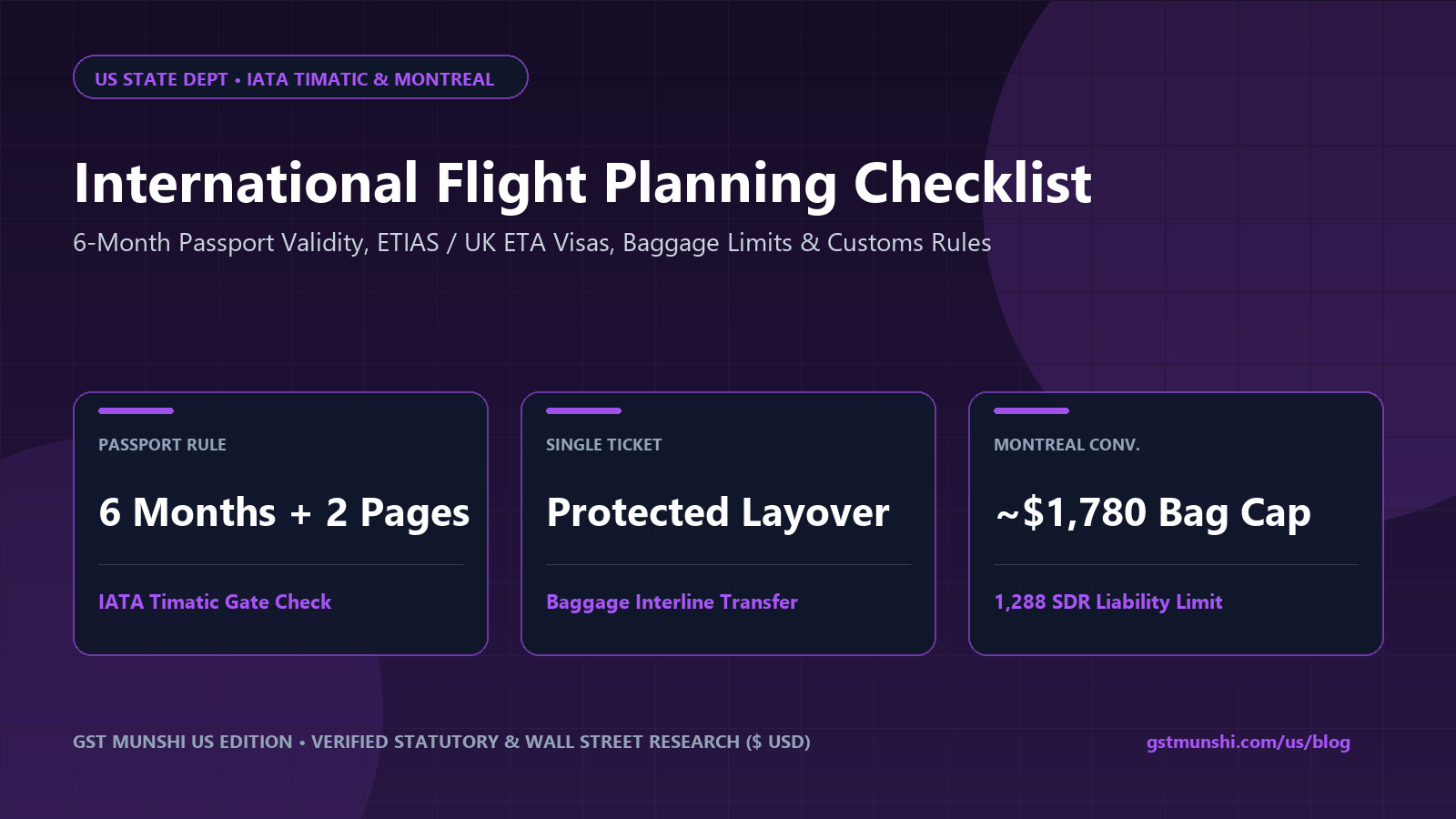
A complete international flight checklist requires verifying five mandatory pillars before departure: (1) Passport Validity under the strict 6-Month Rule (with at least 2 blank 'Visas' pages), (2) Digital Entry Authorizations (such as the UK ETA, European ETIAS, Australian ETA, or Indian e-Visa) verified via the airline's IATA Timatic database, (3) International Baggage Allowances (50 lbs / 23 kg checked bag cap in Economy and strict 7–10 kg carry-on weight checks on foreign carriers), (4) Minimum Connection Time (90–120+ minutes on a single through-ticket), and (5) Zero-Foreign-Transaction-Fee credit cards plus the CBP Mobile Passport Control app.
6-Month Passport Rule, Cabin Hydration & Jet Lag Recovery Calculator
Enter your long-haul flight duration, remaining passport validity months, and time zones crossed to generate your custom international readiness and circadian adjustment plan.
1Pillar 1: The 6-Month Passport Validity Rule, Blank Pages & Digital Visas (ETA / ETIAS)
Every year, thousands of US travelers with valid, unexpired passports are denied boarding at the airport check-in counter because they overlooked the International 6-Month Passport Validity Rule. Airline check-in computers are hard-wired into IATA Timatic, the global immigration rule database. If your destination requires six months of remaining passport validity beyond your planned departure date (enforced across Singapore, Thailand, Indonesia, China, UAE, Brazil, and dozens more) or three months beyond your departure from the European Schengen Zone, the airline system physically blocks your boarding pass from printing.
Why are airlines so strict? When a carrier transports a passenger whose passport or visa fails destination border rules, the destination government fines the airline $3,000 to $10,000+ and forces the carrier to fly the passenger back immediately. Always renew a US passport as soon as it reaches 9 months prior to expiration, and verify that your passport booklet has at least two completely blank pages labeled 'Visas' (the 'Endorsements' pages at the very back cannot be stamped by immigration officers).
In addition to traditional visas, verify mandatory Electronic Travel Authorizations for visa-exempt US passport holders—including the United Kingdom Electronic Travel Authorisation (UK ETA), the European Travel Information and Authorisation System (ETIAS), the Australian ETA, New Zealand NZeTA, and South Korea K-ETA.
- Proof of Onward / Return Travel: Many countries (including Costa Rica, Peru, New Zealand, Japan, and the Philippines) require proof of a return or onward ticket leaving the country within the visa-free window before allowing you to board a one-way flight.
- Digital Backup Protocol: Store encrypted PDF scans of your passport bio page, visa approvals, and global health vaccination cards in offline cloud storage plus two physical color photocopies in your carry-on.
2Pillar 2: International Baggage Limits, 7 kg Carry-On Weigh-Ins & Lithium Battery Laws
International baggage rules differ sharply from domestic US flights in two critical ways: strict carry-on dimension/weight enforcement and interline fare rules. While major US airlines (Delta, United, American) focus on carry-on dimensions (22 x 14 x 9 inches) without weighing cabin bags, international carriers across Europe, Asia-Pacific, and the Middle East (such as Lufthansa, Swiss, Air France, Emirates, Qantas, and ANA) frequently weigh roller bags and backpacks at the check-in counter or gate—enforcing a strict 7 kg (15.4 lbs) to 10 kg (22 lbs) cabin limit.
For checked suitcases, standard international Economy tickets allow up to 23 kg (50.0 lbs) per bag with a maximum linear dimension (length + width + height) of 62 inches (158 cm). Note that 'Basic Economy' international fares on transatlantic routes now charge $75 each way ($150 round-trip) for the first checked bag unless you hold airline elite status or an eligible airline co-branded credit card.
- FAA & ICAO Lithium-Ion Battery Law: Portable power banks, spare camera batteries, E-cigarettes, and smart luggage batteries are 100% prohibited in checked luggage due to cargo fire risk—pack them exclusively in your cabin bag.
- AirTag / Smart Tracker Placement: Place an Apple AirTag, Samsung SmartTag, or Tile inside every checked suitcase and carry-on bag so you can share live location links directly with airline baggage desks if a bag misses a tight transfer.
- 48-Hour Carry-On Survival Rule: Always pack 48 hours of prescription medications (in original pharmacy bottles), eyeglasses, one change of clothes, and chargers inside your under-seat personal item—never in a checked bag.
3Pillar 3: Mastering International Flight Connections, Schengen Transit & US Re-Entry
When booking connecting international flights, always book all segments under a single Passenger Name Record (PNR / single ticket number) rather than stitching together two separate tickets. On a single through-ticket, if your first flight is delayed and you miss your connection, the airline is legally responsible for rebooking you onto the next available flight for free and transferring your checked bags.
Understanding where you clear immigration and customs during a connection prevents missed flights. When connecting through a European Schengen hub (such as Frankfurt, Munich, Amsterdam, Paris CDG, or Madrid) from the US to another Schengen city (like Rome or Barcelona), you clear Schengen passport control at your very first European transfer airport, while your checked bags fly straight through to your final destination. Conversely, when returning to the United States with a domestic connection (for example, London → Chicago O'Hare → Austin), US federal law requires every passenger to clear CBP passport control, claim checked bags from the carousel, walk through customs, and re-drop bags at the very first US port of entry.
4Pillar 4: Foreign Currency, eSIM Data, Plug Adapters & US Re-Entry Apps
Before heading to the airport, complete your financial and connectivity checklist: pack at least two Visa or Mastercard credit cards that charge 0% Foreign Transaction Fees (avoiding the standard 3% bank surcharge on overseas purchases) and a Charles Schwab or Fidelity debit card that rebates 100% of worldwide ATM withdrawal fees. When paying by card abroad, always select the local currency (EUR, GBP, JPY, MXN) on the merchant terminal—never accept 'Dynamic Currency Conversion (DCC)' in US Dollars, which hides a 5% to 9% exchange rate markup.
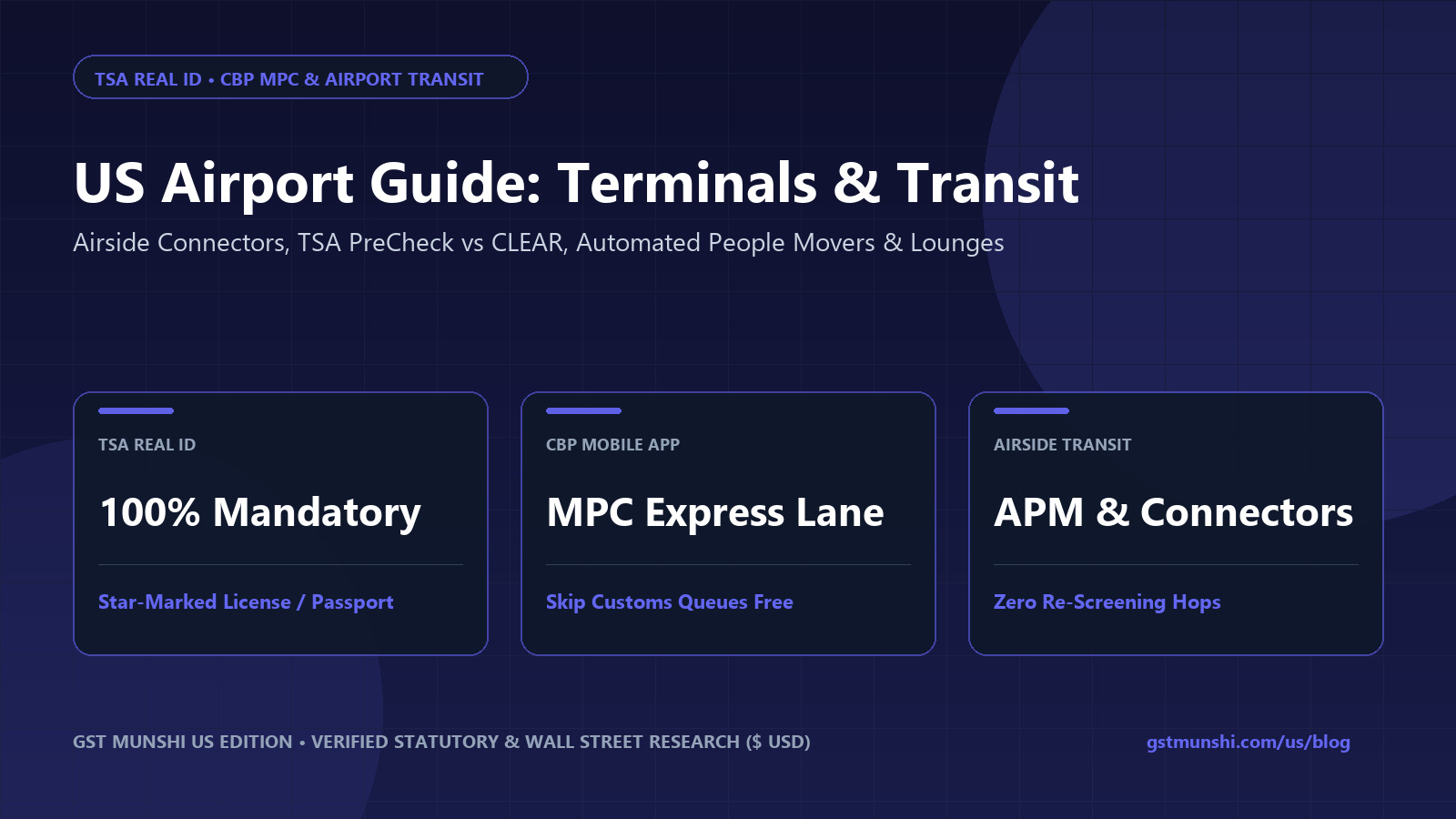
Install a travel eSIM (such as Airalo, Holafly, or your carrier's International Day Pass) before takeoff so your phone connects to local 5G networks the moment the plane touches down, and download the free US Customs Mobile Passport Control (MPC) app for a 60-second customs exit when you return home.
Complete International Flight Countdown Checklist (60 Days to Boarding)
| Timeline Before Flight | Mandatory Checklist Item | Critical Compliance Rule | Consequence if Missed |
|---|---|---|---|
| 60–90 Days Prior | Audit Passport Expiration & Blank Visa Pages | Must have 6+ months validity past trip end & 2+ blank Visa pages | Automatic denied boarding at airport check-in |
| 14–30 Days Prior | Submit Electronic Visas / ETA / ETIAS | Apply only on official government portals (UK ETA, ETIAS, NZeTA) | Blocked online check-in & boarding denial |
| 72 Hours Prior | Verify Connection MCT & Download Offline Maps / eSIM | 90+ mins for intl transfers; install eSIM & CBP MPC app | Missed connections & $10+/MB roaming charges |
| 24 Hours Prior | Complete Online Check-In & Weigh Carry-On / Checked Bags | Checked bag ≤50 lbs (23 kg); Intl carry-on ≤7–10 kg (15–22 lbs) | $100–$200 overweight bag fees at counter |
| 3 Hours Prior | Arrive at Airport Terminal for Document & Bag Drop | Intl bag drop locks strictly 60 minutes before scheduled departure | Ticket cancelled as No-Show if past 60m cutoff |
4-Step Pre-Departure International Verification Routine
Run the 6-Month Passport & Timatic Visa Check
Verify that every traveler's passport is valid for at least 6 months past the return date and obtain required electronic travel authorizations (UK ETA, ETIAS, or e-Visa).
Weigh Both Checked and Carry-On Bags at Home
Keep checked suitcases at or below 49 lbs (22.5 kg) and verify whether your foreign carrier enforces a 7 kg or 10 kg cabin carry-on weight limit.
Pack Prescriptions, Electronics & 48-Hour Kit in Personal Item
Place all medications, passports, lithium power banks, AirTags, and a spare outfit inside your under-seat backpack so gate-checking your roller bag never separates you from essentials.
Always Decline Dynamic Currency Conversion (Pay in Local Currency)
Use a 0% foreign transaction fee Visa/Mastercard abroad and always choose 'Local Currency' (EUR/GBP/JPY) rather than USD on overseas card readers and ATMs.
Curated Expert Video Walkthroughs & Wall Street Briefings




Frequently Asked Questions (Verified Statutory Answers)
Q1: What is the 6-month passport validity rule for international flights?
Many foreign countries require your passport to remain valid for at least 6 months beyond your planned departure date from their country (while European Schengen countries require at least 3 months beyond your planned departure from Europe). Even if your passport is technically unexpired, airlines will refuse to let you board if your remaining validity falls short of the destination country's rule.
Q2: How much connection time do I need for an international layover?
For an international connection booked on a single ticket where you do not have to re-claim checked luggage (such as US-to-Europe via London, Frankfurt, or Amsterdam), allow at least 90 to 120 minutes. When returning to the United States and connecting to a domestic flight (where you must clear US Customs, claim and recheck bags, and re-clear TSA), allow at least 2 to 2.5 hours.
Q3: Do my checked bags go straight through on an international connecting flight?
When flying outbound from the US to a foreign destination on a single through-ticket, your checked bags almost always transfer automatically to your final destination. However, when flying back into the United States with a domestic connecting flight, US federal law requires you to pick up your checked bags at your very first US arrival airport, clear customs, and drop them on the recheck belt.
Q4: Why do international airlines weigh carry-on bags when US airlines do not?
Many European, Asian, and Australian airlines enforce strict 7 kg (15.4 lbs) to 10 kg (22 lbs) cabin baggage weight limits for overhead bin safety and fuel calculations. If your roller bag exceeds the limit, pack heavy compact items (like power banks or cameras) in your coat pockets or personal item, or use a lightweight soft-shell cabin bag.
Q5: Can I use the free Mobile Passport Control (MPC) app instead of Global Entry when returning to the US?
Yes! US citizens, lawful permanent residents (green card holders), and Canadian B1/B2 visitors can use the free official CBP Mobile Passport Control (MPC) app at over 50 US international airports. You submit your photo and customs questions upon landing and use a dedicated fast-track MPC lane at passport control.