
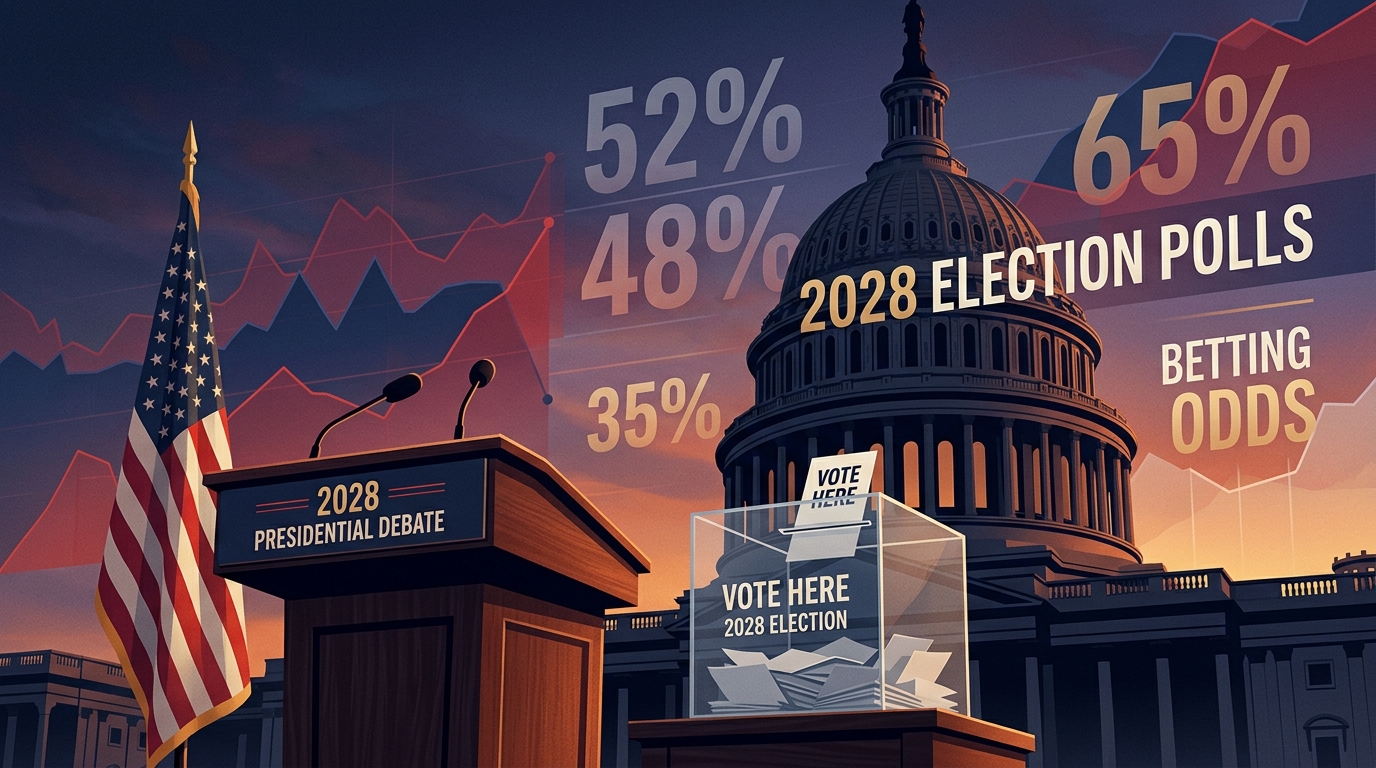
Who are the leading potential candidates and betting favorites for the 2028 US Presidential Election?
The 2028 US presidential election will be an open contest featuring prominent state governors, federal cabinet officials, and congressional leaders. On the Republican side, early contenders include Vice President JD Vance (the polling and prediction market front-runner), Florida Governor Ron DeSantis, Secretary of State Marco Rubio, and Virginia Governor Glenn Youngkin. On the Democratic side, leading prospective candidates include California Governor Gavin Newsom, former Vice President Kamala Harris, Pennsylvania Governor Josh Shapiro, Michigan Governor Gretchen Whitmer, and Secretary Pete Buttigieg.
2028 Presidential Candidates Scorecard & Early Betting Markets
Examine early 2028 presidential contenders, prediction market probability averages (PredictIt, Polymarket), state executive credentials, and anticipated primary calendar battlegrounds.
1The 2028 Landscape: The 22nd Amendment and Open Election Dynamics
The 2028 United States presidential election represents a historic turning point in American electoral politics. Ratified in 1951 following the four-term presidency of Franklin D. Roosevelt, the Twenty-Second Amendment to the United States Constitution establishes an absolute two-term ceiling on the office of the President: 'No person shall be elected to the office of the President more than twice.'
This constitutional barrier guarantees that the 2028 cycle will feature an entirely open primary contest across both major political parties. Without an incumbent president seeking a second term, both the Republican National Committee (RNC) and the Democratic National Committee (DNC) face competitive primary nomination schedules, setting the stage for extensive national debates and multi-candidate primary ballots.
Early positioning typically begins immediately following mid-term congressional elections, as prospective candidates establish federal leadership Political Action Committees (PACs), author policy treatises, and coordinate speaking tours through early primary states including Iowa, New Hampshire, South Carolina, and Nevada.
- 22nd Amendment Enforcement: Precludes any two-term president from appearing on presidential ballots.
- Open Primary Battles: Both major parties will conduct contested multi-candidate primary debates.
- Leadership PAC Formation: Prospective candidates deploy PAC financing to establish early national campaign infrastructure.
2Republican Contenders: Populist Realignment, Conservatism, and Governors
The Republican primary field enters the 2028 cycle shaped by a decade of ideological realignment toward working-class economic populism, industrial trade protectionism, and national border security.
Vice President JD Vance enters as the natural ideological successor and polling front-runner within the populist wing. As a former US Senator from Ohio and bestselling author, Vance possesses substantial credibility among Rust Belt working-class constituencies, combined with strong support from Silicon Valley technology investors favoring domestic industrial reshoring.
Florida Governor Ron DeSantis remains a formidable conservative force, possessing executive governance credentials across tax policy, education reform, and emergency management. Other prominent potential contenders include Secretary of State Marco Rubio, Virginia Governor Glenn Youngkin (representing suburban business conservatism), former Ambassador Nikki Haley, and US Senator Tim Scott.
3Democratic Contenders: Sun Belt Leadership, Rust Belt Pragmatism, and Progressive Coalitions
The Democratic primary contest presents a dynamic contest between prominent Sun Belt executives, popular Rust Belt governors with proven cross-party appeal, and federal administration leaders.
California Governor Gavin Newsom commands exceptional national fundraising infrastructure and aggressive media presence. Positioned as a vocal defender of progressive governance, clean energy transition, and reproductive rights, Newsom possesses deep national name recognition.
Pennsylvania Governor Josh Shapiro represents a pragmatic, high-approval executive model from the nation's premier battleground state. Shapiro's record of rapid infrastructure reconstruction, fiscal discipline, and bipartisan legislative negotiation positions him as a high-viability general election contender. Other leading figures include former Vice President Kamala Harris, Michigan Governor Gretchen Whitmer, Transportation Secretary Pete Buttigieg, and Maryland Governor Wes Moore.
4Primary Calendar Architecture and Modern Prediction Market Mechanics
The road to the 2028 presidential nomination runs through a sequential state primary calendar governed by RNC and DNC delegate allocation rules. While the Democratic National Committee altered early primary sequences in recent years to emphasize South Carolina and Nevada, both parties concentrate decisive delegate counts on Super Tuesday in early March 2028.
In modern electoral forecasting, prediction markets such as Polymarket, PredictIt, and Kalshi have emerged alongside traditional polling as leading indicators of candidate viability. By aggregating real-time capital commitments from thousands of market participants, betting markets dynamically reflect candidate debate performances, fundraising disclosures, and unexpected geopolitical developments.
Leading Prospective 2028 Presidential Contenders & Background Matrix
| Prospective Candidate | Political Party | Current / Recent Role | Geographic Base | Core Policy Emphasis |
|---|---|---|---|---|
| JD Vance | Republican | Vice President of the US | Ohio / Rust Belt | Economic Populism, Tariffs, Industrial Reshoring |
| Gavin Newsom | Democratic | Governor of California | California / West Coast | Clean Energy, Progressive Rights, Gun Safety |
| Josh Shapiro | Democratic | Governor of Pennsylvania | Pennsylvania / Battleground | Bipartisan Governance, Infrastructure, Education |
| Ron DeSantis | Republican | Governor of Florida | Florida / Southeast | Fiscal Conservatism, State Autonomy, Deregulation |
| Kamala Harris | Democratic | Former Vice President | California / National | Voting Rights, Middle-Class Relief, Judicial Reform |
| Marco Rubio | Republican | Secretary of State | Florida / National | National Security, Foreign Policy, Supply Chains |
4-Step Roadmap for Following the 2028 Presidential Primary Cycle
Track Federal Leadership PAC Filings with the FEC
Monitor Federal Election Commission quarterly reports to identify prospective candidates establishing multi-million dollar leadership committees and exploratory accounts.
Observe State Executive Speeches in Iowa & New Hampshire
Pay attention to early speaking engagements at the Iowa State Fair and New Hampshire political gatherings, which historically signal formal candidacy intent.
Follow Aggregated Prediction Markets and RealClearPolitics
Benchmark traditional state polling averages alongside real-time probability contracts on regulated prediction exchanges (Polymarket, Kalshi, PredictIt).
Review RNC & DNC Sanctioned Primary Debate Schedules
Track national party delegate allocation rules and televised primary debate qualification thresholds established in late 2027.
Curated Expert Video Walkthroughs & Wall Street Briefings
Frequently Asked Questions (Verified Statutory Answers)
Q1: Why is the 2028 presidential election guaranteed to be an open contest?
Under the Twenty-Second Amendment to the United States Constitution, no individual can be elected to the office of the President more than twice. Because an incumbent two-term president cannot run for re-election, both major political parties will field entirely open primary nomination battles.
Q2: Who is the early Republican favorite for 2028?
Vice President JD Vance holds early polling leads and top prediction market odds within the Republican party, supported by prominent conservative governors such as Ron DeSantis of Florida and Glenn Youngkin of Virginia, alongside cabinet figures like Secretary of State Marco Rubio.
Q3: Who are the leading Democratic contenders for 2028?
Prominent prospective Democratic candidates include California Governor Gavin Newsom, Pennsylvania Governor Josh Shapiro, former Vice President Kamala Harris, Michigan Governor Gretchen Whitmer, and Secretary Pete Buttigieg.
Q4: When do the 2028 presidential primaries officially start?
Official primary voting begins in January 2028 with traditional early voting states including the Iowa Caucuses, the New Hampshire Primary, South Carolina, and Nevada, culminating in massive multi-state delegate contests on Super Tuesday in early March 2028.
Q5: How do political prediction markets (Polymarket, PredictIt) work?
Prediction markets allow participants to trade financial contracts based on the probability of real-world outcomes. A contract trading at $0.32 implies a 32% market probability of that candidate winning the nomination, updating dynamically in response to real-time events.
Q6: Can a governor run for president without resigning their office?
In most US states, sitting governors are permitted to campaign for president while maintaining their executive duties. Certain states historically maintained 'resign-to-run' statutes, though states like Florida amended these rules to allow sitting officials to seek federal office.
Q7: What is an exploratory committee in presidential politics?
An exploratory committee is an official entity registered with the Federal Election Commission (FEC) that permits prospective candidates to raise funds, conduct national polling, and travel across primary states to gauge political viability before formally declaring their candidacy.
Q8: How does Super Tuesday influence the presidential nomination?
Super Tuesday typically occurs in early March and features primary elections across over a dozen states simultaneously, including large delegate allocations in California, Texas, and Virginia. Candidates who underperform on Super Tuesday typically suspend their campaigns due to depleted fundraising.
Q9: Are independent or third-party candidates expected to run in 2028?
Yes. Open presidential elections frequently attract independent bids, Libertarian Party, and Green Party candidates, though US state ballot access laws and Electoral College winner-take-all rules pose substantial hurdles for non-major-party tickets.
Q10: When will the first official 2028 presidential primary debates occur?
Televised primary debates sanctioned by the RNC and DNC typically commence in the late summer or early autumn of 2027, featuring candidates who satisfy strict fundraising donor thresholds and polling baselines.

Verified X (Twitter) & LinkedIn Expert Insights
“Because 2028 is an open election without an eligible incumbent president, the primary debates will start earlier and carry massive ratings. Look out for high-approval battleground governors like Josh Shapiro in PA and Glenn Youngkin in VA who can appeal to the center.”
“The 22nd Amendment is absolute: no person can be elected president more than twice. Both major parties are already maneuvering for multi-candidate primaries that will reshape national policy through 2036.”