
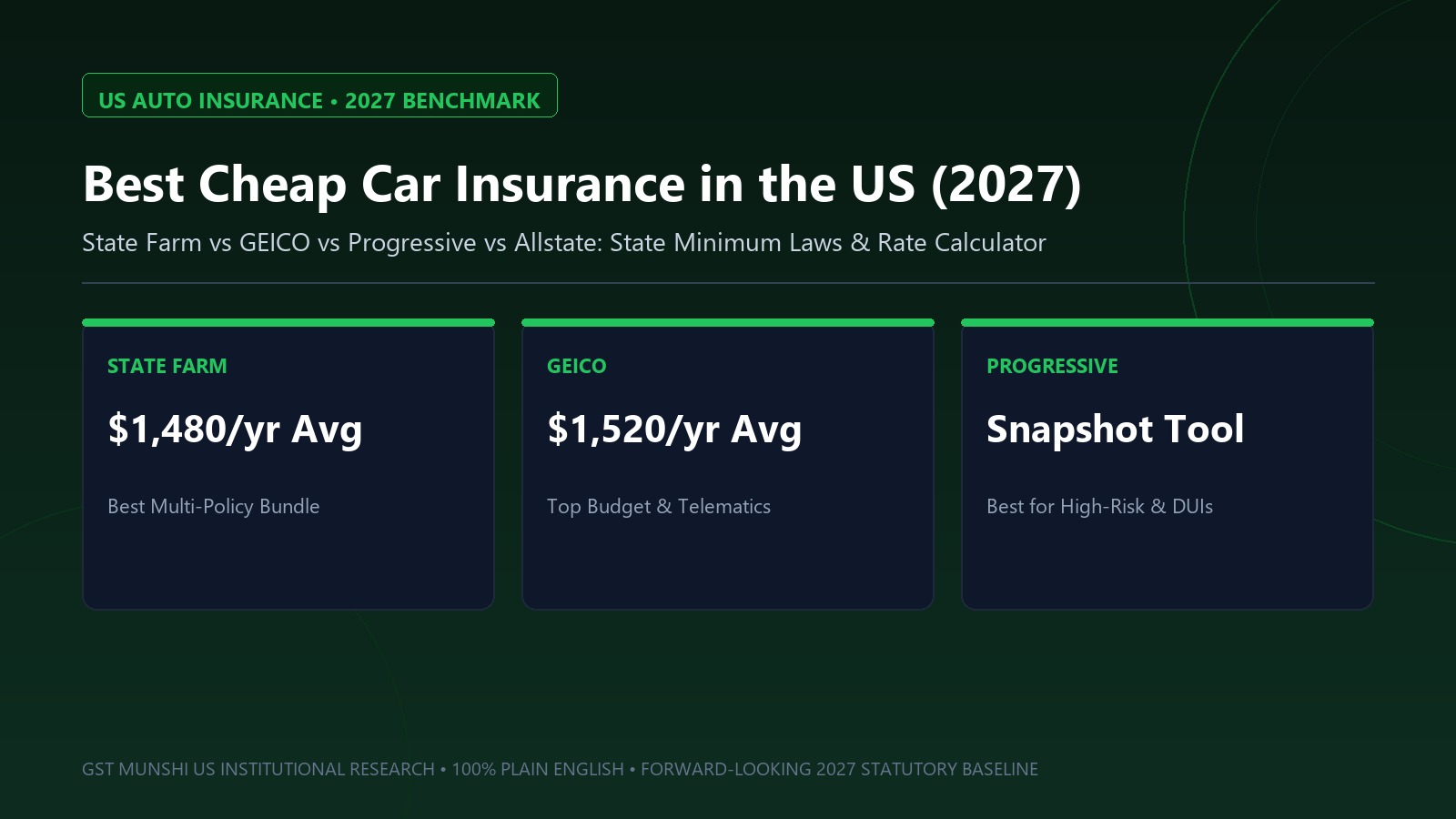
Which US auto insurance company is the cheapest and best for 2027 coverage?
Nationwide rate filing data indicates that State Farm offers the cheapest average full-coverage auto insurance for clean-record drivers at $1,480/year ($123/month), especially when bundled with home or renters insurance. GEICO ranks second at $1,520/year for budget direct shoppers, while Progressive is the most competitive for high-risk drivers, traffic violations, and telematics discounts through Snapshot. Drivers should carry at least 100/300/100 liability limits rather than bare state minimums to prevent catastrophic personal asset seizure in severe multi-vehicle collisions.
2027 US Car Insurance Premium & Carrier Quote Simulator
Adjust your state, age bracket, driving record, coverage tiers, and telematics discounts to estimate real-time annual and monthly premiums across State Farm, GEICO, Progressive, and Allstate.
1Why US Auto Insurance Rates Surged 22%+ into 2026–2027
Over the past 36 months, private passenger auto insurance premiums in the United States have accelerated at their fastest pace in four decades. According to the Bureau of Labor Statistics (BLS) Consumer Price Index (CPI) and the National Association of Insurance Commissioners (NAIC), three structural headwinds are driving loss costs: advanced vehicle technology repairs, severe convective storm weather losses, and medical inflation.
Modern bumpers no longer consist of simple stamped steel or plastic fascias; they house ultrasonic parking sensors, millimeter-wave radar modules, and forward-facing cameras requiring precise computerized recalibration after even minor 5 mph parking lot fender benders. Simultaneously, electric vehicles (EVs) carry battery packs where minor underbody intrusion frequently results in the entire $15,000–$22,000 pack being declared a total loss by insurance adjusters.
- Sensor Recalibration Overhead: Replacing and recalibrating ADAS (Advanced Driver Assistance Systems) cameras and radar modules adds $1,200–$2,800 to routine front-end collision repairs.
- Lithium-ion Battery Vulnerability: EV battery pack replacement costs exceed salvage recovery thresholds, driving up comprehensive and collision loss ratios for carriers.
- Legal System Abuse: Third-party bodily injury litigation and commercial litigation funding have inflated average bodily injury claim severities beyond $24,000 per claim.
2The Big 4 Head-to-Head: State Farm vs GEICO vs Progressive vs Allstate
The US private passenger auto insurance landscape is dominated by four enterprise underwriters that collectively control over 55% of the total national market share. Understanding each company's underwriting philosophy is essential to finding the lowest rate for your specific demographic.
State Farm operates as a policyholder-owned mutual insurer through 19,000+ captive local agents. Because it lacks public shareholders demanding quarterly margin expansion, State Farm consistently offers the lowest rates for multi-car suburban households who bundle auto with homeowners or renters policies.
GEICO (a Berkshire Hathaway subsidiary) relies on direct digital underwriting, eliminating captive agent commissions to offer low baseline rates for prime credit drivers. Progressive excels in complex risk algorithmic pricing, utilizing its proprietary Snapshot telematics database to offer aggressive rates to drivers with blemishes on their Motor Vehicle Record (MVR). Allstate positions itself as a premium service carrier with guaranteed original equipment manufacturer (OEM) replacement parts and accident forgiveness riders.
3The State Minimum Liability Trap: Why 25/50/25 is Financial Suicide
Every state except New Hampshire legally mandates drivers to carry minimum bodily injury (BI) and property damage (PD) liability coverage. However, statutory limits established decades ago have failed to keep pace with modern vehicle pricing and medical trauma costs.
For example, in states with a $25,000 property damage limit, if you cause an accident involving a modern $75,000 Ford F-150 Lightning or Cadillac Escalade, your insurance carrier pays only the $25,000 policy cap. The vehicle owner's insurer will subrogate against you personally, obtaining court-ordered wage garnishments, bank levies, or real estate liens to satisfy the remaining $50,000 judgment.
- Recommended Baseline: 100/300/100 ($100,000 bodily injury per person, $300,000 bodily injury per accident, $100,000 property damage).
- Umbrella Policy Crossover: Once your net worth exceeds $250,000 or you own a home, insurers require 250/500/100 underlying auto limits to attach a $1,000,000 personal umbrella policy for just $180–$250/year.
Big 4 US Auto Insurers: 2027 Rates, Underwriting Moats & Discounts
| Insurance Carrier | Avg Full Coverage (Annual) | Avg Monthly Cost | Best Driver Profile | Primary Discount Program |
|---|---|---|---|---|
| State Farm | $1,480 / yr | $123 / mo | Clean record & suburban homeowners bundling policies | Drive Safe & Save (Up to 30% off) + Multi-line |
| GEICO (Berkshire Hathaway) | $1,520 / yr | $126 / mo | Direct digital shoppers & good credit single drivers | DriveEasy & Federal Employee Affinity (Up to 25% off) |
| Progressive | $1,610 / yr | $134 / mo | Drivers with 1 ticket, minor at-fault accident or DUI | Snapshot Usage-Based Pricing (Avg $156 saved) |
| Allstate | $1,790 / yr | $149 / mo | Drivers wanting OEM parts & claim satisfaction guarantee | Drivewise Rewards & Early Signing (Up to 40% off) |
| USAA (Military Only) | $1,240 / yr | $103 / mo | Active duty military, veterans & immediate families | SafePilot & On-Base Vehicle Storage (Up to 35% off) |
4-Step Blueprint to Secure the Cheapest US Auto Insurance in 2027
Audit Your Current Declarations Page
Pull your existing policy declarations page. Check your bodily injury liability limits, collision/comprehensive deductibles, and whether you are paying for redundant roadside assistance or car rental reimbursements.
Gather Real-Time Quotes from Top Competitors
Request simultaneous rate quotes from State Farm, GEICO, and Progressive using identical liability limits (100/300/100) and $1,000 deductibles to establish an apples-to-apples baseline.
Activate Telematics During Low-Mileage Periods
Opt into your carrier's smartphone telematics program during months when your driving routine is calm and predictable to lock in a permanent 15%–30% policy tier reduction.
Re-Shop Every 12 Months to Avoid Loyalty Penalties
Carriers utilize algorithmic 'price optimization' to steadily inflate rates on dormant customers who do not switch. Re-quote your coverage annually to keep rates compressed.
Curated Expert Video Walkthroughs & Wall Street Briefings




Frequently Asked Questions (Verified Statutory Answers)
Q1: What is the difference between collision and comprehensive coverage?
Collision insurance pays to repair or replace your vehicle if you collide with another car, a tree, a guardrail, or experience a rollover. Comprehensive insurance covers damage caused by events beyond your driving control—including vehicle theft, vandalism, windshield stone chips, falling tree limbs, hail storms, flood water, and animal collisions (such as hitting a deer).
Q2: Will filing a windshield glass claim increase my auto insurance rates?
In most states (including Florida, Kentucky, and South Carolina with statutory zero-deductible glass laws), filing a comprehensive windshield replacement claim will not raise your insurance premium. However, repeatedly filing small comprehensive claims within a 3-year window can impact your loss history (C.L.U.E. report) and disqualify you from claims-free discounts.
Q3: Can insurance companies check my credit score to determine my car insurance rate?
Yes, in 46 states, insurance carriers use a Credit-Based Insurance Score (CBIS) to predict claim frequency. Actuarial studies show a strong statistical correlation between lower credit scores and higher claim severity. Only California (Prop 103), Hawaii, Massachusetts, and Michigan statutorily prohibit or restrict the use of credit scores in auto insurance pricing.
Q4: How does enrolling in a telematics app affect my monthly auto insurance bill?
Telematics apps (such as Progressive Snapshot, State Farm Drive Safe & Save, and GEICO DriveEasy) monitor hard braking, rapid acceleration, late-night driving (between midnight and 4:00 AM), and smartphone phone handling while in motion. Safe drivers generally earn discounts between 10% and 30%. While most programs only offer discounts, some carriers in select states can surcharge aggressive driving habits.
Curated Expert Insights & Verified Consumer Disclosures
“I see people lose their homes after car crashes every single month because they carried state minimum limits. A $15,000 bodily injury limit won't even cover an ambulance ride and 24 hours in a trauma center. Bump your liability to 100/300/100 minimum. It costs $12 more a month.”
“Insurance companies use 'Price Optimization' algorithms that analyze how likely you are to shop around. If you stay with the same carrier for 5+ years without checking competing rates, you are almost certainly paying a 15-25% loyalty surcharge.”