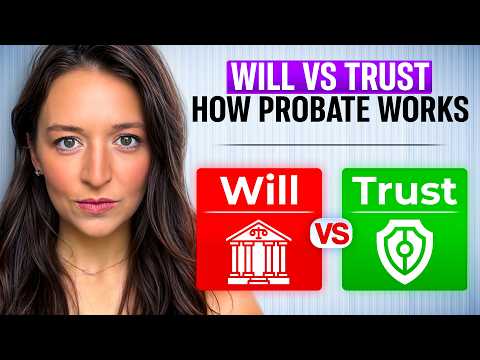
Does a Last Will and Testament avoid probate court, or do you need a Revocable Living Trust?
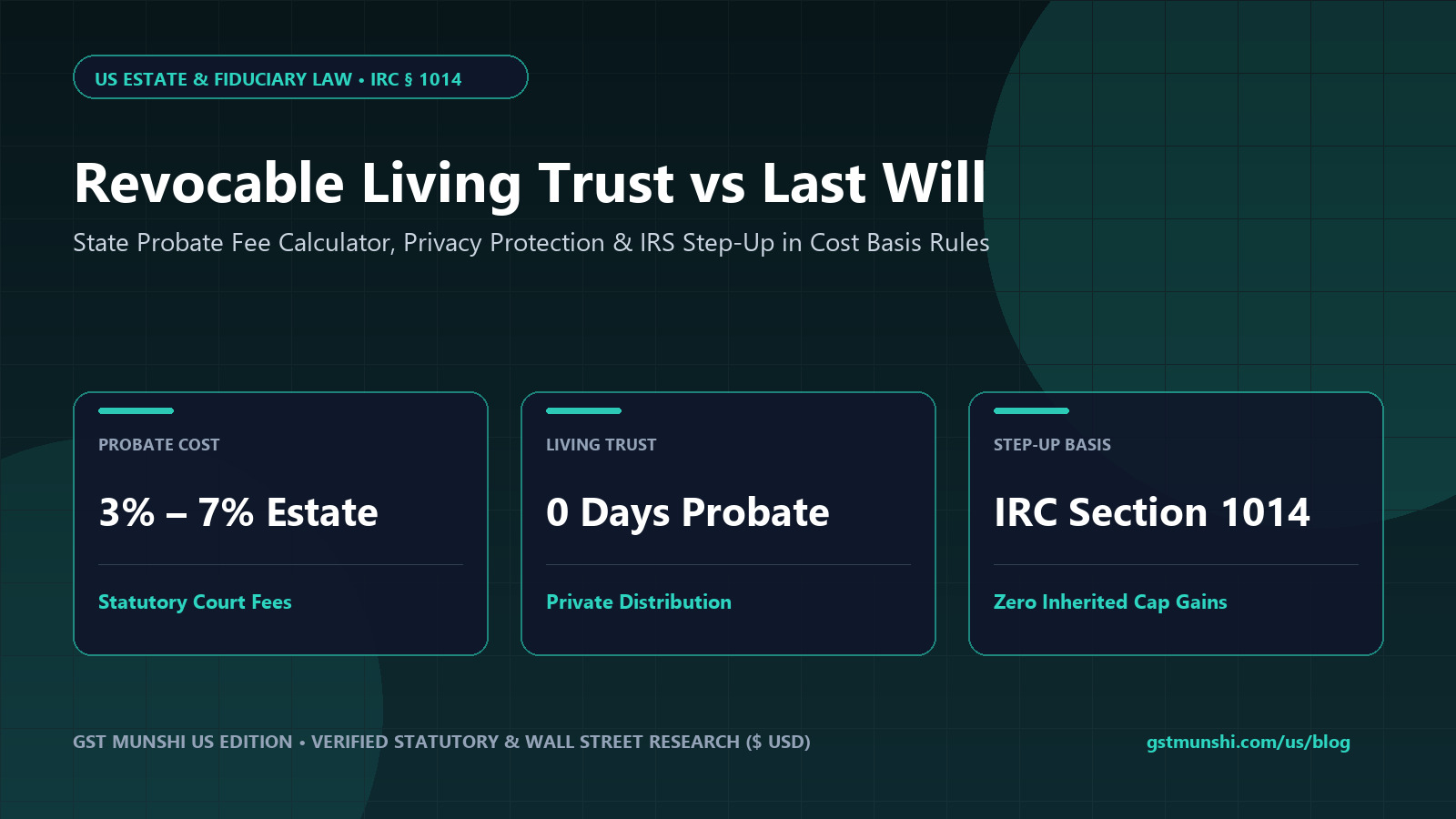
A Last Will and Testament does NOT avoid probate—a Will is simply a legal instruction letter addressed to your local county probate judge. Estates settled solely through a Will must undergo public court-supervised probate lasting 9 to 24 months and consuming 3% to 7% of the gross estate value in statutory attorney and executor fees. A properly funded Revocable Living Trust transfers real estate and financial accounts privately to beneficiaries outside of court jurisdiction while fully preserving the IRC Section 1014 step-up in cost basis.
Estimate State Probate Court Fees vs Living Trust Savings
1The Gross Estate Statutory Fee Trap (Why Mortgages Don't Reduce Probate Fees)
In states like California (Probate Code § 10810), New York, and Florida, statutory probate fees paid to attorneys and personal representatives are calculated on the GROSS appraised value of your home and assets—without subtracting your mortgage or debt.
For example, if you own a home appraised at $1,000,000 with an $800,000 mortgage (leaving only $200,000 in actual family equity), statutory probate fees are assessed on the entire $1,000,000. Under California statutory sliding scale formulas, the attorney receives $23,000 and the executor receives $23,000—draining $46,000 (nearly a quarter of your net equity) simply to pass the house to your children.
- Statutory Attorney & Executor Surcharge: 4% of first $100K, 3% of next $100K, 2% of next $800K, and 1% of next $9M.
- Court Record Vulnerability: Wills filed in probate court become public record; anyone, including predatory solicitors and estranged relatives, can pull copies of your estate inventory.
- Multi-State Ancillary Probate: If you own real estate in more than one state (e.g., a primary home in Illinois and a vacation condo in Florida), your family must open separate, expensive probate proceedings in each state.
2Celebrity Estate Lessons: How Dolly Parton, Prince & Aretha Franklin Shaped Modern Trust Law
Celebrity estate battles underscore why high-profile figures and everyday families alike rely on living trusts. When Prince died without a Will or trust (intestate) in 2016, his estimated $156 million estate endured six years of contentious court battles, generating tens of millions in legal fees and public family feuds.
Similarly, Aretha Franklin left handwritten notes in couch cushions, resulting in five years of litigation before a jury determined her intent. In contrast, legendary artist Dolly Parton structured her multi-million dollar music catalog, brand rights, and real estate holdings through ironclad private trusts and corporate holding entities—ensuring seamless asset continuity, private royalty distribution, and complete avoidance of public probate spectacle.
- Prince's Intestacy Warning: Dying without an estate plan leaves asset distribution entirely to rigid state statutory intestacy formulas.
- Aretha Franklin's Holographic Will Disaster: Handwritten wills generate immense ambiguity and invitation for courtroom challenges.
- Dolly Parton's Intellectual Property Architecture: Royalty rights, music publishing copyrights, and real estate placed into trusts flow without a single day of court intervention.
3Trust Funding Blueprint: Retitling Deeds & Accounts Without Due-on-Sale Triggers
The number-one failure in estate planning is the 'empty trust syndrome'—paying an attorney thousands of dollars to draft a binder of trust documents, but failing to actually transfer title of assets into the trust. If a home remains titled in your individual name at death, it must still go through probate, regardless of what your trust paperwork says.
To properly fund your trust, record a Grant Deed or Quitclaim Deed with your county recorder transferring your real property to yourself as Trustee (e.g., 'Jane Doe, Trustee of the Jane Doe Revocable Living Trust dated October 15, 2026'). Homeowners often fear this will trigger their mortgage's due-on-sale clause; however, the federal Garn-St. Germain Depository Institutions Act of 1982 strictly protects this transfer.
- Garn-St. Germain Act Protection (12 U.S.C. § 1701j-3(d)(8)): Lenders are legally prohibited from accelerating residential mortgage notes when transferring property into a borrower-occupied living trust.
- Bank & Brokerage Retitling: Move non-retirement brokerage accounts and high-yield savings accounts into trust title; contact your brokerage to submit a standard trust certification form.
- Retirement Accounts & Life Insurance: Do NOT transfer ownership of traditional IRAs or 401(k)s to a trust during life (which triggers immediate income taxation); instead, update beneficiary forms naming your spouse as primary and trust or children as contingent.
42026–2027 Federal Unified Estate Tax Exemption & Wealth Transfer Strategies
Under the federal Tax Cuts and Jobs Act (TCJA), the federal lifetime estate and gift tax exemption was temporarily doubled (exceeding $13.6 million per individual and $27.2 million for married couples). As provisions sunset entering 2026 and 2027, the baseline exemption is scheduled to revert to approximately $7 million per individual (adjusted for inflation) unless extended by Congress.
For families with combined net worths (including life insurance death benefits, appreciated primary homes, and retirement accounts) in excess of $7 million, establishing Credit Shelter Trusts (Bypass Trusts), Spousal Lifetime Access Trusts (SLATs), or Irrevocable Life Insurance Trusts (ILITs) is critical to shelter generational wealth from the 40% top federal estate tax bracket.
- Step-Up in Basis (IRC § 1014): Preserved 100% inside revocable living trusts; your heirs receive a new tax basis equal to fair market value on your date of death, completely wiping out lifetime capital gains.
- Portability Election (IRS Form 706): Even if an estate is below the tax threshold, filing Form 706 within 9 months allows a surviving spouse to port any unused estate tax exemption (DSUE).
- Durable Financial POA & Healthcare Directives: Living trusts govern your assets; companion durable financial powers of attorney and advance healthcare directives protect your person and medical decisions during incapacity.
Revocable Living Trust vs Last Will and Testament vs TOD/POD Beneficiaries
| Dimension | Revocable Living Trust | Last Will and Testament | TOD / POD Beneficiary Designations |
|---|---|---|---|
| Avoids Probate Court? | Yes (100% Private Settlement) | No (Mandatory Court Probate) | Yes (For Specific Designated Accounts) |
| Public vs Private Record | Strictly Private Document | Public Court Filing (Anyone Can View) | Private Financial Records |
| Incapacity Protection | Successor Trustee Steps in Seamlessly | Requires Costly Court Conservatorship | None (Only Triggers Upon Death) |
| IRC § 1014 Step-Up in Basis | Yes (Full Fair Market Value Step-Up) | Yes (Full Fair Market Value Step-Up) | Yes (Full Fair Market Value Step-Up) |
| Real Estate Across Multiple States | Single Trust Covers All States | Triggers Multi-State Ancillary Probate | Requires Separate Transfer-on-Death Deeds |
| Typical Setup Cost | $1,500 – $3,500 (Comprehensive Package) | $300 – $1,000 (Simple Will Only) | $0 (Free Bank / Brokerage Beneficiary Forms) |
4-Step Complete US Estate Plan Architecture
Execute a Revocable Living Trust + Companion Pour-Over Will
Your Revocable Living Trust acts as the master wealth vessel, while a companion Pour-Over Will catches any inadvertently omitted personal property at death and pours it into the trust.
Record a Deed to Fund Your Real Property Immediately
Execute and record a Grant Deed or Quitclaim Deed with your county clerk transferring title from your individual name to yourself as Trustee of your Revocable Living Trust.
Coordinate 401(k), IRA & Life Insurance Beneficiary Designations
Retirement assets pass outside probate via direct contractual beneficiary designation. Name primary and contingent beneficiaries in strict coordination with your trust distribution terms.
Execute Durable Financial POA & HIPAA Advance Healthcare Directives
Ensure comprehensive incapacity coverage by naming a trusted agent under a Durable Power of Attorney for financial matters and appointing a Healthcare Proxy with HIPAA release authorizations.
Curated Expert Video Walkthroughs & Wall Street Briefings


Frequently Asked Questions (Verified Statutory Answers)
Q1: Does transferring my house into a Revocable Living Trust trigger my mortgage's due-on-sale clause?
No. Under the federal Garn-St. Germain Depository Institutions Act of 1982 (12 U.S.C. § 1701j-3(d)(8)), mortgage lenders are prohibited from enforcing a due-on-sale clause when a borrower transfers residential property (1–4 units) into an inter vivos (living) trust in which the borrower remains a beneficiary and occupant.
Q2: Do I need a separate tax ID (EIN) to file taxes for my Revocable Living Trust while I am alive?
No. While you (the grantor) are alive and have capacity, a Revocable Living Trust is a 'grantor trust' disregarded by the IRS under IRC §§ 671–679. It uses your personal Social Security Number (SSN), and all income is reported on your standard Form 1040.
Q3: Can a disgruntled relative contest a Revocable Living Trust the same way they contest a Will?
Contesting a Revocable Living Trust is substantially harder than challenging a Will. Because a trust operates privately without an open court hearing and has often been actively managed by the grantor for years or decades, proving lack of mental capacity or undue influence faces a much higher evidentiary bar under state trust codes.
Q4: How does a living trust preserve the IRC Section 1014 step-up in basis?
Because you retain complete revocable control over the trust during your lifetime, the IRS considers all trust assets part of your gross estate under IRC § 2036 and § 2038. Consequently, when you pass away, the assets qualify for a full step-up in basis to fair market value on your date of death under IRC § 1014, completely eliminating capital gains taxes on prior appreciation.