
How is a Powerball jackpot payout calculated after federal and state income taxes, and which option pays more?
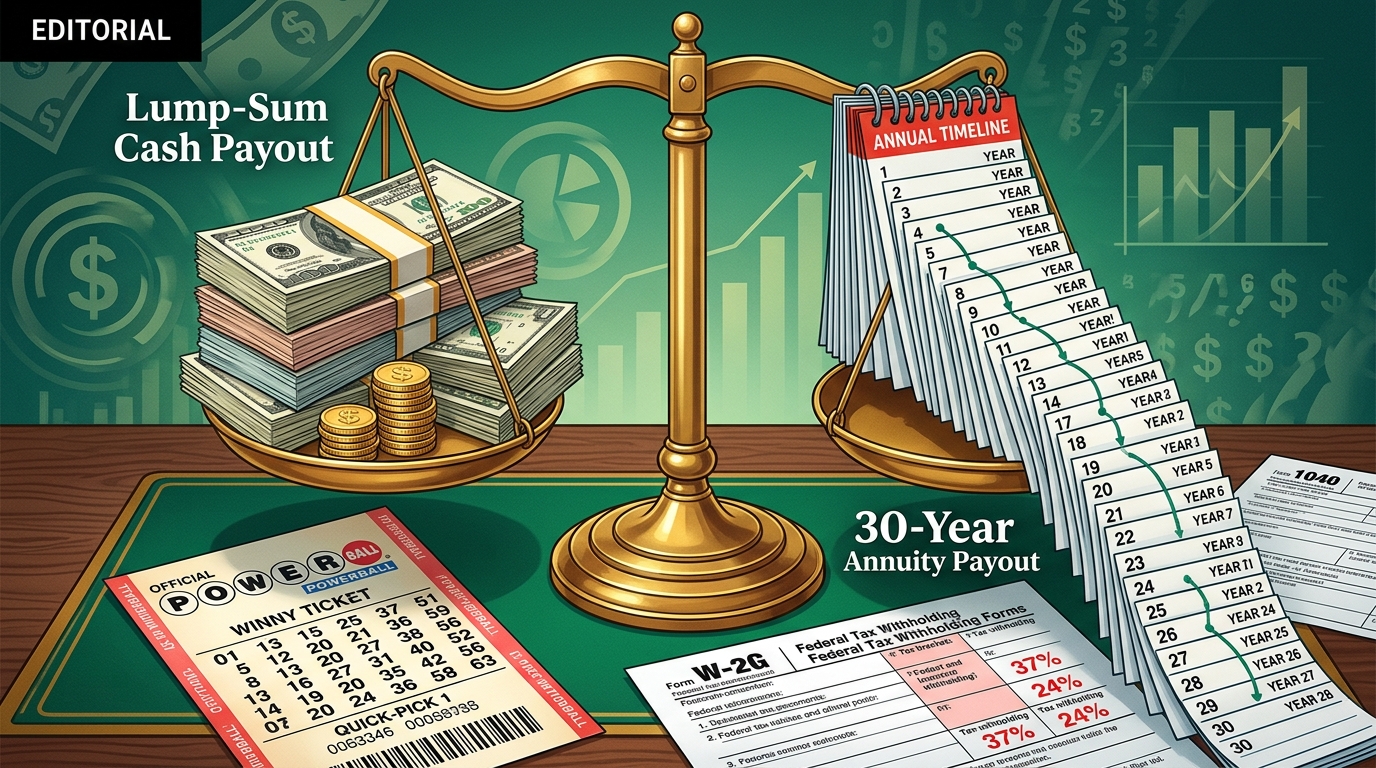
When claiming a Powerball jackpot, winners choose between a lump-sum cash option (typically 48% to 51% of the advertised jackpot) or a 30-year graduated annuity comprising 30 annual payments increasing by 5% each year. The IRS mandates an upfront 24% federal tax withholding on winnings over $5,000, but because multi-million dollar windfalls place winners in the top 37% federal income tax bracket, an additional 13% is owed at tax filing. State income taxes range from 0% (in states like Texas, Florida, and California) up to 10.9% in New York, yielding an effective total tax bite of roughly 37% to 51%.
Powerball Payout Calculator: Cash Lump Sum vs 30-Year Annuity
Enter the advertised Powerball jackpot amount and select your state of residence to calculate gross cash value, mandatory 24% IRS withholding, 37% top bracket federal tax, and net cash in hand.
Lottery commissions only withhold 24% for federal taxes upfront. However, because multi-million dollar winnings instantly push you into the highest 37% federal income tax bracket, you will owe an additional 13% (approx $41,827,500) when you file your Form 1040 the following April!
1Cash Option vs 30-Year Graduated Annuity: Mathematical Mechanics
The headline numbers displayed on lottery billboards and news chyrons represent the 30-year annuity total, not the actual cash sitting in the lottery commission's vault. When you purchase a $2 Powerball ticket, you are competing for an annuity structure funded by US Treasury bonds and government agency securities.
If a winner selects the cash lump sum option, the lottery commission liquidates the underlying bond portfolio, paying out the current fair market cash present value. Historically, this cash value equals roughly 48% to 52% of the advertised jackpot, depending on prevailing interest rates set by the Federal Reserve. When interest rates are higher, bond yields rise, which causes the present cash value to represent a somewhat smaller percentage of the long-term annuity total.
Conversely, the annuity option consists of 30 payments distributed over 29 years (one immediate payment followed by 29 annual installments). Each annual payment increases by 5% compounded annually. For example, on an advertised $1 billion annuity, the first payment is approximately $15 million, while the final payment in Year 30 exceeds $62 million, helping preserve purchasing power against long-term inflation.
- Cash Lump Sum Advantage: Immediate capital liquidity, complete investment autonomy, and protection against future state tax increases.
- Annuity Advantage: Guaranteed creditor protection in many jurisdictions, disciplined spend-rate ceiling, and immunity to early portfolio misallocation.
- Estate Tax Caveat: If an annuity winner passes away before all 30 payments are disbursed, the remaining payments transfer directly to named heirs.
2The Federal Tax Withholding Gap: Why Winners Owe Millions More in April
One of the most dangerous financial pitfalls confronting newly minted lottery winners is the discrepancy between mandatory federal withholding and actual federal tax liability under the Internal Revenue Code. Under IRC Section 3402(q), state lottery commissions are legally required to withhold exactly 24% of proceeds exceeding $5,000 for US citizens with valid Social Security Numbers.
However, the highest federal individual income tax bracket under the Internal Revenue Code is 37%, applicable to taxable income exceeding $609,350 for single filers and $731,200 for married couples filing jointly. Because any substantial Powerball cash payout easily dwarfs these thresholds, the winner's entire windfall—minus minor standard or itemized deductions—is taxed at the full 37% rate.
This dynamic creates an immediate 13% tax shortfall. On a $200 million cash lump sum, the lottery commission withholds $48 million (24%), but the IRS will assess total federal taxes of $74 million (37%). If the winner fails to reserve the additional $26 million in liquid short-term Treasury bills, they will face severe underpayment penalties and catastrophic tax liens when filing Form 1040 the following April.
3State Income Taxes on Lottery Winnings: Where You Live Determines What You Keep
State taxation introduces massive geographic disparities in net lottery take-home pay. State tax rates on gambling windfalls range from zero percent to over ten percent, creating swing differences of tens of millions of dollars on a single jackpot ticket.
Eight states impose zero state income tax on lottery winnings: California, Florida, Texas, Washington, Tennessee, Wyoming, Nevada, and South Dakota. In California, state statutes explicitly exempt California State Lottery winnings from state income tax, even though California maintains the highest individual income tax bracket in the nation for ordinary wage earnings.
At the opposite extreme, winners in New York State face an initial 10.9% state tax withholding, with New York City residents subject to an additional 3.876% local municipal surcharge, pushing the combined local tax burden to 14.776%. Other high-tax jurisdictions include New Jersey (10.75%), the District of Columbia (10.75%), Maryland (8.95%), and Oregon (9.9%).
4Protecting the Windfall: Blind Trusts, Anonymity Laws, and Financial Architecture
Before presenting a signed winning ticket to state lottery officials, winners must assemble an experienced financial triumvirate: a fiduciary wealth manager, an estate planning attorney specializing in wealth preservation, and a certified public accountant (CPA).
Public disclosure laws vary dramatically by state. Approximately twenty states permit lottery winners to remain anonymous or claim their prize through a revocable living trust or limited liability company (LLC). States like Delaware, Kansas, Maryland, Ohio, and Texas allow complete anonymity. In states where winner names are public record under Freedom of Information statutes (such as California), establishing a blind trust allows a designated trustee to represent the winner at public press conferences.
Immediate post-win protocols include placing the original paper ticket in a bank safe deposit box, disabling all public social media accounts, securing unlisted telephone communications, and establishing multi-million dollar umbrella liability insurance coverage to protect against frivolous litigation.
Net Powerball Payout Comparison Across Key States ($500 Million Jackpot Example)
| State Jurisdiction | Gross Cash Option | Federal Tax (37%) | State Lottery Tax | Net Take-Home Cash | Effective Tax Bite |
|---|---|---|---|---|---|
| California / Texas / Florida | $247,500,000 | $91,575,000 | $0 (0.00%) | $155,925,000 | 37.0% |
| Pennsylvania | $247,500,000 | $91,575,000 | $7,598,250 (3.07%) | $148,326,750 | 40.1% |
| Massachusetts | $247,500,000 | $91,575,000 | $12,375,000 (5.00%) | $143,550,000 | 42.0% |
| Maryland | $247,500,000 | $91,575,000 | $22,151,250 (8.95%) | $133,773,750 | 46.0% |
| New Jersey | $247,500,000 | $91,575,000 | $26,606,250 (10.75%) | $129,318,750 | 47.8% |
| New York (NYC Resident) | $247,500,000 | $91,575,000 | $36,570,600 (14.78%) | $119,354,400 | 51.8% |
4-Step Blueprint for Handling a Winning Powerball Ticket
Sign and Secure the Original Ticket
Sign the back of the physical paper ticket immediately in blue ink to establish legal ownership, photograph both sides alongside government ID, and lock it in a secure bank deposit vault.
Assemble Fiduciary Legal & CPA Representation
Retain a fiduciary wealth advisor, estate attorney, and tax CPA before contacting the lottery commission. Never announce your win to friends, coworkers, or social media networks.
Establish Legal Entity & Trust for Prize Claiming
Determine whether your state allows prize redemption via a revocable blind trust or LLC to preserve personal privacy, protect residential addresses, and minimize predatory solicitations.
Reserve the 13% Federal Tax Shortfall Immediately
Immediately isolate the 13% difference between the mandatory 24% upfront withholding and the 37% top bracket into short-term US Treasury bills to satisfy April tax liabilities.
Curated Expert Video Walkthroughs & Wall Street Briefings
Frequently Asked Questions (Verified Statutory Answers)
Q1: Why is the cash lump sum so much lower than the advertised jackpot?
The advertised jackpot represents the total sum of 30 graduated annual payments funded by government bonds over 29 years. The cash option represents the actual present cash value required today to purchase those bonds. Depending on prevailing bond yields, the cash option is approximately 48% to 52% of the advertised annuity total.
Q2: How much tax does the IRS take upfront from a Powerball prize?
Under federal law (IRC Section 3402(q)), the state lottery commission automatically withholds 24% from any lottery prize exceeding $5,000 for US citizens with valid Social Security Numbers. For non-resident aliens, the mandatory federal withholding rate is 30%.
Q3: Will I owe additional federal taxes beyond the 24% withholding?
Yes. Any substantial lottery prize places you in the highest federal individual income tax bracket of 37%. Because only 24% was withheld upfront, you are legally responsible for paying the remaining 13% tax difference when you file your federal income tax return the following April.
Q4: Which US states do not tax Powerball lottery winnings?
Eight states charge zero state income tax on lottery winnings: California, Florida, Texas, Washington, Tennessee, Wyoming, Nevada, and South Dakota. California law specifically exempts California State Lottery prizes from state income taxation.
Q5: Can I remain anonymous if I win the Powerball jackpot?
It depends on state law. Around twenty states allow winners to remain anonymous or claim through a blind trust or LLC. States allowing anonymity include Delaware, Kansas, Maryland, Mississippi, Montana, New Jersey, North Dakota, Ohio, South Carolina, and Texas. In other states like California, winner names are public record.
Q6: What happens if a lottery winner dies while receiving the 30-year annuity?
If an annuity recipient passes away before receiving all 30 payments, the remaining scheduled installments become part of the winner's estate and transfer directly to their designated beneficiaries or heirs. The lottery commission does not keep unpaid annuity installments.
Q7: Should I choose the lump sum or the 30-year annuity?
Mathematically, disciplined investors often choose the lump sum because historical market index returns (S&P 500 averaging ~10% nominal annual return) outpace the ~5% implied growth of lottery annuities. However, individuals concerned about financial self-discipline or predator solicitations often benefit from the guaranteed annual income shield of the annuity.
Q8: Can I sell my lottery annuity payments for a lump sum later?
Yes, structured settlement purchasing companies buy future annuity rights in exchange for immediate cash. However, these secondary market transactions typically apply aggressive discount rates (often 8% to 15%+), resulting in significant losses compared to selecting the initial cash option.
Q9: Are lottery ticket purchases tax-deductible?
You can only deduct the cost of losing lottery tickets as an itemized deduction on Schedule A (Form 1040) up to the exact amount of your reported gambling winnings. You cannot deduct lottery ticket losses if you take the standard deduction, nor can losses exceed total gambling gains.
Q10: How long do I have to claim a winning Powerball ticket?
Claim deadlines vary by jurisdiction, ranging from 90 days to one full year (365 days) from the drawing date. In most states, winners have 180 days to claim, with an earlier 60-day window required in certain states to elect the cash lump sum option rather than default to annuity.


Verified X (Twitter) & LinkedIn Expert Insights
“The biggest shock for lottery winners isn't the 24% IRS cut—it's the additional 13% due the next year. On a $300M cash payout, you will owe an extra $39,000,000 check to Uncle Sam in April. If you spent it or locked it into illiquid real estate, you face immediate IRS seizure.”
“If you win Powerball in a state that permits trust redemption, never sign the ticket in your personal name before legal consultation. A blind trust structure protects your home address, family safety, and shields you from professional scammers.”