What does a Flash Flood Warning mean and what immediate actions should you take?
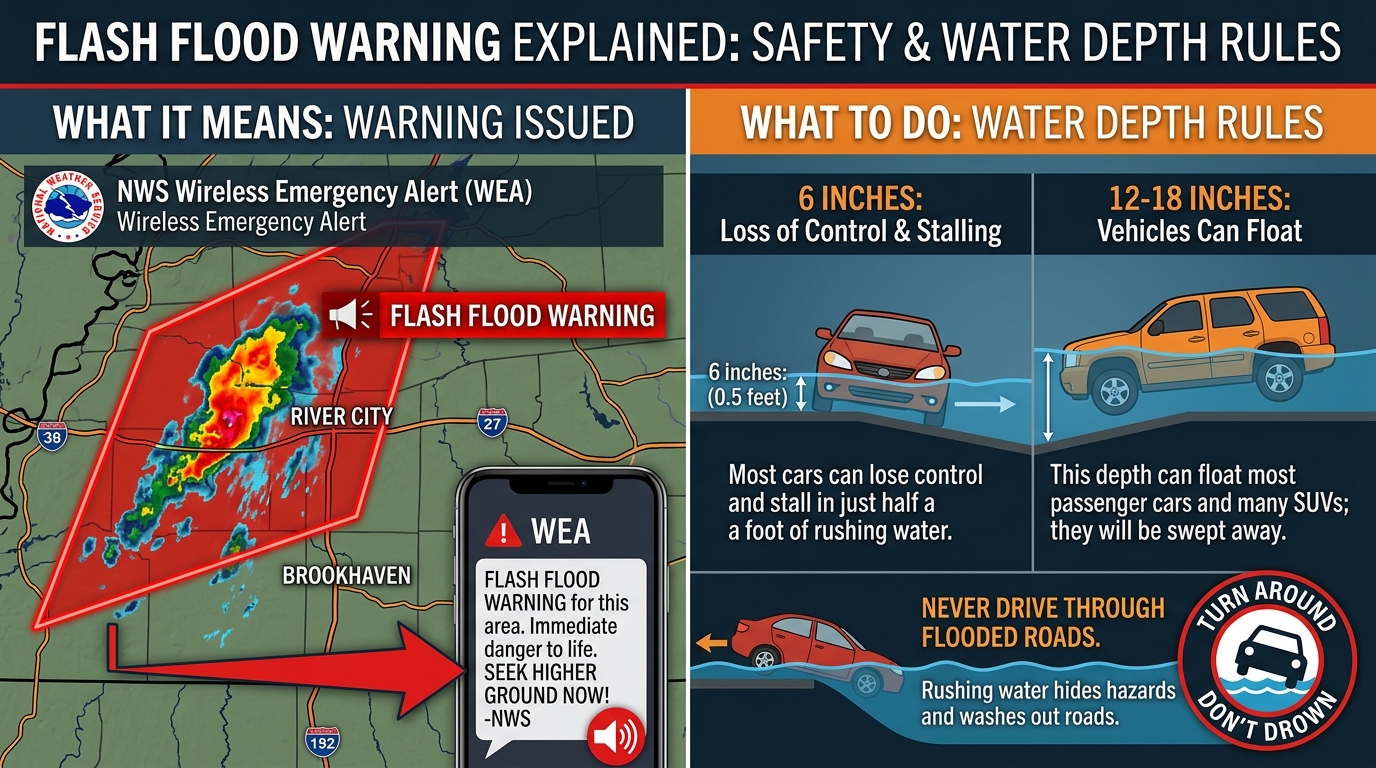
A Flash Flood Warning issued by the National Weather Service means rapid, life-threatening flooding is already occurring or will begin within minutes to under 6 hours due to torrential rainfall, dam failure, or levee breach. If you are in a low-lying area, basement, or floodplain, move immediately to higher ground and never drive into flooded roadways.
Interactive Weather Watch vs. Warning Decoder & Flood Water Vehicle Buoyancy Tool
1What Makes a 'Flash' Flood Different From a Standard River Flood Warning?
In National Weather Service (NWS) hydrology, the distinction between a **Flash Flood Warning** and a standard **Flood Warning** comes down to onset speed and hydraulic force. A Flash Flood Warning is issued when intense rainfall (typically 2 to 5+ inches per hour from training thunderstorms, tropical remnants, or atmospheric rivers), an ice jam break, or a structural dam/levee failure causes water levels in creeks, urban storm drains, canyons, and streets to surge dangerously within minutes up to 6 hours of the causative event.
By contrast, an Areal Flood Warning or River Flood Warning covers gradual, prolonged rises along mainstem rivers (such as the Mississippi, Ohio, or Missouri Rivers) that develop over 12 hours to several weeks and are forecast using United States Geological Survey (USGS) streamgauge hydrographs.
Urbanization dramatically accelerates flash flood physics. Whereas natural forest or prairie soil absorbs a significant fraction of initial rainfall, impervious asphalt parking lots, concrete highways, and compacted suburban developments force 85% to 95% of torrential rainfall directly into storm sewers. When rainfall rates exceed local drainage capacity (often just 1.5 to 2 inches in 60 minutes), highway underpasses and subterranean basements transform into violent hydraulic traps within 10 to 15 minutes.
- Base Flash Flood Warning: Issued for localized urban street flooding, small stream overflows, and low-water crossings; does NOT trigger loud phone WEA alarms.
- Considerable Flash Flood Warning: Issued when high-velocity water threatens homes, businesses, and major highways; triggers smartphone WEA alerts.
- Flash Flood Emergency (Catastrophic Tag): The highest NWS alert level, reserved for exceedingly rare, life-threatening deluges where water is entering homes and swift-water rescues are underway.
2Hydrodynamic Physics: Why 12 Inches of Water Sweeps Away a 4,000-Pound Vehicle
Many drivers underestimate flooded roadways because they assume a heavy SUV or four-wheel-drive pickup truck will maintain tire traction on the pavement beneath the water. Fluid mechanics proves why this assumption is fatal. According to Archimedes' principle of buoyancy, water weighs 62.4 pounds per cubic foot. Every foot of water depth displaced by the sealed undercarriage and wheel wells of a standard automobile generates roughly 1,500 pounds of upward buoyant lift.
Once water reaches 12 inches (one foot) up the side of a passenger sedan—or 18 to 24 inches on a full-size SUV or pickup—the vehicle loses effective downward normal force on the asphalt. Simultaneously, flowing water moving at just 6 to 10 mph exerts hundreds of pounds of lateral hydrodynamic drag against the broad side surface area of the doors and chassis. With zero tire friction left to resist the lateral current, the vehicle acts like an unsteerable boat and is pushed off the roadway into deeper drainage channels.
Even worse, murky floodwater hides washed-out culverts and collapsed bridge approaches. What looks like 6 inches of water pooling over a road dip is frequently a 6-foot-deep sinkhole where the roadbed has already been scoured away by the current.
3Does Auto & Homeowners Insurance Cover Flash Flood Damage?
Financial recovery after a flash flood depends entirely on which insurance policies you carried prior to the storm. If your car, SUV, or truck is inundated in a parking lot, driveway, or street during a flash flood, the repair or total-loss payout is covered **only if you carry Optional Comprehensive Coverage** on your auto insurance policy. Liability-only or Collision-only auto policies pay $0 for floodwater engine hydrolock or electrical total loss.
For residential structures, standard HO-3 and HO-5 homeowners insurance policies **strictly exclude surface flash flooding**, creek overflow, and mudslides. Covering structural framing, drywall, HVAC equipment, and personal contents against flash flooding requires a separate FEMA National Flood Insurance Program (NFIP) policy (up to $250,000 building / $100,000 contents) or a private flood insurance policy. Over 38% of all NFIP flood claims occur in 'Low-to-Moderate Risk' Zone X neighborhoods outside mandatory 100-year FEMA floodplains.
NWS Impact-Based Flash Flood Warning Tiers & Water Depth Danger Chart
| NWS Alert Tier / Water Depth | Triggers Phone WEA Alarm? | Hydrodynamic & Property Impact | Mandatory Immediate Action |
|---|---|---|---|
| Flood Watch / Flash Flood Watch | No | Atmospheric moisture & terrain favor flooding within 6–36 hours | Clear storm drains, charge power banks, move valuables upstairs |
| Flash Flood Warning (Base Tag) | No (Weather Apps / NOAA Radio Only) | 6–12 in. water on streets, creeks, and underpasses | Avoid low-water crossings; do not walk through flowing water |
| Flash Flood Warning (Considerable) | Yes (90 dB WEA Tone) | 12–24 in. fast-moving water floating sedans & flooding first floors | Evacuate basements & ground-floor units immediately |
| Flash Flood Emergency (Catastrophic) | Yes (Highest Priority WEA) | 24+ in. violent current sweeping SUVs & submerging rooftops | Move to highest floor immediately; never enter a closed attic without roof exit |
4-Step Emergency Survival Checklist During a Flash Flood Warning
Evacuate Basements & Subterranean Parking Garages Immediately
Basement apartments and underground garages fill rapidly and water pressure can jam inward-swinging doors shut. Move to an upper floor as soon as a Flash Flood Warning sounds.
Never Drive Around Barricades ('Turn Around, Don't Drown')
If you encounter standing or moving water across a roadway where you cannot clearly see the painted lane markings on the pavement, reverse or turn around immediately.
If Trapped in a Stalling Car in Rising Water, Exit via the Window Immediately
Do not wait for the car to sink; outside water pressure will prevent doors from opening. Roll down or break the side window immediately and climb onto the roof or move to high ground.
Never Climb Into a Closed Attic Without a Roof Escape Tool
If extreme floodwaters rise inside your home, only retreat to the attic if it has a large dormer window or you carry an axe/crowbar to break through to the roof.
Curated Expert Video Walkthroughs & Wall Street Briefings


Frequently Asked Questions (Verified Statutory Answers)
Q1: What is the difference between a Flash Flood Watch and a Flash Flood Warning?
A Flash Flood Watch means weather conditions are favorable for flash flooding to develop over the next 6 to 36 hours (be prepared). A Flash Flood Warning means flash flooding is already happening or imminent within minutes (take immediate action to reach higher ground).
Q2: How many inches of water does it take to float a car?
According to the National Weather Service, just 12 inches (1 foot) of moving water will float most passenger cars, and 18 to 24 inches of rushing water will sweep away large SUVs, vans, and pickup trucks.
Q3: Why did my phone buzz with a 'Flash Flood Emergency' alert?
A Flash Flood Emergency is the highest, rarest tier of NWS Impact-Based Flash Flood Warnings. It is issued only during catastrophic, life-threatening flooding when deep water is actively inundating homes and businesses.
Q4: Does car insurance cover a flooded engine if I drive into a puddle?
If you carry Comprehensive coverage on your auto insurance policy, flood damage (including engine hydrolock) is generally covered minus your deductible. Liability-only and Collision-only policies do not cover floodwater damage.