What are the exact wind speeds and damage risks for Hurricane Categories 1 through 5?
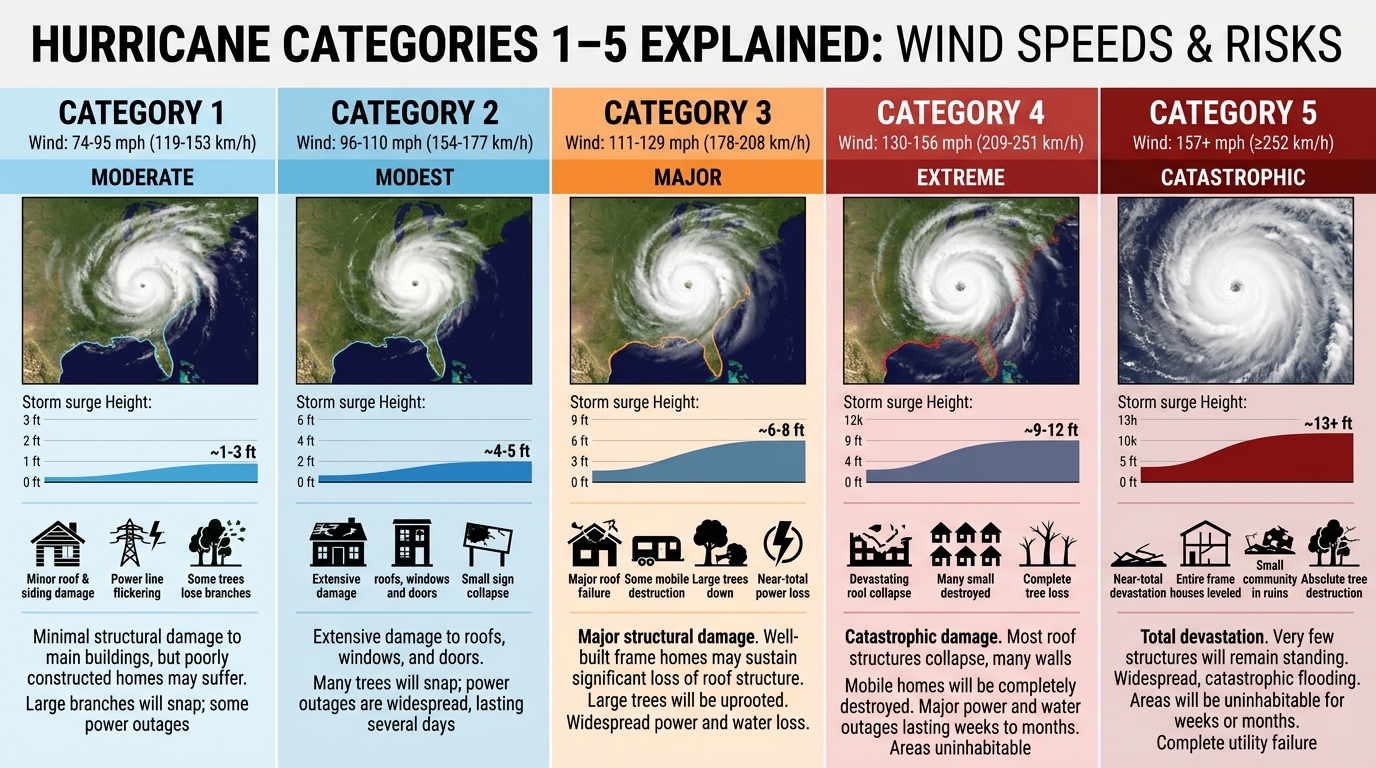
The Saffir-Simpson Hurricane Wind Scale classifies hurricanes into Categories 1 through 5 based strictly on 1-minute maximum sustained wind speeds: Category 1 (74–95 mph), Category 2 (96–110 mph), Category 3 Major (111–129 mph), Category 4 Major (130–156 mph), and Category 5 Major (157+ mph). Because wind force scales exponentially, a Category 4 storm exerts roughly 4 times the structural destructive force of a Category 1 storm.
Interactive Hurricane Categories 1–5 Wind Speed, Storm Surge & Deductible Analyzer
1Saffir-Simpson Hurricane Wind Scale: Categories 1 to 5 Breakdown
Developed in 1971 by civil engineer Herbert Saffir and National Hurricane Center (NHC) director Robert Simpson, the Saffir-Simpson Hurricane Wind Scale is the official benchmark used across the Atlantic and Northeast Pacific basins to estimate potential property damage from sustained tropical cyclone winds. In operational NHC advisories, 'sustained wind' is strictly defined as the 1-minute average wind speed measured at a standard meteorological height of 10 meters (33 feet) above unobstructed terrain or open water.
Peak 3-second wind gusts inside hurricane eyewalls and convective rainbands typically run 20% to 30% higher than the sustained wind rating. Furthermore, wind pressure on vertical walls and roof overhangs increases with the square of wind velocity ($P = 0.00256 \times V^2$ in pounds per square foot), while total kinetic destructive power scales with the cube of wind speed. Consequently, an increase from a 75 mph Category 1 hurricane to a 150 mph Category 4 hurricane does not merely double the wind hazard—it quadruples aerodynamic uplift pressure on roofs and multiplies destructive energy eightfold.
Hurricanes reaching Category 3, 4, or 5 (sustained winds of 111 mph or higher) are officially designated by the NHC as 'Major Hurricanes'. While Major Hurricanes account for only about 20% to 25% of all US landfalling tropical systems, historical NCEI Billion-Dollar Disaster records show they are responsible for over 82% of all hurricane-related economic and insured property damage in the United States.
- Tropical Depression (<39 mph) & Tropical Storm (39–73 mph): Named once winds reach 39 mph; capable of catastrophic inland flash flooding despite sub-hurricane winds.
- Category 1 (74–95 mph) & Category 2 (96–110 mph): Shingle, siding, gutter, and tree-fall damage; extensive power outages lasting several days to two weeks.
- Category 3 (111–129 mph): Devastating damage; gable-end roofs fail on older homes, uprooted trees block highways, water and electricity unavailable for weeks.
- Category 4 (130–156 mph) & Category 5 (157+ mph): Catastrophic damage; complete roof structure and wall collapse on many residences, uninhabitable zones for months.
2Why Category Number Alone Can Mislead: Storm Surge & Freshwater Flooding
Prior to 2010, public versions of the Saffir-Simpson table included estimated storm surge ranges (such as 4–5 feet for Category 1 and 18+ feet for Category 5). However, following Hurricane Katrina (2005)—which made Gulf Coast landfall as a Category 3 wind storm yet generated a historic 28-foot storm surge along the Mississippi coast due to its massive Category 5 offshore wind field—and Hurricane Ike (2008), which produced a 15-to-20 foot surge in Texas as a Category 2 hurricane, the NHC officially decoupled storm surge from the wind scale.
Storm surge height depends on at least six variables beyond peak wind speed: the total radius of hurricane-force and tropical-storm-force winds, forward speed of motion, angle of approach to the coast, nearshore bathymetry (shallow continental shelves like Tampa Bay, Southwest Florida, and the Louisiana-Mississippi Bight pile up far higher surge than steep offshore shelves like southeastern Florida), and astronomical tide timing.
Similarly, inland freshwater rainfall depends on forward translation speed rather than wind category. Tropical Storm Allison (2001) and Hurricane Harvey (2017) stalled over southeastern Texas, dropping 40 to 60 inches of rain and causing tens of billions of dollars in uninsured flood losses across neighborhoods miles inland from any coastal surge zone.
3Coastal Hurricane Deductibles (2%–5%) vs. Flood Insurance Exclusions
For coastal homeowners from Texas through Florida, the Carolinas, New York, and New England, understanding how hurricane categories interact with property insurance is essential. In 19 coastal states plus Washington, D.C., insurers enforce separate 'Named Storm' or 'Hurricane' percentage deductibles ranging from 1% to 5% (and up to 10% in high-risk Florida barrier islands) of the home's insured Coverage A dwelling limit.
On a home insured for $450,000 with a 3% hurricane deductible, the homeowner must pay the first $13,500 of wind damage out of pocket before insurance pays a dollar. Crucially, standard homeowners policies cover wind-driven rain only if wind first creates an opening in the roof or walls, and they exclude rising storm surge and overland floodwater entirely—which must be insured separately through NFIP or private excess flood policies.
Official NHC Saffir-Simpson Hurricane Categories 1–5 Comparison Table
| Category | Sustained Winds (mph / kt) | Est. 3-Sec Gusts | Structural & Roof Impact | Power Grid & Utility Impact | Historic US Benchmark Storms |
|---|---|---|---|---|---|
| Category 1 | 74–95 mph (64–82 kt) | 90–115 mph | Roof shingles, vinyl siding & gutters damaged | Multi-day power outages from downed limbs | Sandy (2012), Beryl (2024) |
| Category 2 | 96–110 mph (83–95 kt) | 116–135 mph | Major roof & siding damage; shallow trees snapped | Near-total power loss lasting 5–14 days | Ike (2008), Francine (2024) |
| Category 3 (Major) | 111–129 mph (96–112 kt) | 136–160 mph | Roof decking & gable ends removed; roads blocked | Electricity & municipal water out 1–3 weeks | Katrina (2005 LA/MS), Idalia (2023) |
| Category 4 (Major) | 130–156 mph (113–136 kt) | 161–195 mph | Severe roof structure loss & exterior wall failure | Poles & transformers destroyed; out 3–8 weeks | Charley (2004), Harvey (2017), Helene (2024) |
| Category 5 (Major) | 157+ mph (137+ kt) | 196+ mph | Total roof & wall collapse on many framed homes | Catastrophic infrastructure collapse for months | Andrew (1992), Michael (2018), Ian (155 mph peak) |
4-Step Hurricane Wind & Surge Protection Blueprint for Homeowners
Check Your FEMA Flood Zone & NHC Storm Surge Inundation Zone
Look up your property on the National Hurricane Center Storm Surge Risk Map (Zone A through E) rather than relying solely on the storm's Saffir-Simpson wind category.
Calculate Your Exact Dollar Hurricane Deductible Reserve
Check your homeowners insurance declarations page for a 2%, 3%, or 5% Named Storm/Hurricane Deductible and hold that exact dollar amount in a liquid high-yield savings account.
Upgrade to IBHS FORTIFIED Roof Standards & Impact Windows
When replacing a roof in coastal states, install sealed roof decks, ring-shank nails, and hurricane clips (IBHS FORTIFIED standard), which cuts wind claims by up to 70% and unlocks 15%–45% premium discounts.
Secure NFIP or Private Flood Insurance 30 Days Before Hurricane Season
Because FEMA NFIP policies enforce a 30-day statutory waiting period, bind flood coverage by May 1 so storm surge and tropical rainfall inundation are covered before June 1.
Curated Expert Video Walkthroughs & Wall Street Briefings



Frequently Asked Questions (Verified Statutory Answers)
Q1: Is there a Category 6 hurricane on the Saffir-Simpson scale?
No. While climate researchers have debated proposing a hypothetical 'Category 6' for storms exceeding 192 mph, the National Hurricane Center maintains Category 5 (157+ mph) as the highest tier because any Category 5 wind already causes near-total catastrophic structural destruction.
Q2: What wind speed makes a hurricane a 'Major Hurricane'?
A tropical cyclone becomes a Major Hurricane when its 1-minute maximum sustained winds reach 111 mph (96 knots) or higher, corresponding to Category 3, Category 4, or Category 5.
Q3: Does the hurricane category tell you how high the storm surge will be?
No. The NHC removed storm surge from the Saffir-Simpson scale in 2010 because a large, slow-moving Category 1 or Category 2 storm over a shallow coastline can produce a much higher storm surge than a compact, fast-moving Category 4 storm.
Q4: What triggers a hurricane insurance deductible?
In most coastal states, the percentage hurricane deductible is triggered only when the National Hurricane Center officially issues a Hurricane Watch or Hurricane Warning for any part of the state (or county) and sustained hurricane-force winds occur within a specified 24-to-72-hour window.