How do you check the Northern Lights forecast tonight and what Kp index is needed to see the aurora in the US?
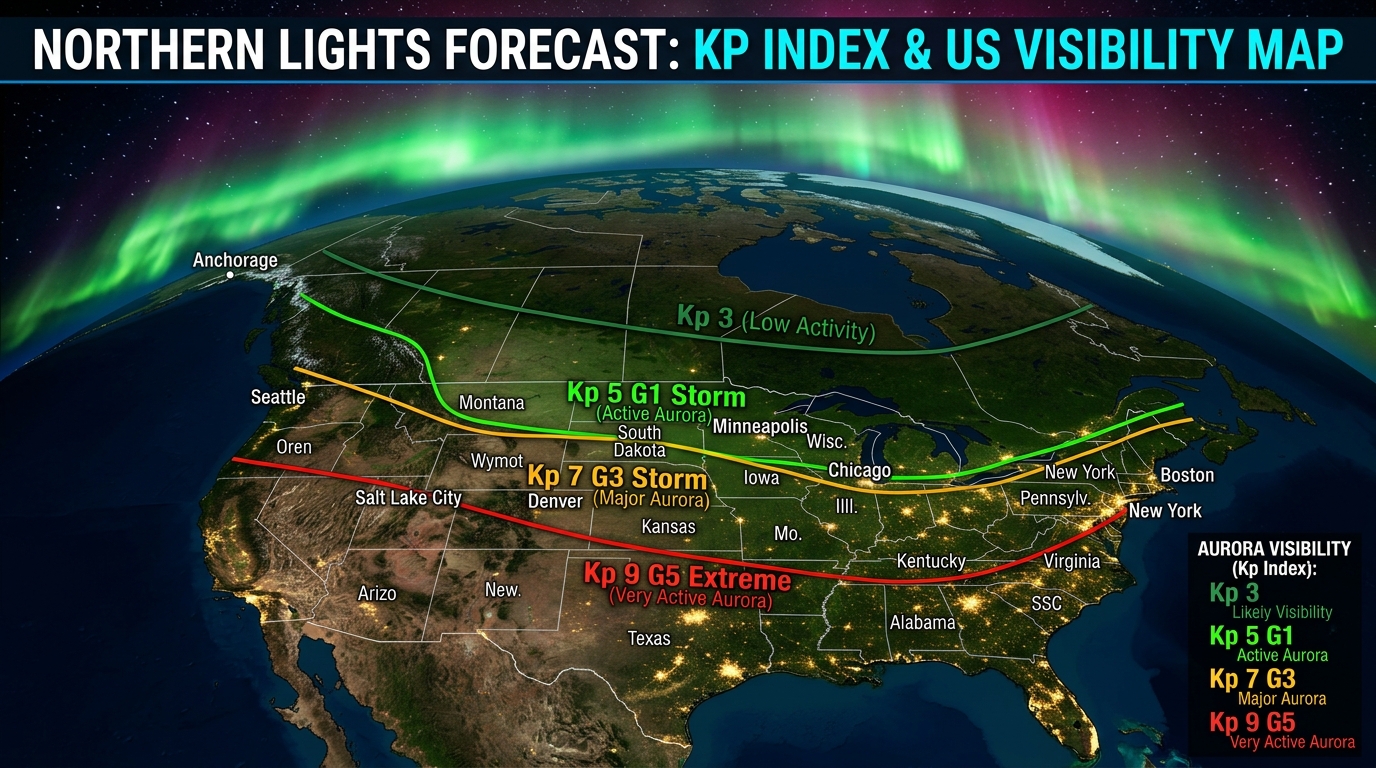
To check tonight's Northern Lights forecast, monitor the NOAA Space Weather Prediction Center (SWPC) 30-minute OVATION Aurora Map and Planetary Kp Index (scaled 0 to 9). A Kp 4–5 (G1 storm) makes the aurora visible along the northern US border (WA, MT, ND, MN, ME); Kp 6–7 (G2–G3) pushes visibility into Chicago, Boston, Denver, and Oregon; and Kp 8–9 (G4–G5) brings aurora across Texas, Florida, and California.
Interactive Northern Lights Kp-Index (0–9), G-Scale & US State Visibility Checker
1How to Read the Planetary Kp Index (0 to 9) & NOAA G1–G5 Geomagnetic Scale
The Aurora Borealis (Northern Lights) occurs when magnetized plasma clouds ejected from the Sun—known as Coronal Mass Ejections (CMEs)—or high-speed solar wind streams from coronal holes slam into Earth's magnetosphere. Charged electrons and protons funnel down Earth's magnetic field lines into the upper atmosphere (thermosphere and ionosphere, 60 to 250 miles high), colliding with oxygen and nitrogen atoms that emit photons of green, crimson red, purple, and blue light.
To quantify how far south the auroral oval expands on any given night, the NOAA Space Weather Prediction Center (SWPC) in Boulder, Colorado publishes the **Planetary K-index (Kp)** every three hours on a quasi-logarithmic scale from 0 (quiet) to 9 (extreme geomagnetic storm). NOAA also translates Kp values >= 5 into its five-level **Geomagnetic Storm Scale (G1 Minor to G5 Extreme)**: G1 equals Kp 5, G2 equals Kp 6, G3 equals Kp 7, G4 equals Kp 8, and G5 equals Kp 9.
Importantly, aurora visibility in North America depends on ** Geomagnetic Latitude** rather than strictly geographic latitude. Because Earth's north magnetic dipole is tilted toward northern Canada and Hudson Bay, states in the Upper Midwest and Great Lakes (such as Minnesota, North Dakota, Wisconsin, and Michigan) sit several degrees closer to the auroral oval than West Coast states at the exact same geographic latitude.
- Kp 3 to 4 (Unsettled / Active): Visible in Fairbanks/Anchorage (AK), northern Montana, North Dakota, northern Minnesota, and Michigan's Upper Peninsula.
- Kp 5 to 6 (G1 Minor to G2 Moderate Storm): Visible across Seattle, Spokane, Boise, Minneapolis, Milwaukee, Detroit, Buffalo, and Burlington, VT.
- Kp 7 (G3 Strong Storm): Visible across Portland, Salt Lake City, Denver, Omaha, Chicago, Indianapolis, Columbus, Pittsburgh, New York, and Boston.
- Kp 8 to 9 (G4 Severe to G5 Extreme Storm): Overhead corona in northern states; visible on the northern horizon as far south as California, Texas, Georgia, and Florida.
2Real-Time Solar Wind Telemetry: Why Negative Bz Is the Key to Tonight's Aurora
While the 3-day NOAA Kp forecast tells you *which night* a CME is expected to arrive, predicting the exact *hour* the Northern Lights will erupt requires checking real-time solar wind data from the **DSCOVR** and **ACE** satellites stationed at the L1 Lagrange point, roughly 1 million miles upstream from Earth. When a CME shockwave passes the L1 satellites, you have an exact **15 to 45 minute lead time** before that plasma strikes Earth's magnetosphere.
Experienced aurora chasers watch two numbers on the NOAA SWPC Real-Time Solar Wind graph: **Bt** (total strength of the Interplanetary Magnetic Field, measured in nanoteslas, nT) and **Bz** (the north-south orientation of that magnetic field). Because Earth's magnetic field points northward, a positive (+Bz) solar wind bounces harmlessly off our magnetosphere like two repelling magnets. However, when **Bz flips sharply negative (southward, e.g., -10 nT to -35 nT)** alongside solar wind speeds of 500 to 800+ km/s, magnetic reconnection rips open the magnetosphere and triggers explosive substorms within 20 to 30 minutes.
3How to See & Photograph the Northern Lights (Naked Eye vs. Smartphone Night Mode)
At mid-latitudes (Kp 5 to Kp 7), first-time skywatchers often look north and think they are only seeing faint, milky white or grayish vertical clouds. Because human rod cells (night vision) have low color sensitivity in dim light, faint auroras appear pale white or grey to the naked eye unless a strong substorm brightens the sky enough to activate cone cells.
Your smartphone camera acts as an instant aurora detector. By setting an iPhone (12 through 17 Pro) or Samsung Galaxy/Google Pixel on a steady tripod or car roof, turning off the flash, and enabling **3-second to 10-second Night Mode** (or Pro Mode: ISO 1600–3200, shutter speed 4–8 seconds, focus set to infinity), the digital CMOS sensor integrates incoming photons and reveals vivid emerald green curtains and high-altitude magenta pillars instantly on your screen.
US Northern Lights Visibility by Kp Index, NOAA G-Scale & State Latitude
| Planetary Kp Index | NOAA Storm Tier | Southernmost Horizon Viewline | Representative US Cities & States | Visual & Camera Appearance |
|---|---|---|---|---|
| Kp 0 – Kp 2 | Quiet (G0) | 62°N–66°N Geomagnetic | Fairbanks & Anchorage, Alaska | Green arcs restricted to high Arctic latitudes |
| Kp 3 – Kp 4 | Active (G0) | 55°N–58°N Geomagnetic | Northern MT, ND, Voyageurs NP (MN), UP Michigan | Low green glow on northern horizon; bright on 3s phone exposure |
| Kp 5 (G1) | G1 Minor Storm | 52°N–54°N Geomagnetic | Seattle, Fargo, Minneapolis, Green Bay, Acadia NP (ME) | Distinct green band & dancing pillars during substorms |
| Kp 6 (G2) | G2 Moderate Storm | 48°N–50°N Geomagnetic | Portland, Boise, Milwaukee, Detroit, Chicago, Boston | Bright green curtains & pink/violet upper rays |
| Kp 7 (G3) | G3 Strong Storm | 44°N–47°N Geomagnetic | Denver, Omaha, St. Louis, Columbus, NYC, Philadelphia | Dynamic multi-color curtains visible to naked eye in dark skies |
| Kp 8 – Kp 9 (G4–G5) | G4 Severe / G5 Extreme | 30°N–42°N Geomagnetic | California, Arizona, Texas, Tennessee, Carolinas, Florida | Overhead corona in North; bright crimson red sky glow in South |
4-Step Blueprint to Catch Tonight's Northern Lights in the US
Check the NOAA SWPC 30-Minute OVATION Aurora Map & Red Viewline
Visit swpc.noaa.gov and check the OVATION model. If your state lies inside or just south of the thin red 'Viewline', you can see the aurora on the northern horizon.
Verify Live Solar Wind Bz (< -10 nT) & Local Cloud Cover
Confirm the real-time L1 satellite Bz is pointing southward (negative red line) and check NWS sky cover forecasts to find a cloud-free window between 10:00 PM and 2:00 AM local time.
Drive 20–40 Miles North of Urban Light Pollution
City streetlights wash out northern horizon auroras. Drive north of your metro area to a dark lake shore, state park, or rural road with an unobstructed northern horizon.
Use 3–10 Second Smartphone Night Mode to Spot Substorms
Prop your phone steady pointing North, turn off flash, and take a 3-second Night Mode test shot to confirm auroral pillars before they brighten to the naked eye.
Curated Expert Video Walkthroughs & Wall Street Briefings


Frequently Asked Questions (Verified Statutory Answers)
Q1: What Kp index do I need to see the Northern Lights in the United States?
Along the northern border (Washington, Montana, North Dakota, Minnesota, Upper Michigan, Maine), Kp 4 to Kp 5 is sufficient. For cities like Chicago, Boston, Detroit, and Seattle, look for Kp 6 (G2). For Denver, New York, Ohio, and Pennsylvania, look for Kp 7 (G3), and for southern states (Texas, California, Florida), a Kp 8–9 (G4–G5) storm is required.
Q2: What is the best time of night to look for the Northern Lights?
The peak viewing window is typically between 10:00 PM and 2:00 AM local time (centered around local magnetic midnight), when the sky is darkest and auroral substorms are most frequent.
Q3: Why do the Northern Lights look brighter in phone photos than to the naked eye?
Human night vision relies on rod cells that struggle to perceive color in low light, making faint auroras look like pale grey clouds. A smartphone camera on a 3-to-10-second exposure gathers light over several seconds and captures full RGB color spectra.
Q4: Why are red Northern Lights visible farther south than green Northern Lights?
Red auroras are produced by atomic oxygen excited at very high altitudes (150 to 250 miles up), whereas green auroras occur lower (60 to 150 miles up). Because of Earth's curvature, observers in southern states can see the high-altitude red tops of the aurora over the northern horizon even when the lower green curtains are blocked by the horizon.